Why Note Taking Is Important: 5 Research-Backed Reasons
Discover why note taking is important for learning and retention. Explore research-backed strategies that boost memory and academic performance.

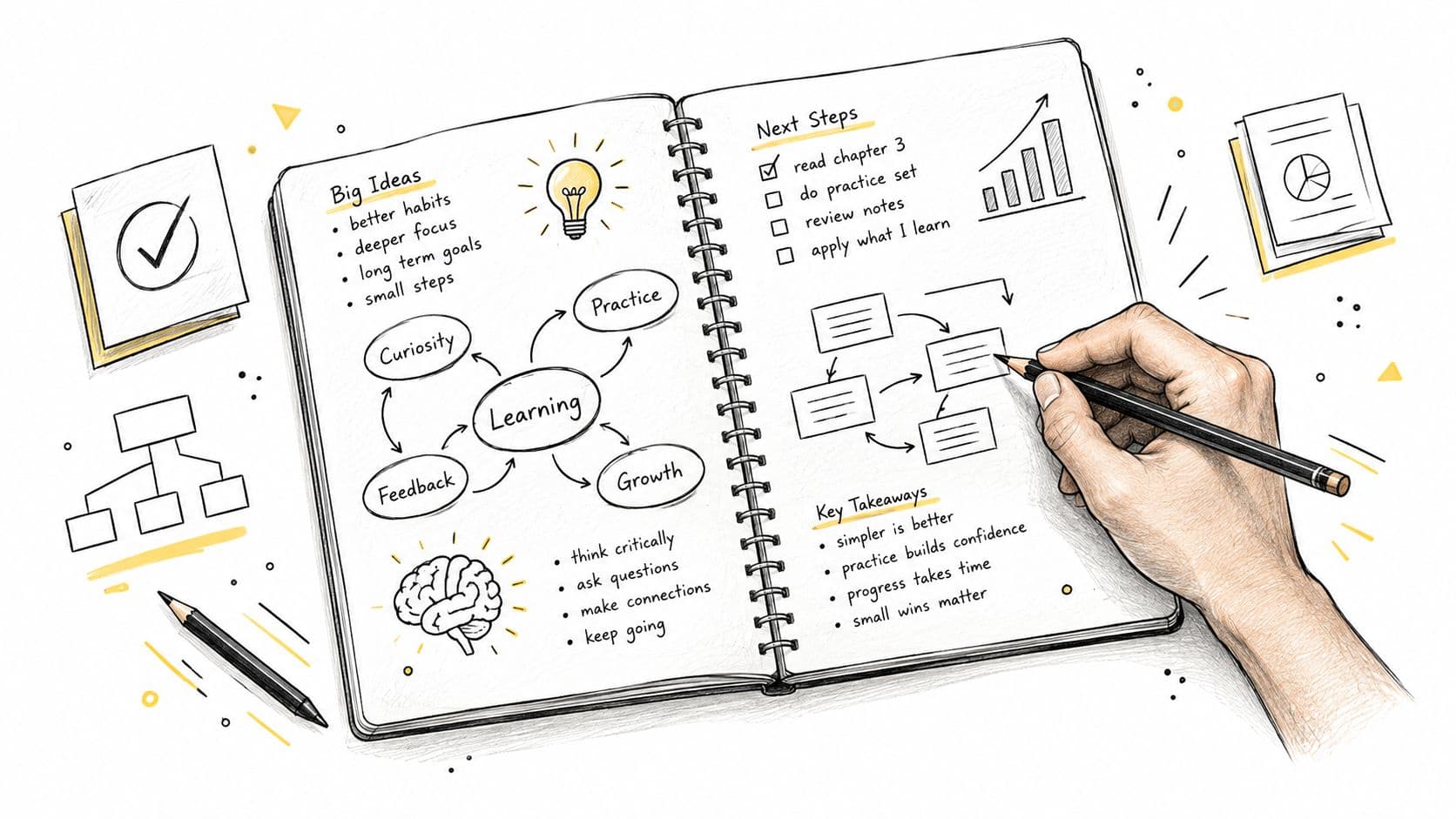
Longhand note-takers can perform significantly better than laptop users on conceptual questions requiring explanation or application, even when they produce fewer total words. The reason note taking is important isn't the amount you write, but the mental work you do while selecting, organizing, and rephrasing ideas.
Many students discover this only after a disappointing exam. Their notebook is full, their lecture slides are highlighted, and their laptop contains a complete transcript. Yet when asked to explain why a process works, compare two theories, or apply a principle to a new problem, they can't find a clear answer.
That experience points to a more useful question than “Should I handwrite or type?” The better question is, how can I turn notes into a study system that helps me explain, retrieve, and apply what I learned?
The Science Behind Why Note Taking Matters
The central benefit of note-taking is an encoding effect. Encoding happens when you select important information, organize it, and translate it into a compact representation. You aren't merely receiving information. You're deciding what matters and creating a structure that your mind can use later.
A three-study investigation of college students watching educational videos found that longhand note-takers performed as well as laptop users on factual recall but significantly better on conceptual questions requiring explanation or application. Laptop users produced more notes, but those notes contained more verbatim transcription, which indicated weaker semantic processing. The findings are discussed in the research on note-taking and learning (opens in a new tab).
That distinction explains why a shorter page of thoughtful notes can be more useful than several pages of copied sentences. A student who writes “enzyme lowers activation energy, but doesn't change overall energy released” has processed a relationship. A student who copies the lecturer's definition word for word may recognize the sentence later without being able to explain it.
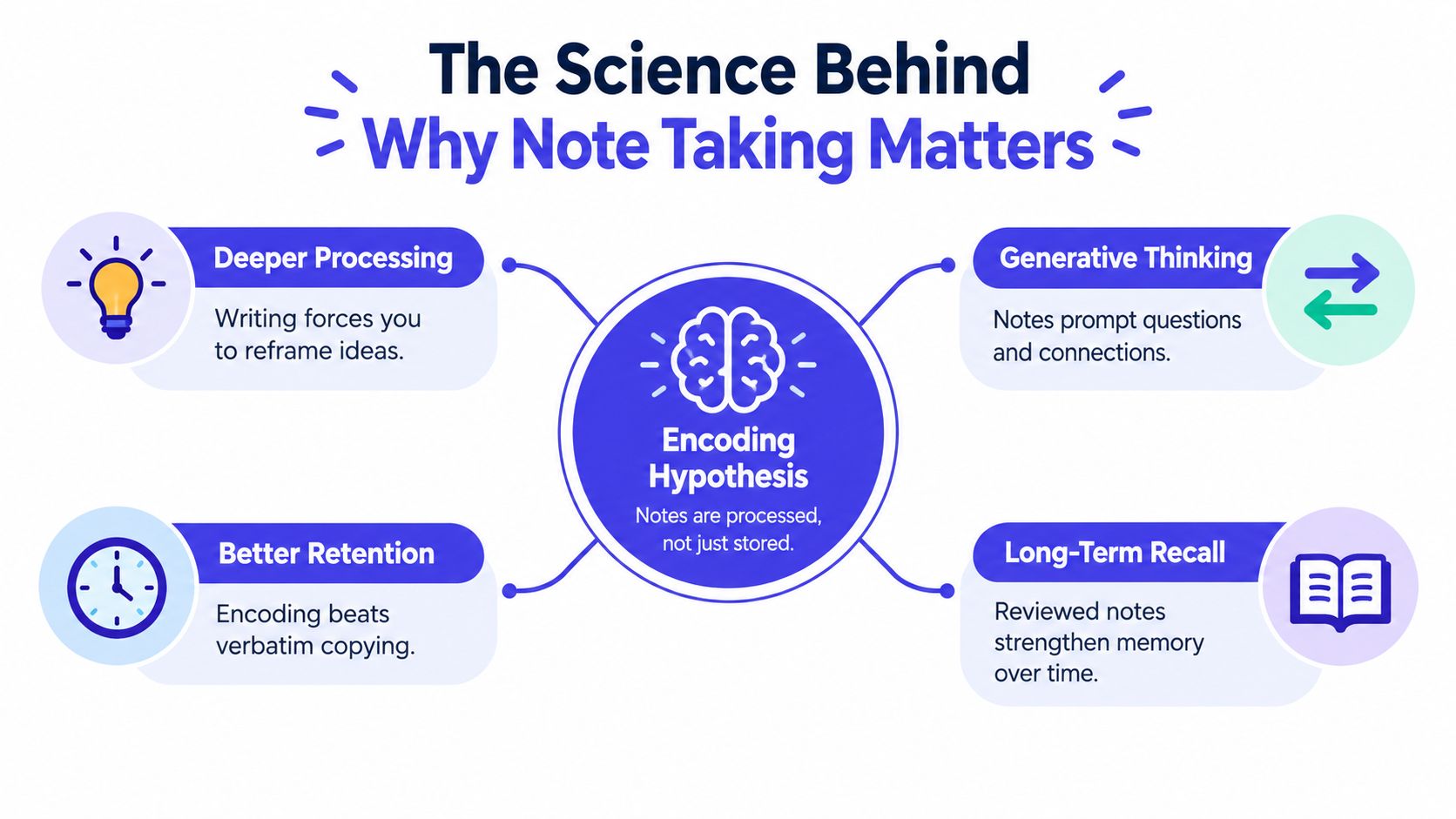
What effective notes preserve
Good notes preserve the conceptual structure of a lesson. They show how ideas relate, not just which sentences appeared on a slide.
For a technical topic, that structure might look like this:
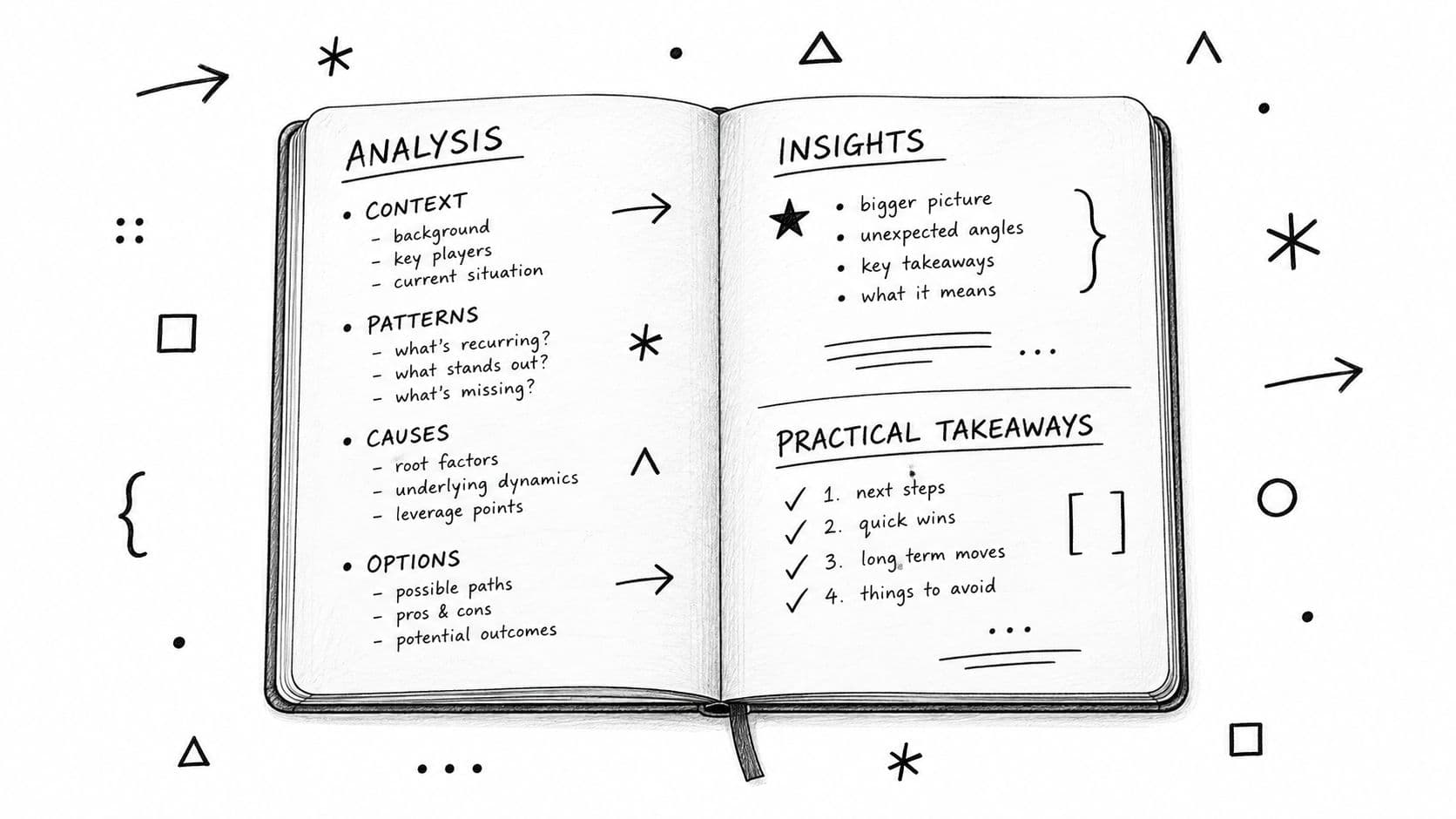
- Mechanism: What process causes the outcome?
- Evidence: What observation, experiment, or example supports it?
- Limitation: When might the explanation fail or need qualification?
This format gives you something to work with during revision. You can turn each line into a question, explain the sequence aloud, or apply the mechanism to a new example.
Practical rule: Judge notes by whether they help you explain an idea later, not by how complete or attractive they look today.
Note-taking matters because it creates a useful external record while forcing immediate interpretation. The notebook isn't a storage box for every sentence. It's a working model of the lecture, built from the choices you make about importance, connection, and meaning.
How Encoding Transforms Passive Listening Into Active Learning
Passive listening asks you to receive information. Active note-taking asks you to make decisions while the information is arriving. You listen for the main claim, identify the supporting example, notice a contrast, and decide how to express the idea in language you understand.
That process turns a lecture into a mental map. Copying a definition is like photographing a road map without learning where the roads connect. Paraphrasing the definition, adding a cause, and linking it to an example starts to build a route you can follow without the original presentation.
Four actions that strengthen understanding
Paraphrase definitions. Write the meaning as you would explain it to a classmate. If the lecturer defines opportunity cost, don't record only the formal wording. Add a plain-language version such as “what you give up when choosing one option over another.”
Connect causes to effects. Use arrows, linking phrases, or short statements. “Reduced insulation → more heat loss → higher energy demand” captures a relationship that isolated keywords can't.
Record examples. Examples show how an abstract principle behaves in a real situation. They also give you material for later practice questions.
Mark unanswered questions. A question mark beside “Why does this happen?” is more useful than a confident but incomplete sentence. It tells you exactly where to review the textbook, ask your lecturer, or test your understanding.
Follow the lecturer's structure
Technical subjects often depend on relationships. A biology student may need to understand how a mechanism produces evidence and where a limitation appears. An engineering student may need to connect an assumption to a formula, then identify what changes when that assumption no longer holds.
Instead of reproducing each sentence, build a sequence such as:
- Mechanism: What happens?
- Evidence: How do we know?
- Application: Where does it matter?
- Limitation: What should we avoid assuming?
Your notes become more valuable when they preserve that sequence. Later, you can cover one part and try to reconstruct the rest, which turns review into retrieval rather than rereading.
A student who writes fewer words but captures these connections has created a stronger foundation for explanation. The aim isn't to make every line perfect during class. It's to leave class with enough structure to rebuild the idea accurately.
Why the Handwriting Versus Typing Debate Misses the Point
Handwriting has a measurable advantage in some learning situations, but that doesn't make typing useless or handwriting universally superior. A meta-analysis covering 33 reports, 42 independent samples, and 88 effect sizes found a statistically significant but small overall advantage for handwriting over typing in recall, with g = 0.144. The analysis is available in the research on handwriting and typing for note-taking (opens in a new tab).
The more important finding is what happened to the notes themselves. Typed notes contained substantially more words and ideas, yet greater volume didn't reliably produce better learning. When students type almost every sentence, transcription can use the attention they need for interpretation and organization.
That doesn't mean you should tell every student to close their laptop. Slow handwriting, accessibility needs, multilingual learning demands, and courses with extensive technical detail can make typing the more practical choice. The method matters less when the student follows typing with active summarizing, questioning, diagrams, and post-class restructuring.
Choose the method that supports the next task
Ask what you'll need to do with the material:
- Recall facts: Use concise prompts, definitions, and retrieval questions.
- Explain concepts: Use paraphrases, linked arrows, and examples.
- Solve problems: Record worked steps, assumptions, and points where the method could fail.
- Compare theories: Create a contrast table rather than two disconnected summaries.
A typed document can support all of these tasks if you create it intentionally. A handwritten notebook can fail if it becomes a rushed transcript. The capture method is only the first stage.
More words don't automatically create more understanding.
For a broader discussion of the evidence and its practical implications, students can read this guide to note-taking research.
Students often need a short pause before writing. Listen to the complete idea, identify its role in the lecture, and then record the part that will help you reconstruct it. That pause may produce fewer words, but it leaves more attention available for meaning.
Watch the video on YouTube (opens in a new tab)
The Two-Stage Workflow for Turning Raw Notes Into Study Assets
The notes you take during class don't need to be finished study materials. Treat them as raw material. The mistake I see most often is a student taking notes once, filing them away, and expecting the same pages to carry the entire burden of exam preparation.
A more reliable system has two stages. During class, capture the essential material quickly. After class, transform that capture into resources that make you retrieve and explain the content.
Stage one capture selectively
During a lecture, record three categories:
- Key claims: The ideas the lecturer returns to, defines, contrasts, or uses to solve a problem.
- Examples: Cases, demonstrations, calculations, or applications that make the claim concrete.
- Uncertainties: Terms you don't understand, steps you missed, and questions you want to resolve.
Don't spend your attention designing a perfect page while the lecture continues. Use abbreviations, arrows, incomplete phrases, or a quick diagram if they help you keep up. Your future self needs meaning, not a polished transcript.
Stage two transform the material
After class, choose a form that matches the learning task. Turn definitions into recall questions. Turn a process into a concept map. Turn a worked calculation into a fresh problem with the answer hidden. Turn a broad lecture into a short course-specific summary that shows the main claims and their relationships.
This is also when you repair gaps. Check an unclear term against the textbook or lecture recording, add the missing link between two ideas, and mark anything that still needs help. The transformation stage is where raw capture becomes a usable study asset.
A set of notes can look neat and still be weak. Evaluate it by asking whether it supports retrieval and explanation.
Students comparing their own work with course-specific lecture notes or revision guides should use the same criteria. A resource is useful when it matches the course and helps you test understanding, not just because it contains many pages. You can find more practical guidance in this lecture note-taking guide.
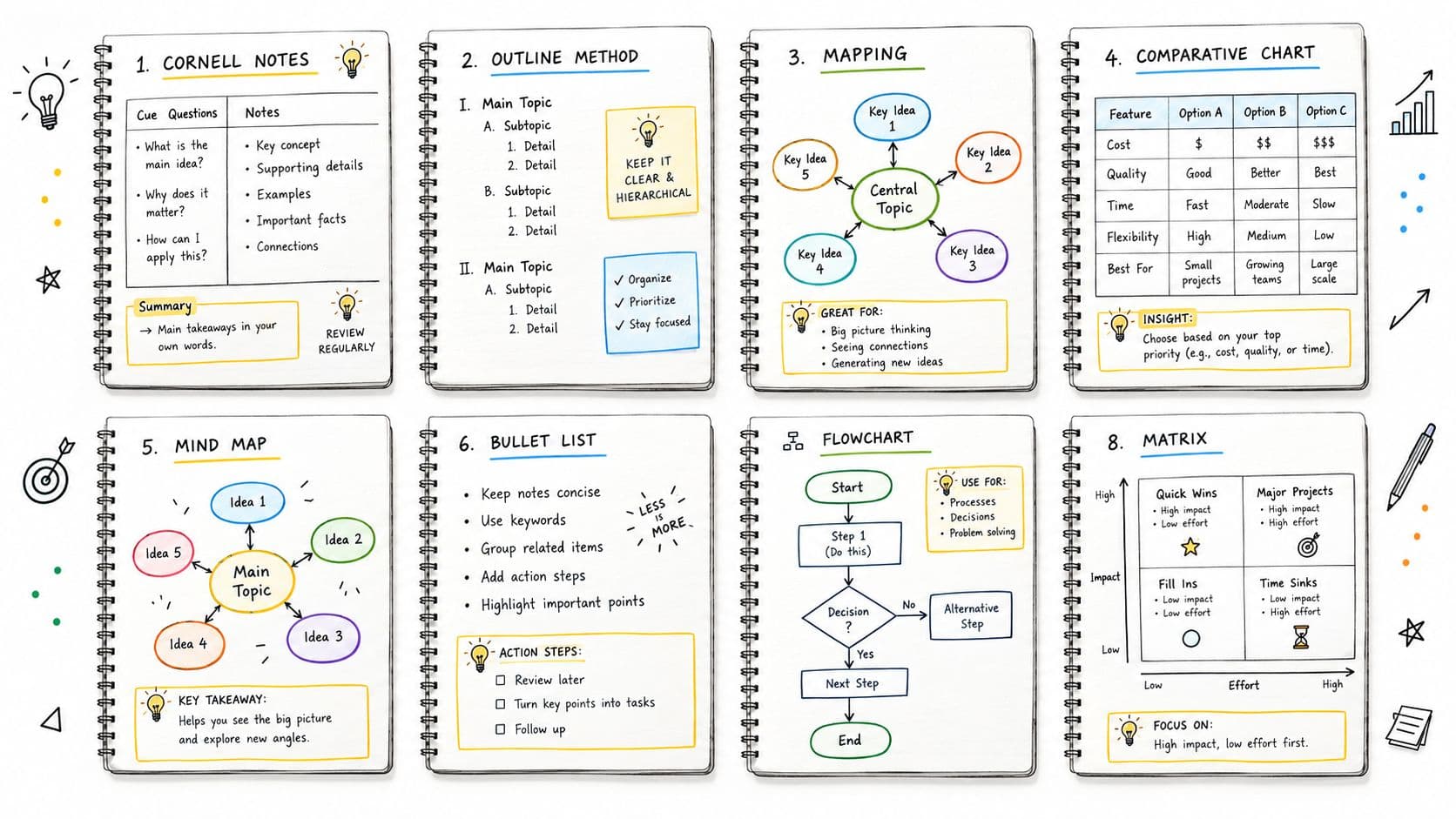
Comparing Note Methods for Different Course Demands
No single layout fits every subject. A method that helps you follow a fast economics lecture may be awkward during a philosophy seminar, while a visual map that clarifies a biology process may become cluttered during a law lecture with a strict hierarchy of rules.
Choose the format by looking at the work you'll perform later. Do you need to compare arguments, follow a sequence, connect causes, reproduce a formula, or generate questions for discussion?
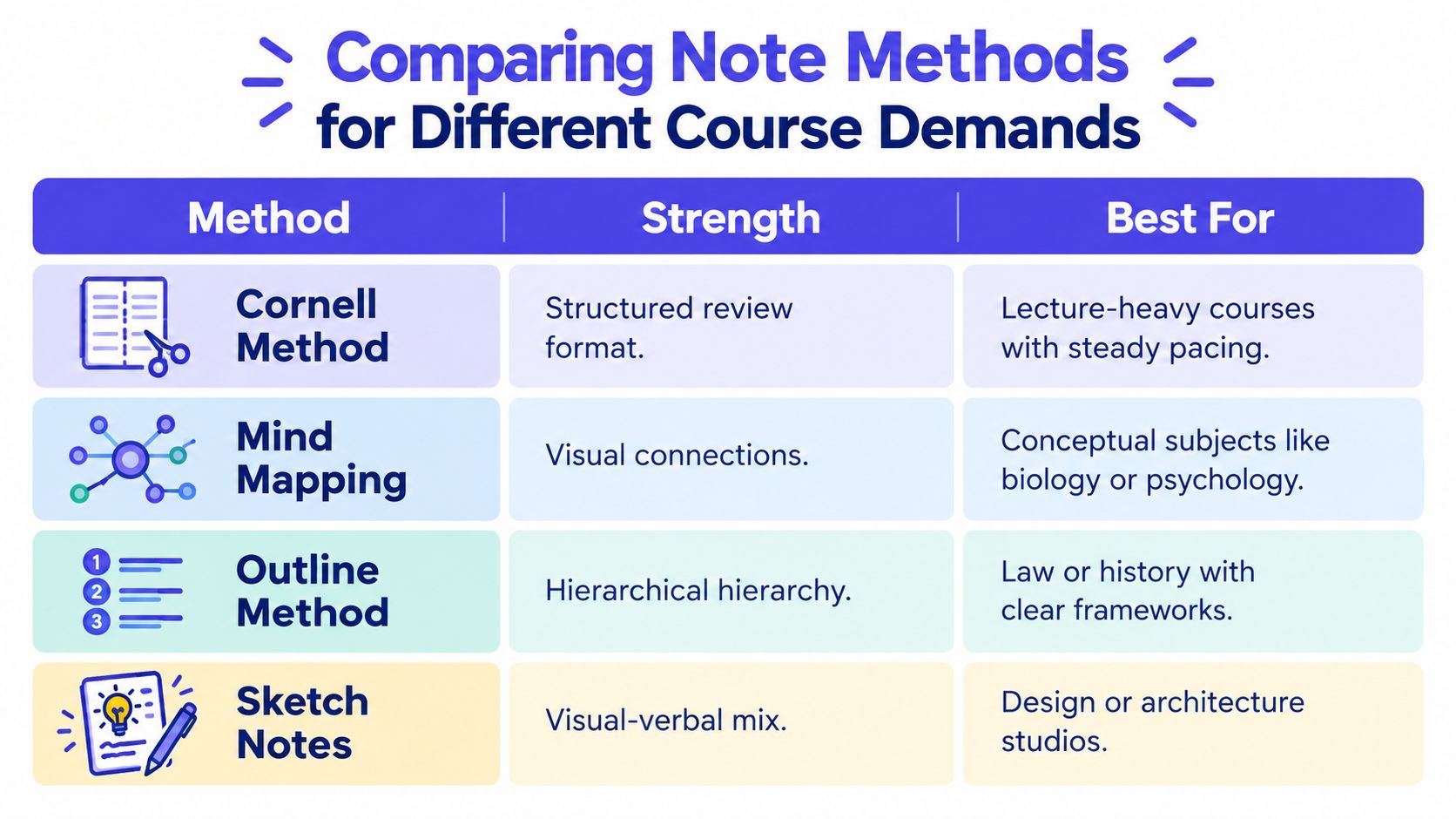
Match method to course pressure
For formulas and mechanisms, structured outlining can keep assumptions, steps, and outcomes visible. A concept map may work better when the main challenge is understanding how several factors influence one another.
In a seminar, a question-centered format can be more effective than a conventional summary. Record the claim, write the question it raises, identify the evidence offered, and note your response. That layout preserves the conversation's intellectual movement instead of flattening it into a list of statements.
Sketch notes can help students who think spatially, but drawings shouldn't replace meaning. A symbol is useful only when you can still explain what it represents during revision.
The right method is the one that makes the next act of learning easier.
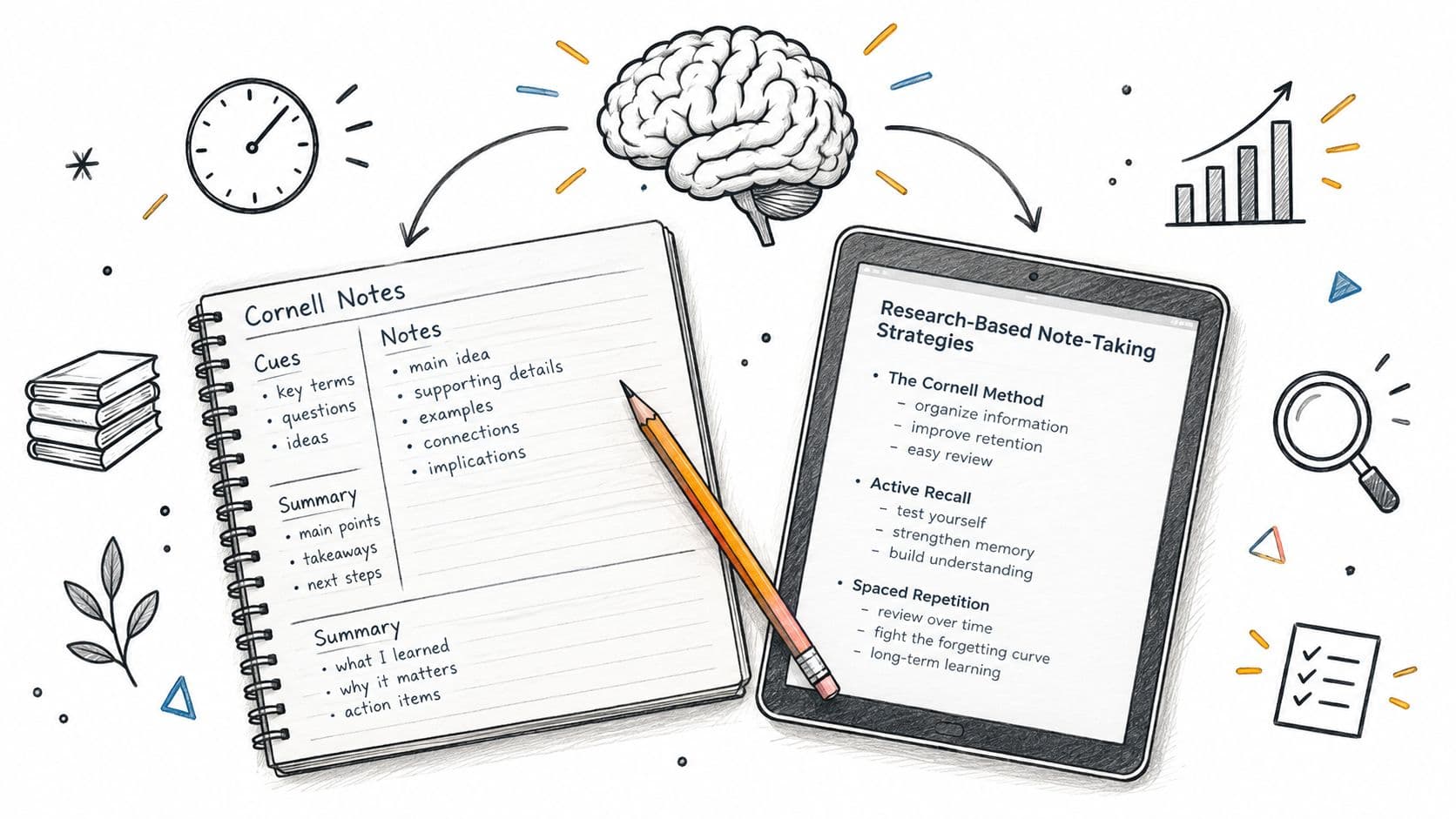
You can adapt an established layout rather than follow it rigidly. A Cornell page can include a diagram. An outline can contain a question column. A mind map can include a short written summary. If you're comparing layouts in detail, this guide to note-taking formats can help you choose a starting point.
Building an Integrated Study System That Actually Works
A useful study system connects four decisions: what you capture, how you organize it, how you retrieve it, and how you check your explanation. Handwriting or typing belongs only to the first decision. The stronger system comes from what happens after the words reach the page or screen.
Start by testing your notes without looking at the original lecture. Can you explain the central concept aloud? Can you write practice questions from the page? Can you describe the mechanism, evidence, and limitation in the right order? If you can only recognize the material when the lecturer's wording is visible, your notes need another transformation.
A worked example
Suppose a technical lecture introduces a process in which a change in one condition affects a system, produces measurable evidence, and creates a limitation under a different condition. During class, you might capture:
- The process and its purpose
- The condition that triggers it
- The evidence used to demonstrate it
- An example from the lecture
- The assumption behind the explanation
- A question about what happens when the assumption changes
After class, convert those fragments into a concept map. Put the process in the center, connect the trigger to the outcome, attach the evidence to the outcome, and place the limitation beside the assumption. Then create questions such as “What triggers the process?”, “What evidence supports it?”, and “What changes when the assumption no longer applies?”
Finally, answer those questions without looking. If the answer is incomplete, return to the relevant part of the notes and revise the map. This sequence gives you a visible way to locate confusion instead of rereading everything.
Test notes by retrieval
Use these checks when reviewing your own material or evaluating shared resources:
- Explanation check: Can you teach the idea in plain language?
- Connection check: Can you show how the main ideas influence or depend on one another?
- Application check: Can you use the principle in an example that wasn't copied from class?
- Question check: Can you generate useful questions from the notes?
- Course-fit check: Does the material match your lecturer's terminology, sequence, and assessment demands?
Course-specific materials can support this process when you use them as comparison and practice tools rather than substitutes for your own work. Check the university, module, course code, textbook, and academic year. Then compare the resource with your syllabus and lecture materials, and follow your institution's rules on independent work and academic integrity.
A strong set of notes doesn't need to contain every detail. It needs to help you recover the important ideas, expose what you don't understand, and practise using the material under exam conditions. That is why note taking is important. It turns listening into processing and gives revision something more useful than a pile of copied sentences.
Start with your next lecture. Capture only the key claims, examples, and uncertainties, then turn them into questions or a concept map while the material is still familiar. For additional course-specific lecture notes, summaries, revision guides, and exam resources, visit CramShare and compare each resource against your course requirements before using it.