Best Note Taking Organization in 2026: 8 Methods Compared
Explore the best note taking organization systems for students, from Cornell notes to Zettelkasten and PARA, with guidance on when each one works best.


You've got three months of lecture notes, an exam in two weeks, and no clear order. Your laptop holds slide annotations, your notebook contains explanations you half remember, and the diagram you need is somewhere in your phone's camera roll. You've taken notes consistently, but turning them into a usable revision plan feels like starting the course again.
The problem usually isn't that you need more notes. You need a way to find an explanation, review it without looking, and connect it to the questions you'll face.
A 2024 synthesis of college-student note-taking studies (opens in a new tab) found that typing produced greater note volume, while taking and reviewing handwritten notes was associated with higher achievement. That doesn't mean you should abandon your laptop. It means capturing more words and preparing useful study material aren't the same job.
Practical rule: Choose your structure around what you'll need to do in the assessment, not how attractive the finished page looks.
The best note taking organization for a pharmacology comparison exam won't necessarily suit a history essay or a postgraduate dissertation. Some methods help you capture a lecture; others help you compare concepts, develop arguments, or manage deadlines. Keep those jobs separate, and you can improve your system without rewriting everything you've already collected.
1. Cornell Note-Taking System
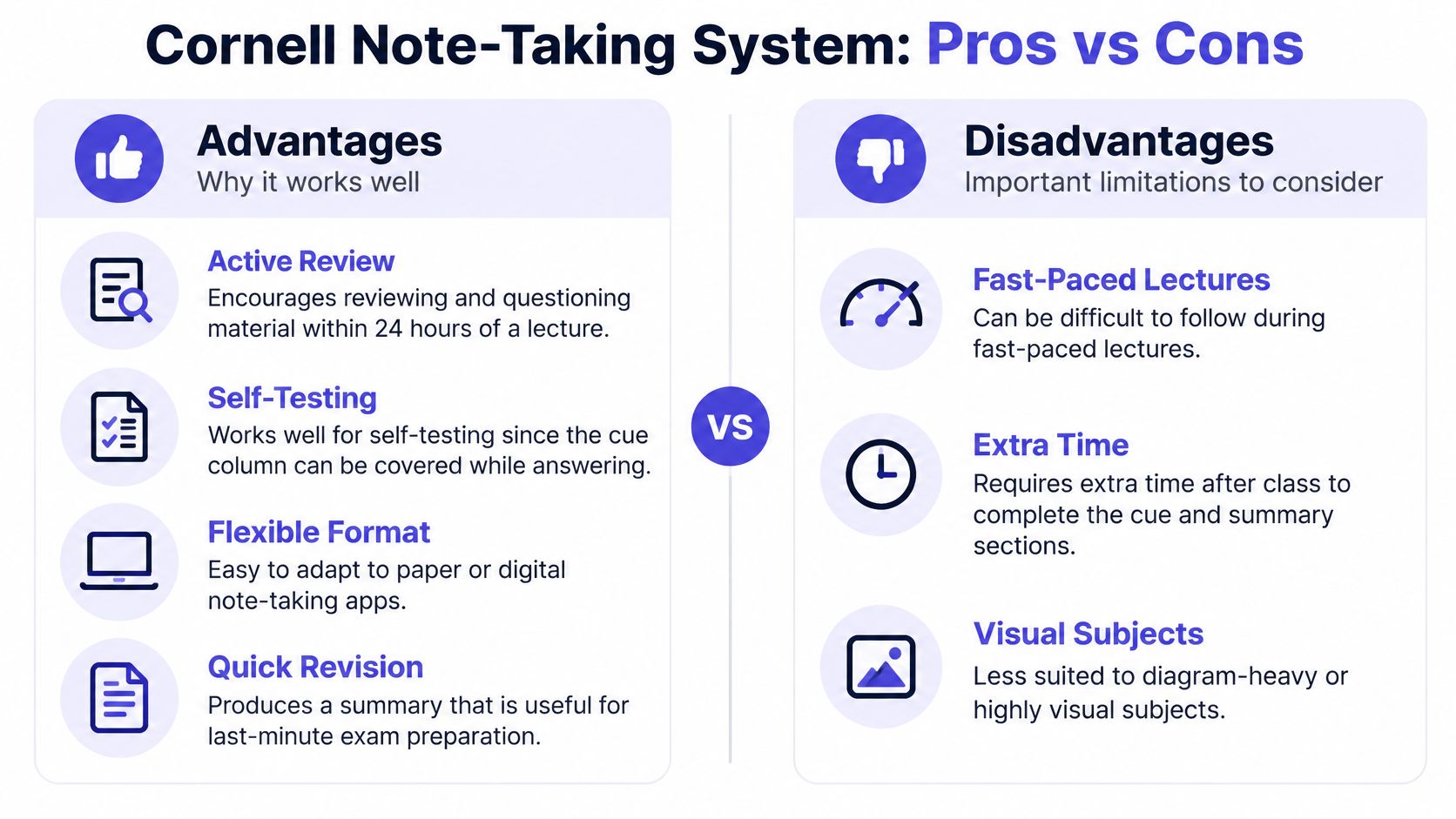
Choose Cornell for lecture-heavy courses where you'll revise repeatedly from your own notes. Nursing, medicine, and cumulative science modules are useful starting points because you need both detailed explanations and prompts for recall.
Divide the page into a wide main-notes area, a narrow cue column, and a summary area at the bottom. The Cornell account of its note-taking system (opens in a new tab) describes this structure as a way to turn recorded information into material you can question, summarize, and review.
During class, capture explanations in the main area without trying to complete every part of the page. Afterward, write questions beside the relevant material and summarize the central idea in your own words.
Make the cue column do real work
For a nursing lecture on fluid balance, a cue might ask how you would distinguish dehydration from fluid overload. That's more useful for self-testing than a cue containing only the topic name.
- Capture selectively: Note mechanisms, examples, and instructor explanations rather than copying every slide.
- Question specifically: Ask yourself to explain a process, distinguish conditions, or justify an intervention.
- Summarize meaning: Explain what connects the page's ideas instead of repeating its headings.
- File by module: Keep Cornell pages under the course code and topic so related lectures stay together.
Cover the main notes and answer the cues aloud. Check your explanation, correct it, and revisit the questions you couldn't answer.
Switch to an outline if the lecture moves too quickly for the layout. You can add Cornell-style questions later without redrawing the original notes. For calculation-heavy classes, keep worked solutions on separate pages and use cues to test why each step applies.
2. Outline Method
A history lecturer moves from political conditions to a major event, then explains its consequences. An outline lets you follow that sequence without deciding where every idea belongs on a diagram.
Use headings for main topics, subheadings for supporting arguments, and indented bullets for evidence or examples. In law, that could mean organizing a topic around a legal rule, its elements, relevant cases, and exceptions. In history, organize around periods and arguments rather than producing an uninterrupted chronology.
The main advantage is speed when the lecturer already follows a clear hierarchy. The limitation is that you may reproduce their structure without checking whether you understand it.
Keep the hierarchy shallow
Start with slide titles when they're useful, but rename vague headings so you can recognize their meaning during revision. Keep indentation shallow enough that you can scan the page without following a trail of nested bullets.
Use a consistent shorthand for definitions, consequences, and uncertainties. A practical guide to note-taking symbols can help you choose marks you'll still understand when you reopen the file.
For essay preparation, add an argument beneath each topic heading, followed by supporting evidence and a possible objection. For a law problem question, separate the rule from your application so you don't mistake knowing a case for knowing how to use it.
An outline is ready for revision when you can explain each heading without reading the bullets beneath it.
Switch to charting when you keep repeating the same categories under different headings. Switch to a concept map when the difficult part is explaining connections across branches. Don't force a complicated feedback loop into a hierarchy because your notes started as an outline.
3. Charting Method
Pharmacology notes become easier to compare when drug classes share the same categories. Put each class in a row, then use columns for mechanism, indications, adverse effects, contraindications, and monitoring considerations.
Charting suits assessments that ask you to distinguish similar things. Economics students can compare policy tools by mechanism, intended effects, limitations, and conditions of use. Language students can compare grammatical forms alongside their functions and exceptions.
The practical constraint is preparation: you need useful column headings before you can capture information efficiently. Skim the reading or lecture slides first, and leave space for exceptions that don't fit neatly.

Build comparisons, not cramped paragraphs
Use Excel or another spreadsheet when you need searchable text and room to update entries. Keep cells concise, then link to longer explanations or worked examples rather than squeezing them into the grid.
- Choose meaningful categories: Include distinctions the course assesses, not every fact available.
- Mark missing information: Distinguish material you haven't checked from a category that doesn't apply.
- Preserve qualifications: Add conditions and exceptions where a short entry could otherwise mislead you.
- Test across columns: Hide a column and explain its contents from the remaining information.
During revision, turn a comparison into a decision: given a particular scenario, which option fits, and why don't the alternatives?
Switch to prose or an outline when you're studying an argument that depends on sequence and context. A chart can summarize competing explanations, but it shouldn't replace the reasoning behind them. Build the comparison after you understand the material, not instead of understanding it.
4. Mind Mapping
Use a mind map when you need an overview before you need detail. It's useful for planning a business case-study answer, brainstorming an essay, or checking which parts of a psychology module you can recall.
Place the topic in the center and branch outward into major themes. For a memory module, your branches might cover models, processes, experiments, and applications, with brief labels beneath each.
Keep words short and give colors a consistent purpose. If a branch needs a paragraph to make sense, move that explanation into a linked note rather than shrinking the text.
Use the map as an entry point
Create an initial map from the module outline, then update it as you work through the course. During essay planning, use branches to collect possible arguments before deciding their order in a written outline.
Your note-taking layout should leave enough space to distinguish major themes from supporting details. A crowded page with crossing lines isn't a useful overview, even if every fact is technically present.
For a demonstration of the format, use this video alongside your own course material.
Watch the video on YouTube (opens in a new tab)
For revision, redraw the map without looking, then compare it with your notes. Add a written explanation of the branches you couldn't reconstruct, especially when the assessment requires extended answers.
Switch to concept mapping when you need to explain exactly how ideas relate. Switch to an outline when you've finished brainstorming and need a defensible essay sequence. Mind mapping can help you collect possibilities, but it doesn't establish which claim your evidence supports.
5. Concept Mapping
A line between insulin and blood glucose doesn't tell you much. A labeled connection that explains how insulin affects glucose uptake gives you a statement you can examine and correct.
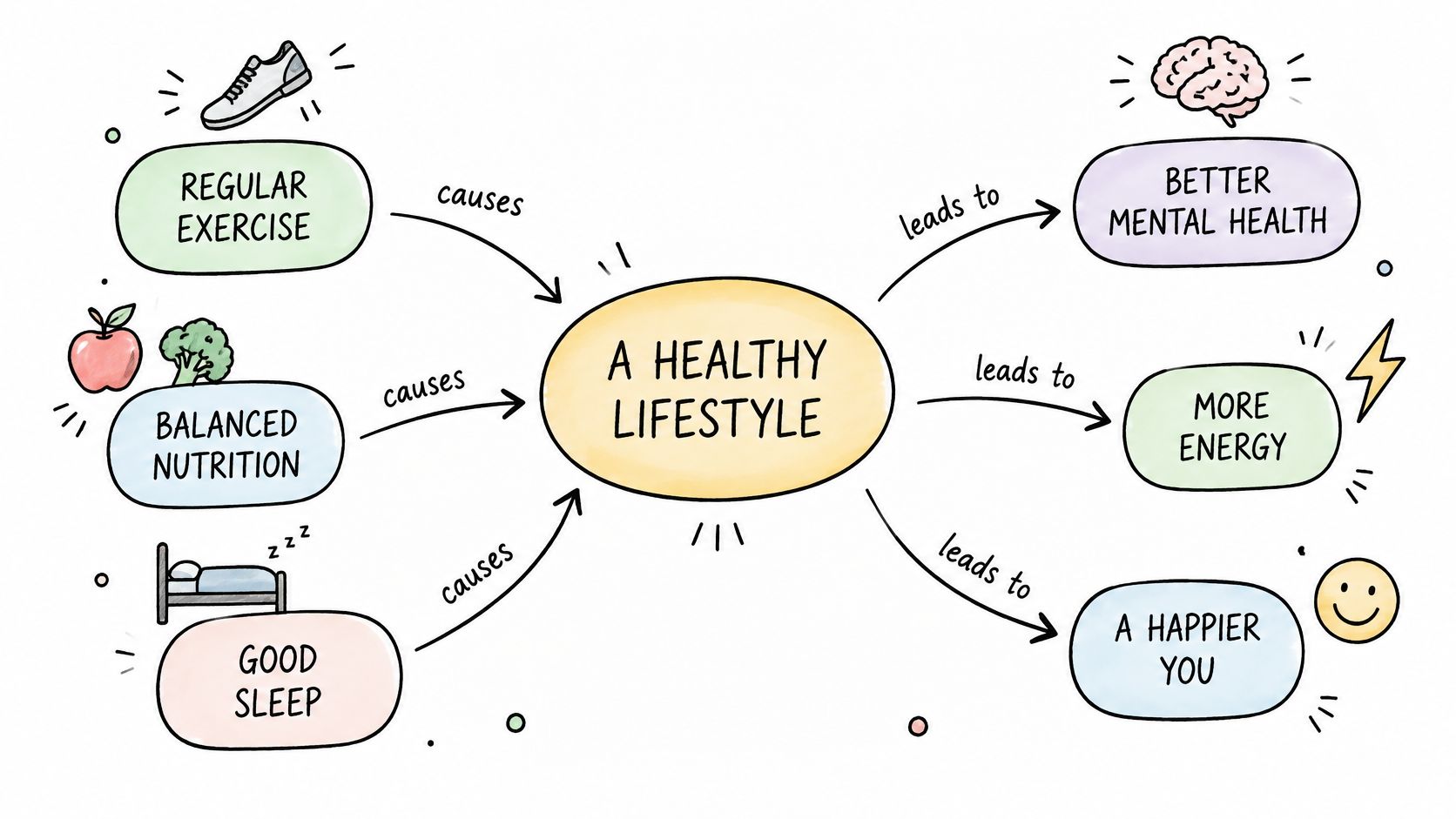
That's the practical distinction between concept mapping and mind mapping. A concept map uses explicit linking phrases such as causes, requires, inhibits, or is a component of. It suits physiology, biology, and engineering topics where the assessment tests relationships rather than isolated definitions.
For a physiology module, connect cells, tissues, organs, and systems, then label what each connection means. For engineering, connect a governing principle to its assumptions, relevant equations, and applications.
Make every connection explain something
Start with the core concepts from the learning objectives. Arrange them provisionally, add labeled arrows, and read each connection as a sentence to check whether it says what you intended.
- Name the relationship: Replace an unexplained line with a specific linking phrase.
- Include conditions: State when a relationship applies, particularly for formulas and physiological responses.
- Expose uncertainty: Mark questionable links for checking against readings or instructor explanations.
- Rebuild from memory: Reconstruct the map, then investigate missing or incorrect connections.
A study of note-taking methods (opens in a new tab) found that a Cornell group outperformed a sentence-note group on a later retention test, although immediate differences weren't significant. The useful design principle here is to make notes testable: reconstruct and explain your map rather than repeatedly inspecting it.
The branching example below illustrates visual grouping. For a concept map, you'd also need precise labels on the relationships.
Switch to worked solutions when you need procedural practice. Explaining how principles connect won't replace applying them to an unfamiliar problem.
6. Zettelkasten Method
Reserve Zettelkasten for knowledge you'll reuse beyond the next exam. A dissertation, literature review, or extended research project gives linked notes a clear purpose. A short revision sprint usually doesn't justify building a new knowledge network.
Write an atomic note around a distinct idea, using your own explanation and retaining its source. Then connect it to related notes with a sentence explaining the relationship, not just a tag indicating a shared subject.
Say you're reviewing papers on student engagement. You might keep separate notes on attendance as a proxy, participation measures, and limitations of self-report, then link them around a question about how engagement should be measured.
Separate evidence from your interpretation
Each note should make clear what the author argues, what evidence supports that argument, and what you think it means. Keep quotations visibly separate from paraphrases and preserve page references for later citation.
- Title the claim: Use a descriptive title that tells you what the note contributes.
- Explain each link: State whether another note supports, contradicts, qualifies, or extends the idea.
- Keep a project index: Gather relevant links around your dissertation question or chapter.
- Maintain course labels: Retain module and reading information even when ideas cross subject boundaries.
Research safeguard: A linked note is useful when you can trace both the idea's source and your reason for connecting it.
The trade-off is maintenance. Splitting readings into tiny fragments can leave you with plenty of notes but no sustained argument, so keep article-level summaries alongside atomic notes.
Switch to an outline when drafting a chapter, and use Cornell questions or charts for near-term exam preparation. Zettelkasten supports developing arguments over time; it isn't a substitute for practicing the assessment you face.
7. PARA Method
Your notes may be readable while your semester remains disorganized. If you're losing assignment briefs, searching through downloads, or confusing active work with old material, PARA addresses storage and action rather than page structure.
Sort material into Projects, Areas, Resources, and Archives. Projects have an outcome and deadline; Areas represent ongoing responsibilities; Resources hold reference material; Archives contain inactive work.
For a laboratory module, the course can sit under Areas while the current report has a Project containing its brief, draft, results, and submission requirements. Link to shared reference notes instead of copying them into every assignment folder.

Keep course identity visible
A 2024 higher-education survey (opens in a new tab) found that 69% of lecture note-takers used digital methods, while only 48% used software specifically designed for note-taking. Build a filing convention that works across documents, spreadsheets, scanned pages, and slide annotations rather than depending on a particular app.
Use filenames containing the course code, module topic, academic year, and resource type. Scan handwritten notes into a coherent PDF, and check that page order and legibility survive the scan.
Review active Projects regularly, move completed work into Archives, and keep reusable conceptual notes easy to locate. Compare other organization methods if you're unsure whether your main difficulty is filing, planning, or studying.
Pair PARA with a learning method. An exam Project can hold Cornell questions, comparison charts, and practice answers, but placing documents together doesn't test your understanding. If folder maintenance starts taking longer than studying, simplify the categories and return to the course task.
8. Bullet Journal Rapid Logging
A bullet journal works well when your immediate problem is remembering what to do after class. Use short entries and consistent symbols to distinguish tasks, events, and notes, then maintain an index so you can find module-specific pages.
Choose rapid logging for seminars, practical sessions, and revision planning where actions and observations arrive together. For a chemistry practical, record a procedural question, a report deadline, and a reminder to check an anomalous result without opening separate systems.
Don't turn every page into a designed spread. A usable index and legible entries matter more than decorative trackers.
Separate captured information from unfinished work
Create collections for individual modules and reference their pages from your daily log. Keep exam dates in a forward-looking calendar, and review unfinished tasks before moving them into your next plan.
- Write actionable tasks: Replace a vague revision entry with a specific question to answer or problem set to complete.
- Distinguish uncertainty: Mark concepts to check separately from administrative reminders.
- Record the destination: Point detailed lecture material to its notebook page or digital file.
- Migrate deliberately: Reschedule relevant work and remove tasks that no longer matter.
In the MaRginalia study of 45 students (opens in a new tab), 18 reported that taking notes distracted them enough to miss lecture content. Don't make rapid logging another demand for constant transcription: capture the essential prompt, then return your attention to the explanation.
Switch to Cornell or an outline when you need substantial lecture content. Keep the journal as your control panel for deadlines, questions, and next actions rather than expecting a chronological log to function as a complete revision guide.
How the eight note-taking systems differ in purpose, structure, and main drawback
Matching Your System to Each Course
Choose your method by asking what the course requires you to produce. Cornell suits recall from lecture material; outlines suit structured explanations; charts suit comparisons; concept maps suit relationships. Use mind maps to survey a topic or plan an answer, then move into the structure your final task requires.
Keep semester management separate. PARA can organize the files, and a bullet journal can organize your next actions, while your study notes use a different format. Reserve Zettelkasten for research questions and ideas you'll develop across readings and projects.
Test the system against real work
Try a method on a single module over a short trial rather than reorganizing your entire semester. Use an actual tutorial question, permitted past-paper question, or learning objective to judge whether the notes help.
- Check retrieval: Can you locate the relevant explanation without searching unrelated files?
- Check recall: Can you answer your prompts with the notes covered?
- Check application: Can you use the idea in an unfamiliar example?
- Check maintenance: Can you keep the system current without sacrificing practice?
A 2025 study comparing note-taking approaches (opens in a new tab) found that digital note-taking reduced perceived cognitive load without producing significantly better retention. Treat convenience as a benefit, not proof that the method is helping you learn.
You also don't need to rewrite all your existing material. Add a course index, label uncertain explanations, and create retrieval questions for the topics most relevant to your assessment. Preserve useful worked examples and link them to the concepts they demonstrate.
Keep assistance accountable
If you use AI to organize notes, retain your original material and verify summaries against readings, slides, and instructor explanations. A qualitative study of Canadian graduate students (opens in a new tab) identified accessibility and efficiency benefits alongside concerns about reduced critical engagement. Check institutional rules before recording, and don't upload classmates' voices or restricted teaching materials without permission.
When you're unsure how detailed your notes should be, compare examples matched to your institution, course code, and academic year. Use peer materials to identify missing topics or alternative structures, not as a replacement for checking the syllabus and doing your own work. The right system lets you find an idea, explain it, and use it when the question changes.
CramShare offers course-matched student notes, summaries, and revision materials searchable by university, course code, module, textbook, and academic year. Visit CramShare to compare relevant resources with your own notes and choose a structure to test in your next study session.