10 Types of Note Taking Methods: Which Suits Your Course
Compare 10 types of note taking methods, including Cornell, outlines, mind maps, and Zettelkasten, with pros, cons, and the courses each suits best.


You leave a macroeconomics lecture with pages of notes, but when a classmate asks why an interest-rate rise might reduce spending, you struggle to explain it. Another student has fewer notes, with questions down the side and a short summary underneath, but can explain the mechanism without looking. The difference isn't necessarily effort or neatness. It's what each student did with the ideas while recording them.
Your timetable probably demands several kinds of thinking. A pharmacology lecture asks you to organise details, a politics seminar asks you to compare arguments, and a dissertation asks you to connect sources without losing their origins. Using the same layout for all of them creates unnecessary work.
The useful distinction between types of note taking methods is what they help you do: capture information, organise relationships, question a reading, or test an explanation. Some work during class; others earn their place afterward. A polished mind map won't rescue missing evidence, and a complete transcript won't tell you whether you understand an argument.
Choose a method for the work your course requires, not for how impressive the finished page looks.
Keep your medium flexible, too. Paper, Microsoft OneNote, a tablet, or an accessible text document can all support purposeful notes. Start with the course task, then choose the layout and tool that let you complete it without spending your study time redesigning pages.
1. Cornell Note-Taking System
Cornell suits lecture-heavy modules where you need to turn explanations into exam questions. Biology, introductory economics, and law are good candidates because you must recall information and explain how it applies.
Walter Pauk, an education professor at Cornell University, developed the system during the 1950s, according to Cornell's account of Cornell Notes (opens in a new tab). Divide your page into a main notes area, a narrower cue column, and a summary space underneath.
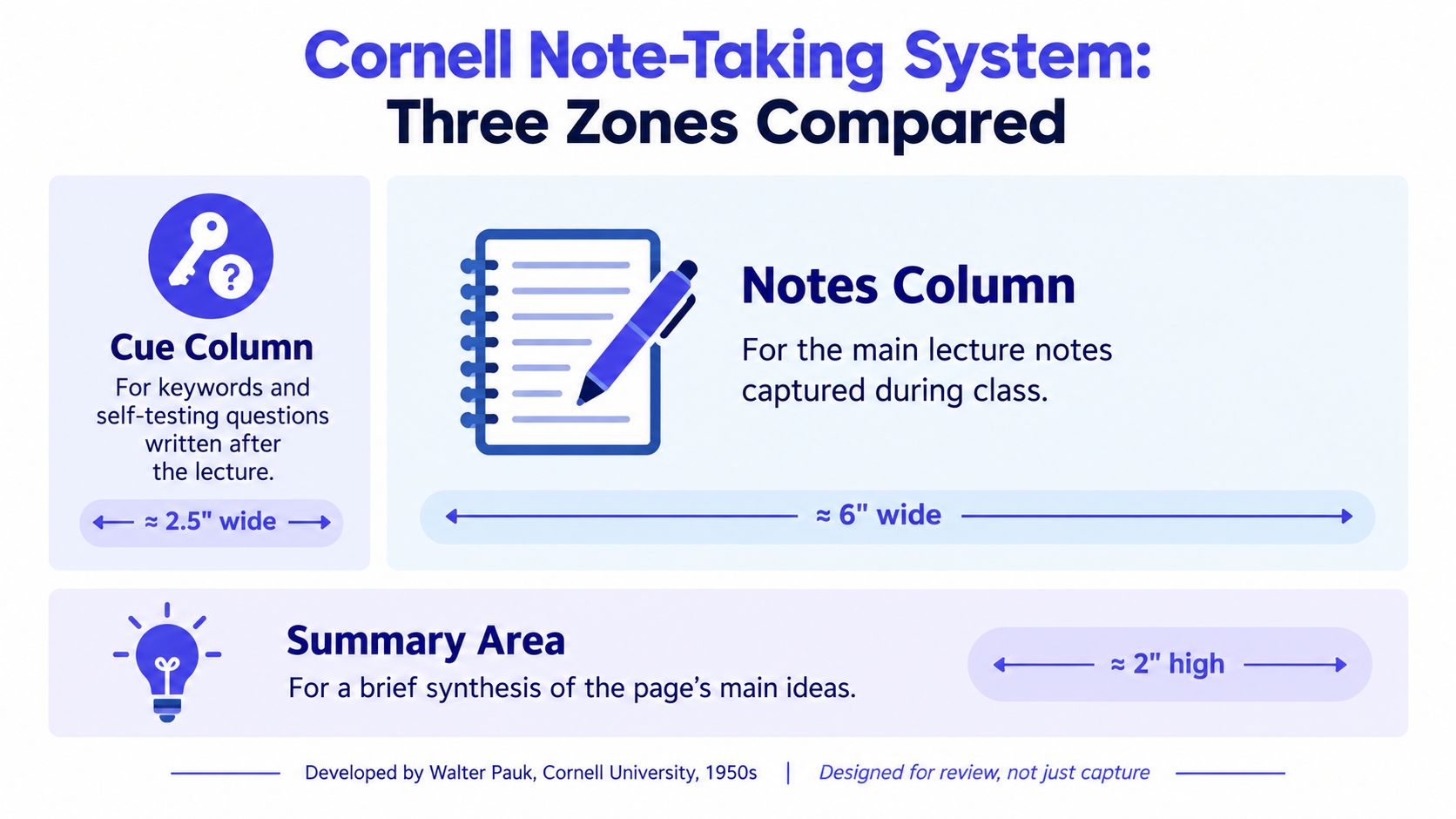
During class, record explanations, examples, and diagrams in the main area. Afterward, write questions beside the relevant material and summarise the page's central argument.
Make the cue column do useful work
For a biology lecture on cell division, a cue such as How do checkpoints prevent damaged cells from dividing? asks more of you than checkpoints. Cover the main notes and answer the question aloud, then check what you missed.
- Capture applications: Include the lecturer's worked example, not just the definition.
- Separate uncertainties: Mark anything you need to clarify before writing your summary.
- Test the cues: Compare them with authorised past-paper questions and module learning outcomes.
The cost is a deliberate review after class. Cornell underperforms when you draw the columns but never add questions, or copy a summary while looking at every line. For calculation-heavy modules, keep worked solutions alongside it rather than squeezing every calculation into the layout.
2. Outline Method
An outline works best when the lecturer already presents a clear hierarchy. In clinical pharmacology, you might place drug classes at the main level, mechanisms underneath, and adverse effects and contraindications beneath the relevant class.
That structure makes outlines useful for lecture-heavy nursing, economics, accounting, and survey courses. You can follow the teaching sequence without deciding where every point belongs on a diagram.

Use headings from the lecture slides or module guide as a starting point. Under a heading on demand, distinguish determinants of demand from movements along the demand curve, and place examples beneath the explanation they illustrate.
Keep indentation meaningful
Use each indentation level consistently: topic, explanation, then evidence or example. In Microsoft Word or OneNote, collapsible headings can make a long module easier to move through, but excessive nesting makes revision awkward.
- Leave room for correction: Add missing examples after class without rewriting the whole section.
- Flag uncertain placement: If you don't know where an idea belongs, mark it instead of forcing a connection.
- Preserve contrasts: Put exceptions beside the rule they qualify.
Outlining has a low setup cost and works well for fast typing. Its weakness is relationships across topics: a branch under inflation won't automatically reveal its connection to unemployment or monetary policy. Add a cross-reference or a later concept map when the module starts combining those topics.
3. Mind Mapping
A history essay on the causes of a conflict rarely benefits from a longer list alone. You need to group causes, distinguish background conditions from triggers, and decide which arguments deserve space in the essay.
A mind map helps with that sorting. Put the central question in the middle, then branch into political, economic, social, and other relevant themes.

Mind mapping earns its place in essay-based history, business, literature, and interdisciplinary modules. It's particularly useful after a lecture or reading session, when you have enough material to see the larger organisation.
Map arguments, not just vocabulary
Keep branch labels short, but retain enough wording to make the meaning clear. A branch labelled economic pressure needs supporting examples or links back to your detailed notes; otherwise, it's only a topic label.
A useful mind map helps you decide what belongs together. It doesn't need decorative lettering or a different colour for every twig.
The time cost comes from arranging and revising branches. Use scrap paper or a rearrangeable canvas such as XMind before committing to a polished version.
Avoid relying on mind maps for exact quotations, detailed calculations, or source-heavy evidence. Keep those in accompanying notes, then redraw the main branches from memory to check whether you can reconstruct the argument.
4. Concept Mapping
Mind maps group ideas around a topic; concept maps make you specify relationships. The difference matters in theory-based science and engineering, where knowing the component names isn't enough.
For example, a chemistry student might connect atomic structure to bonding, then bonding to molecular properties. Each arrow needs a meaningful label explaining the relationship, rather than merely showing that the terms appeared in the same chapter.
Make every arrow defensible
Begin with a focused question, such as how a control system responds to a disturbance. Add the relevant components and label links with phrases such as measures, compares with, or changes in response to.
- Start broadly: Position general concepts before adding specific processes and examples.
- Read connections aloud: Each linked pair should form a statement you can defend.
- Mark uncertainty: Use a question mark where you suspect a connection but can't explain it.
- Revise freely: Sticky notes or diagrams.net make rearrangement easier than a crowded pen drawing.
This demonstration offers a visual starting point for building a concept map.
Watch the video on YouTube (opens in a new tab)
Concept maps take more thought than outlines because you must decide how ideas interact. That makes them valuable after reading or during revision, but cumbersome during a fast lecture.
Don't force every relationship into a simple hierarchy. Feedback loops and cross-links may be essential, especially in physiology, ecology, and systems engineering. Keep equations and worked problems nearby so the map supplements technical work rather than replacing it.
5. Charting Method
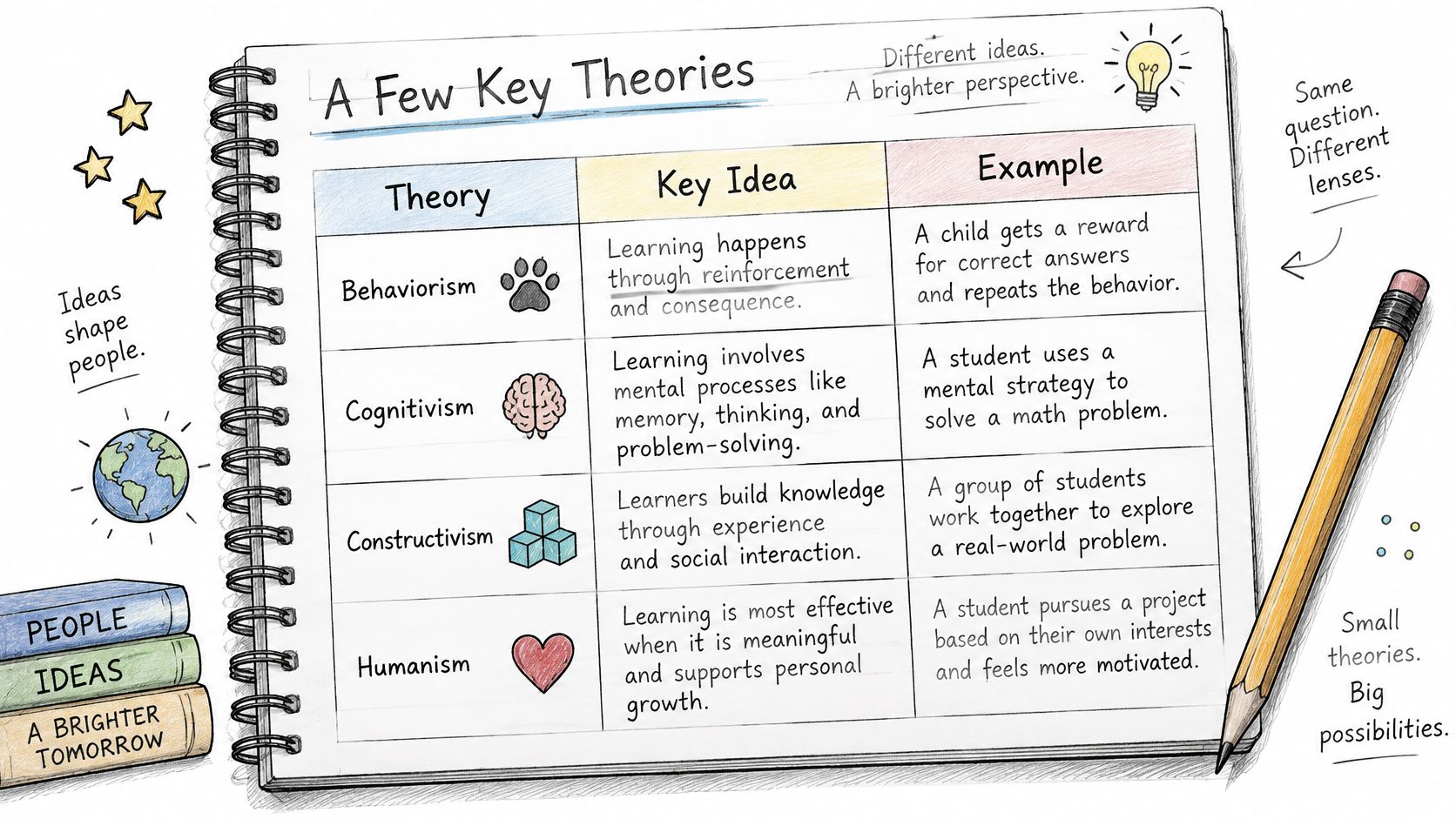
When a module repeatedly asks you to compare, use a chart. Psychology theories, political systems, drug classes, and research methods all lend themselves to consistent categories.
Set the items being compared down the page and the comparison criteria across it. In psychology, useful headings might include assumptions, learning mechanism, supporting evidence, limitations, and classroom application.
Choose headings from the assessment
If your politics exam asks about representation and accountability, organise electoral-system notes around those questions. A chart full of country names and terminology won't prepare you to evaluate competing arrangements.
- Keep criteria consistent: Compare each theory against the same questions.
- Distinguish gaps: Mark information as missing, not applicable, or disputed rather than leaving an ambiguous blank.
- Retain evidence: Add a source reference beside claims you'll need in an essay.
- Include application: Record an example that shows what the distinction means in practice.
Charting takes some preparation because poorly chosen headings lead to cramped cells and repeated information. Microsoft Excel or Google Sheets works well when you need to expand categories as the module develops.
Its main limitation is compression. Don't turn a qualified argument into a misleading phrase just to fit a cell. Keep a short explanatory note for exceptions, and practise writing a comparison paragraph without looking at the chart.
6. Sentence Method
Some lecturers move between arguments, examples, and questions without an obvious hierarchy. In that situation, capture each new idea on a separate line rather than spending the lecture repairing an outline.
The sentence method suits discussion-led sociology, literature lectures, guest presentations, and seminars with unpredictable contributions. Each entry should contain a self-contained thought, not an unfinished fragment that makes sense only while the speaker is talking.
For a literature lecture, record the interpretation, the textual evidence supporting it, and any competing reading as distinct entries. Label whose interpretation you're recording so your own response doesn't become confused with the lecturer's claim.
Capture first, organise afterward
- Keep ideas separate: Start a new line when the argument changes.
- Preserve context: Add the work, passage, speaker, or slide reference needed to understand the point later.
- Mark connections: Use arrows or brief labels to identify examples, objections, and conclusions.
Speed is the advantage; later organisation is the cost. Before the next class, group related entries into an outline or use them to construct an essay plan.
Don't confuse this method with transcription. In a 2014 study of 67 university students, researchers from Princeton University and UCLA found that laptop note-takers performed worse on conceptual questions than handwritten note-takers, while factual recall was similar, as described in Boston.com's account of the study (opens in a new tab). Whichever device you use, shorten the speaker's explanation into your own words without dropping essential qualifications.
7. Zettelkasten Method
A dissertation changes the note-taking problem. You don't just need to remember what a paper says; you need to find its claims later, connect them to other sources, and develop an argument of your own.
Zettelkasten uses linked notes built around individual ideas. It suits research-based modules, postgraduate coursework, and extended literature reviews better than routine lecture capture.
Separate source records from your own claims
Keep bibliographic details and reading notes attached to the source. Then create a standalone note expressing an idea in your own words, with a descriptive title, a stable identifier, and links explaining its relationship to other notes.
For example, a dissertation on online participation might connect a note about assessment incentives with another about student workload. State whether the sources support, contradict, or qualify each other instead of adding unexplained links.
- Preserve provenance: Record page references and clearly distinguish quotations from paraphrases.
- Explain connections: Write why a linked note matters to the current claim.
- Add navigation: Use topic or hub notes to gather useful routes through the material.
Obsidian supports this workflow, but linked text files or index cards can also work. The Zettelkasten note-taking guide provides a fuller starting point for organising the system.
The upfront cost is substantial: you must rewrite ideas and maintain useful links. Don't apply it to every lecture just because the software makes linking easy. Use it where connections across readings will contribute directly to a research question.
8. Bullet Journal Method
A bullet journal solves a coordination problem more than a content problem. It helps you keep deadlines, study tasks, tutorial questions, and module administration together when they're scattered across emails and learning platforms.
That makes it useful across a mixed semester or while preparing for a professional qualification alongside work. It isn't a substitute for detailed lecture notes, research records, or worked solutions.
Connect plans to actual study materials
Use a dated log for current tasks and indexed collections for modules or projects. Distinguish tasks, appointments, and observations with a simple symbol key that you can maintain without consulting instructions.
A nursing student might log an upcoming assessment, note a question for a pharmacology tutorial, and point to the notebook page containing relevant drug-class notes. The journal directs the next action; the subject notes hold the explanation.
- Write concrete tasks: Replace revise physiology with explain cardiac output, then check the worked questions.
- Index longer material: Record where lecture notes and reading summaries live.
- Review unfinished work: Move a task forward only after deciding it still matters.
Planning boundary: If maintaining the journal takes the time you intended to spend answering questions, simplify the journal.
Setup can be light: a notebook, page numbers, an index, and a usable task key. Avoid elaborate spreads that require constant copying. Pair the journal with Cornell for lecture content, SQ3R for reading, or a dedicated problem notebook for technical practice.
9. SQ3R Method
Reading-heavy modules need a process that interrupts passive highlighting. SQ3R stands for Survey, Question, Read, Recite, and Review, and it turns textbook reading into a sequence of questions and attempted answers.
It suits introductory law, medicine, education, and other courses built around explanatory chapters. It's less comfortable for close literary analysis, where wording and ambiguity may deserve sustained attention rather than rapid extraction.
Read toward an answer
Survey the headings, introduction, summary, and figures before reading closely. Turn the relevant headings into questions, then read a manageable section looking for an answer.
For a contract-law chapter, ask what makes an agreement enforceable and which conditions qualify the general rule. Close the book and explain the answer before checking the text.
- Survey purposefully: Identify which parts address your module outcomes.
- Recite from memory: Don't copy the passage and mistake copying for recall.
- Review selectively: Revisit incomplete explanations and misunderstood distinctions.
Use the cue column of Cornell notes to hold the questions if you want reading and lecture notes to share a review format. The guide to taking notes from textbooks offers a useful companion workflow.
SQ3R takes longer than skimming because you repeatedly stop and formulate answers. Apply it to assigned core readings and difficult sections, not indiscriminately to everything in the bibliography. Preserve page references so you can return to the author's precise explanation when needed.
10. Feynman Technique
You can recognise a definition without being able to explain it. The Feynman Technique exposes that difference by asking you to describe a concept plainly, identify gaps, and repair the explanation.
It's most useful as a review method for theory-based physics, economics, computer science, and physiology. Start from a focused concept rather than trying to explain an entire module at once.
For recursion, explain what a function does when it calls itself, why a stopping condition matters, and how a simple example reaches that condition. If you can't trace the example, simplifying the vocabulary won't solve the underlying gap.
Simplify without distorting
Write the explanation without consulting your notes first. Mark the places where you rely on unexplained terminology, skip a causal step, or use an analogy you can't justify.
- Return to the source: Repair the specific missing step using lecture notes, textbooks, or worked solutions.
- Check the analogy: State where it stops matching the actual concept.
- Restore precision: Add the formal terminology, assumptions, and equations required by your course.
This pairs naturally with active recall study methods, because you attempt an answer before consulting the material.
The cost is concentrated thinking rather than page production. A fluent explanation can still be wrong, so compare it with authoritative course materials and assessment criteria. In technical subjects, finish with a problem: explaining an algorithm or physical principle doesn't establish that you can apply it correctly.
How the 10 note-taking methods compare by best use, main limitation, and origin
Match the Method to the Module, Then Test It Against Real Past Papers
No single method wins across every course. Lecture-heavy subjects often suit Cornell or outlines, comparative modules suit charting, and theory-based modules benefit from concept mapping and plain-language explanation. Reading-heavy courses justify SQ3R, while extended research projects can justify the maintenance cost of Zettelkasten.
Pick a primary method for each module, then add another only when it solves a different problem. In macroeconomics, you might capture lectures as outlines, convert competing policy approaches into charts, and use the Feynman Technique to explain transmission mechanisms. You don't need to reproduce the entire lecture in every format.
Build a semester workflow, not a notebook collection
Early in the module, use the syllabus, learning outcomes, and assessment format to decide what your notes must support. During teaching, capture explanations and examples efficiently; afterward, repair gaps and create questions. As assessment approaches, spend more time answering those questions and less time formatting material you already understand.
- For calculations: Keep worked examples, assumptions, units, and an error log alongside your main notes.
- For essays: Preserve evidence and references, then practise selecting them for a specific argument.
- For research: Keep source records separate from your developing interpretation.
- For recorded lectures: Pause at changes in the argument and formulate a question or example instead of copying captions continuously.
Accessibility should shape the workflow from the start. Use speech-to-text, captions, keyboard input, digital ink, or accessible headings where they remove a barrier. Keep exportable copies, and check technical terms in transcripts against the lecture or course materials.
AI can help reorganise headings or suggest practice questions, but verify its output before using it for revision. Write your own explanation before comparing it with an automated summary. Otherwise, you may end up reviewing language you recognise without knowing whether you can produce the reasoning yourself.
Judge notes by what they let you answer
After a short trial, attempt an authorised past-paper question without your notes. Then inspect the answer against the marking guidance or a worked solution, distinguishing missing knowledge from weak application or poor structure.
If your cues don't prompt the required explanation, rewrite them. If a chart hides important qualifications, expand it; if an outline obscures relationships, add a concept map. Change the method where it fails, rather than assuming the answer is to write more.
Course-specific shared notes can help you identify gaps, but check the institution, module, syllabus coverage, and academic year before relying on them. Use them to complement your own work, and follow your institution's rules on assessment materials and academic integrity.
CramShare offers course-specific lecture notes, summaries, revision guides, and past papers through its community library and marketplace. Visit CramShare to look for materials matched to your institution and module, then compare their coverage with your own notes and practise answering relevant questions.