How to Cite Lecture Notes in APA, MLA and Chicago
Learn how to cite lecture notes in APA, MLA and Chicago, with in-text and reference list examples for slides, online notes and class handouts.

You've got the slide deck open in one tab and a half-finished reference list in the other. The lecturer's name sits on the first slide, the date is buried in the course schedule, and the assignment only says "cite your sources." You know the idea came from class. You can't tell whether the source is the slides, the talk you heard, or the notes you wrote yourself.
That gap is what makes how to cite lecture notes feel harder than citing a book. The style matters, but a prior question matters more. Who made the material, and can your reader get back to it?
Lecture Note Citation Formats at a Glance
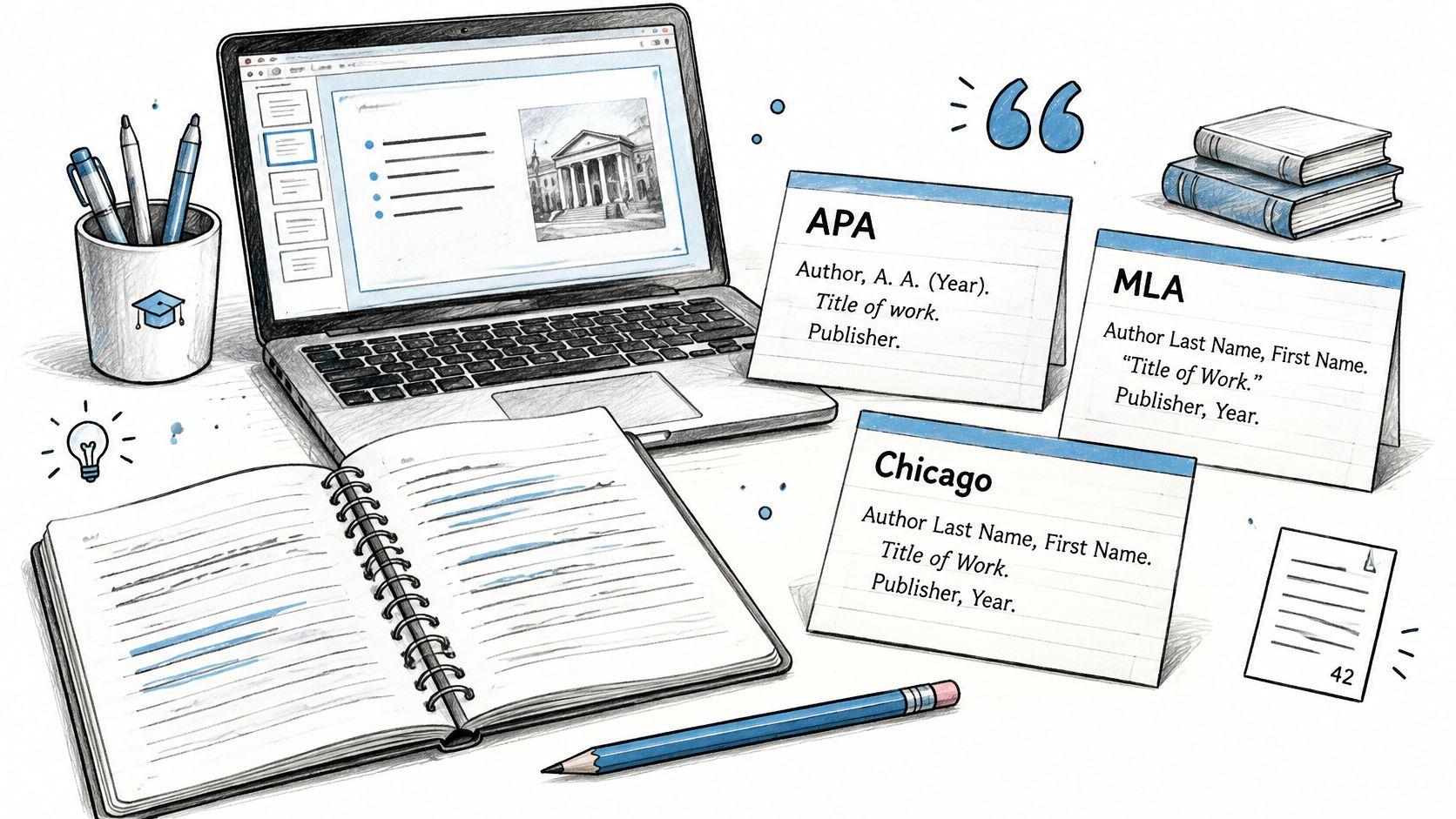
Say the common case is a retrievable deck: Dr. Amara Okafor's Week 4 slides, Cell signalling pathways, posted on the 2025 course site. The same deck produces a different in-text citation in each style.
APA 7 places the year immediately after the author. The reference entry italicizes the title, adds a bracketed descriptor such as [Lecture notes] or [PowerPoint slides], and names the course site as the publisher.
MLA 9 builds the entry from the course, the institution, and the date. It drops a separate descriptor when the course title already says what the item is. In text you give the author's surname only.
Chicago 17 author-date keeps the year in the citation and uses a plain lecture notes label in the reference entry. Chicago notes-bibliography puts the lecturer, course, and date in a numbered footnote, then repeats the details, without the note number, in the bibliography.
Three things change between the rows. The date sits after the author in APA and Chicago author-date, inside the container for MLA, and inside the footnote for notes-bibliography. The title is italic in APA, while Chicago often uses quotation marks or a plain title depending on the form you were assigned. The in-text citation is author-date, author only, or a superscript.
Practical rule: Your course handbook wins. If the instructor specifies a variant of APA, MLA, or Chicago, follow that sheet, then keep the chosen style the same across the whole paper.
Sort Your Lecture Material Before Citing It
Most guides treat "lecture notes" as one pile. They aren't. Instructor slides, a handout, a recording, notes you wrote in an unrecorded class, and a textbook assigned that week each need a different citation. ANU's academic integrity guidance for learners (opens in a new tab) classifies lectures, lecture notes, slides, handouts, recordings, and lecturer notes as unpublished unless a publisher issues them or teaching staff post them publicly.
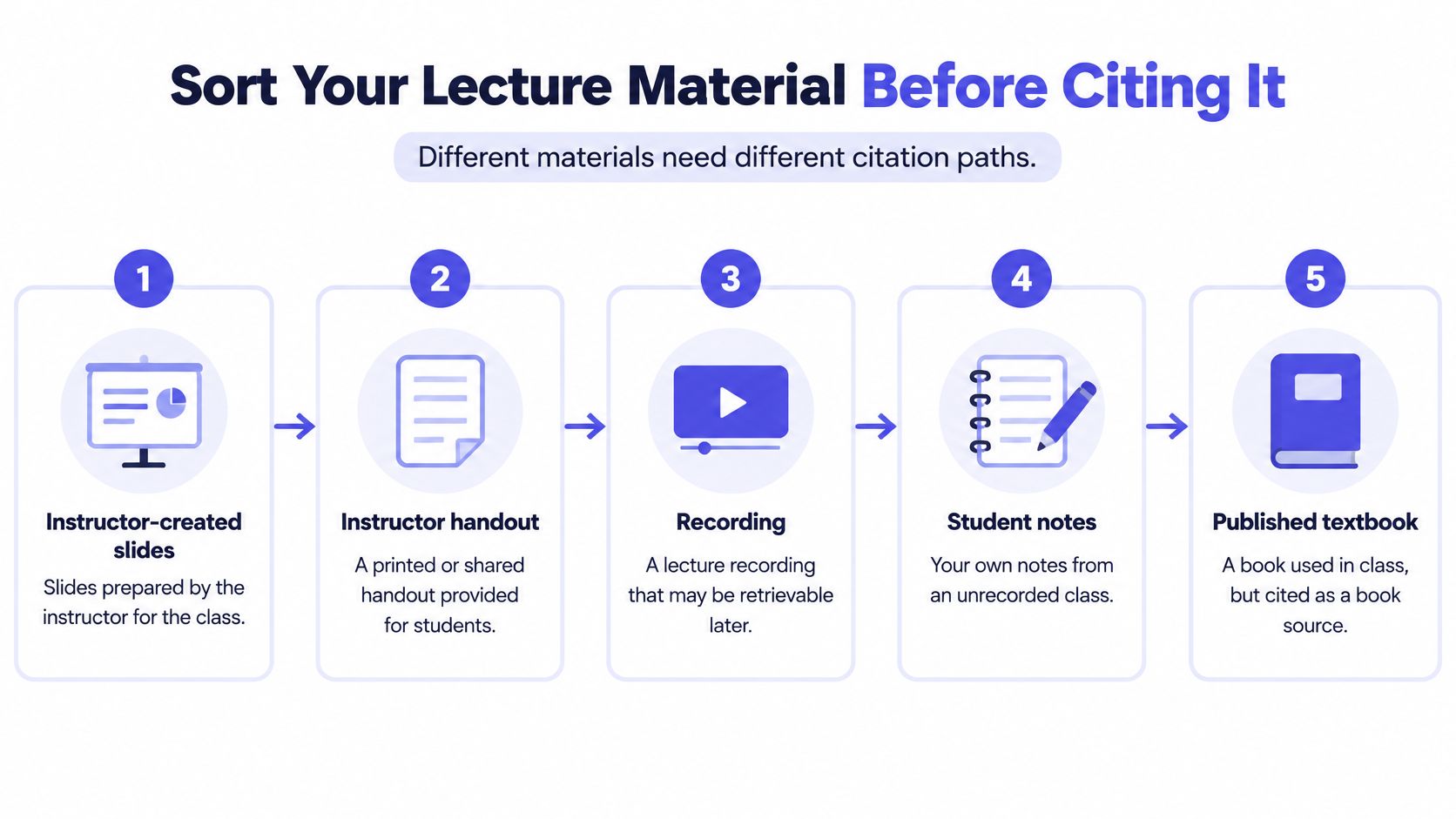
The creator and the access route decide the entry before any style does.
Work through three questions in order.
- Name the creator. The lecturer is the author only when they made the item. A guest speaker who wrote the handout takes the author slot, not the host department.
- Classify the access. Call it published, publicly posted, restricted LMS content, or personal communication.
- Then pick the style. APA, MLA, Chicago, Harvard, or the variant your department requires.
When the metadata is thin
A deck with no title and no date still needs an anchor. Use the course code as the title and the lecture date from the course schedule. If no person is named, put the course or institution in the author position rather than inventing a lecturer.
More detail isn't always better. A login-only URL looks precise and then fails for anyone outside the class. Prefer a stable course landing page, or leave the address off when readers can't open it. Chicago may treat the same deck as an unpublished presentation, while APA and MLA want different mixes of date, course, format label, and platform. International students hit this often, because home and host institutions don't share one template.
How to Cite Slides and Online Lecture Notes
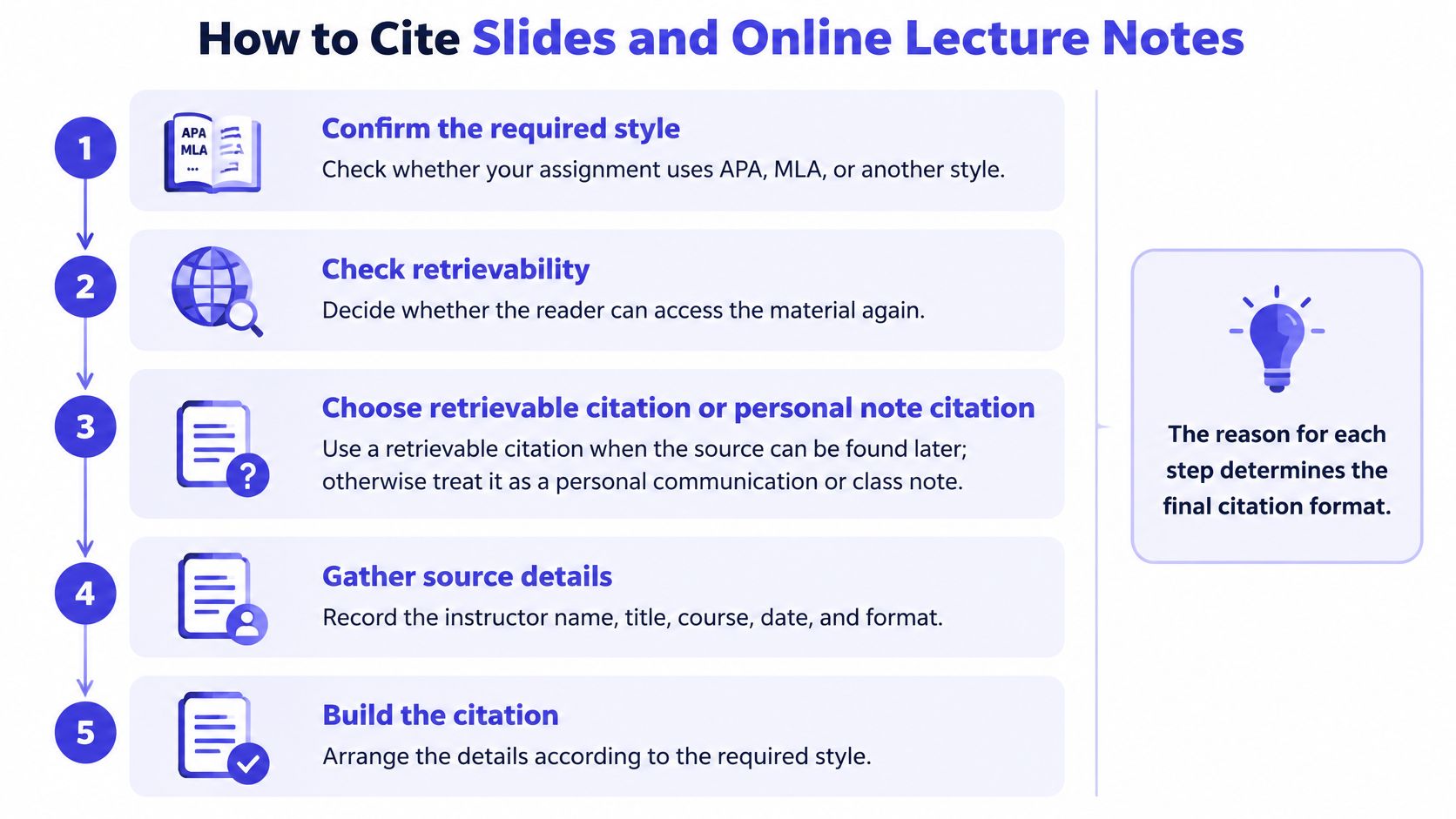
Use Okafor's 2025 cell-signalling deck as the worked example through every step. MLA's guidance on notes and presentations (opens in a new tab) is clear on the first fork: cite the presentation itself, not your private notes as if they were a public source. Personal notes are usually incomplete, unpublished, and hard for a reader to verify. List the instructor as author only when they created the slides. Otherwise name them as a contributor, or enter the work by title.
- Confirm the style and whether a reader can retrieve the file. That choice splits a reference-list entry from a personal communication. Okafor's posted deck is retrievable, so it earns a full entry.
- Record the metadata before you format anything. Surname and initials (Okafor, A.), the exact lecture date, the title Cell signalling pathways, the department and institution, the medium, and a stable course-platform address. Skip the temporary download link that expires after the session.
- Separate posted slides from notes you wrote in an unrecorded class. Only the downloadable slides go in the reference list. Your notebook stays out of it.
- Write the in-text citation to match how you used the idea. A paraphrase needs the lecturer and year, (Okafor, 2025). A direct quotation also needs a locator: slide 7, a page, or a timestamp on a recording.
- Match every citation to an entry, and every entry to a citation. If you quoted slide 7, the reference list must contain that deck. If the deck is in the list, the paper must cite it.
What the entry looks like
In APA the title is italic and the descriptor sits in brackets: Cell signalling pathways [PowerPoint slides]. MLA leans on the course title and the institution instead of that bracket. Chicago uses a plain lecture notes label and, in notes-bibliography, a numbered footnote with the course and date.
If the deck has no date, don't invent one from memory. Check the course schedule first. A required departmental variant still overrides these defaults, so open the handbook before you submit.
The short walkthrough below shows the same retrieval check in motion.
Watch the video on YouTube (opens in a new tab)
Citing Notes From a Lecture You Attended
A page of your own handwriting feels like a source. It isn't one. Those notes are a private record of someone else's talk. They're incomplete, they were never published, and a marker can't open them. Citing the notebook as if it were Dr. Okafor's posted notes sends the reader to a file that doesn't exist.
The lecture is the source. Your notes are only how you remembered it.
Take the unrecorded class on 4 March 2025.
APA 7 keeps this out of the reference list. In the sentence you name the communicator, the words personal communication, and the full date: (A. Okafor, personal communication, March 4, 2025). Adding it to the bibliography creates a verification problem, because nobody else can retrieve it.
MLA 9 treats the live talk as an oral presentation. Name the speaker, a lecture title if one exists, the course, the institution, and the date, and add the descriptor Lecture. You are citing the event, not the page in your binder.
Chicago 17 handles an unpublished lecture as an unpublished presentation. The note gives the lecturer, the title or topic, the course, and the date.
Edge cases students hit in week one
A talk with no formal title still needs a handle. Use the topic printed on the course schedule, not a label you made up afterward. A guest speaker is named as the speaker. Don't substitute the host university, and don't credit the regular lecturer for words they didn't give. A paraphrased idea from the class still needs the lecturer's name. Changing the wording doesn't make the idea yours.
A citation acknowledges the source. It doesn't give you permission to copy, upload, sell, or redistribute the underlying material. Cornell's essential guide to academic integrity (opens in a new tab) states that sharing or selling course materials, including a student's own notes summarizing lectures, may constitute copyright infringement without instructor authorization. If you want a cleaner set of notes to cite from later, start with a method for how to take lecture notes that separates the lecturer's claims from your own comments.
What Stays Off Limits
A citation at the bottom of a shared file answers one question only: whose idea is this. Whether you may circulate the file at all is a different question, governed by copyright and course policy rather than by the reference list. The gap between the two is where students get into trouble.
Four actions, in rising order of risk:
- Quoting a short passage in an assignment. Low risk when the extract is brief, marked as a quotation, and cited. You are showing the marker a few of the lecturer's words inside work that is otherwise yours.
- Paraphrasing with attribution. Low risk when the sentences are yours and the lecturer is named. The idea stays credited, and the wording never pretends to be a transcript.
- Submitting lecture notes or slides as your own work. High risk. A perfect reference list does not convert someone else's structure into your assignment.
- Publishing, posting, or selling notes or recordings. Highest risk. Universities commonly prohibit selling, distributing, or posting instructor-provided material without written permission, and notes that summarize unpublished teaching can fall under the same restriction.
The answer is not identical everywhere. Jurisdiction, institutional policy, the course contract, recording consent, and how much original commentary you added all shift the risk. Two conclusions are equally wrong: that student notes are always safe, and that all sharing is illegal.
A permission check before you distribute anything
Work through four questions before a file leaves your hands. Identify the rights holder. Often the lecturer or the university, even when you typed the summary. Separate your words from theirs. Copied slides, textbook pages, and recordings come out of anything you plan to pass on. Check what the course requires. Some courses ask for written permission before notes are shared. Respect what you agreed to. Recording and distribution rules accepted at enrolment still apply after the lecture ends.
On CramShare, lecture slides, textbook pages, exam papers the seller did not write, and anyone else's work are not allowed for upload, and a purchased document is for the buyer's own study only, never for sharing or resale. If you are weighing what a downloaded file permits, read what a study-material download covers before you post one. Write the summary in your own words, cite the original lecture, and check the rules before a file leaves your account.
Citation Errors to Fix Before You Submit
The mistakes that cost marks are usually missing facts, not a misplaced comma. Students name the university instead of the lecturer, swap in the day a file was uploaded, or list a notebook nobody else can open. Punctuation is the last pass, not the first.
Run the pre-submission audit
Purdue OWL's guidance on electronic sources (opens in a new tab) frames the failures as incomplete metadata and source misidentification. Work the list in this order.
Author. Use the lecturer, not the university, unless no individual is named. Then the course or institution takes that slot. Date. Use the day the lecture was given, not the upload timestamp, whenever the content date is known. Title. Keep the exact wording, including its capitalisation. Don't retitle Cell signalling pathways as "Week 4 biology." Format. In APA, put [Lecture notes] or [PowerPoint slides] in brackets so the reader knows the medium. Link. Point to a stable course page or landing page. A session download link dies, and a login wall the marker can't open doesn't help them check you. Access match. Notes from an unrecorded class are personal communication in the text and stay out of the reference list. Don't dress them up as the professor's published notes.
MLA oral lectures take a different set of pieces: the speaker, the lecture title if you have one, the course context, the organization, the venue or city, and the descriptor "Lecture."
Keep one-to-one traceability
Every borrowed claim should map to one identifiable source record, and every reference-list entry should appear in the text. That's the check to run the night before submission. When no date exists, APA permits "n.d." An approximate or inferred date should not be invented.
Changed wording doesn't retire the citation. Purdue's guidance states that paraphrased ideas still require attribution. If the course uses its own variant of APA, MLA, or Chicago, check the handbook or the library style guide, or email the instructor before the deadline rather than guessing.
Keep a source log while the course is running. For each lecture, write the lecturer, date, title, medium, and access route the same day. Reconstructing that from memory in week 12 is how upload dates and missing authors get into the paper. A clear record also supports what academic integrity means when a marker asks where a claim came from.
CramShare is where students share original, course-matched notes, summaries, and revision guides tagged to real course codes, so you can study from material written for the module you're in. Pair that with the citation habits above: credit the lecture, and upload only notes you wrote yourself. Visit CramShare to find course-specific study notes or to publish your own.