7 Study Techniques for Auditory Learners: A 2026 Guide
Discover 7 study techniques for auditory learners, from recording lectures to audio summaries and spaced verbal quizzing, with practical steps for each.
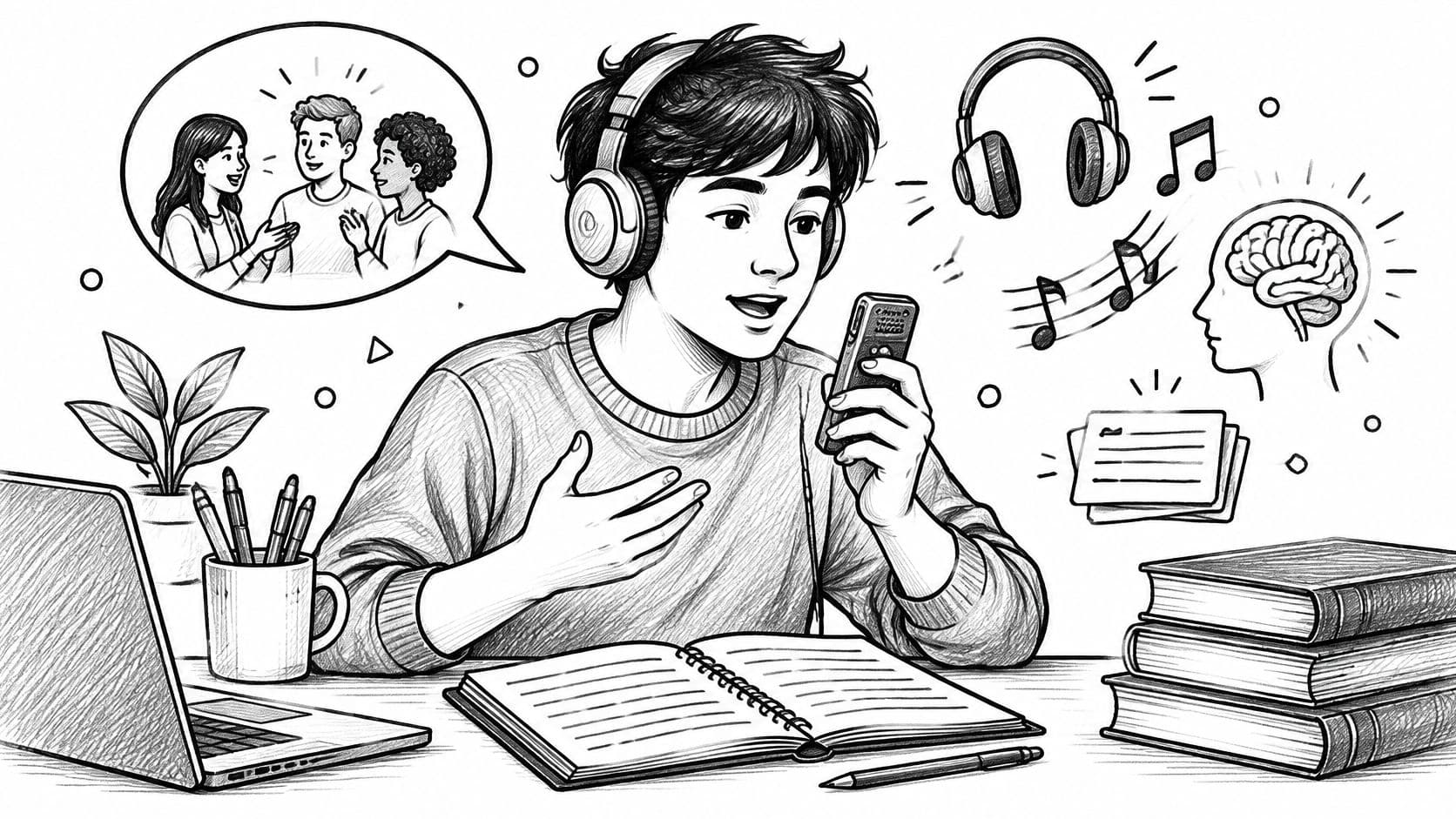
You've replayed the same lecture recording three times. The lecturer's voice sounds familiar, you can almost predict the next sentence, and then a practice question asks you to apply the idea and your mind goes blank. That's the trap with most study techniques for auditory learners. Familiarity isn't recall, and hearing information again doesn't prove you can produce it under exam conditions.
You don't need to stop listening. You need to make listening do harder work. The American Psychological Association spotlight on learning styles (opens in a new tab) notes that a major 2008 review by Pashler, McDaniel, Rohrer, and Bjork found insufficient evidence that students learn better when instruction is matched to a self-identified auditory style. Treat auditory learner as a preference, not a fixed type.
The seven methods below keep the audio channel you like, but each one forces a check. You'll pause, explain, answer, or teach before you replay. That's how you find out whether a recording taught you something or only sounded clear.
1. Recording and Replaying Lectures
A recording is useful for one job, filling gaps. It captures the example your lecturer improvised, the emphasis that never made the slides, and the definition you misheard while writing. It fails when you replay a full lecture passively and count the hours as revision.
Usage is already common. The University of Colorado Boulder lecture recordings assessment (opens in a new tab) reports that in 2024, 32.2% of students viewed lecture recordings, watching an average of 3 hours and 8 minutes per student. Volume alone tells you nothing about whether those hours produced answers.
How to Replay Without Wasting the Hour
Say you recorded a 50 minute physiology lecture. Don't restart at minute one. Go to the 10 minute segment on the cardiac cycle, listen once, then close your notes and write the sequence from memory. A law student can do the same with a recorded seminar, checking each spoken argument against a case brief template for facts, issue, ruling, and reasoning.
- Check permission first: Confirm your institution's and instructor's recording policy before you record.
- Label every file: Use course code, date, and topic so you can find a segment in seconds.
- Write before you check: After each segment, write three to five bullet points from memory, then replay only to correct them.
- Control the speed: Use 1.2x to 1.5x for familiar material and normal speed for dense sections.
Pair this with solid first pass notes. If your in class capture is weak, fix that with a consistent system for taking lecture notes in college before you rely on replay to rescue you.
2. Reading Aloud and Self-Explanation
Reading aloud only helps if you stop reading. Say the passage in your own words, with the book closed, and you'll hear exactly where your explanation turns vague. That stumble is the useful part. It's a precise map of what you don't know yet.
The payoff comes from retrieval practice, not from your voice alone. A review of retrieval practice in university courses (opens in a new tab) reports that in a University of Louisville statistics course, students who completed short answer retrieval exercises averaged 86% across four exams, compared with 78% for lecture only students. Speaking your answer from memory is the auditory version of that same move.

A Two Minute Test for Any Topic
A nursing student reads a pharmacology section aloud, closes it, and explains each drug's mechanism of action without notes. An economics student narrates a graph step by step, stating what changes, what stays fixed, and why the curve moves. If either student can't finish the chain, they reopen the source for that link only.
Practical rule: If you can't explain it aloud in under two minutes without looking, you don't know it well enough to write it in an exam.
Record the attempt on your phone and listen back for filler, circular definitions, and missing steps. This works best for conceptual topics in law, philosophy, medicine, and theory heavy modules. It's inefficient for long factual lists, which need quizzing instead. For the underlying method, use the same recall first logic as the active recall study method, just spoken rather than written.
3. Study Groups and Peer Teaching
Most study groups fail because everyone listens politely. Nobody gets challenged, errors pass uncorrected, and the confident speaker learns the most. Flip the roles. Each person teaches, each person gets questioned, and the group checks every claim against course materials.
Teaching forces organization. You can't explain a procedure out of order without hearing the problem yourself, and a peer's simple question, why does that step come first, exposes a gap faster than another hour of rereading. The trade off is real. Groups are slower than solo study and they can spread a wrong explanation if nobody verifies it.
Run It Like a Teaching Session
Engineering students can rotate at a whiteboard, with one person explaining a stress analysis problem while the others challenge each assumption and calculation step. Medical students can run weekly viva style sessions, where one member presents a case and the rest ask follow up questions until the reasoning breaks or holds.
- Assign topics in advance: Each member prepares one topic to teach for 10 minutes.
- Set the agenda and clock: Decide the questions and the finish time before you start.
- Keep an unanswered list: Park questions nobody can resolve and research them after the session.
- Verify before you adopt: Check explanations against your textbook, lecture notes, or past paper mark scheme.
Watch how a structured peer session keeps every member speaking and answering, rather than watching one person perform.
Watch the video on YouTube (opens in a new tab)
I recommend groups of three or four. Larger groups give quiet members somewhere to hide.
4. Audio Summaries and Podcast-Style Notes
Short audio summaries turn dead time into review time, but only if they're built for recall. A rambling 40 minute voice note of everything in a module is just a worse lecture. A tight recording on one outcome, with pauses and prompts, is a portable quiz.
Students do respond well to the format, which is part of the trap. Enjoyment helps you press play. It doesn't guarantee durable learning, so build the check into the recording. Before you commit an hour to any podcast-style resource, ask whether it ever stops and makes you produce an answer, or whether it just keeps talking. The first kind trains retrieval. The second trains familiarity, and familiarity feels like knowledge right up until the exam.
Build a Recording You Can Answer
A history student records one summary per lecture, stating the main argument, two pieces of evidence, and one counterargument, then listens on the bus before a midterm. A business student uses text to speech on a revision guide while walking between buildings. Both should pause after each main point and state the next point aloud before the recording says it.
Keep each file under ten minutes and focused on one topic. Use clear signposting, define technical terms out loud, and end with two or three retrieval prompts you answer rather than skip. Pair every audio pass with written practice questions, diagrams, or equations where the course demands them, because an exam sheet won't respond to your voice. If you record from shared materials, confirm you have the right to use and share them before you distribute the file.
Judge any audio resource you didn't make the same way:
- One topic per file: Whole-module recordings invite passive listening.
- Prompts you can answer: It stops and asks, instead of summarizing end to end.
- Recall holds overnight: If you can't restate the argument the next morning, the format entertained you without teaching you.
A good audio summary asks you questions. A bad one just talks at you while you commute.
5. Text-to-Speech Review of Written Materials
Treat text to speech as an editing and access tool. Hearing notes, PDFs, or a draft essay read aloud exposes clumsy phrasing, missing transitions, and wrong terms that silent scanning lets slide. Your ear catches what your eye autocorrects.
Accessibility is the stronger reason to use it well. A randomized study of 144 undergraduate psychology students (opens in a new tab) reported trivial differences in quiz performance between caption conditions; in that study, students valued captions, and those with hearing difficulties benefited from reading captions while listening. Use the voice to support access and checking, then make it retrieve: at each heading, stop the reader and write the points that should follow before you play on.
Where It Works and Where It Breaks
A student with dyslexia can work through a long chapter by listening while following the highlighted text, then summarizing each section from memory. A postgraduate can play a draft essay aloud and mark every sentence they have to hear twice. Both uses keep the written version in view, which matters when the exam wants technical terms spelled correctly.
- Start at 1.0x: Increase speed only when you can still summarize what you just heard.
- Read along on screen: Following the text strengthens the link between sound and print.
- Proofread before sharing: Listen to your own notes before you upload or swap them.
- Test symbols early: Check how the tool handles equations, units, and notation before trusting it for quantitative courses.
Use text to speech after you have engaged with the material once. A reader earns its place when it shows the words as it speaks, pauses cleanly, and pronounces the notation your course depends on; if it turns formulas into noise or lets you drift, switch back to written practice.
6. Rhythm, Songs, and Mnemonic Chants
You remember lyrics from years ago without trying. Rhythm and melody give a sequence a shape, and that shape is easier to retrieve than a flat list. Use that for the narrow set of material that's a list, an order, or a set of labels.
Chemistry students chant the order of periodic groups or the steps of a reaction mechanism. Medical students use rhymes for cranial nerve names and functions. In both cases the chant retrieves the sequence quickly, which frees attention for the harder question of what the sequence means.

Keep the Chant on a Short Leash
Set new information to a familiar tune so you spend minutes creating it, not an evening. Keep each chant to one concept or sequence, because a song covering a whole module collapses under its own weight. Then test yourself properly. Recite it without prompts, check against your notes, and fix any word you substituted to fit the rhyme.
- One sequence per chant: Ordered lists, classifications, vocabulary, and basic formulas fit best.
- Recite before you check: Say the whole thing from memory, then verify every item.
- Move on quickly: Use the chant as a starting point, then switch to written practice questions.
Here's the limit I want you to respect. A chant can tell you the order of steps and still leave you unable to perform them. If your exam asks for reasoning, calculation, or essay argument, the chant is scaffolding. Remove it and practice the actual task.
7. Audio-Based Spaced Repetition and Verbal Self-Quizzing
This is the strongest method on the list because it combines three things that work. You hear a prompt, you answer aloud from memory, and you repeat the items at increasing intervals instead of cramming them in one sitting. Listening is only the delivery system. Recall does the learning.
The spacing matters as much as the speaking. A retrieval practice experiment using stepwise worked examples (opens in a new tab) found learners receiving retrieval prompts studied for 31 minutes versus 13 minutes for controls and achieved significantly better recall and problem solving one week later. Delayed performance is the benchmark that counts, not how fluent you feel today.
Set Up Verbal Cards That Force an Answer
An accounting student records a definition prompt, leaves a pause, then records the correct answer, and reviews the set across the week before a professional exam. A language student hears a vocabulary prompt, answers aloud, then hears the correct response and marks the miss. The Pimsleur method, developed by Paul Pimsleur, uses this same spaced audio recall structure.
- Record prompt, pause, answer: Leave enough silence to speak your full answer before the recording continues.
- Review misses more often: Correct items move to longer intervals, errors come back sooner.
- Use a scheduler: A timer or app keeps intervals honest when motivation dips.
- Check against the source: Verify answers against course notes or the official exam syllabus so you don't drill an error.
Choose your platform deliberately from the available spaced repetition tools, then judge it by delayed quiz accuracy, not playback count.
How the seven auditory study techniques compare
Build Your Audio Study System This Week
Don't adopt all seven methods at once. You'll spend the week building systems instead of learning content, and you won't know which method produced any improvement. Pick two techniques that match your actual assessments and run each one properly for a week.
Match the method to the task. If your exam is problem based, choose peer teaching and verbal self-quizzing with worked examples, because both force you to produce steps in order. If it's essay based, choose self-explanation and audio summaries, because you need arguments you can state cleanly without notes. If it's fact heavy, spaced verbal quizzing and a small number of chants will carry more weight than lecture replay.
Your One Week Test
Run technique one on half a topic and technique two on the other half. Keep the study time roughly equal so the comparison means something. Two or three days later, attempt past paper questions on both halves with no audio, no notes, and a timer running.
Score the answers against the mark scheme and write down the result. Keep the method that produced better unaided answers, not the one that felt easier or more enjoyable. The Learning Scientists post on retrieval practice (opens in a new tab) makes the same distinction, using auditory activities as retrieval practice rather than passive replay. Feeling familiar with a recording is not evidence. A correct delayed answer is.
Apply the same discipline to your materials. Check the rights and quality of any shared audio, transcript, or notes before you rely on them, and verify explanations against your own course materials, textbook, and syllabus. On our platform, documents are reviewed for course match and tagged to the course, exam, or textbook they were written for, but you should still confirm the content fits your module and academic year.
Build one small habit this week. Listen once, close the source, speak the answer, check it, and correct it. Do that consistently and your audio study stops being background noise and starts behaving like training.
Find course matched lecture notes, summaries, and past papers for your exact module, then turn them into audio summaries and spoken recall prompts using the methods above. Browse resources by university, course code, and textbook at CramShare and pick one topic to test aloud today.