Active Recall Study Method That Actually Works
Learn the active recall study method with practical techniques, spaced retrieval, and sample plans to boost exam prep and long-term retention.

The popular advice to “just make flashcards” misses the hardest part of studying: what you do when you can't answer them. The active recall study method isn't a stationery choice or an app feature. It's a manageable routine of answering without your notes, checking your reasoning, repairing gaps, and returning later.
Why Rereading Your Notes Is Costing You Marks
You've read the lecture slides, highlighted the important sentences, and worked through your summary. Everything looks familiar. Then an exam question asks you to explain the topic without those familiar sentences in front of you, and you don't know where to begin.
The problem isn't necessarily that you didn't work hard. You practised reading an explanation, but the exam asks you to produce one. Those are different tasks.
Familiar isn't the same as available
Rereading has a legitimate role: you need to encounter and understand material before you can retrieve it. The trouble starts when you use the ease of reading as your main readiness check. Seeing an answer and thinking you recognise it doesn't tell you whether you could reconstruct it independently.
The distinction between immediate performance and later recall is central to the research discussed below. For your own revision, replace the question “Does this look familiar?” with “What can I explain when it's hidden?”
This familiar study setup can make it difficult to notice that difference.
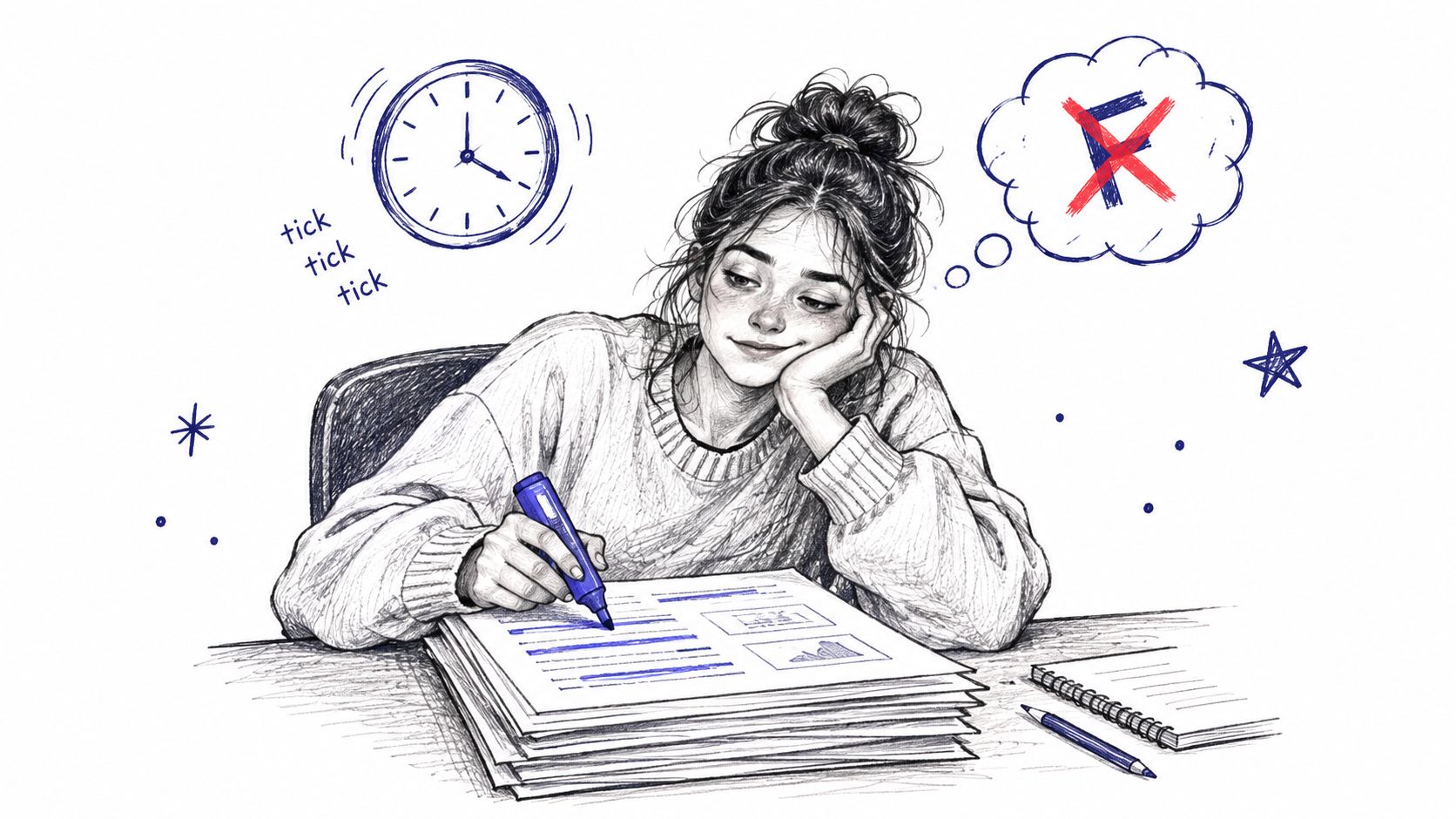
Readiness check: Close your notes before deciding whether you know the topic.
Suppose a slide contains a definition, a diagram, and an example. Cover it and try to supply each part yourself. If you remember the definition but can't explain the diagram, you've identified a specific task for your next study session.
That hesitation isn't a verdict on your ability. It tells you where your preparation needs attention. You don't have to abandon reading, but you do need to stop letting recognition stand in for an independent answer.
What Active Recall Actually Does in Your Brain
Active recall, also called retrieval practice, means attempting to retrieve information from memory instead of keeping the answer visible. You might write an explanation, sketch a diagram, solve a problem, or mentally reconstruct an argument.
The central contrast is between accessing information yourself and encountering it again.
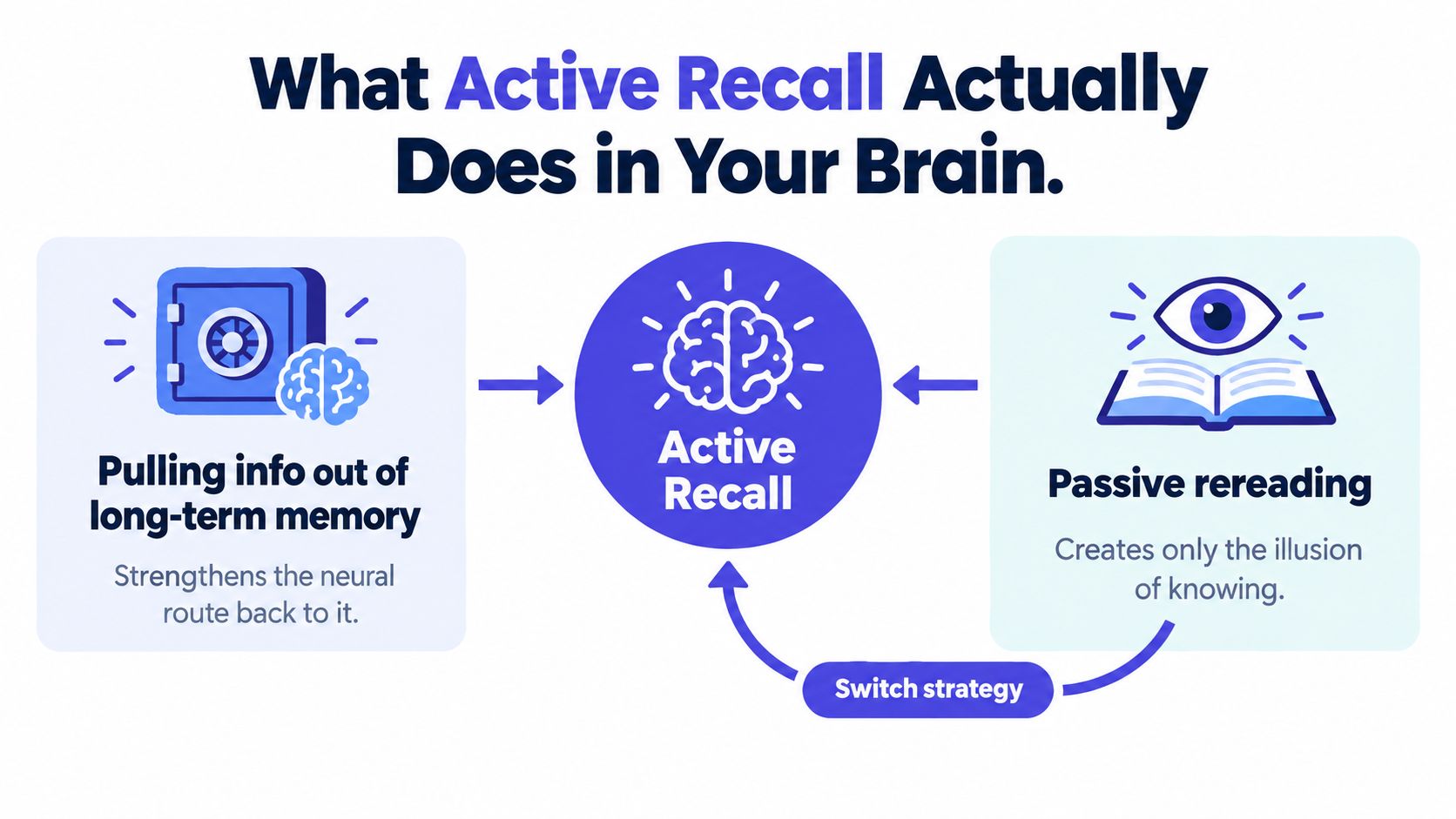
Retrieving and correcting belong together
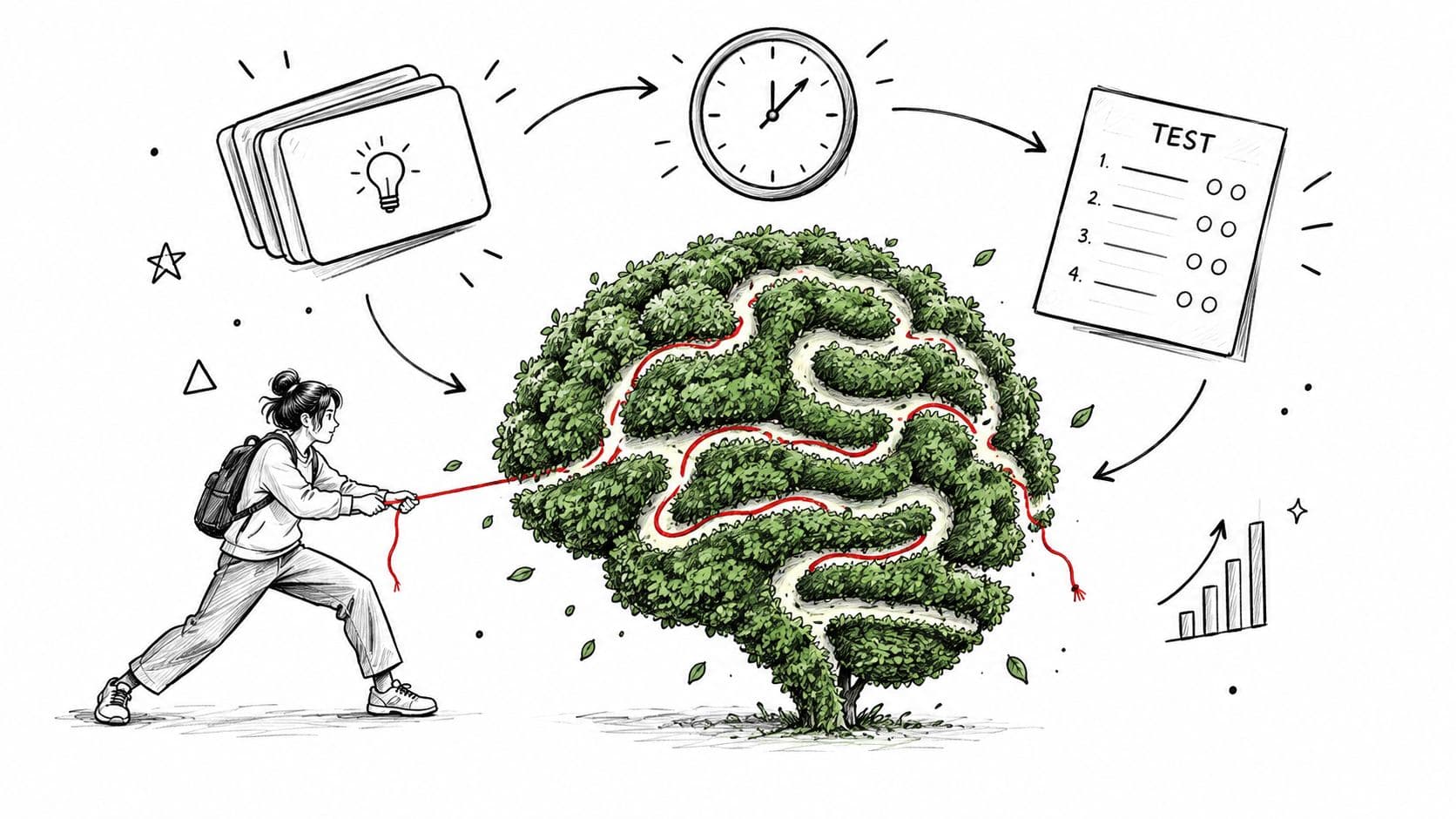
Think of retrieving a memory as pulling a thread through a hedge. Each successful pull makes the route easier to follow; looking at the hedge from outside doesn't require you to find that route. It's an analogy for accessibility, not a literal description of what neurons do.
Research on retrieval practice supports benefits for later accessibility and learning beyond simple repetition, while highlighting the importance of feedback when initial answers are inaccurate. The practical implication is straightforward: an attempted answer needs an answer check.
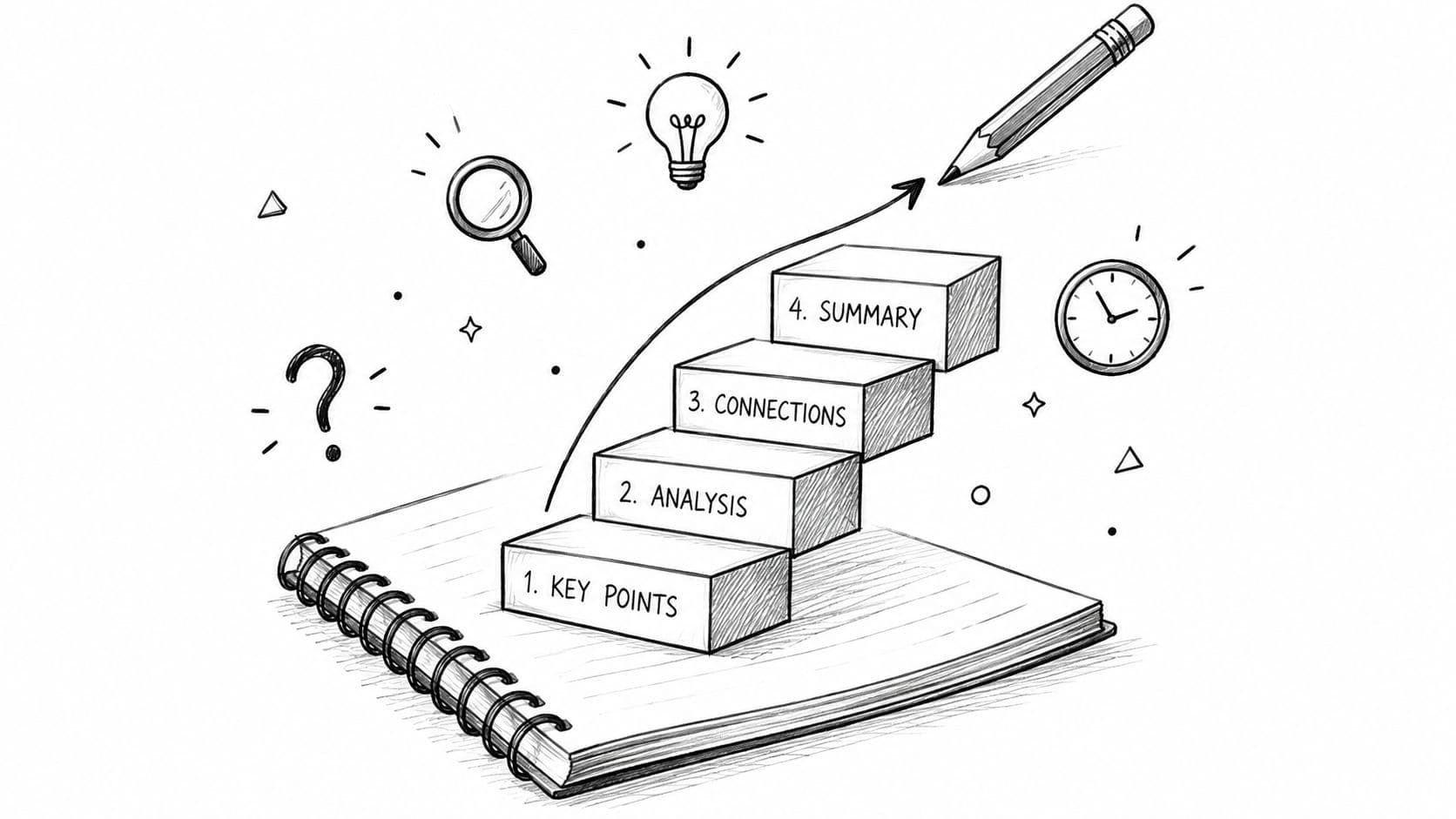
Use this sequence:
- Retrieve: Hide the source and make a genuine attempt.
- Compare: Check your answer against the course explanation.
- Repair: Correct missing steps, mistaken terminology, or faulty reasoning.
- Return: Attempt the question again later without looking.
Suppose you remember a concept's name but give the wrong explanation. Don't count the attempt as complete merely because it felt difficult. Read the relevant explanation, identify where your reasoning went wrong, and prepare to retry it.
Difficulty can be useful, but persistent confusion needs instruction, not more guessing. Equally, you don't need perfect wording when the task is to explain an idea. Check whether your answer preserves the meaning and includes the details your course requires.
For a visual walkthrough of moving from reading to self-testing, you can watch this video.
Watch the video on YouTube (opens in a new tab)
The Century of Evidence Behind the Method
Active recall wasn't invented for digital flashcards. Its research history begins long before study apps, with researchers asking whether recalling material could improve learning rather than merely measure it.
The historical account of active recall (opens in a new tab) traces early empirical work to Edwina E. Abbott in 1909, followed by Herbert F. Spitzer's 1939 study of 3,605 sixth-grade students in Iowa, in which intervening recall tests reduced forgetting over a 63-day period. Spitzer used short articles on topics such as bamboo and peanuts, varying when pupils received tests.
The result changed when researchers waited
The important question wasn't who performed well immediately after studying. It was who could still remember once time had passed.
In the foundational 2006 experiment by Henry Roediger and Jeffrey Karpicke, students studied science passages through restudy or retrieval; after a week, recall was approximately 58% with retrieval versus 40% with restudy, a difference of roughly 18 percentage points, as described in this discussion of the testing effect (opens in a new tab). Immediate performance could favour rereading, but delayed performance favoured retrieval.
Judge your preparation by what you can produce later, not only by how smooth studying feels today.
These findings help explain an otherwise puzzling experience: a study session can feel less successful while preparing you better for a later assessment. The effort of recalling may expose gaps that rereading leaves hidden.
They don't mean every question, flashcard, or practice session will work equally well. They support a narrower, useful conclusion: testing yourself during learning can contribute to retention, rather than serving only as a final check. Your job is to turn that principle into practice that matches your course.
Four Techniques You Can Use This Week
Choose a technique according to the answer you'll need to produce. Flashcards are useful for focused questions, but they're not a substitute for practising an extended explanation or a complete solution.
For a consistent example, use a topic from your own module that compares competing explanations. Call them Model A and Model B, and substitute the names and details from your lecture notes.
These options give you different ways to attempt retrieval.
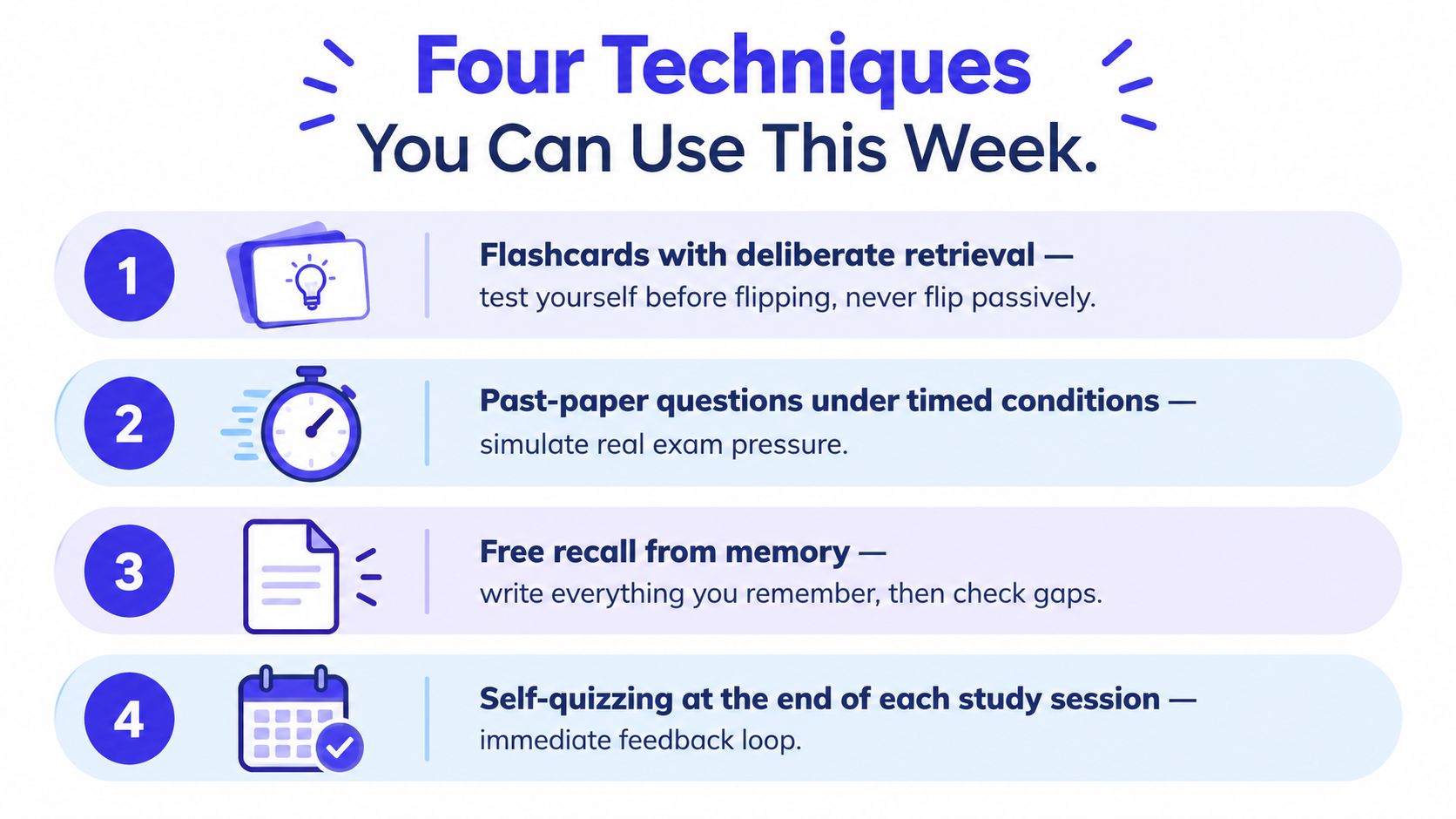
Flashcards and practice questions
Flashcards work when you answer before revealing. A useful front might ask, “What assumption distinguishes Model A from Model B?” Write a concise answer on the reverse, with enough explanation to check meaning rather than just keywords.
Avoid cards that give away the answer in the question. If you can respond by copying the wording on the front, you haven't created much of a retrieval task.
For practice testing, choose a legitimate past-paper prompt such as, “Compare the models and justify which applies to this scenario.” Attempt it without notes, then check the marking guidance or course materials.
- Begin with reasoning: If you're still learning, attempt the question without a timer.
- Add exam conditions: Once you can construct an answer, practise within the time allowed by your assessment.
- Review the omission: Distinguish a missing fact from a weak comparison or unsupported conclusion.
Choose exam preparation materials that include explanations or marking guidance where possible. A question bank alone gives you tasks, but you still need a trustworthy way to assess your answers.
Blank-page recall and self-explanation
Take a blank page and write the topic heading. Without opening your notes, reconstruct the assumptions, key terms, diagram, and example associated with the models. Then compare your page with the lecture material and mark omissions separately from mistakes.
Keep the scope narrow enough to check properly. “Everything from the module” is harder to diagnose than “the comparison covered in this lecture.”
For self-explanation, answer as though a classmate has asked why the models lead to different conclusions. Explain the connection between assumptions and outcomes, not just the definitions. Stop whenever you notice yourself using a technical term you can't explain.
As noted in the retrieval research above, mental recall can also help. If you're studying, reconstruct the explanation internally, then check it rather than assuming that a vague sense of knowing counts.
Match the method to the task: use flashcards for focused knowledge, practice questions for assessment-style reasoning, blank-page recall for topic coverage, and self-explanation for connections.
Spaced Retrieval and Why Timing Beats Intensity
A long evening of self-testing isn't the same as returning to a topic after a gap. Active recall describes how you practise; spacing describes when you practise. You can use retrieval in either a crammed block or a distributed schedule.
A meta-analysis of 29 studies on spaced retrieval (opens in a new tab) found an advantage over massed retrieval of approximately g = 0.74, while finding no reliable advantage for expanding over uniform intervals, with g = 0.034. The effect size describes a research comparison, not a promised percentage increase in your marks.
Make the schedule simple enough to keep
You don't need an elaborate algorithm before you can begin. Pick recurring opportunities to revisit questions and attach them to study periods you already use.
The timeline below is an illustrative schedule, not a universal prescription. Its last session shouldn't be treated as a point when learning becomes permanently “locked in”; difficult material may need further review.
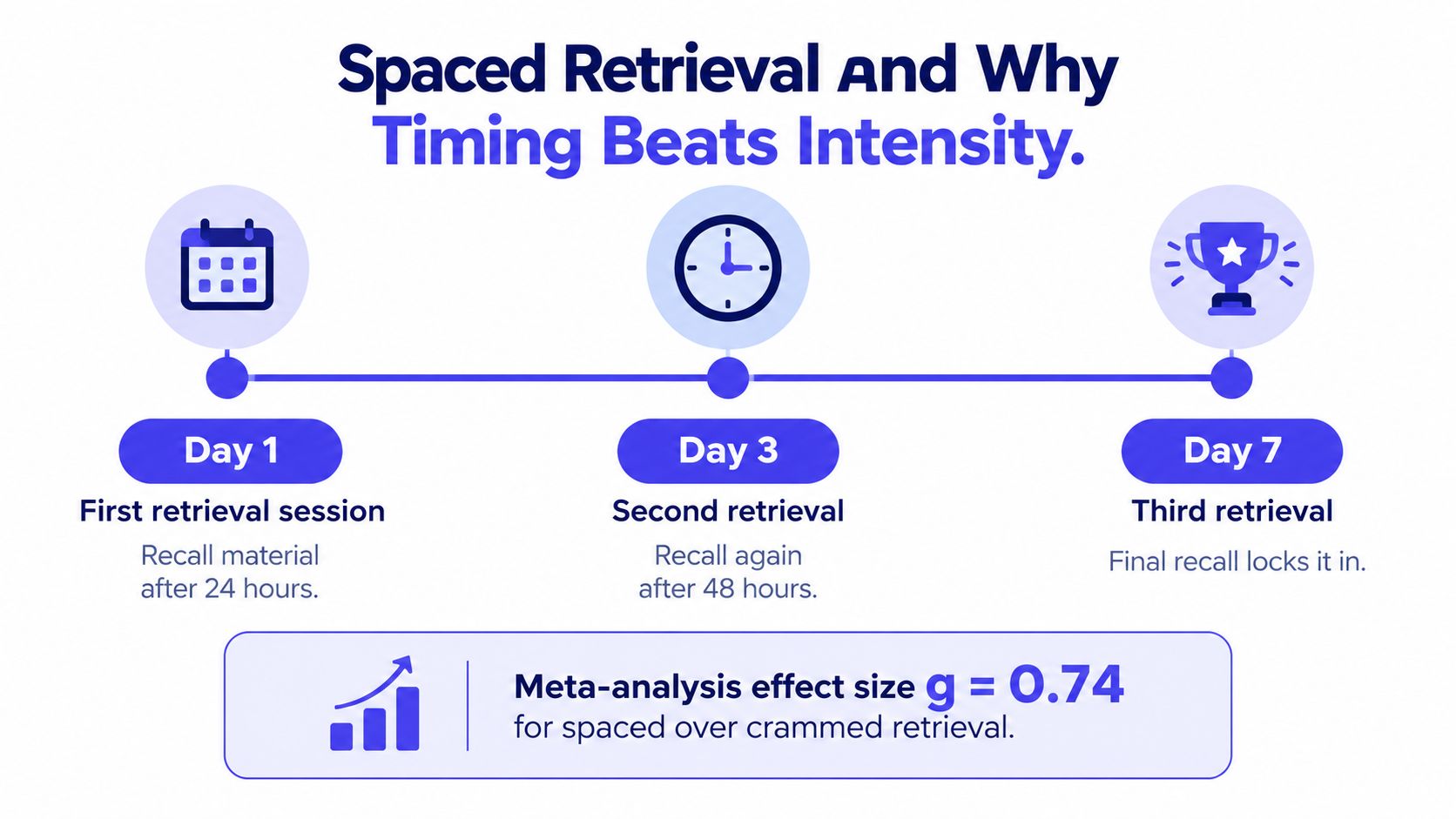
Use a calendar, a paper planner, or spaced repetition tools to make the next session visible. The tool should reduce planning work, not become another project you have to maintain.
- After initial learning: Make an early attempt once you've understood the material.
- On a later study day: Revisit the questions without reviewing their answers first.
- During subsequent review: Combine older prompts with current topics and check whether you can still answer independently.
Let errors influence the next session
Record whether each answer was correct, incomplete, or incorrect. Add a short reason when useful: missing condition, confused terminology, unsupported explanation, or calculation error.
Give forgotten and incomplete items priority, but retain some questions you previously answered correctly. You need to find out whether those answers remain available after a delay.
If your schedule slips, resume from the questions that need attention. Don't spend the next study session rebuilding a perfect calendar. A workable pattern of repeated attempts is more useful than a complicated plan you avoid.
Turning Course Notes Into Retrieval Cycles
Open a lecture summary and choose a specific learning outcome. Suppose it asks you to compare Model A and Model B, explain their assumptions, and apply them to an unfamiliar situation.
Your task isn't to convert every sentence into a flashcard. It's to create prompts that require the knowledge and reasoning described by that outcome.
Convert the assessment task into prompts
Read the relevant material first. Then write questions whose answers can be checked against it. Separate a broad learning outcome into focused tasks, while retaining a larger question that brings the parts together.
Prompt Types Mapped to Common Assessment Formats
Don't put the explanation inside the prompt. “Why does Model A assume the condition listed below?” may let you recognise an answer rather than retrieve the condition yourself.
Keep a source location beside each question, such as the lecture heading or textbook section. Following a clear lecture-note structure makes this checking stage easier.
Use the notes as a reference, not a script
Attempt the prompts closed-book, then open the source. Compare the substance of your answer, including assumptions and reasoning, rather than looking only for matching words.
A synthesis of retrieval-practice evidence (opens in a new tab) describes the importance of corrective feedback and continuing practice until concepts are correctly recalled. For your module, that means an error log should lead to a correction and another attempt, not merely a mark beside the question.
- Name the error: “I described Model A when the question asked for Model B.”
- Find the distinction: Identify the relevant assumption in the course explanation.
- Improve the answer key: Include the reason, not just the final label.
- Retry later: Answer a related prompt without your correction visible.
For shared notes or revision guides, check the institution, module, academic year, and alignment with current instructor materials. If explanations conflict, use the authoritative course source or ask your teaching team.
Once individual prompts are manageable, mix questions from related topics. For example, place a model-selection question beside a comparison question so you have to decide what kind of answer is required. Keep topic labels available for checking, but avoid showing hints that make the choice for you.
A Sample 14-Day Study Plan
This is an illustrative fortnight, not a research-prescribed timetable. Adapt it to your lectures, assessment date, and available study time. Keep routine sessions brief enough to finish before they become an excuse to postpone starting.
Begin with current coursework
Days 1 to 3 focus on learning new content and making an initial closed-book attempt that evening. Choose a lecture outcome, create a small set of prompts, and check your answers before moving on.
Use prompts such as “Define the key concept without repeating the slide,” or “Explain how the assumption leads to the conclusion.” Finish by recording the source you'll need for checking and the question that needs another attempt.
During the middle period, try prompts such as “Which approach fits this scenario, and why?” or “What changes if the question removes this assumption?” These ask you to select and use knowledge, rather than reproduce a familiar paragraph.
Keep a fallback version
A busy day doesn't need the same workload as a free afternoon. Decide in advance what a reduced session looks like.
- Normal session: Attempt mixed questions, check reasoning, and update the error log.
- Busy-day session: Retry a troublesome prompt and verify the correction.
- Practice-exam session: Follow your course's timing and permitted-resource rules, then review the answer separately.
Before the exam, don't automatically create another complete summary. Use the errors you've documented to choose targeted checks. If a practice answer reveals a fundamental misunderstanding, return to the teaching explanation or seek help rather than repeatedly rehearsing an answer you don't understand.
Why Students Skip This Method and How to Start Anyway
Knowing that retrieval practice is useful doesn't make it easy to start. Rereading requires little setup, while self-testing asks you to choose questions, tolerate uncertainty, and face answers that may be incomplete.
A study of 268 undergraduates conducted in 2024 (opens in a new tab) found that rereading notes and textbooks remained the most common behaviours, while practice tests and flashcards were among the least used and were perceived as less effective. The implementation problem includes time, effort, anxiety, and planning, not a lack of awareness alone.
Lower the cost of beginning
Don't require yourself to build a complete question bank before using active recall. Choose a topic you're already studying and write a prompt beside the relevant note.
- Prepare the check: Keep the relevant course explanation easy to find.
- Limit the scope: Start with a learning outcome, not the entire module.
- Make the next action visible: Leave the next prompt ready in your notebook or planner.
- Separate practice from judgment: Treat an incomplete answer as information about what needs work.
You're allowed to discover a gap before you're ready to close it. Record it, find the explanation, and return to the task.
Organise your materials by module, use legitimate past papers as prompts, and treat revision guides as references for checking. That gives each resource a clear job.
The first useful session may be modest: answer a question, identify what's missing, and arrange a later retry. You don't need to feel confident before beginning. You need a process that helps you see what to do next.
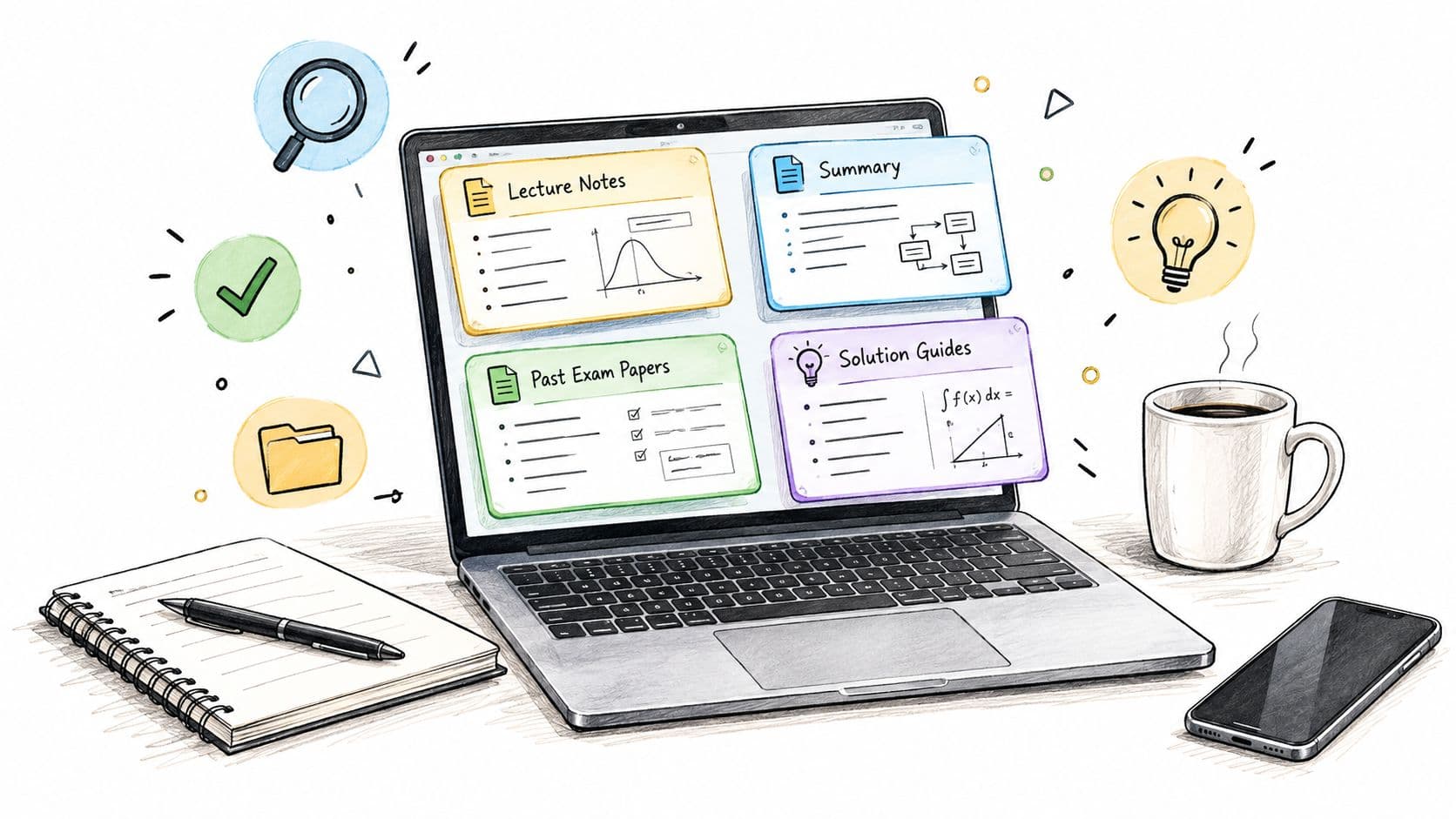
CramShare offers course-specific lecture notes, summaries, revision guides, and practice materials organised by institution and module. Visit CramShare to find resources that match your course, then use them to create closed-book prompts and check the reasoning in your answers.