10 Note Taking Tips and Methods That Work in 2026
Discover 10 note taking tips and methods, from Cornell notes to Zettelkasten, with examples and advice on when to use each for lectures and revision.


You've filled a notebook all semester. Now revision starts, and the pages don't help you answer a single question without rereading the lecture from the beginning. The notes record what the lecturer said, but they don't prompt you to recall, explain, or apply it.
That's the difference between notes that look complete and notes that work for studying. The best method depends on the subject, the lecturer's pace, and whether you're listening, organizing, or reviewing. An outline can make a history lecture easy to follow, while a mind map may suit a psychology topic built around connected ideas. For a maths derivation, you may need space to work through each step rather than summarize it.
These note-taking tips offer ten approaches matched to specific courses and study stages. Each has a practical use case and a trade-off, so you can choose a method for the class in front of you instead of trying to force one system onto every subject. The shared principle is simple: capture the important ideas in a form you understand, then return to them in a way that makes you retrieve and explain what you learned.
1. Cornell Note-Taking System
Cornell notes work well when a lecture has clear concepts to learn and likely exam questions to answer. Divide the page into a wide main notes area on the right, a narrower cue column on the left, and a summary space along the bottom. During class, use the main area for key points, examples, and relationships rather than a word-for-word transcript.
After class, turn important ideas into questions or keywords in the cue column, then write a short summary in your own words. A biology student might note how osmosis works, add “What moves across the membrane?” as a cue, and summarize the process at the bottom. A law student could list case names and principles, then cover the notes column and test recall using the cues.
Walter Pauk, an education professor at Cornell University, developed the system during the 1950s. Cornell's description of the note-taking system (opens in a new tab) explains how the layout supports both capturing lecture content and preparing it for review.
Practical rule: Use cues that ask you to explain or compare, not only define. “How does this differ from osmosis?” is more useful for revision than a list of terms alone.
Leave about one-third of the page for cues, and set aside a short period after each lecture to add questions and a summary. The system takes more time than saving slides, so it's not worth filling every page with elaborate questions. It is worth the effort when you'll use those questions to quiz yourself.
2. Outline Method
For a lecturer who teaches in a clear sequence, the outline method is often the easiest format to keep up with. Put the main topic at the top level, indent subtopics below it, and add supporting facts or examples another level down. The structure makes relationships visible without requiring special software or a drawn layout.
An economics student studying market structures could write “Market Structures” as the main heading, then list monopoly, oligopoly, and perfect competition beneath it. Key features and examples sit under each category. A history student could organize a lecture by era, event, cause, and consequence, making it easier to trace what led to what.
Keep headings specific. “Causes of the French Revolution” tells you more than “History,” and it gives later review a clear starting point. Leave blank space after major sections so you can add an example, a lecturer's qualification, or a question without crowding the page.
The outline method is less useful when a lecture jumps between ideas, relies heavily on diagrams, or develops several arguments at once. Don't try to impose a tidy hierarchy while you're still working out how the ideas connect. Capture the major points first, then reorganize the notes after class into a shorter outline. That second pass can reveal which details support the main idea and which are just examples you don't need to memorize.
3. Mind Mapping
When a course depends on relationships between ideas rather than a straight sequence of facts, try a mind map. Write the central concept in the middle of the page and draw branches for related themes, examples, definitions, causes, or effects. Short labels keep the map readable, while arrows and colors can show connections that a linear list hides.
A nursing student revising a condition might place its name in the center and branch to symptoms, causes, assessment, and treatment. A literature student preparing an essay could map a novel's themes, characters, and relevant quotations, then draw lines between a character's decisions and the themes those decisions illustrate.
The format is particularly useful for brainstorming, building a revision overview, or planning an essay. It can be awkward during a fast lecture, especially when you don't yet know which ideas belong together. In that situation, take quick linear notes first and map them afterward.
- Keep branches brief: Use one keyword or a short phrase instead of copying full paragraphs.
- Use color with a purpose: Assign colors to categories such as definitions, examples, and questions.
- Test the map: Recreate it from memory, then compare it with your notes to spot missing links.
A mind-mapping approach to note-taking (opens in a new tab) can support visual organization, but the point isn't to make an attractive diagram. If you can't explain why two branches connect, add a short label or revise the link.

4. Zettelkasten, or Connected Notes
Zettelkasten, German for “slip box,” is useful when your course involves sustained reading and ideas that reappear across lectures, articles, and assignments. Instead of writing one long set of notes, make separate notes for individual ideas. State each idea in your own words, then link it to related notes so you can follow connections later.
A postgraduate student working on a literature review might create a note for each theory, explain the argument briefly, and link it to the papers that support or challenge it. A medical student could connect a physiology concept to a clinical case, making it easier to move from foundational knowledge to practical application.
The trade-off is that a connected note system takes more organization than a single document. It's usually not worth setting up for a short course or a class where the material won't be reused. Start with a simple digital folder or note app, give each note a clear title, and add a link to at least one related idea when you can explain the connection. Revisit the network periodically to find topics you've studied in isolation but haven't yet brought together.
Niklas Luhmann used a paper version of the approach to organize ideas for his work. For a practical guide to applying the system to your own study notes, see how to use the Zettelkasten method.
Keep each note understandable on its own. A title like “Memory and attention” is a useful starting point, but the note should also explain the claim or question it contains. Links are valuable only when they help you reason across ideas, not when they become a web of unexplained references.
5. Feynman Technique
Use the Feynman technique when a topic seems familiar but you're not sure you can explain it without your notes. Pick one concept and write an explanation in plain language as if you were teaching someone new to the subject. When your explanation turns vague, circles back on itself, or relies on jargon you can't define, mark that spot as a gap.
An engineering student might try to explain how a transistor works, then realize they can't describe what the gate does. That's a useful signal to return to the lecture, textbook, or a worked example and clarify the missing piece. A chemistry student could explain a reaction mechanism to a study partner, using questions from the listener to find steps that need more attention.
The technique is most useful after you've encountered the material, not as a replacement for taking notes during a fast lecture. It can feel slow if you try to explain every term in a chapter, so choose the concepts most likely to matter for an assignment or exam.

Write your first explanation without looking at your notes. Then compare it with your course material, correct errors, and try again in simpler language. Richard Feynman was known for explaining complex subjects clearly, but this four-step written routine is a study technique built around that principle, not a formal method he created.
6. Active Recall and Spaced Repetition
Notes become more useful when they make you retrieve information instead of reread it. Active recall means trying to bring an answer to mind before checking the page. Spaced repetition means returning to material over multiple review sessions rather than trying to learn it all in one sitting.
As you take notes, add questions beside important claims, steps, or definitions. A law student could turn a case summary into prompts about the facts, principle, and application. A language student could make flashcards from vocabulary, then use an app such as Anki to schedule reviews.
This approach is a strong fit for material you must retrieve accurately, such as terminology, formulas, dates, or case principles. It's less effective to turn every sentence in a textbook into a flashcard. Too many cards can turn review into a second full-time task, and isolated recall won't replace practice applying concepts to unfamiliar problems.
Cover the answer before you read it. If you only recognize a definition after seeing it, you haven't tested recall yet.
Try answering questions on a blank page before opening your notes. Mark what you couldn't retrieve, review those gaps, and make the next study session focus on the difficult material. For a more detailed routine, see this guide to the active recall study method.
7. Progressive Summarization
Progressive summarization suits material you'll revisit, particularly textbook chapters, research papers, and lecture series. Rather than trying to write a perfect summary on the first pass, build it in layers. First capture the material you need, then highlight the most important passages, identify the key points within those highlights, and write a short summary once you understand the whole document.
A postgraduate student reading a research paper might mark the main findings, emphasize the most important ones during a later review, then write a brief summary before drafting a literature review. A student working through a long textbook could mark useful definitions and examples, then create a condensed review sheet at the end of a unit.
The benefit is that you can return to a document and find its core ideas more quickly. The drawback is that the method can become a highlighting exercise with no real thinking. If most of the page is highlighted, the highlighting no longer helps you decide what matters. Make the first pass selective, and only emphasize points that support a concept, argument, or question you expect to revisit.
Write the summary after you've worked through the earlier layers. Otherwise, you may restate the introduction without noticing the evidence or qualifications that change the author's point. For a short lecture you'll never use again, this level of processing may be more work than the material deserves. For a major reading tied to an essay or exam, the layers can make review more manageable.
8. Sketchnoting and Visual Notes
When a lecture explains a system, sequence, or process, combine short labels with simple drawings. Sketchnoting uses shapes, arrows, symbols, and layout to show how ideas relate. You don't need drawing skill. A box can represent a stage, an arrow can show direction, and a quick icon can mark an example.
A business student could sketch a Porter's Five Forces diagram and use arrows to show how each force affects competition. A biology student might draw a cell, label the organelles, and add brief notes about each one. For an anatomy or engineering lecture, a rough diagram with accurate labels can be more useful than a page of disconnected sentences.
This method can slow you down if you try to illustrate every point in real time. Keep the sketch simple, use a consistent layout, and add written labels wherever the drawing could be misunderstood. A small set of repeatable symbols, such as arrows, stars, and boxes, is enough to make notes easier to scan.
Mike Rohde's The Sketchnote Handbook helped popularize the practice among students and professionals. Use visual notes when the material has spatial or procedural relationships worth showing. For a lecture built around dense legal reasoning or a sequence of detailed definitions, a structured written format may be faster and clearer.
The example below shows how visual notes can combine words and simple symbols.
Watch the video on YouTube (opens in a new tab)
9. Choosing Between Handwritten and Digital Notes
A fast lecturer may make typing feel like the obvious choice. A handwritten page, however, can make you slow down enough to choose which ideas matter. The decision isn't just paper versus screen. It's whether your chosen format lets you stay engaged without turning note-taking into a transcription job.
In a set of experiments published in Psychological Science, Pam Mueller and Daniel Oppenheimer found that laptop note-takers recorded more material, but performed worse on conceptual questions than students who took notes longhand. In one experiment, laptop users transcribed approximately 65% more lecture content verbatim than students writing by hand, according to the Harvard Business Review's account of the study (opens in a new tab). Later evidence has complicated a simple “handwriting is always better” conclusion, so focus on how you process information, not just the device.
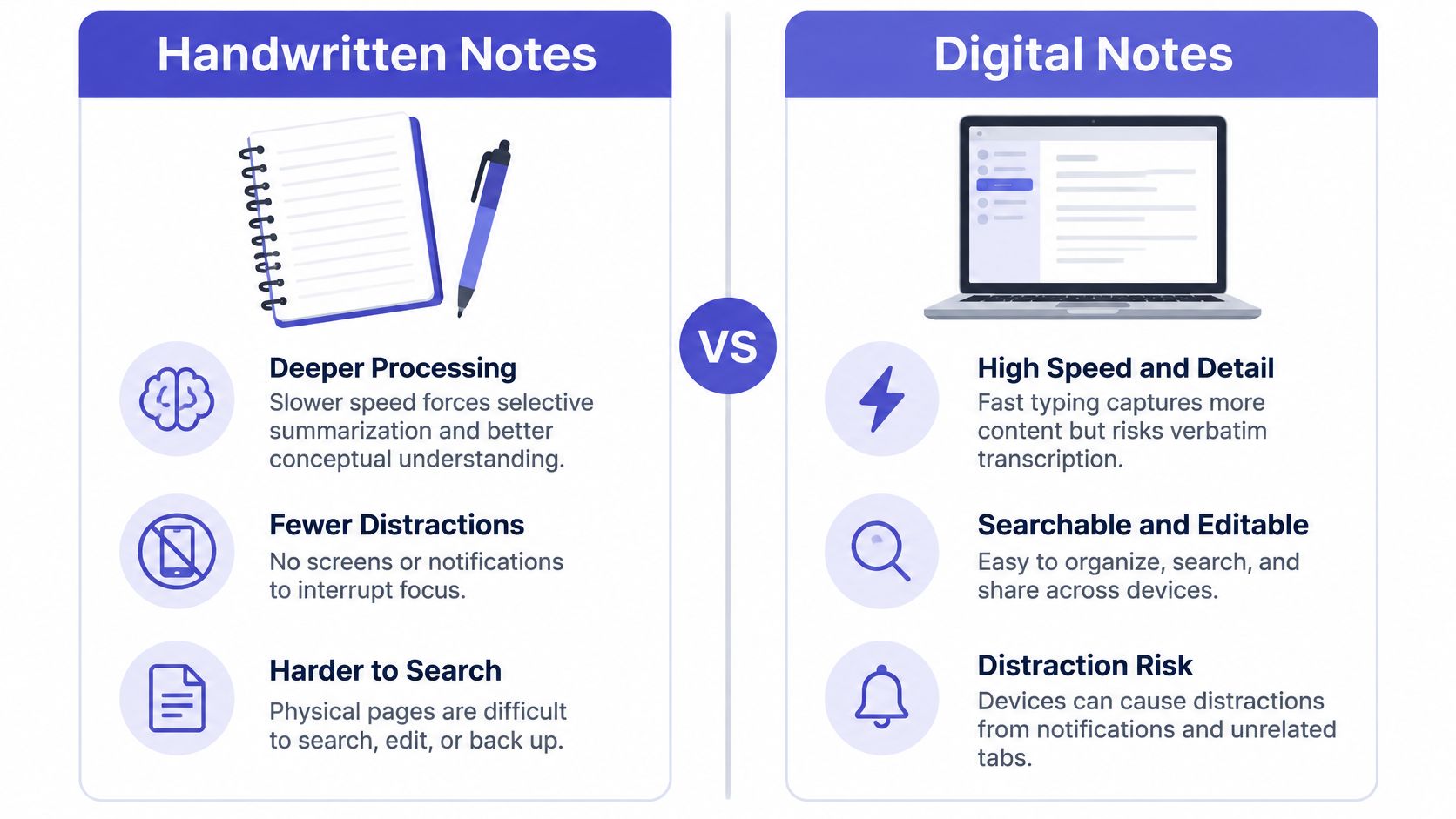
A practical compromise is to handwrite equations, diagrams, and worked examples, then type a clean summary you can search later. If you type during class, close unrelated tabs, silence notifications, and paraphrase rather than copying full sentences. After class, rewrite the main arguments or explain the difficult ideas in your own words.
Choose the tool that fits the lecture and your access needs. If the pace is fast, digital notes may help you capture headings and details, but review them soon. If the subject depends on conceptual relationships, handwriting can encourage selection. Either way, a device only helps when the notes support understanding rather than replace it.
10. Course-Organized Notes with a Review Routine
A useful note system makes it easy to find material when you need it. Group notes by course and module, then label each file or page with the topic and class date. Keep the naming format consistent so you can search for a lecture without remembering exactly which folder you used.
A psychology student might create folders by module and week, adding a short summary and open questions to each lecture note. An accounting postgraduate could keep a separate notebook for each course and add an index of topics. Linking lecture notes to relevant readings or practice questions makes it easier to see what the course expects you to know.
The routine matters more than a beautifully designed filing system. Soon after class, add a one-sentence summary, mark anything you don't yet understand, and write at least one question to answer during review. If your notes are handwritten, scan them to PDF rather than photographing each page separately. That gives you a single document you can store and search alongside other course materials.
A useful test: Can you find a lecture quickly, and can you use its notes to test yourself without starting from scratch?
Before an exam, compare your notes with practice questions and assigned readings. That can reveal missing topics or places where your notes are too thin to support an answer. If you use shared materials, make sure they match your course and follow your institution's academic-integrity rules. This guide to organizing notes by course can help you build a consistent system.
How the 10 note-taking methods compare by best use, format, and main drawback
Pick One Method This Week and Build the Review Habit
Don't switch between every method at once. Choose one that fits a course you're taking now, then use it consistently for two weeks. For a linear lecture, test the outline method. For a concept-heavy class, try Cornell notes or a mind map. For a course where you need to explain ideas clearly, use the Feynman technique after class. The point is to see whether the method helps you understand and retrieve the material, not whether it makes your notes look polished.
Add a short review within a day of each lecture. Read your notes once to fill gaps, write a summary without copying the lecturer's wording, and create questions you can answer later. If you can't explain a point or solve a problem without looking, mark it and return to the relevant course material. A small review soon after class is easier to act on than discovering a semester's worth of notes right before an exam.
The format matters less than what you do with it afterward. Handwritten notes can still be passive, and digital notes can support active learning when you add questions, summaries, and explanations. Keep materials organized by course and topic so each lecture builds on the last. Over time, that gives you a more complete set of revision resources, rather than a pile of pages you have to decode.
Shared study materials can help you check your understanding, but use resources that match your course and module, and follow your institution's academic-integrity policy. CramShare offers course-matched study notes written by students who have already sat the exam, with the same policy on uploads. Treat those notes as a supplement to your own class engagement and study, not as a substitute for attending lectures or completing your work independently.
Start this week with one format, one course, and a review slot you can keep. After two weeks, keep what helps you answer questions and explain ideas, and change what only adds formatting work.
If you want course-specific lecture notes, summaries, or revision guides to compare with your own, explore the student-written materials on CramShare. Search by university, course code, subject, or textbook, then use relevant resources to check gaps and strengthen your own review routine.