G60 Practice Exam: Where to Find One That Is Accurate
Learn how to find a current G60 practice exam, check it against FDNY rules, and use timed practice to reach the 70% pass mark.
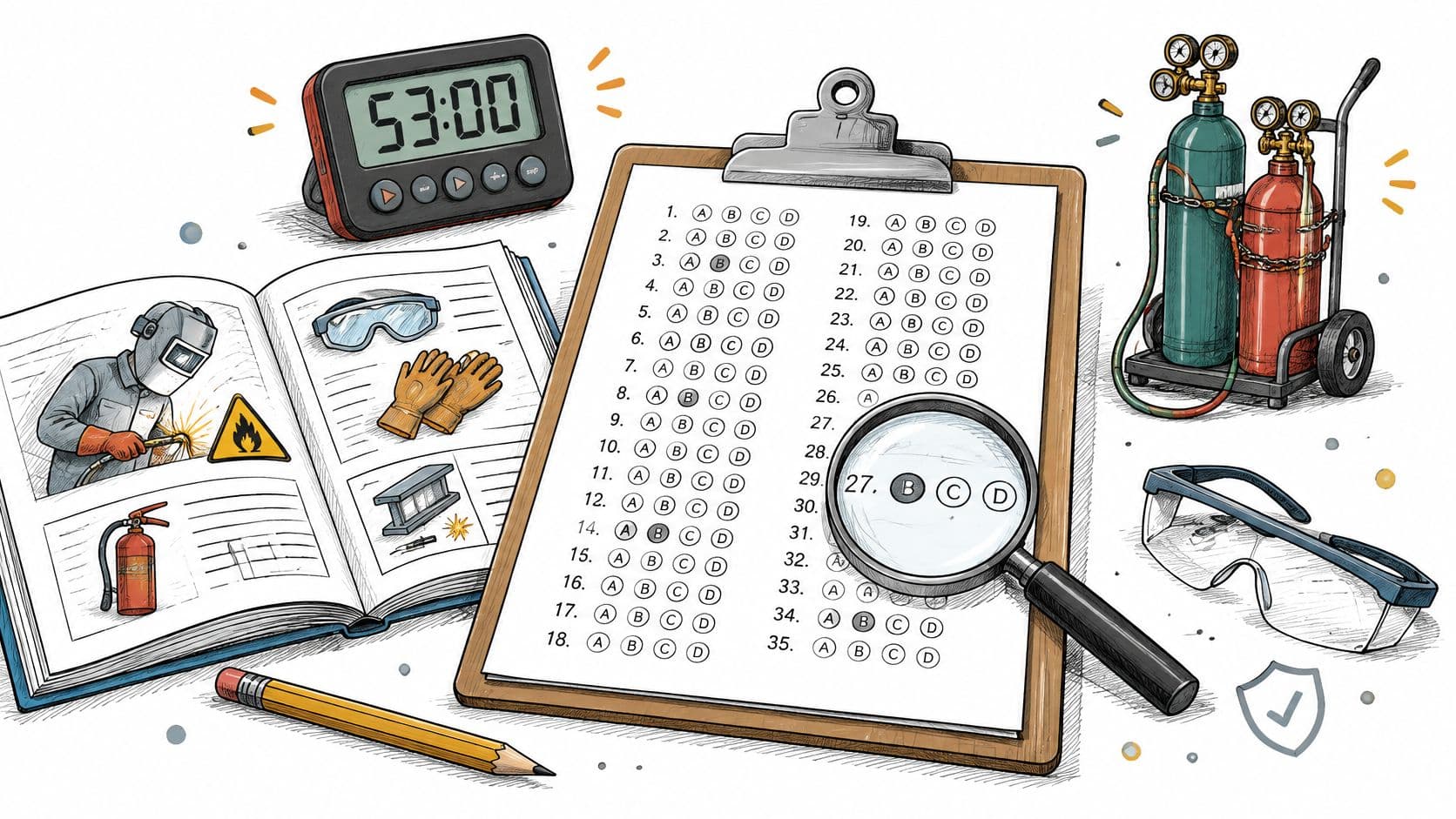
38 minutes isn't the official G60 exam time, even though the Practice Test Geeks emergency-response mock exam (opens in a new tab) uses that limit. That difference shows why a G60 practice exam needs more than an answer key. You need to know where its questions came from, whether its rules are current, and whether its timer matches the test you're preparing to take.
A smaller collection of questions you can verify is more useful than a large bank of answers you can't explain. Treat practice as a measurement tool: check the sources, work under realistic conditions, and use each mistake to choose what to revise.
G60 Exam Format and Pass Mark at a Glance
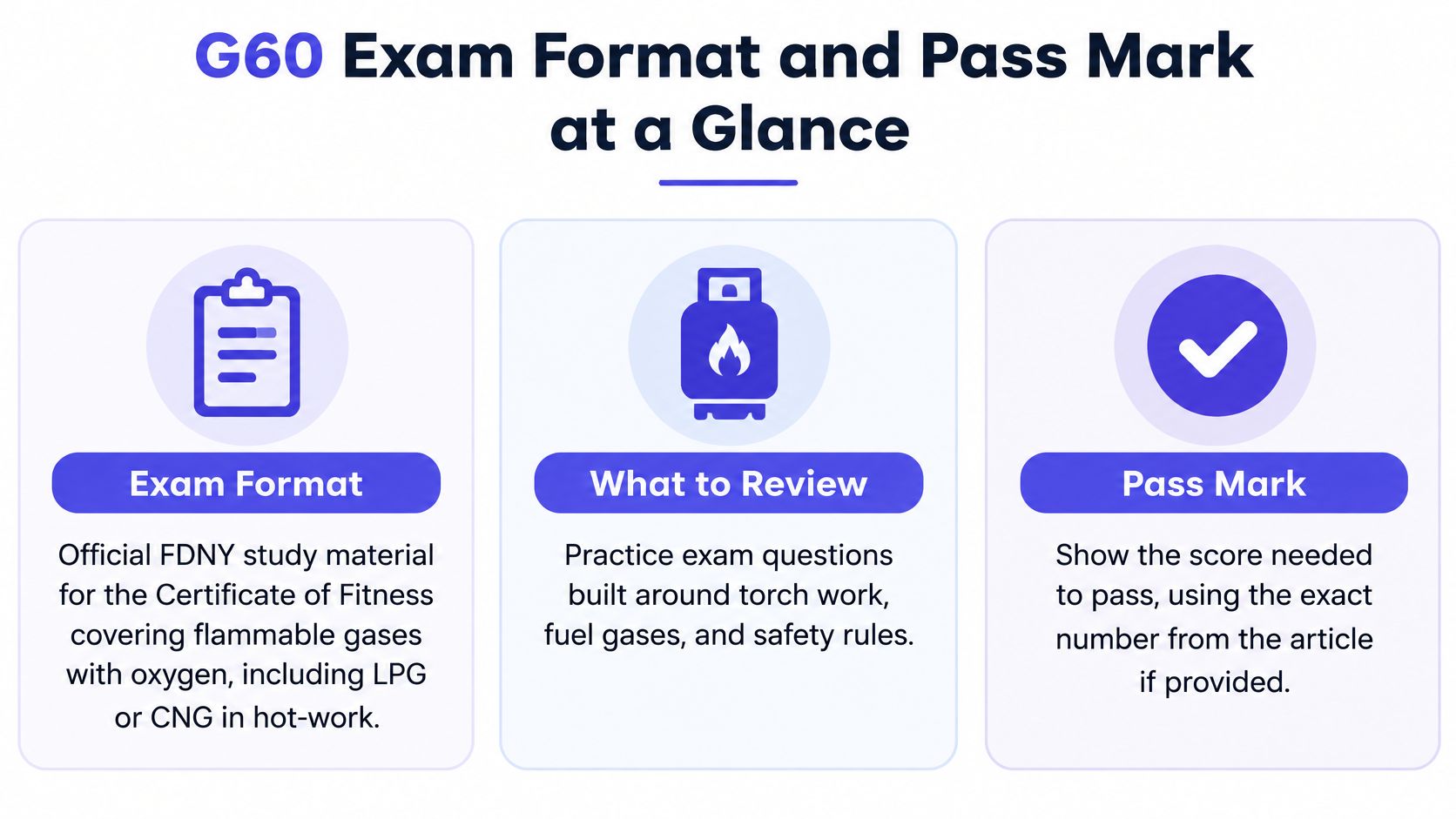
53 minutes and 25 correct answers are the practical targets: the official FDNY G-60 study material (opens in a new tab) specifies 35 multiple-choice questions, a 53-minute limit, and a passing score of at least 70%, which requires at least 25 correct answers. The examination is delivered on a touch-screen computer and covers using flammable gases with oxygen, including LPG or CNG in hot-work operations.
Those requirements change how you should study. Recognizing an answer while browsing notes isn't the same as choosing it independently while the clock runs.
What the format means for practice
The official requirements translate into the following practice setup. The pacing figure is calculated by dividing the available time by the question count.
Official G60 exam elements and what they mean for practice
The error allowance assumes you've answered every question. FDNY asks for the one most-correct answer, so don't treat several plausible options as equally acceptable. Read for the condition that makes one choice fit better, such as whether the question concerns normal operation or an emergency.
Use this overview to keep the exam's purpose in view.
Review applied safety, not just definitions
A realistic practice set should cover torch use, cylinder handling, flammable-gas controls, and hot-work procedures. Questions should ask you to recognize unsafe conditions and choose an appropriate action, not merely identify equipment names.
For example, knowing what a regulator does isn't enough if you can't distinguish routine adjustment from a situation that requires stopping work. Look for explanations that identify the decisive condition in the question.
Before your first attempt, write the passing target beside your score sheet and set a timer to the official duration. Keep short topic quizzes for revision, but don't mistake them for a full exam rehearsal.
How to Find Past Papers and Check They Are Current
A page labelled past paper isn't necessarily a released FDNY examination. It may contain original practice questions, reconstructed recollections, or an uploaded answer bank with no clear history. Treat the label as something to investigate, not proof of authenticity.
Commercial resources such as the Prosyllabus G60 practice kit (opens in a new tab) can be starting points for finding practice, but a provider's confidence isn't a substitute for question-level source notes. Traceability matters more than the size of the bank.
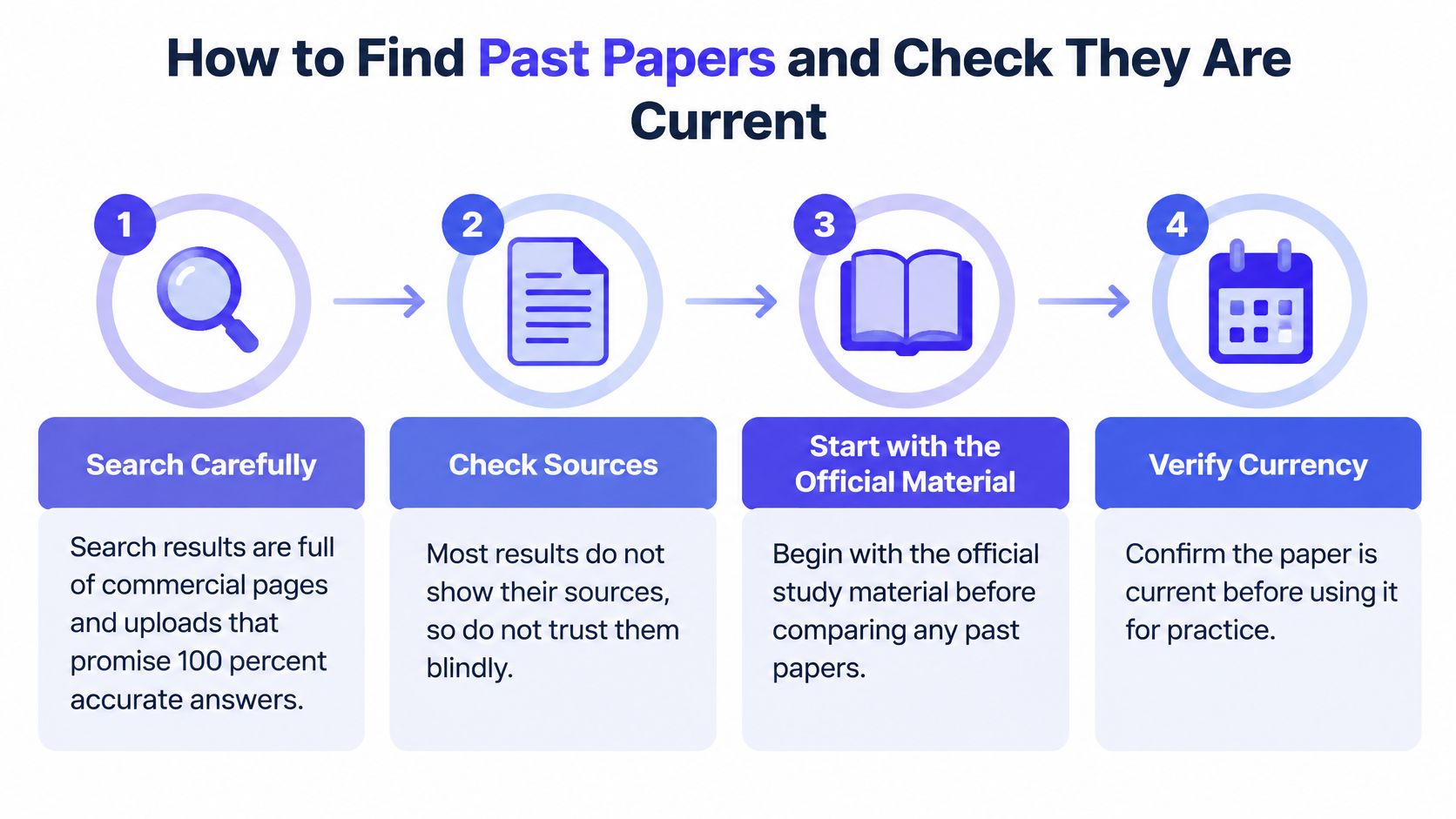
Use this verification sequence before committing study time to a set.
Check the document before the answers
- Start with FDNY's official material. Download the G-60 Certificate of Fitness study document from the FDNY website and record any publication or revision date shown, because your comparison needs an identifiable version.
- Search using the exact exam name. Combine G-60 or Certificate of Fitness torch use with practice, because a general gas-safety quiz may cover a different qualification.
- Map each question to an official topic. Record the relevant page, heading, or passage so you can explain why the keyed answer is supported.
- Check rule dates and numerical limits. Verify distances, pressures, and cylinder limits against current FDNY guidance, because an old answer can remain widely circulated after its context has changed.
- Reject unsupported guarantees. Don't rely on an answer key that promises a pass but offers no way to check its reasoning.
- Keep the traceable questions. Prefer a manageable collection with clear explanations over a larger collection whose answers depend on trust alone.
When an answer conflicts with the official material, put it aside until you've resolved the conflict. Don't average competing numbers or choose whichever answer appears on more websites. Your exam preparation materials checklist should separate document relevance, currency, and answer accuracy rather than treating them as the same check.
Apply the same standard to videos
Pause a video explanation and locate its supporting passage before adding the answer to your notes. Use the embedded video as supplementary material, not as proof that a rule is current.
Watch the video on YouTube (opens in a new tab)
Timing warning: the Practice Test Geeks G-60 study guide (opens in a new tab) describes 35 questions in 38 minutes. Use the official duration for exam simulation; treat a shorter mock as an extra speed drill only.
How to Run a Timed G60 Practice Session
Set up your practice so the result means something. Sit at a quiet table with a phone timer, a pen, and a score sheet, then put your notes out of reach. Silence notifications so an interruption doesn't become an excuse to pause the clock.
Keep testing and learning separate. During the attempt, you're measuring what you can retrieve without help; afterward, you can look up rules and examine explanations.
Follow a repeatable routine
- Prepare the workspace. Open only the practice set and timer, with somewhere to record uncertain items.
- Start the official-length countdown. Begin before reading the first question, not after previewing the difficult ones.
- Answer in order. Select your best answer and flag uncertainty without repeatedly returning to earlier items.
- Check your pace. Use the checkpoints below as approximate progress markers rather than deadlines for individual questions.
- Finish with every item answered. Reserve any remaining time for flagged questions and accidental omissions.
- Score the completed attempt. Compare your result with the passing target, then record the date and elapsed time.
The following is an illustrative pacing schedule calculated from the official exam format. The halfway checkpoint is rounded to a practical whole minute.
Pacing checkpoints for a 53-minute session
Don't let a difficult question consume the attempt
Say you spend several minutes debating a pressure-regulation question because both options sound familiar. You reread it, change your answer, then read it again. Meanwhile, you've stopped making progress through questions you might answer confidently.
Use a flag-and-move rule instead. As a suggested practice technique, give a stubborn question roughly a couple of minutes, select your best answer, and continue. That's a study recommendation, not an FDNY timing requirement.
Pacing rule: Don't demand certainty from a difficult question before you've given yourself a chance to answer the rest.
If you're behind at a checkpoint, stop repeatedly reviewing completed items. Read carefully, make a decision, and move forward. If you're ahead, keep the same deliberate pace rather than rushing toward submission.
Record whether lost time came from unfamiliar rules, slow reading, or indecision. Those problems need different remedies, and deliberate exam study techniques can help you choose the right one. An initial result below the passing target is useful diagnostic information, provided you use it to change the next revision session.
Turning Missed Questions into a Revision Plan
A total score tells you whether an attempt met the target. A topic-by-topic error log tells you what to do next. Sort mistakes into cylinder handling and storage, flammable-gas controls, torch use and pressure regulation, leak response, fire watch and extinguishers, and hot-work procedures.
Give each missed question a primary topic so you don't count the same misunderstanding repeatedly. Add a short cause beside it, such as didn't know the rule, missed the word first, or confused operator and fire-guard duties.
Match the revision task to the mistake
Use the relevant topic passages in the official FDNY material. The descriptions below are topic labels for finding content, not promises that every document edition uses those exact section headings.
For a focused retest, a suggested study exercise is a set of ten source-checked questions from the weak family. That's a revision choice, not an official exam requirement.
Revision map by missed topic
Work through a cluster rather than rereading everything
For example, suppose you miss three leak-response questions in one attempt. Treat that cluster as a reason to pause full-length testing and investigate the underlying misunderstanding. You might know that a leak is dangerous but be unclear about the order of safe actions.
Find the relevant passage, close the document, and write the response sequence from memory. Reopen it, correct your wording, and note the page and heading beside the correction. This is an active recall study method, not a copying exercise.
Keep exam guidance and employer policy in separate columns. A site's procedure may include additional reporting arrangements, but a question asking about FDNY guidance needs an answer supported by that guidance.
Also revisit answers you guessed correctly. If you can't explain why the other options fail, the score has hidden a knowledge gap. Write a short explanation before considering that topic secure.
A missed question shows where to look. It doesn't establish that you're incapable of passing.
Handling Torch Job Scenarios Where Rules Collide
Recognizing a rule isn't the same as applying it when conditions change. A useful scenario question forces you to decide what happens first, who has responsibility, and which action would create another hazard.
The Practice Test Geeks G60 overview (opens in a new tab) includes topics such as equipment inspection, leaks, fire protection, and operator responsibilities. Use those topics to build connected situations rather than memorizing isolated answers.
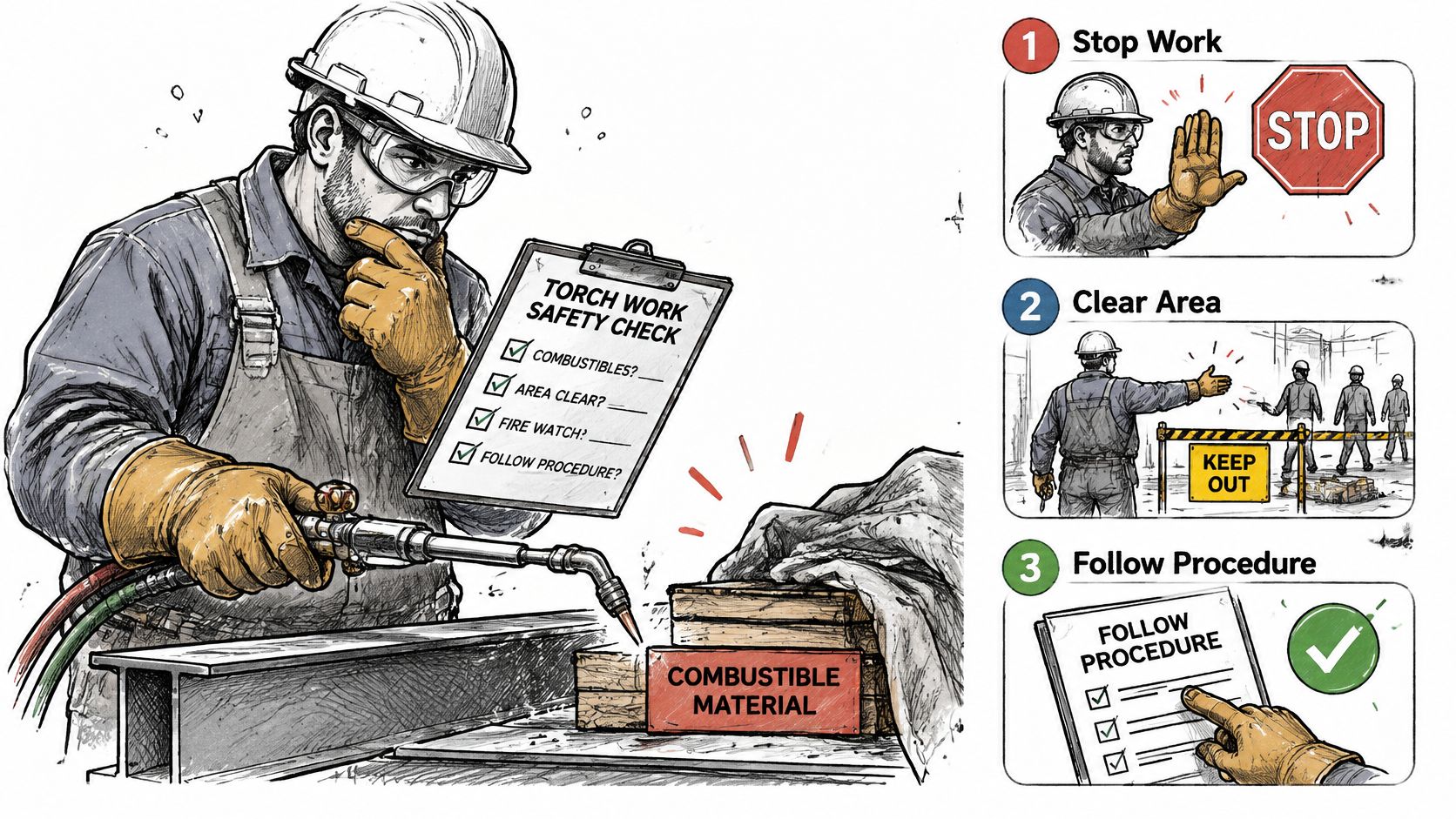
Check the work area before treating the torch setup as ready.
Combustible material appears near the job
Situation: Someone places packaging near an active torch operation. The tempting wrong answer is to continue because the flame is already adjusted and the task is nearly complete.
The safe learning sequence is to stop work, address the changed conditions, and confirm the protective arrangements before resuming. A fire guard's presence isn't permission to leave an ignition hazard unaddressed. The operator must respond to the changed work area, while the site must support safe conditions.
A gas leak is suspected
Situation: During hot work, the operator suspects a leak. Finishing the joint first is a plausible distractor because it appeals to convenience, not safety.
Stop the operation. Shut off the supply only where it's safe to do so, move clear of danger, warn others, and escalate through the emergency procedure, including emergency services when needed. Don't approach a hazardous release just to complete a memorized shutdown sequence.
The certificate holder's responsibility for gas pressure and flow doesn't turn that person into an emergency responder. Keep operator duties, fire-guard monitoring, and emergency escalation distinct.
The workplace doesn't resemble the diagram
Situation: A practice diagram shows a simple work area, but the actual site has partitions and concealed spaces. Copying the pictured arrangement without assessing the different layout misses the point.
Apply the rule's purpose while retaining its actual requirements. The torch operator handles the operation, the fire guard monitors for ignition, and the employer or site manages wider work conditions.
Before trusting a scenario answer, check:
- Trigger: What changed to make continued work unsafe?
- Responsibility: Who must act, and who must be notified?
- Support: Which official passage supports the proposed action?
- Sequence: Does the answer prioritize safety over finishing the task?
Book Your G60 Exam After Two Clean Timed Runs
Book when your performance is repeatable, not when the answer bank starts to look familiar. Consecutive clean runs are a useful personal readiness standard, although they're not an FDNY booking requirement.
For this study plan, aim for a pair of full-length attempts using different source-checked questions. Repeating the same set can test your memory of answer positions rather than your understanding of the rules.
Use a personal readiness checklist
- Complete both attempts within the official time limit. Use uninterrupted, closed-note conditions so the results reflect independent performance.
- Meet the passing target on each attempt. Don't average a stronger result with a weaker one and call the combination ready.
- Resolve topic clusters. In this suggested plan, a cluster of three or more misses in the latest attempt calls for focused revision before booking.
- Explain every missed rule. State the correction in your own words and identify the supporting passage in the official study material.
Readiness check: You should be able to explain the answer without seeing its letter or its position on the page.
Choose supplementary practice carefully
If you need more material, our notes on CramShare can be browsed by subjects, exams and certifications, universities, course codes, and textbooks. Search for the G60 exam, then inspect the listing rather than assuming a relevant title guarantees accurate content.
Every listing shows its first pages in full before purchase, the course or exam it was written for, its coverage, page count, and buyer ratings. We check premium documents for completeness, legibility, and course match before they can be sold.
Those checks don't replace verification against current FDNY guidance. Use previews to look for explanations and source references, and don't assume a G60-specific document is available because the platform supports certification resources.
Once your timed performance is consistent and you can explain the corrected rules, book through FDNY's current examination process. Check the current application instructions and required documents before making arrangements.
CramShare helps you find exam-focused notes and practice materials, with previews so you can assess their relevance before choosing them. Visit CramShare to search for G60 study resources, then build a source-checked practice set against the current FDNY material.