Scarlet Letter Summary Chapter 11: Key Events and Meaning
The Scarlet Letter summary chapter 11 covers the key events, the actions of Dimmesdale and Chillingworth, key passages and themes for study.

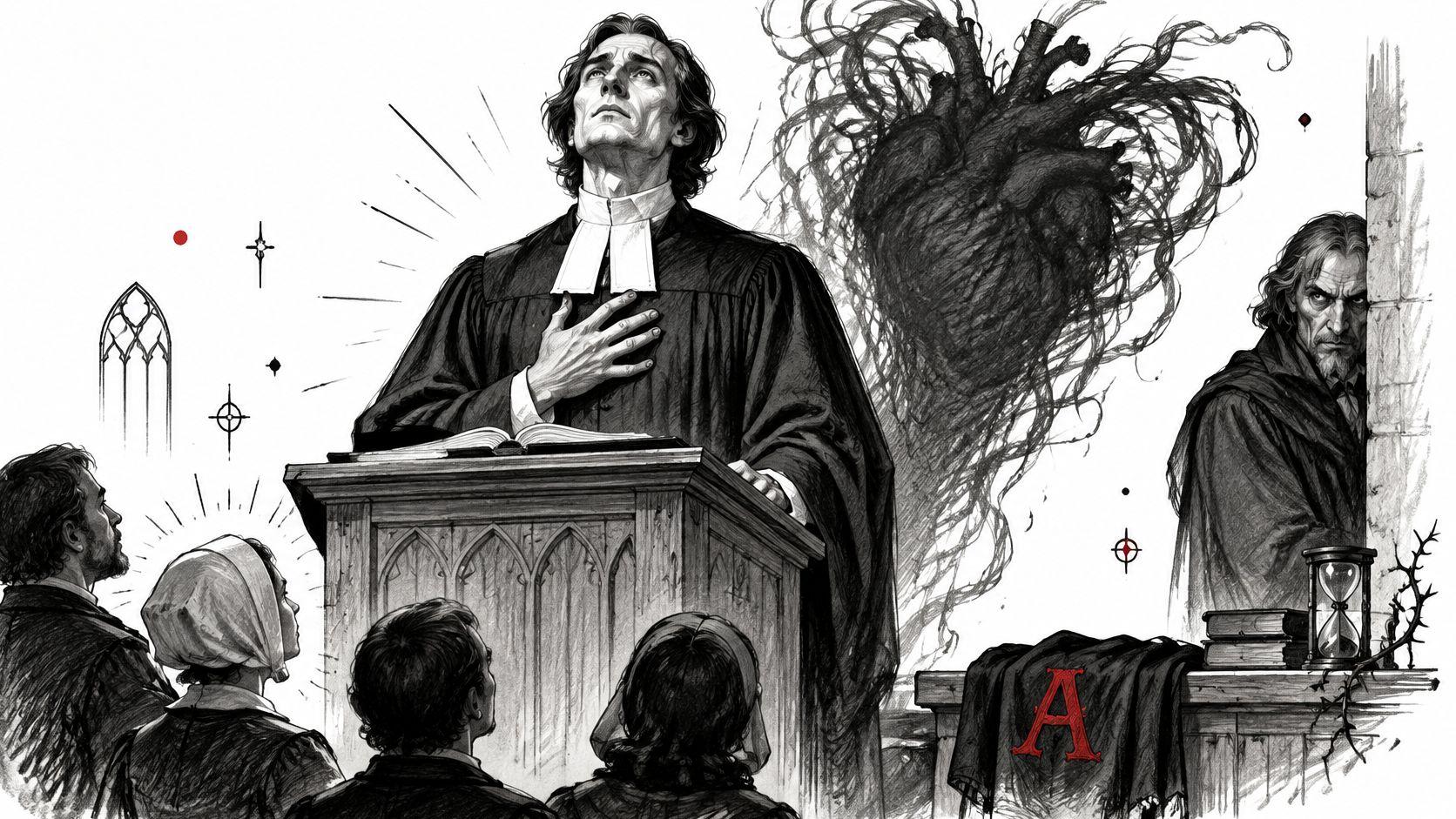
If a man stands in the pulpit and calls himself the worst of sinners, in front of the whole town, week after week, has he confessed? Most students answer no and move straight to the guilt. The sharper answer is that Dimmesdale says something true and makes it impossible for anyone to act on it.
That gap between speaking and being heard is the engine of Chapter 11. Read the chapter as a lesson in communication failure and the plot stops feeling like one man's private misery. It becomes a system: a speaker who generalizes, an audience that flatters, and a secret that survives because everyone prefers it that way.
Chapter 11 Summary in Brief
Chapter 11, "The Interior of a Heart," is a central chapter in Nathaniel Hawthorne's 1850 novel The Scarlet Letter, first published in Boston by Ticknor and Fields, and its significance is structural. As the full text archive at ibiblio (opens in a new tab) describes it, the chapter moves the narrative from public punishment to the concealed psychological consequences of sin. Hester's embroidered letter has been the visible punishment since the opening scaffold scene. Now the novel turns inward, to damage nobody can see.
By this point, Reverend Arthur Dimmesdale has lived for approximately seven years with the secret that he is Pearl's father and Hester Prynne's partner in adultery. His congregation watches him weaken, hears him preach about human sinfulness, and concludes that he is exceptionally holy. The same evidence that should raise suspicion gets read as proof of sanctity. His visible suffering even increases his influence, because listeners believe such humility gives him special understanding of other people's weaknesses.
The core idea: secrecy functions here as a prolonged form of punishment, not an escape from one.
That reversal is what makes the chapter teachable. In plain language: the town rewards the appearance of virtue while the man himself falls apart behind the door.
Three Things to Lock In Before You Read
- Who is on stage. Dimmesdale and Roger Chillingworth carry the chapter. Hester and Pearl exist in it as the thing Dimmesdale cannot say out loud.
- How long the secret has lasted. About seven years, which is the difference between a crisis and a condition.
- What changes in the telling. The novel shifts from public shame to hidden cost, and it never shifts back.
The historical setting explains why the pressure works. The novel takes place in seventeenth-century Puritan New England, where religious authority and communal judgment shaped social identity, so a minister's reputation was not a private matter. Hold one sentence from this chapter in your head for the rest of the book: hidden guilt can damage a person even when society rewards the appearance of virtue.
Key Events in Chapter 11, in Order
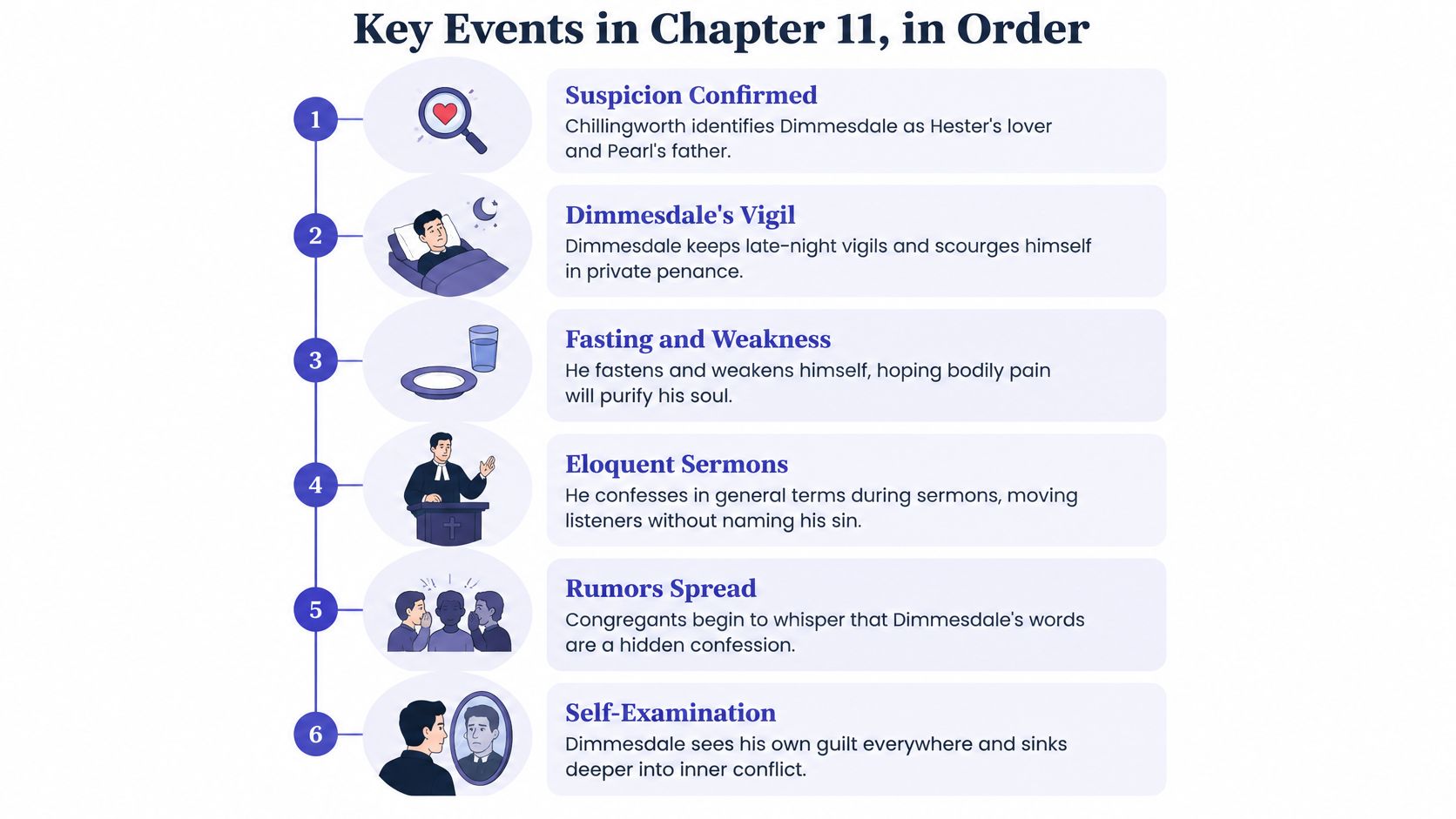
Chapter 11's events form a chain: Chillingworth confirms his suspicion, Dimmesdale suffers in private, and the congregation mistakes his suffering for holiness. Follow the sequence to see why the secret remains hidden.
- Chillingworth confirms his suspicion. He identifies Dimmesdale as the man who committed adultery with Hester and fathered Pearl.
- He chooses revenge over exposure. Rather than accuse Dimmesdale publicly, Chillingworth begins a deliberate campaign of psychological revenge.
- He probes Dimmesdale's guilt. Through insinuations and conversations, he presses the minister without directly naming the secret.
- Dimmesdale punishes himself. He beats himself with a bloody whip, a private act the town does not see.
- He keeps all-night vigils and fasts. Frightening visions and physical deprivation accompany his attempt to force himself toward confession.
- His sermons grow more powerful. The congregation hears greater eloquence and emotional force, interpreting his suffering as evidence of holiness.
- He still does not name himself. The chapter ends with confession and concealment unresolved. His general sermons sound sincere, but because he does not identify his own sin, the community has no clear accusation to answer.
The chapter's cause-and-effect sequence appears in the infographic below.
The concealment lasts for years, turning a single unmade confession into repeated private choices. Dimmesdale's guilt stays hidden because his public words describe human sin in general, while his congregation hears them as sincere preaching rather than a confession about their minister.
The retelling test. Summarize the chapter in seven sentences, naming the actor in each one. If a sentence describes only a mood, add the action that creates it.
How Their Roles Shift
Two men share a house, and by Chapter 11 their positions have flipped. Chillingworth entered the story as a physician. He leaves this chapter as an investigator with a patient he intends to break.
The chapter marks the decisive transformation of Chillingworth's relationship with Dimmesdale. Earlier, his suspicion developed gradually. Here it is confirmed, and his response is not prosecution or public accusation but a campaign of psychological revenge, as the Book-EDU chapter guide sets out. The physician's role becomes morally comparable to an investigator who studies a patient in order to intensify suffering.
Dimmesdale's guilt turns physical at the same time, and his sermons gain power as his body declines. Suffering gives him real sympathy for other sinners. It also deepens his hypocrisy, because he still will not identify himself publicly.
The Note-Taking Move That Prevents Confusion
Students lose marks by collapsing three different things into one. Keep them apart in your notes.
- Intention. What the character is trying to achieve. Chillingworth wants to torment, not to expose.
- Action. What the character does on the page.
- Interpretation. What other characters conclude, which in this chapter is almost always wrong.
That third column is where the chapter's irony lives. The congregation's reading is evidence about the congregation, not about Dimmesdale's holiness.
Write one sentence per character using this shape: action, then motive, then effect on the other man. Something like "Chillingworth insinuates until Dimmesdale's private guilt hardens into physical penance." One sentence like that is worth more in an essay than a paragraph of retelling.
Key Passages to Quote in Your Essay
Citation comes first, before anything else in this section. Every quotation must be copied from your own edition of the novel, with a page number or chapter reference, because a summary should never be used to reconstruct an author's exact wording. Rebuilding a quote from memory is the fastest way to lose credibility in an essay, and examiners check.
Four kinds of passage in Chapter 11 repay the effort of marking them.
- The passage that gives the chapter its title and its idea of the inner heart, since it frames everything the chapter argues.
- The description of Dimmesdale's self-punishment, the whip and the vigils, where guilt becomes bodily.
- The passages where Chillingworth probes the minister, which show the investigation happening in dialogue rather than in narration.
- A sermon the congregation hears as holiness, which is the clearest evidence of the communication gap.
For each one, use a three-part method. Quote, claim, connect. State the line, make one specific claim about what it shows, then link that claim to a theme such as guilt, reputation, or confession.
[Exact sentence from your edition, with page number]
This line shows that Dimmesdale's confession is general enough to be admired rather than understood.
Two or three passages, explained in your own words, will carry an essay further than eight quotations dropped in without commentary. If your course also requires you to cite lecture material alongside the novel, this guide to citing lecture notes and course handouts covers the format questions that come up most often.
Why Chapter 11 Matters to the Whole Novel
The usual reading says Dimmesdale cannot confess. The text supports a more uncomfortable claim. He confesses constantly, and the failure sits in the communication, not in his willingness.
His language stays at the level of general moral abstraction. He calls himself sinful, weak, wretched. He never names the specific act, the relationship, or the responsibility that would make a confession verifiable. His words therefore work as truth, evasion, and performance at the same time, a reading the Chapter 11 analysis at LitCharts (opens in a new tab) develops. The community's desire to keep its image of a saint helps prevent the confession from ever being heard.
The Loop That Keeps Him Silent
The chapter is best mapped as a feedback loop rather than a state of mind.
- Concealed guilt produces emotionally powerful sermons.
- Powerful sermons increase public praise.
- Praise intensifies guilt.
- Intensified guilt produces further indirect confession.
Then the loop repeats. Once you see it, the chapter stops being a portrait of private psychology and becomes a study in rhetoric, reputation, and social interpretation. The audience is a participant, not a bystander.
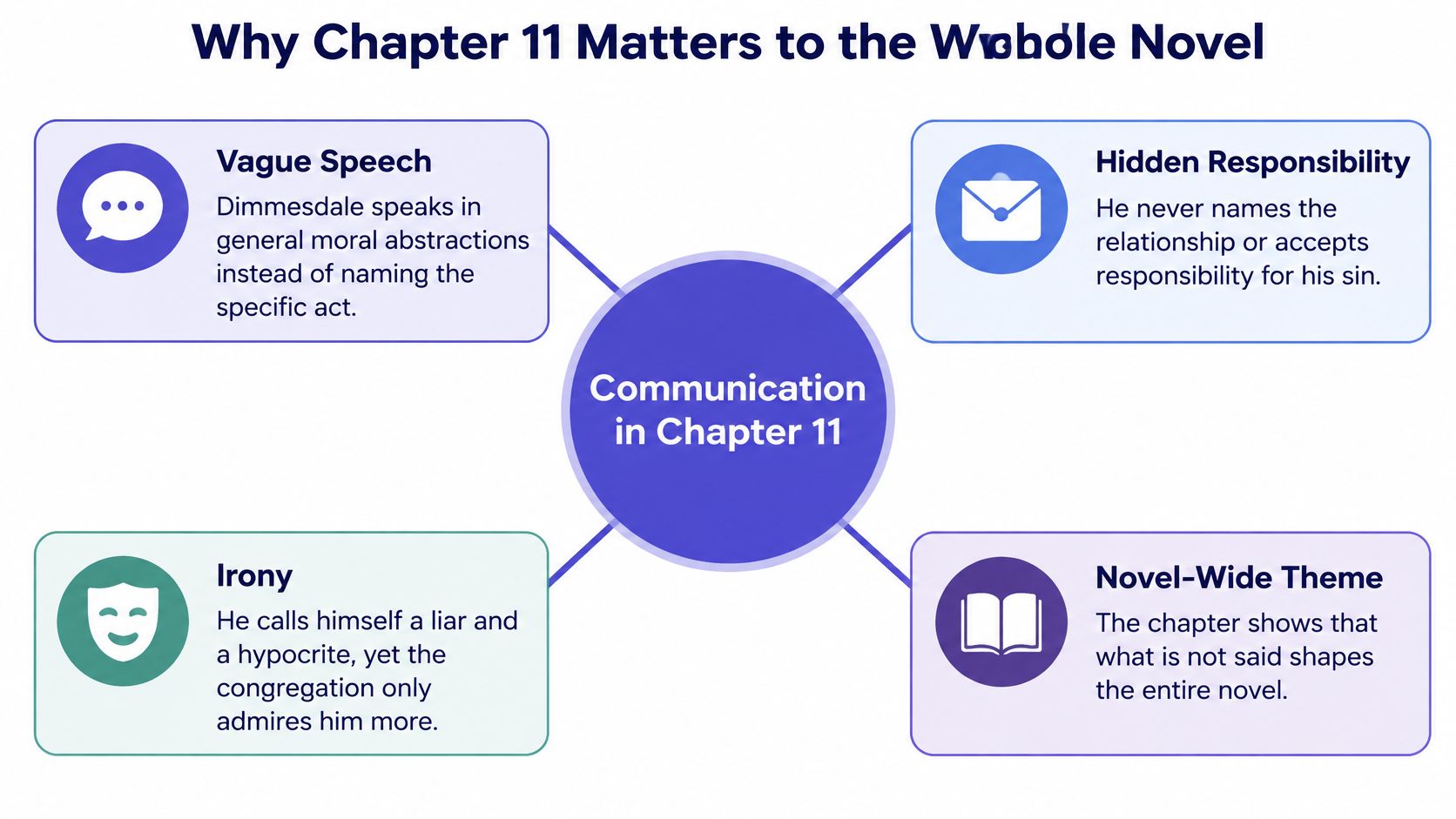
The question worth debating in class is not whether Dimmesdale should confess. It is whether public confession would produce moral repair or merely satisfy the community's appetite for spectacle. A town that rewards ambiguity may want the performance of shame more than the truth of it. For a second example of how a single chapter carries a novel's themes, this walkthrough of The Great Gatsby, Chapter 2 shows the same technique applied elsewhere.
The title says it plainly. Hawthorne is examining an inward heart divided between confession, self-condemnation, and public religious authority. That division is why the chapter prepares the novel's later climax. By making concealment itself a form of punishment, Hawthorne raises the stakes of the eventual revelation and makes the reader wait for something the characters cannot say.
Study Notes Checklist
Revision should test whether you can reconstruct the chapter, not whether you can reread it comfortably. Work through these six steps in one sitting and you'll have material for an essay, a seminar, and an exam question.
- Write a three-sentence summary. One sentence on setting, one on the central action, one on the chapter's effect on the novel. If the third sentence is missing, you've summarized a scene instead of a chapter.
- Copy the seven events in order, keeping the actor beside each one. Names first, adjectives later.
- Record the three rows from the comparison table, especially the congregation's misreading. That row is the chapter's argument in miniature.
- Choose two passages from your own edition and write one claim for each. Quote, claim, connect.
- Write one thematic question you can't answer in a sentence, such as whether public confession would repair anything.
- Check every name, number, and event against the text. The span of the concealment and the spelling of Chillingworth are the two details students most often get wrong.
Tonight's check: retell the chapter aloud in six sentences with no notes, then open the book and fix every wrong name or timeline. Five minutes of correction beats another hour of highlighting.
A good Scarlet Letter summary for Chapter 11 separates three things on the page: what Dimmesdale intends, what he says, and what the congregation concludes. A summary that blurs them will leave you writing about his guilt when the interesting question is about his audience.
If you want a second pass through the chapter from a different angle, alternatives to SparkNotes for chapter summaries are worth comparing for depth. And when you're checking whether a study document is worth your time before you commit to it, CramShare lets you preview pages first, so a 21-page course document opens with its first 3 pages visible before you access the rest.
CramShare is a course-focused library where students publish and find notes tied to a specific module, textbook, and academic year, which is exactly what you want when your seminar is on The Scarlet Letter and not on American literature in general. You can search by course code or institution, preview a document before accessing it, and keep it in your library. Bring your own chapter notes along, compare them against what other students on the same module produced, and fill the gaps in your Chapter 11 analysis at CramShare.