10 SparkNotes Alternatives for Course-Specific Study Help
Compare 10 SparkNotes alternatives for literature and course study, with pricing, free access, pros, cons and tips for choosing the right resource in 2026.
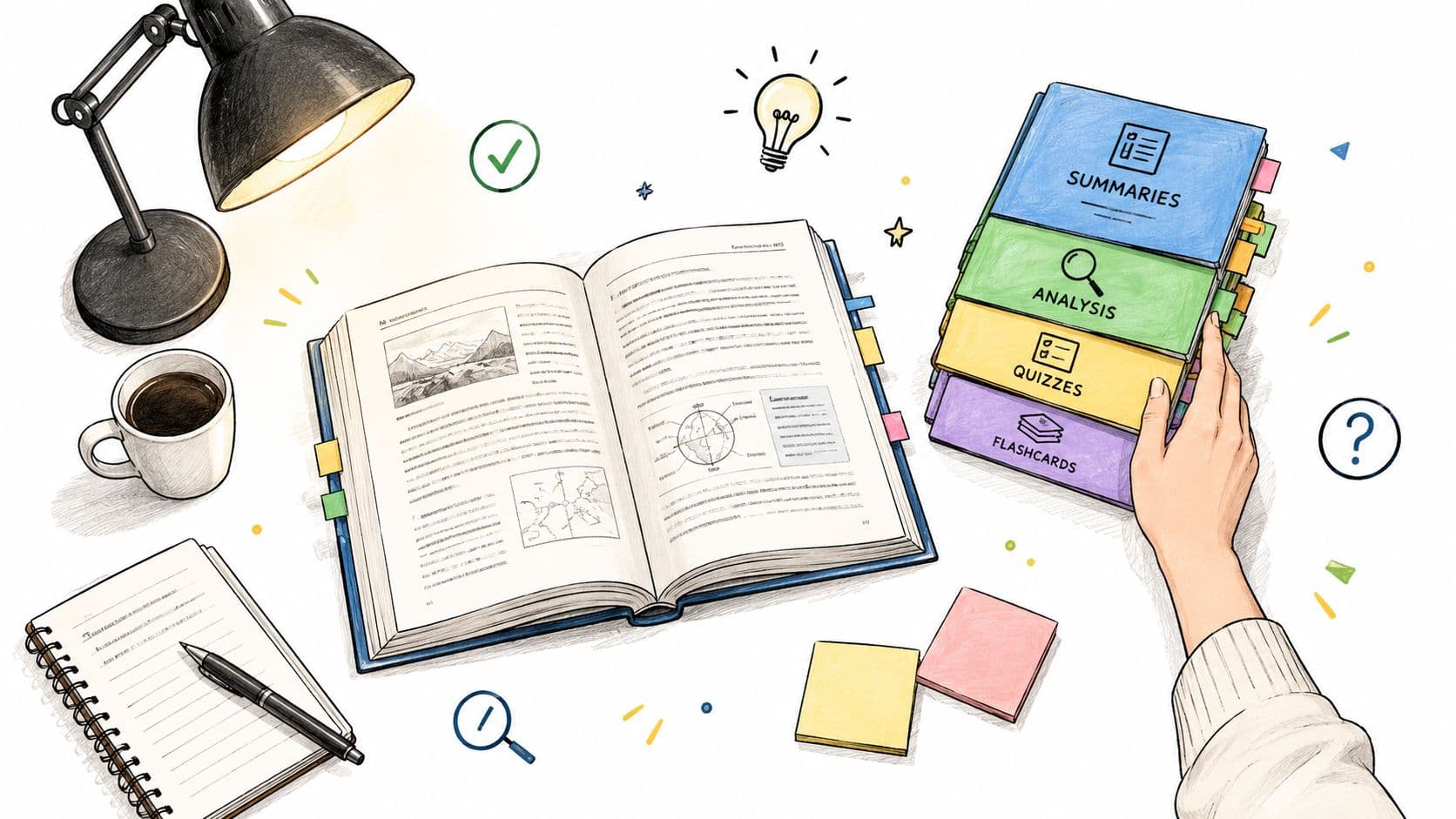
The worst part of a late-night reading crisis is that you usually don't need “more study.” You need the right kind of help for the thing that's missing. If the chapter is confusing, a summary can get you moving. If the course is the true problem, you need notes tied to your module, textbook, and assessment format. If the exam is close, you need retrieval practice, not just another wall of prose.
That's why sparknotes alternatives are worth comparing by job, not by popularity. Some tools are built for literature analysis, some for course-matched notes, some for exam practice, and some for teacher materials. The trade-offs matter, especially once you factor in academic integrity, source quality, and whether the material is meant for your course.
1. CramShare
CramShare is the most useful option when the problem isn't “I need a plot summary,” but “I need something that matches my exact class.” It organizes materials around course code, institution, module, textbook, and academic year, which is the right way to solve the common “same subject, wrong course” problem. That makes it especially strong for students who are tired of generic summary sites that know the book but not the syllabus.
Best use case: finding study notes that line up with the exact course you're taking, not just the title of the book.
The platform combines a free community library with reviewed premium documents, and the free resources can be read without page limits, watermarks, or daily caps. Premium documents can be previewed across multiple pages before purchase, so you can check whether the notes are legible, complete, and relevant before you pay. For students comparing sparknotes alternatives, that preview step matters because it reduces the odds of buying something that looks helpful in a thumbnail but falls apart on inspection.
CramShare also works for student authors. Eligible sales pay 70% to the seller, and payouts are monthly with no minimum threshold, which is a practical incentive if you've built your own notes responsibly. Just keep the academic-integrity boundary clear. Upload only materials you're allowed to share, and use the platform as a supplement to class, not a replacement for reading or attending.
- Course-level matching: Search by university, course code, module, textbook, and academic year.
- Low-risk evaluation: Multi-page previews help you judge whether a document is worth using.
- Free first pass: The community library gives you a way to test fit before buying.
- Integrity matters: Use it for support, not for outsourcing work you should do yourself.
Website: CramShare
Who should use it
Use CramShare when your biggest pain point is relevance. It's a better fit than broad literature-only sites if your lecturer assigned a specific edition, a specific unit, or a course pack that older summary sites don't cover well. It's also the strongest choice here if you want to move from passive reading into course-matched revision materials without wasting time sorting through unrelated uploads.
2. LitCharts
LitCharts is one of the cleanest choices for students who want structured literature analysis rather than a quick plot recap. It was built by two original SparkNotes editors, so the editorial style feels familiar, but the guides go deeper on interpretation, quotes, and literary terms. That makes it a strong fit when your assignment asks you to talk about theme, symbolism, or authorial technique instead of explaining what happened.
The platform's literature library is broad, and the teacher-facing material is a real advantage if you're studying in a class that uses guided discussion, close reading, or classroom packets. The explanations are built to be citation-friendly, which helps when you need to tie a passage back to the text rather than rely on loose paraphrase. It's also useful for Shakespeare students, since the modern-language support can cut down on time lost in confusing wording.
A practical limitation is cost. The full experience sits behind a paid plan, and there isn't a free trial. If you only need a one-off refresher, that's a drawback. If you need PDFs, teacher editions, and question-generation tools regularly, the paid tier may be easier to justify.
The best way to use LitCharts is alongside the original text, not instead of it. Read a scene, compare the guide, then write your own response before checking the analysis again. That keeps the tool in a support role instead of turning it into a substitute for thinking.
Website: LitCharts (opens in a new tab)
Practical rule: if the assignment asks for interpretation, not just comprehension, LitCharts is usually a better fit than a summary-only site.
3. CliffsNotes
CliffsNotes still works because it stays simple. The free online guides are easy to reach, many titles are readable without creating an account, and the format is familiar enough that you can find the important sections quickly. That makes it useful when you're short on time and just need a basic scaffold before you go back to the text.
It's also broader than many students expect. The site isn't limited to literature, so it can help when your study load spills across subjects and you want one place to start. Some guides include PDF download buttons, and there are optional mobile app purchases for offline use or teacher one-pagers. That mix of free and paid access is convenient, but it also means the experience isn't uniform from title to title.
The main trade-off is depth. Some guides are solid for quick orientation, while others are lighter on explanation or classroom usefulness. If you need nuanced literary criticism or course-specific alignment, CliffsNotes can feel too general. If you need fast access and a consistent layout, it still earns its place.
Use it as a first pass, especially when you're deciding whether a chapter deserves a closer reread. Then return to the primary text with a clearer map of characters, themes, and conflicts. That's where CliffsNotes tends to help most, by lowering the friction of the first read.
Website: CliffsNotes (opens in a new tab)
4. eNotes
eNotes makes sense for students who want a mix of literature guides, homework help, and teacher materials in one place. The site leans into expert-written explanations and a large Q&A library, so it's useful when you're stuck on a specific passage or class question rather than browsing a general study guide. That can be more efficient than searching across multiple sites for the answer to one stubborn problem.
The subscription model is straightforward in a way many education sites aren't. Subscribers get ad-free reading and monthly PDF downloads, while Homework Help access is tied to plan allowances. There are also teacher lesson plans and educator tools, which gives the platform more classroom utility than many student-only summary sites. If you study in a class where teachers assign supplemental questions or reading packets, that can be a real plus.
The limitation is that a lot of the convenience is gated. Downloads are capped by month, and the more useful features sit behind higher tiers. That means eNotes is best for students who will use the site repeatedly, not just once before a quiz. Refunds generally aren't offered, so you want to know what you're buying before you commit.
Use it when you need expert answers plus a readable archive of study material, not when you just want a one-off skim. It's strongest for students who value a structured support system over a free, browse-and-leave model.
Website: eNotes
5. SuperSummary
SuperSummary is a good fit when you want a modern catalog and a polished reading experience. It offers a large library of study guides, and the platform keeps adding new titles regularly, which matters if your reading list includes recent books as well as the classics. For students who bounce between old and current titles, that freshness is a real advantage.
The main draw is the packaging. The guides are premium, but they're presented in a way that feels easy to use, with downloadable PDFs and audio available on the higher tier. That makes it useful for students who like to switch between reading modes, especially if they study on a phone during commutes or short breaks. There's also a mobile app and quiz support on the higher plan, which gives it more flexibility than a static summary site.
The trade-off is that value depends heavily on billing choice and tier. Most of the richer features sit in the more expensive plan, and one-off guide purchases aren't the model here. If you only need one title, that can be annoying. If you want an ongoing library that covers lots of current reading, it can still be worth it.
Use SuperSummary when you're after convenience, format variety, and a broad catalog. It's less of a specialist tool than a course-matched document library, so it works best for general literature support rather than exact assignment alignment.
Website: SuperSummary (opens in a new tab)
6. GradeSaver
GradeSaver is a practical middle ground between free browsing and paid convenience. Many of its literature guides are available online at no cost, which makes it easy to sample the structure before deciding whether to pay. That matters if you're the type of student who only wants to access downloads or quizzes after you know the guide is genuinely useful.
The Members Only area adds downloadable PDFs, quizzes, and ad-free reading, which turns the site from a casual reference stop into something more revision-friendly. It also includes community Q&A sections on many works, so you can sometimes see how other students framed the same text. That said, the value depends on the title, and the most convenient features are behind the paywall.
GradeSaver can be especially handy when you need a light touch. It doesn't try to overwhelm you with classroom polish or heavy theory. Instead, it gives you straightforward literary support with optional upgrades if you want to go further. The paid essay-editing and tutoring services are there too, but those are separate costs and should be treated as support, not a shortcut around doing the work yourself.
Website: GradeSaver
Free access is useful here, but don't assume every guide has the same depth. Open the title first, then decide whether the paid layer is actually worth it.
7. BookRags
BookRags is better suited to teachers and students who want study materials that feel ready to use in a class setting. Its “Study Packs” combine guides, essays, and practice questions, which makes the platform more classroom-oriented than a simple summary library. That bundled approach can save time when you're building revision support from scratch.
The biggest advantage is convenience. One subscription opens access to guides and lesson plans, which is useful if you're teaching, tutoring, or organizing a study group. Students who like having essays and practice questions in the same place may find that structure helpful too. The downside is that the interface and depth can vary from title to title, so you may need to dig a little to find the best-fit resource.
BookRags is less interactive than newer platforms, and that matters if you want quizzes that adapt or tools that track your progress. It's more of a resource shelf than a guided study engine. That doesn't make it weak, just more traditional.
Use it when you need a stable library of teaching materials and study packs, especially if you're building a course around a text. If you just want a quick answer to one reading question, another platform may feel faster.
Website: BookRags (opens in a new tab)
8. Shmoop
Shmoop stands out because it doesn't talk like a textbook. The tone is lighter, the explanations are more approachable, and that makes it easier for high-school students to stay engaged when the material feels dense. If you've ever bounced off a guide because it sounded too formal, Shmoop is worth a look.
The platform also stretches beyond literature into AP prep, college prep, and test-prep resources, so it can support the broader school load, not just reading assignments. Videos and interactive tools make it feel more like a study hub than a single-purpose summary site. That breadth is useful, but it also means the literary depth can be lighter than what you'd get from a specialist platform.
The trade-off is clarity versus rigor. Shmoop is often better at being readable than being academically dense. That's fine if you need comprehension, a quick refresh, or a way to get started on homework. It's less ideal if your teacher expects close analysis with a strong critical vocabulary.
Use it when you want a friendlier study environment, especially in high school or in mixed-subject prep. For students who need one platform that can bridge literature, exams, and general academic support, Shmoop is one of the more flexible choices.
Website: Shmoop (opens in a new tab)
9. Study.com
Study.com is the right pick when you need structure more than a single-book summary. The platform is built around video lessons, quizzes, and study guides, so it feels closer to a self-paced course than a traditional SparkNotes-style reference site. That helps if you learn better in small steps and want a clear sequence instead of jumping between isolated pages.
The course structure is a big advantage for pacing. You can move through material in a more deliberate way, and the progress tracking helps you see what's left. The coverage also goes beyond literature into writing, grammar, and other subjects, which makes it a broader academic tool than a pure reading aid. The downside is that full access requires membership, and pricing may not be obvious until checkout.
If you want a single chapter explanation, Study.com may feel heavier than necessary. If you want exam prep with built-in pacing, it makes more sense. That's the divide. It works best for students who need a curriculum-style path rather than a one-off guide.
A useful way to pair it with your own work is to watch a lesson, close the tab, and explain the concept back in your own words before moving on. That keeps the material active instead of passive.
Website: Study.com
10. Course Hero
Course Hero is useful when you need course-specific material rather than polished editorial summaries. The repository is built from student and educator contributions, which means you can find notes, guides, and Q&A tied to real classes and textbooks. That breadth makes it especially handy if you're searching for something close to your own syllabus.
The access model is flexible. There's a basic free tier, paid Premier membership, and an upload-to-access system, so students can reach materials in more than one way. That flexibility is a strength, but it also comes with a clear warning sign. Quality varies because the documents come from users, so you have to verify accuracy instead of assuming every upload is reliable.
That trade-off matters more here than on editorially curated sites. Course Hero can save time, especially if you're looking for past notes or textbook solutions from a similar course. But it's not the place to switch off your judgment. Academic-integrity rules still apply, and any material you use should be checked against your class expectations and original sources.
Use it for discovery, not blind trust. It's strongest when you already know what you need and are using the platform to locate a likely match.
Website: Course Hero (opens in a new tab)
Practical rule: treat user-uploaded material as a lead, not an answer key, until you've checked it against your own course.
Top 10 SparkNotes Alternatives Comparison
Match the Resource to the Gap, Then Test It
The best choice depends on the gap you're trying to close. If you need literature analysis, LitCharts, eNotes, and GradeSaver are stronger fits than a generic summary page. If you need course-matched notes, CramShare and Course Hero are more relevant because they organize around the structure of a class, not just the title of a book. If you need exam practice, Study.com, BookRags, and some of the quiz-heavy tiers from the other tools can help more than passive reading alone.
The mistake students make is treating every SparkNotes alternative as if it solves the same problem. It doesn't. A summary site can help you understand a chapter, but if the assignment is tied to a course code, an instructor's reading list, or a specific textbook edition, you'll do better with a platform that matches those details. That's why course-level organization is such a useful filter, and why broader coverage isn't always the smartest choice.
Academic integrity should stay in the frame the whole time. The right question isn't just whether a resource is free or paid, it's whether you're using it to support your own reading, writing, and revision. Summaries can orient you, practice questions can strengthen recall, and shared notes can save time, but none of them should replace the work you're expected to do yourself.
Start with one free option and test it on the same chapter you're struggling with. If it only gives you surface-level clarity, move up to a tool that matches your course more closely or adds retrieval practice. If you want a course-specific place to find, preview, and compare study materials, visit CramShare and see how its course-level search fits your module, textbook, and academic year.