How to Study for Professional Exams: A Practical Plan
Learn how to study for professional exams: build a realistic schedule, use retrieval practice and spaced review, and run mock exams that predict readiness.


Spaced retrieval outperformed massed retrieval with an effect size of g = 0.74 in a meta-analysis of 29 studies (opens in a new tab). The practical implication isn't that you need longer evenings at your desk. You need repeated attempts to produce an answer, separated by enough time that you can't remember the last attempt.
If you're deciding how to study for professional exams while working full-time, start with your actual calendar. A useful plan specifies what you'll retrieve, how you'll check it, and what you'll change when the answers expose a weakness.
Start From Your Exam Date and Weekly Hours
Your first decision is how much preparation time you have, not which textbook to buy. Put the exam date beside your work shifts, commuting time, caregiving commitments, and existing obligations. Count the study slots you could sustain during an ordinary difficult week, not an unusually quiet one.
Copy the official exam blueprint into a spreadsheet. Give each domain or module a row, then add columns for exam weight, confidence, diagnostic results, the relevant reference material, and the next scheduled task. Leave confidence blank until you've attempted representative questions, so familiarity with a topic name doesn't become your starting assessment.
Choose a workable time budget
The Casualty Actuarial Society's guide to research-backed study strategies (opens in a new tab) supports distributing preparation across time and using structured, repeated retrieval. It doesn't establish a universal weekly-hours requirement. Use the following illustrative planning template, not a claim about the hours needed to pass.
Weekly study hours by time before the exam
An early start gives you room to build foundations. A late start forces a trade-off: you can't promise complete coverage, extensive note-making, and realistic simulations within the same limited calendar. Prioritize heavily weighted weaknesses and keep a record of what remains uncovered.
Fit the work around your job
For a working candidate with 30–60 minutes available on weekdays, use those shorter windows for recall, focused questions, and correcting a specific error. Keep the longer weekend block for timed application and reviewing the reasoning behind your answers.
Give every appointment an output. “Study accounting” is too vague; “solve unfamiliar lease-classification questions and explain the treatment without notes” tells you whether the session achieved anything.
- Protect practice time. Put timed work on the calendar before filling every slot with reading.
- Allocate by need. A high-weight domain with weak diagnostic performance deserves more attention than a comfortable minor topic.
- Make recovery possible. Leave some unscheduled capacity rather than planning every available evening.
Practical rule: A missed session is a scheduling problem, not a reason to double tomorrow's workload.
Before opening a book, write the opening fortnight into your calendar. Include the topic, task, required material, and evidence you'll use to judge completion.
Replace Rereading With a Retrieval Cycle
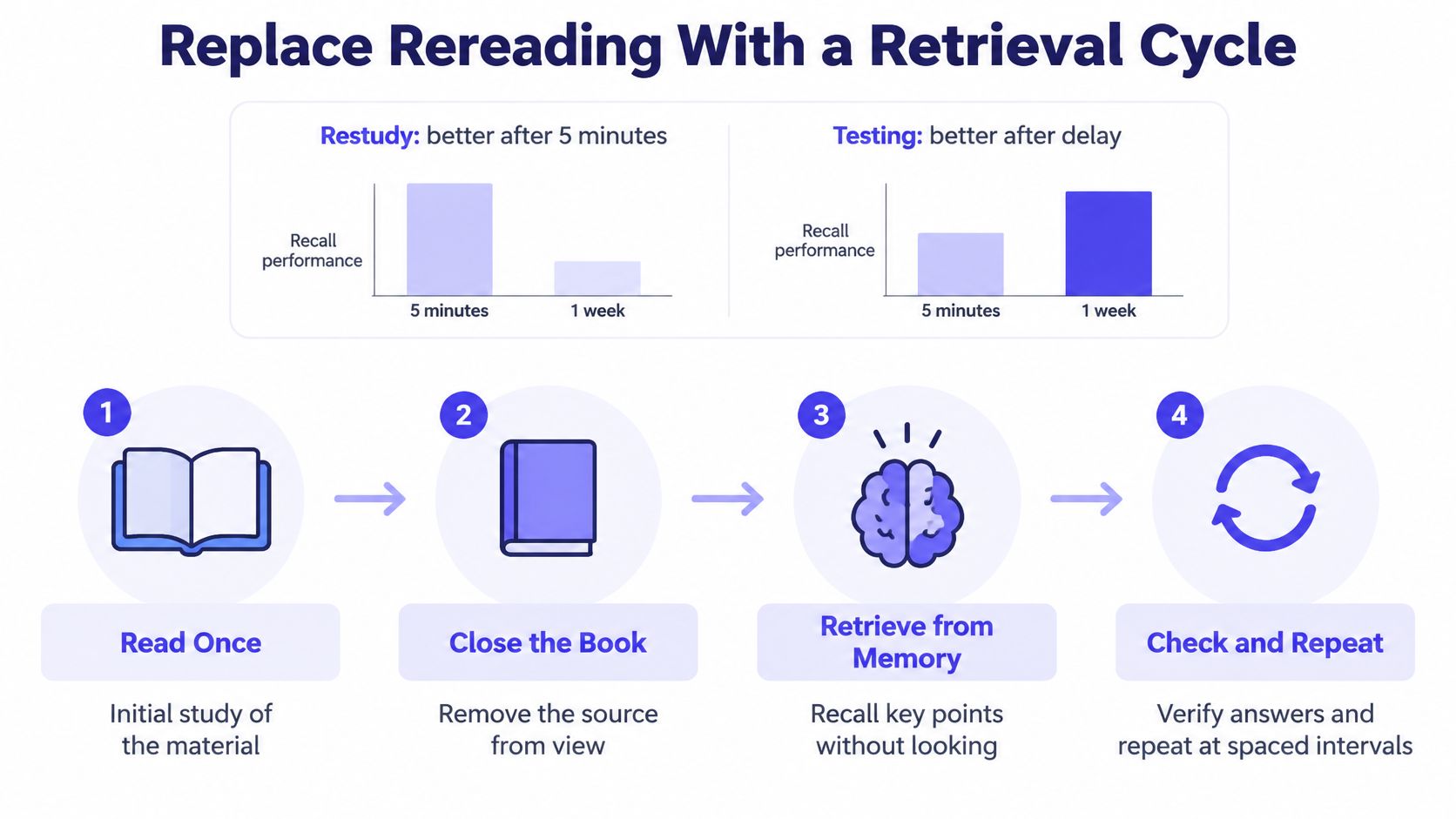
After one week, students who completed repeated recall tests remembered 56% of the material, compared with 42% among students who restudied it the same number of times, in Roediger and Karpicke's prose-learning study (opens in a new tab). Restudying produced better performance after five minutes, but testing produced better delayed retention. That distinction matters when your exam isn't immediately after your study session.
The task wasn't a professional qualification, so don't treat those percentages as predicted exam gains. Use the finding to choose a study activity: try to produce the answer before looking at it.
The diagram captures the basic change from reading to retrieval.
Build a complete attempt-and-correction cycle
- Take a timed baseline set. Use representative questions and record wrong answers alongside correct guesses. A lucky answer isn't secure knowledge.
- Study the concept behind the question, not the entire surrounding chapter. If you misunderstood a clinical priority, identify the decision rule rather than copying every condition mentioned.
- Close the materials. Reconstruct the rule, calculation, mechanism, or decision pathway from memory. For a calculation, write the setup and units, not just the formula.
- Compare your response with an authoritative explanation. Classify the failure as a knowledge gap, reasoning error, misread stem, or timing problem.
- Create a targeted correction. Record the earliest point where your reasoning failed, then turn it into a question or card.
- Schedule another attempt after a gap, using neighboring topics and different question formats. The test is whether you can apply the principle without recognizing an old answer.
An error-log entry should be short enough to use. “Forgot exceptions” is unhelpful; “check whether the exception applies before using the general recognition rule” tells you what to do differently.
This accompanying video can sit alongside your practice routine, but viewing it shouldn't replace an unaided attempt.
Watch the video on YouTube (opens in a new tab)
Give each study method a limited job
Rereading feels productive because the wording becomes familiar. The problem appears when you remove the page and can't explain the rule or decide when it applies.
Use this comparison to keep supporting activities from taking over the session.
Study methods compared by evidence
Don't ban reading. You need it to understand unfamiliar material and repair mistakes. Stop using it as evidence that you could answer a question.
Start closed-book and finish with a check. That rule makes even a short evening session produce something you can evaluate.
Space Your Sessions Across Weeks, Not Nights
Completing the syllabus once isn't the same as retaining it. If you study an early module and leave it untouched until final revision, you've postponed finding out what survived.
A quantitative review of distributed practice examined 839 assessments from 317 experiments and found that spacing learning episodes generally improved final-test retention compared with massed practice. The appropriate gap depends on how long you need to remember the material, with longer retention periods generally calling for longer intervals.
Use a calendar, not an elaborate algorithm
Make each review an appointment with a defined retrieval task. A topic isn't “reviewed” because you opened its notes; it's reviewed when you've attempted to explain or apply it and checked the result.
A workable pattern is:
- Initial study. Understand the concept and complete an unaided explanation before ending the session.
- Early return. Revisit it after a short gap to identify what didn't stick.
- Later application. Attempt fresh questions after a longer interval, without warming up by rereading.
- Cumulative review. Mix it with topics that require different rules or procedures.
For example, after studying a safety procedure, your early return might involve reconstructing its sequence. Later, use a scenario where you must recognize which procedure applies. Those tasks test different parts of readiness.
Don't stretch intervals just because the calendar says to. If you can't reconstruct the core rule, correct it and bring the next attempt forward. If you can explain it and apply it to unfamiliar questions, leave a longer gap.
A spacing system is useful only if you actually return to the difficult material.
Keep old modules in circulation
The trade-off is that cumulative practice makes progress look slower. You'll spend some evenings on earlier material instead of checking off another chapter. That's preferable to discovering near the exam that your first modules need rebuilding.
Use a spreadsheet, calendar reminders, or spaced-repetition tools to track due reviews. Choose the simplest system that lets you see the topic, the retrieval task, and the result.
Before closing a topic's first study session, assign its next review dates. Don't leave future revision as an intention.
Read Practice Exam Scores as Diagnostic Data
A rising score on the same question bank can mean you're remembering the answers. Switch to unfamiliar items before treating that improvement as readiness.
Your overall percentage is only the beginning. Separate accuracy by blueprint domain, question type, and difficulty, then track timing and confidence alongside it. A confident wrong answer needs a different correction from an unanswered item at the end of a rushed block.
Decide what the score requires you to change
Calculate each domain's error rate by dividing its incorrect responses by its attempted questions. Keep guesses visible even when they're marked correct, and avoid strong conclusions from a tiny sample. Compare the pattern across independent sets.
When a domain remains weak across separate sets, stop shopping for another resource. Return to the relevant standard, textbook section, or lecture explanation; write a concise account of how the mechanism works; then attempt unfamiliar application questions.
Practice-exam symptoms, causes and fixes
For permitted historical material, the guide to using university past papers can help you organize practice. Check the syllabus version and response format before treating any paper as representative.
Review the simulation as carefully as you sit it
Use authentic timing, permitted tools, and break conditions. Reserve time afterward for a same-day postmortem, rather than scheduling a full simulation immediately before another obligation.
Explain why each option is right or wrong. For written responses, compare your work with the marking criteria and identify what you failed to state, justify, or calculate. Find the earliest faulty reasoning step, not merely the final incorrect answer.
Keep expectations grounded: a nine-course spaced-retrieval analysis (opens in a new tab) reported an average improvement of 2.06 percentage points, with high heterogeneity of I² = 89.2%. Implementation and subject matter matter.
A practice score doesn't establish a universal probability of passing. It tells you what to investigate and what your next study block should contain.
Use AI and Course Resources Without Fooling Yourself
More questions don't automatically mean better preparation. A large collection can still cover the wrong syllabus, test recognition when your exam requires judgment, or provide explanations you can't verify.
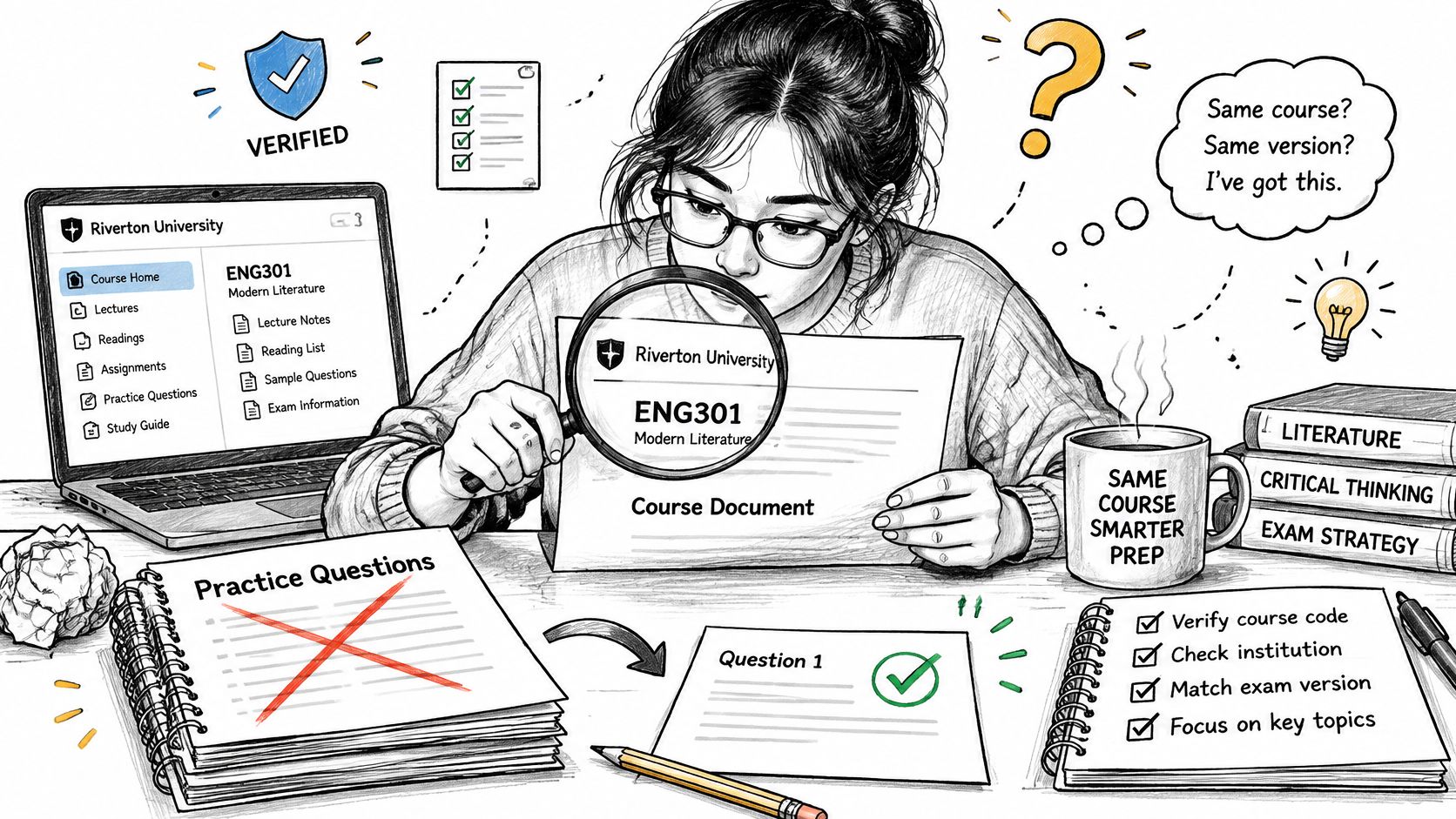
Start by matching the material to your course code, institution, exam version, and blueprint. An older past paper might use a superseded standard; a similarly named module might omit a domain your examiner weights heavily.
Use the document itself to assess relevance, rather than relying on its title.
Inspect before relying on a resource
At CramShare, every document listing shows its first pages in full before purchase, the course or exam it was written for, its coverage, page count, and ratings from buyers. Read those pages for worked reasoning, legibility, and alignment with your actual task.
A polished summary may be useful for orientation but inadequate for case-based decisions. Ratings can help you evaluate a listing, but they don't establish that its answers match the current authoritative standard.
Put generated questions through quality control
Assessment work on AI-assisted retrieval practice (opens in a new tab) describes generative tools producing practice questions and feedback. Treat that capability as an aid to question generation, not proof that an explanation is correct.
- Check blueprint alignment. Ask whether the question tests the required knowledge and cognitive level. A definition question doesn't replace a professional judgment scenario.
- Require an explanation pointing to an identifiable source. Open that source and confirm that it supports the answer.
- Solve independently before viewing feedback. Write your reasoning so you can distinguish your own understanding from agreement with fluent text.
- Log recurring errors by concept. Don't let an endless stream of new questions hide an unresolved weakness.
- Verify under official conditions. Use permitted, authentic materials to check whether performance transfers beyond generated practice.
Keep sensitive workplace information and restricted assessment content out of prompts. Follow your institution's and professional body's rules, including restrictions on AI assistance.
Downloaded documents are for the buyer's own study; sharing or reselling a purchased document isn't allowed. Don't upload lecture slides, textbook pages, or someone else's work to CramShare, and apply the same permission checks before sharing material with an AI tool. Understanding why academic integrity matters is part of professional preparation, not an administrative detail.
AI is a question-generation aid, not a replacement for official materials, human marking, or authentic past-paper practice.
Protect Sleep, Plan Exam Day and Lock In Your Schedule
Protect your normal sleep routine instead of treating late-night study as emergency capacity. Keep a consistent wake time as the exam approaches and avoid all-night sessions. A plan that depends on repeatedly sacrificing sleep isn't a sustainable plan for someone who also has to work.
Give focused sessions clear boundaries. Put your phone away, choose a task before starting, and take a break when you can no longer explain what you're doing. Use a timer to make the boundary visible, but don't turn a preferred block length into another target you can fail.
Set checkpoints that produce decisions
Your first checkpoint belongs in the current week: finish the blueprint matrix, establish your sustainable weekly hours, and complete representative diagnostic work. The output should be a prioritized calendar, not a larger reading list.
Your later checkpoint is a full simulation with enough preparation time remaining to act on it. Book both the attempt and its postmortem. Use the result to decide whether you need content repair, pacing practice, or more experience constructing written answers.
- If knowledge is missing, assign the relevant reference section and a fresh application task.
- If reasoning breaks down, practise explaining why the tempting alternative is wrong.
- If timing fails, rehearse decisions about moving on, flagging items, and allocating effort by marks.
- If written answers lose marks, compare your structure with the marking criteria rather than merely adding detail.
Don't use the final stretch to launch an unrelated textbook or rebuild all your notes. Keep attention on established priorities and unresolved errors. If an important unfamiliar topic emerges, make a deliberate choice based on its blueprint weight rather than imposing a blanket ban on new learning.
Before adding work: Decide which existing task it will replace.
Remove exam-day uncertainty
Read the candidate instructions early enough to resolve problems. Requirements for identification, calculators, reference materials, remote proctoring, and permitted breaks belong in your preparation calendar.
Use a practical checklist:
- Confirm the appointment. Verify the venue or remote-login process, start time, time zone, and required identification.
- Pack only permitted items. Check calculator approval, stationery rules, and any required admission document against the exam body's instructions.
- Keep food and travel familiar. Eat a normal meal and plan your route with a margin for disruption. Follow the provider's arrival requirement.
- For a remote exam, test the required equipment and room setup using the provider's process. Don't discover installation or identity-check requirements at login.
- Use scratch space only when allowed. Write formulas or reminders only after the rules permit you to begin; don't assume a pre-exam memory dump is authorized.
- Apply the pacing plan you rehearsed. For unevenly weighted questions, allocate effort by available marks rather than giving every item identical time.
If accommodations may be needed, contact the exam body's support service before the relevant deadline. If anxiety prevents practice or persistent sleep problems interfere with functioning, speak with a healthcare professional rather than trying to solve everything by studying harder.
Keep the calendar when life interrupts
When work overruns or family commitments change, move the missed task to the next available slot. Don't restart the entire plan from the beginning. If disruption becomes persistent, reduce scope, reconsider the exam date where possible, or seek support instead of pretending the original capacity still exists.
Choose replacement materials narrowly. At CramShare, every document is tagged to the course, exam, or textbook it was written for, and every premium document is checked for completeness, legibility, and course match before sale. Those checks help with selection, but you still need to compare the content with your current blueprint.
Finish today by writing your exam date and sustainable weekly hours on the calendar. Then book the next diagnostic task and specify what you'll change based on its result.
CramShare offers course- and exam-matched notes, revision guides, past papers, and practice materials to complement your preparation. Visit CramShare to find materials for your qualification, inspect their previews, and choose a resource that addresses a specific gap in your study plan.