2nd General Order: Which Meaning Applies to Your Course
2nd General Order can mean a sentry rule, an Army duty order or a differential equation term. Find out which one fits your course.


You sit down with a stack of flashcards, and every card says the same thing: know the 2nd general order. So you learn it. Then the exam asks about a sentry walking a post at night, and the line you memorized turns out to be about obeying special orders, which is a different answer entirely. What went wrong?
Nothing about your discipline. The label itself is ambiguous, and it has been for a long time. "2nd General Order" points to at least four different documents depending on the course, branch or subject you're sitting in, and the wordings differ enough that one version can't stand in for another. A maths student and a Marine recruit can both be told to learn the second order and be told two unrelated things.
The first skill this topic asks of you isn't memorization. It's source identification: working out which document your course means before you commit a single word of it to memory. Do that step properly and the rest of the topic becomes straightforward. Skip it and you'll rehearse the right answer to the wrong question.
Identify Which 2nd General Order Your Course Means
Four documents can share one short label, and an exam will grade only one of them. Set the candidates side by side before a single line goes onto a flashcard.
Read those rows as four meanings, not four drafts of one rule. The Army sentence is about obeying special orders and performing every duty in a military manner. The Navy and Marine sentence is a sentry instruction about walking a post. In a maths problem, "order" names the highest derivative, so y'' marks a second-order equation. Historical commanders also issued numbered General Orders that had nothing to do with sentry duty. In that setting the second order is an administrative directive from a campaign, not a standing guard rule.
Quotation marks do not make those sentences interchangeable. One describes a duty to carry out assigned orders. Another describes how a sentry moves and watches. The equation sense does not describe a person at all.
Wording and numbering have long varied by branch and by historical setting, as a study hosted by East Tennessee State University's digital commons (opens in a new tab) sets out. A course title works like a library shelf mark. It tells you which stack to pull before you trust a card someone else wrote.
Three checks to run before you memorize a word
- Branch or department on the cover. Look at the header, footer or cover page. A named service branch settles which military wording you are in. A mathematics department puts you in the differential equations sense.
- Date and kind of document. A campaign order from an early war and a current training manual can share the label and still describe different jobs. Note the year, and note whether the page is a historical directive or a modern manual, before you trust an explanation of the numbering.
- Course title or code. Your syllabus is the authority for this class. A module called Ordinary Differential Equations will not test sentry duty. A military science module will not ask you to classify y''.
Numbering and wording follow the branch, so settle the context before you quote any version. Recycled flashcards and unofficial study guides often drop the branch name somewhere along the chain. The miss then comes from an ambiguous card, not from a lack of effort. Cadets, ROTC students and applicants meet this often, because shared decks travel farther than the service manual they were copied from.
Match the numbering to your current manual or to what your instructor assigned. Quote one tradition in an answer. If a source is a historical directive, use it as history, not as the wording of a modern sentry test.
The Navy and Marine Sentry Order Explained
Think about a night watchman in a shopping centre. One version of the job is sitting at the front desk with the lights on. The other is walking the perimeter, checking the fire door, listening for the sound of a shutter moving in the wind. The second version is what the naval sentry order describes, and the difference between those two jobs is the difference between presence and surveillance.
The eleven general orders study guide from Study.com (opens in a new tab) records the wording as follows:
"To walk my post in a military manner, keeping always on the alert and observing everything that takes place within sight or hearing."
Read it as three separate expectations you can be tested on. Movement around the post, not a fixed position. Continuous alertness, meaning the guard doesn't switch off between checks. And observation by both sight and hearing, which is where most students under-prepare.
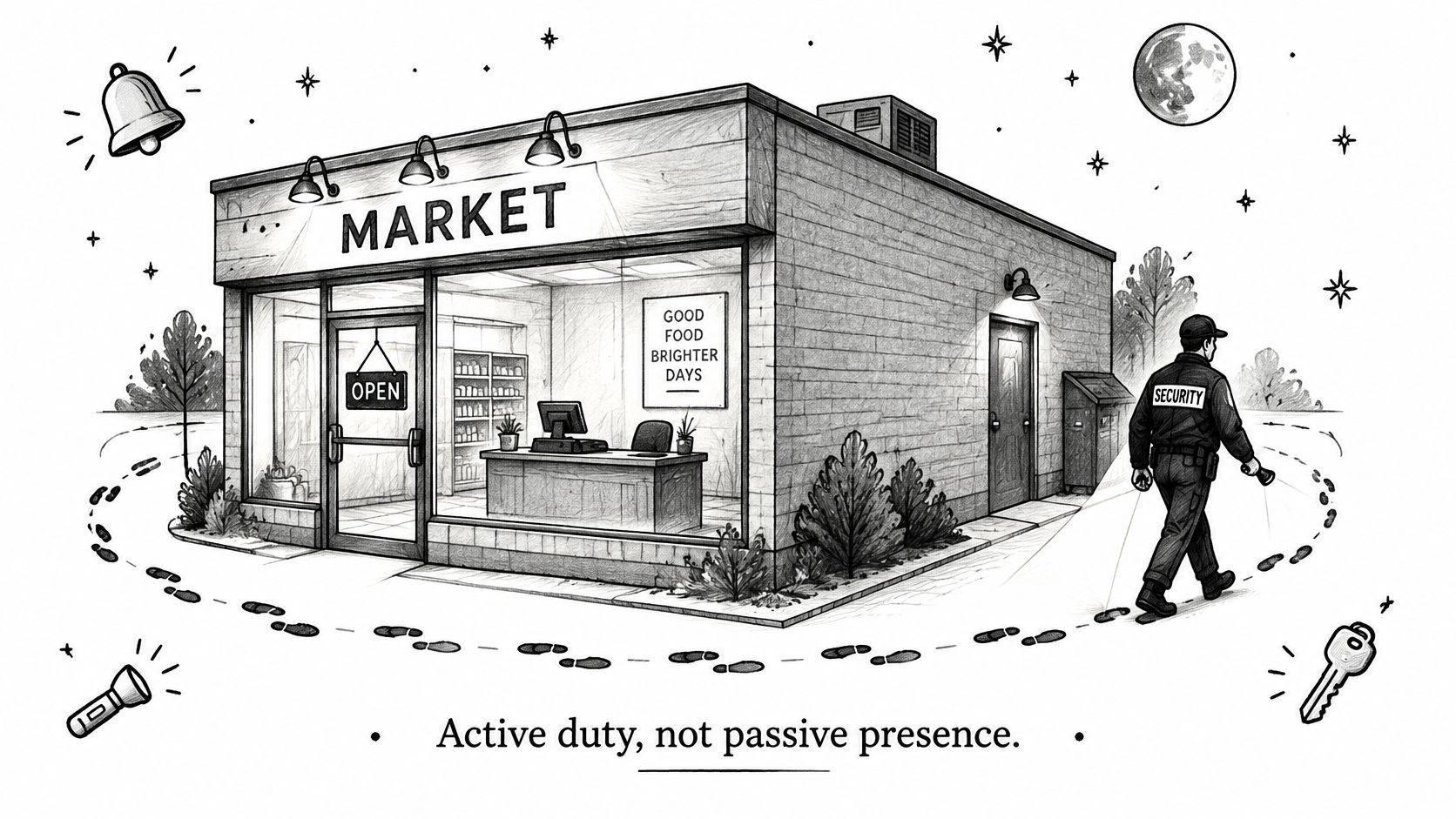
Hearing is the part people skip. In darkness, a guard often hears a fence rattle or a door click before anything becomes visible, so the observation area extends past the line of sight. That's why the wording names both senses rather than just telling the sentry to look.
The order is taught as a short memorized formula for a practical reason: a guard may need to recall and apply it while tired, in the dark, in noise, or in the middle of an uncertain situation. Prose you have to reconstruct under those conditions is worthless.
Practice task: restate the order in your own words, then name one scenario it clearly covers and one it doesn't. A guard hearing glass break behind a fence is covered. A guard deciding whether to arrest a trespasser is not, because that belongs to the special instructions for the post.
For a related set of course-style practice questions, the Cpl's Course fire team operations question set shows how military material gets tested in recall format.
How the Sentry Orders Connect as One System
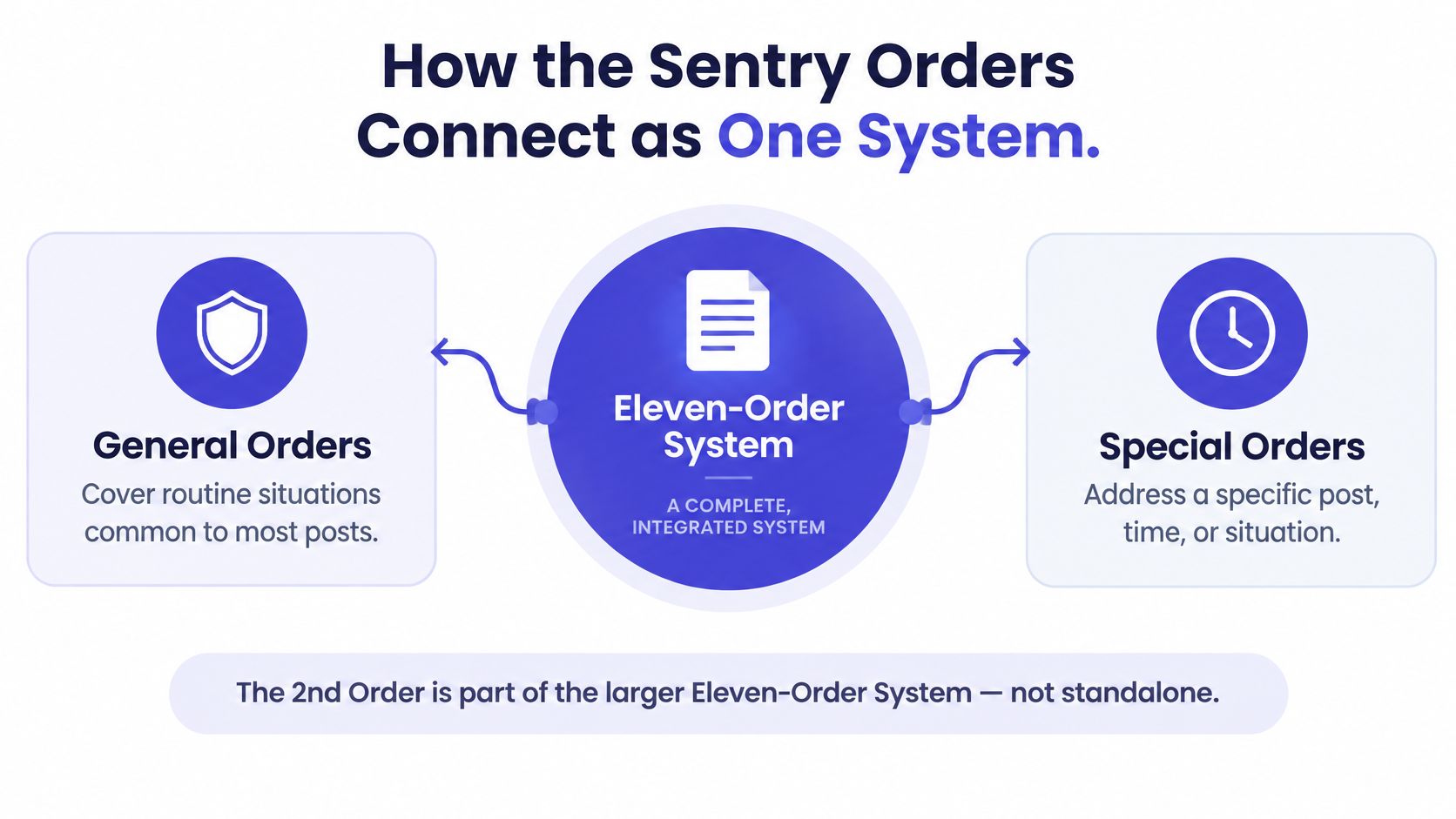
The second order never stands alone. It's one component of an eleven-order sentry system, and its surveillance requirement feeds the reporting and escalation duties that later orders impose.
The system separates two categories that students routinely merge. General orders cover routine situations common to most sentry posts, which is why they're memorized by everyone. Special orders address a specific post, time or operational condition, which is why they differ from gate to gate. The Navy's Basic Military Requirements training manual (opens in a new tab) describes the resulting layered model: the second order governs how the sentry gathers information, the third order requires reporting violations of enforceable instructions, and the ninth order requires contacting the responsible officer when the instructions on hand don't cover the situation.
Read as a workflow, compliance runs in three stages.
- Detect. The guard observes something within sight or hearing.
- Classify. The guard checks what was detected against the standing orders and the post's special instructions.
- Escalate. If it's a violation, it goes to the right person under the third order. If nothing covers it, the ninth order sends it up the chain.
Effective compliance therefore needs three capabilities working together: persistent observation, classification, and escalation through the correct channel. A guard who observes but doesn't route the information has produced nothing useful.
Where students usually go wrong is the boundary. The same training guidance states that a sentry has authority over persons within the limits of the assigned post, so accurate knowledge of those limits prevents two opposite failures: underreacting inside the post and unauthorized intervention outside it.
Practical rule: if you can't name who you'd notify, you haven't finished learning the order.
The following walkthrough covers guard duty in more depth.
Watch the video on YouTube (opens in a new tab)
A study method that maps cleanly onto exam scenarios: write three fields for every case, what was detected, which order or special instruction applies, and who must be notified. Fill those three in and you've demonstrated the whole system rather than reciting one line.
What Perform All My Duties in a Military Manner Requires
Most explanations translate this phrase into a single word, usually obedience, professionalism or discipline, and then stop. That's a slogan, not an instruction. It tells you nothing about what a guard does at 03:00 when a vehicle is idling outside the barrier.
The operational reading has four parts. The guard executes the post's special instructions accurately. The guard keeps the expected bearing and alertness. The guard uses the required procedures rather than improvising a shortcut. And the guard reports or escalates deviations instead of absorbing them without notice.
That framing answers the question students ask: does the second order mean obey every instruction automatically? No. It governs lawful, authorised duty performance within the chain of command, while the applicable special orders define what the guard must do at that post. The order doesn't replace post-specific instructions. It tells you to obey them and carry them out properly, as this analysis of the Army's three general orders (opens in a new tab) puts it.
Test yourself against five situations and name the reason before you check the table.
Notice that four of the five turn on procedure rather than attitude. A guard can be perfectly composed, polite and alert and still violate the order by dropping a special instruction. Public explanations tend to blur the Army's three-order framework with the naval sentry system, which is exactly how candidates end up writing a blend of two traditions in one answer.
Exam framing: the question is never "can you recite the order". It's "can you show which action carries it out".
When 2nd Order Means a Differential Equation
The order of a differential equation is the highest derivative it contains. That's the whole definition, and it's why a mathematics course can use the same phrase as a military manual without any confusion between them.
The analogy that makes it stick: first-order change tracks speed, and second-order change tracks acceleration, which is the rate at which speed itself changes. Take dy/dx = ky, a first-order equation, because the highest derivative is the first derivative. Now take y'' + y = 0, which is second order, because a second derivative appears. Nothing else in the equation sets the order. Not the powers, not the number of terms.
The reason the distinction matters in practice is the general solution. A second-order equation carries two arbitrary constants, which is why y = C1 cos x + C2 sin x has two free parameters and needs two conditions before you can pin down a specific solution. Count the constants and you can check your own work.
The pattern is the useful takeaway. Order in, constants out, one for one.
Many courses label their second-order material as "the second order", so check the syllabus definition before assuming a military or a mathematical meaning. A module handbook that lists second-order linear equations under that heading is telling you precisely which document the phrase refers to in your course. If you want practice material for that side of the topic, browse the mathematics study resources organised by subject and module.
Refine Your Search for Your Exact Course
A generic search for the phrase will hand you a mix of branches, decades and subjects. The fix is to search like someone who knows their own syllabus, using the fields below as filters.
- Copy the exact course code and title from the syllabus, punctuation included. "MIL 101" and "Military Science 101" return different results.
- Note the institution and academic year. A manual used at one academy in one year may carry different numbering from the same course elsewhere.
- Name the subject or module, such as military science, ordinary differential equations, or leadership and ethics.
- Add the textbook if the course lists one. Textbook-linked notes tend to follow the same chapter order as your reading.
- Add the field or branch term, for example USMC sentry orders or second-order ODE. Two extra words can remove most of the noise.
- Check the document header for branch, date and course title before you start studying. If the header is missing, treat the document as unverified.

The header check is where most students skip a step. A two-page summary with no branch label and no date could be describing the Army version, the naval version, or a blend of both written by another student. You can't tell, and neither can your instructor when you reproduce it in an exam answer.
When a resource conflicts with your class material, follow your instructor's version and treat the outside document as a complement to your course, not a replacement. Use only material you have the right to use, and follow your institution's academic-integrity policy on shared notes. A worked example makes this concrete: our Cpl's Course: Fire Team Operations document runs 21 pages and includes full written notes, which is the depth to look for when you check whether a document covers the whole module or just the highlighted lines.
To search by course code, institution, subject and academic year rather than by a loose phrase, start with the course-specific study documents on CramShare.
If you're revising a course-specific order list, a mathematics module, or anything in between, CramShare organises study documents by institution, course code, subject and academic year, so what you find matches the syllabus you're sitting. Every premium document can be previewed across multiple pages before you decide, and the free library opens without page limits or watermarks. Head to CramShare and search the exact course code from your syllabus instead of the phrase on your flashcards.