Opposite of Genuine: Words, Uses, and Writing Tips
Discover the opposite of genuine, with clear definitions, synonym choices, academic examples, and practical writing tips to choose the right word every time.

“Fake” is the usual answer to “What's the opposite of genuine?” It's a useful starting point, but poor advice if you stop there. A fake textbook, an insincere apology, and an unverified source have different problems. Choosing the right word means identifying the difference, not picking a stronger-sounding synonym.
Why One Antonym Is Not Enough
The opposite of genuine changes with what you're describing. A product can have a falsely claimed origin. A statement can contain invented information. A person can express a feeling they don't hold. These aren't interchangeable kinds of nongenuineness.
Students often meet this problem while revising a sentence such as “The source didn't seem genuine.” That sentence communicates doubt, but it doesn't tell the reader what prompted it. Was the author's identity unclear? Did the document contradict the assigned reading? Did a seller advertise unofficial practice questions as an official examination paper?
Replace the Judgment With a Diagnosis
Before choosing an antonym, complete this thought: “The problem with this material is its…”
- Origin: The claimed author or issuing institution may be wrong.
- Accuracy: The information may be incorrect or invented.
- Expression: The words may not reflect the speaker's actual feelings.
- Permission: Someone may lack the right to share or use the material.
These distinctions also matter when discussing why academic integrity is important. Clear descriptions help you explain a concern without making an accusation your evidence can't support.
Writing-center rule: Describe the specific mismatch before you label the entire source.
Consider a revision guide that covers an older syllabus. Calling it fake suggests a false identity or deceptive presentation. Calling it outdated identifies the actual limitation. You haven't weakened your criticism. You've made it more useful.
A good vocabulary choice tells readers both what went wrong and how confidently you know it.
What Genuine Actually Means
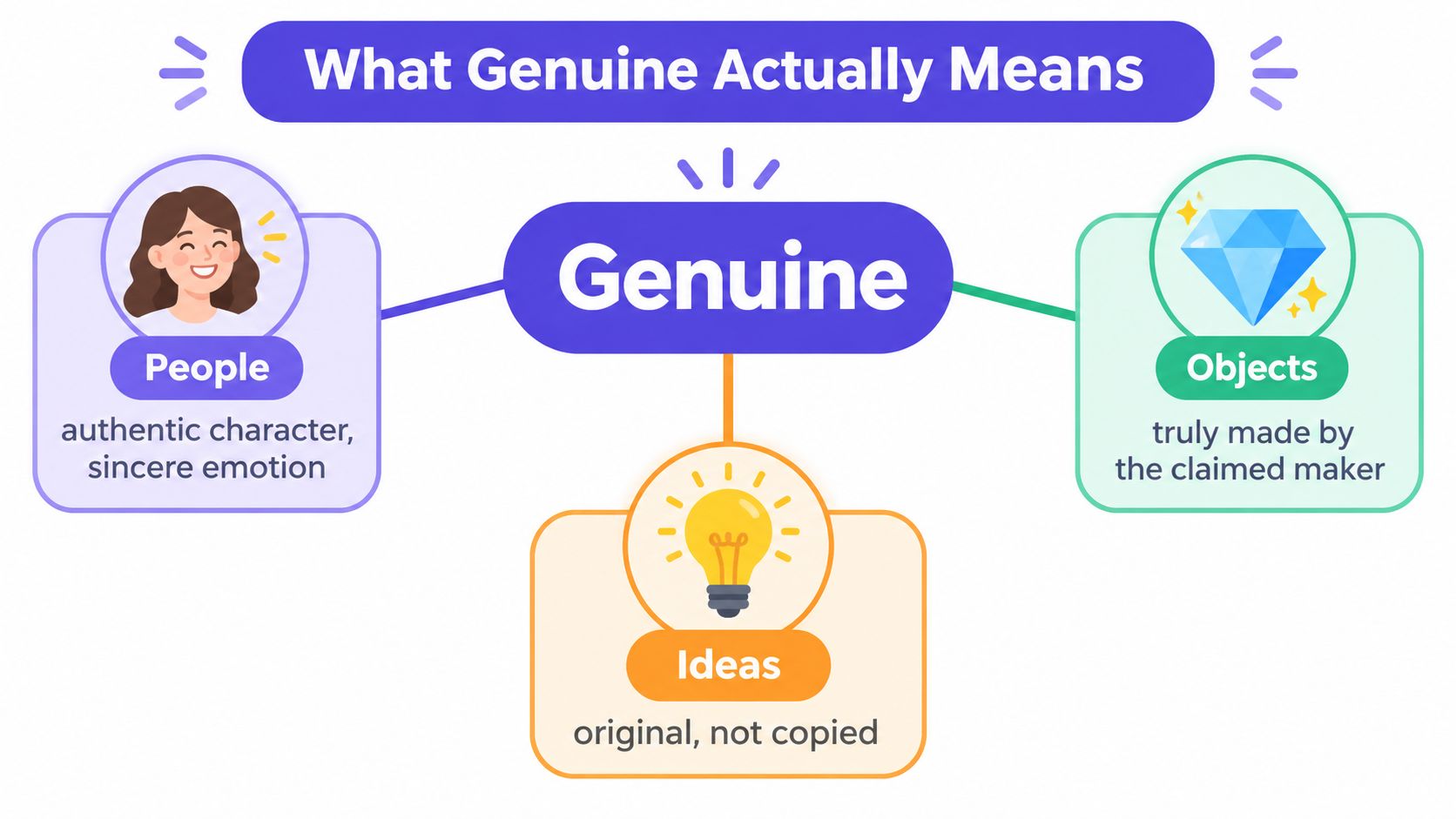
Genuine generally means real or authentic in the relevant respect. The important phrase is in the relevant respect: a genuine document isn't automatically an accurate document, and a genuine feeling doesn't automatically justify someone's behavior.
People, Objects, and Documents
Applied to people, genuine suggests that someone's outward behavior reflects their character or feelings. “She showed genuine interest in my research” describes sincere engagement, not whether she agreed with the argument.
Applied to objects, genuine concerns identity and provenance. Is the item what it claims to be, and does it come from the claimed maker? ISO's guidance on authenticating material goods (opens in a new tab) defines counterfeit goods through imitation or copying of authentic goods, emphasizing origin and authorization rather than appearance alone.
Applied to documents and ideas, genuine can concern authorship, originality, or claimed institutional origin. However, don't turn it into a guarantee of reliability. A student's genuine lecture notes can contain a misunderstood definition; an authentic university notice can become outdated.
- Genuine authorship: The claimed author created the work.
- Reliable content: The information withstands checking.
- Original thinking: The contribution isn't merely copied from elsewhere.
These descriptions can overlap, but none substitutes for the others.
Related Words That Can Trip You Up
Genuinely is the adverb: “The student was genuinely interested.” Genuineness is the noun: “The committee questioned the document's genuineness.”
Ingenuous isn't another form of genuine. It describes someone as candid, innocent, or unsuspecting. Its opposite, disingenuous, can describe a misleading presentation of someone's knowledge or intentions.
Genuine usually carries positive associations of trustworthiness. When you replace it, check whether you're questioning authenticity, criticizing accuracy, or judging someone's motives. Your sentence should make that distinction visible.
The Main Antonyms Side by Side
Choose an antonym by asking what it rules out. Counterfeit challenges an item's claimed identity; false challenges a statement's truth; insincere challenges an expression's honesty. The differences matter more than which word sounds most forceful.
Choosing the Right Opposite of Genuine
Watch the Implications
Artificial isn't automatically a criticism. Artificial materials can be openly labeled and useful. Similarly, a false answer may result from a calculation error rather than dishonesty.
Fabricated needs particular care in research writing. Calling a dataset fabricated suggests that observations were invented. If someone changed real observations, falsified or altered may describe the problem more precisely. Don't use fabricated merely because the results look surprising.
Related terms have narrower jobs:
- Forgery: A false document, signature, or work presented as authentic.
- Hoax: A deception designed to make people believe an invented event or story.
- Knockoff: An imitation product, without necessarily claiming to be the original.
- Replica: A copy that may be openly identified as a reproduction.
A copy isn't necessarily counterfeit. The crucial question is whether someone misrepresents it as authentic.
In an essay, phony and bogus can sound dismissive without explaining much. Prefer a term that names the defect: invalid credential, unsupported claim, or misattributed document.
A Practical Decision Framework
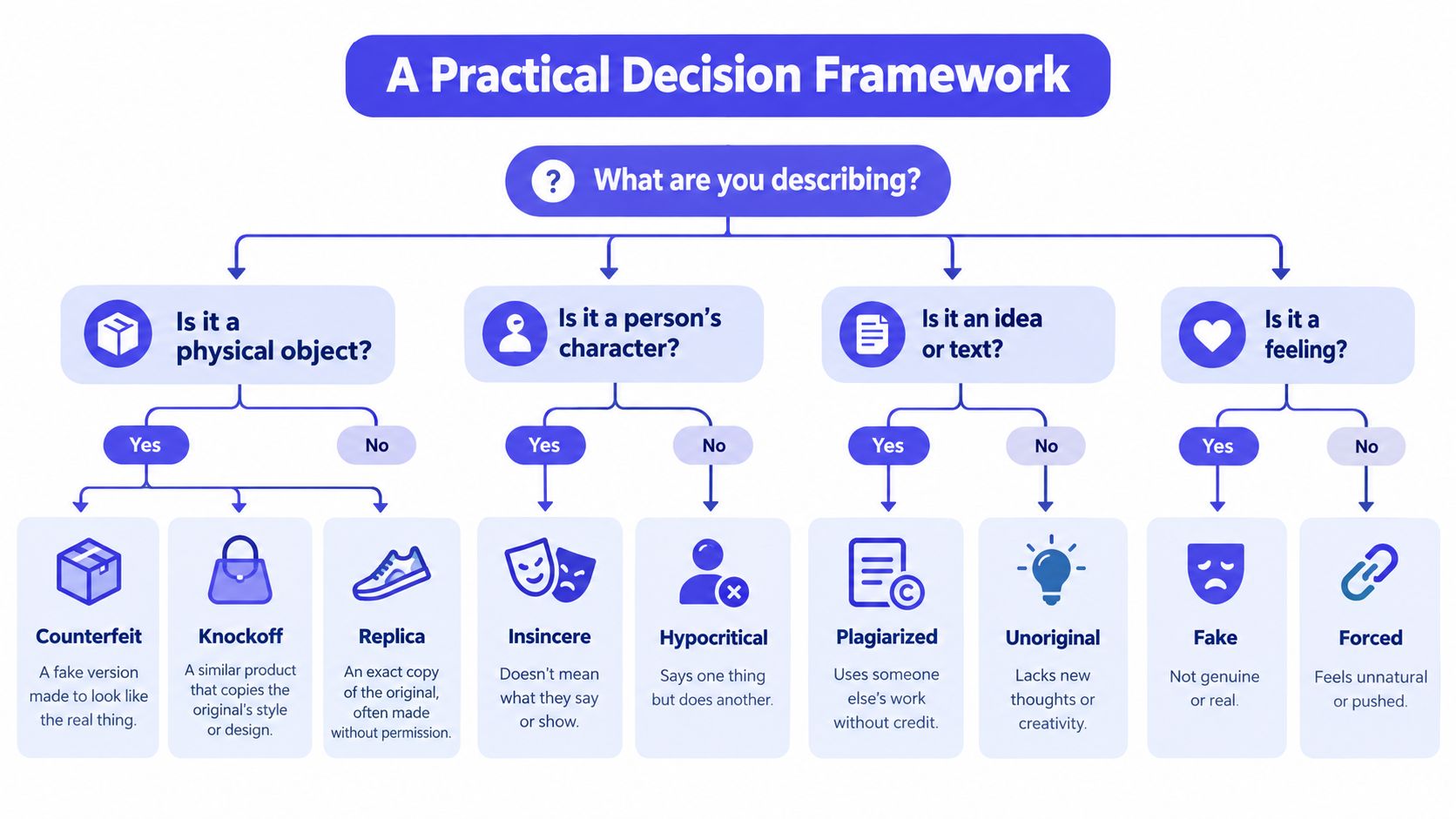
Start with the subject of your sentence, then consider the evidence. Don't begin by deciding how suspicious you want the source to sound.
Ask These Questions Before Choosing
-
What am I describing?
For an object, consider counterfeit, knockoff, or replica. For a statement, consider false, fabricated, or misleading. A misleading statement can use accurate details while encouraging a mistaken conclusion. -
Have I established deception, or am I missing verification?
Use unverified when a claim hasn't been checked. Use unauthenticated when a document's claimed identity or origin hasn't been established. Neither means you've proved it false. -
Am I describing someone's feelings or presentation?
Insincere fits a mismatch between expressed and actual feelings. Affected can describe an adopted manner, while performative suggests behavior intended for an audience. Neither automatically proves dishonesty. -
Does the word suit the assignment's tone?
Replace informal labels with evidence-based descriptions. “The citation couldn't be located” is usually more useful than “The citation looks bogus.”
Check More Than the Label
For study materials, compare the course code, institution, academic year, preview, and document contents. Also distinguish evidence of who uploaded a file from evidence that they had permission to distribute it.
ISO authentication guidance presented by EUIPO (opens in a new tab) explains that tracking and tracing alone don't establish authenticity. A file's history or unchanged contents can support a check, but neither independently proves ownership rights.
Your repeatable editing procedure is:
Identify the subject → name the suspected defect → assess the evidence → choose the appropriate register.
If evidence remains incomplete, describe the uncertainty. Purported identifies a claimed status; alleged signals an assertion that hasn't been established. They're attribution tools, not definitive antonyms.
Academic Examples You Can Model
The following sentences are hypothetical writing models, not reports of actual incidents. Each shows how a precise word changes what the reader understands.
Objects and Research Evidence
“If an unauthorized textbook copy is sold as an authentic publisher-issued edition, counterfeit is the appropriate description.”
Counterfeit identifies deceptive imitation. Poor printing alone wouldn't justify that label, and an openly labeled reproduction would require a different description.
“The methods review established that the reported interview responses were fabricated, rather than collected from participants.”
Fabricated identifies invented evidence. If real responses had been selectively changed, altered or falsified would be more exact.
Feelings, Sources, and Student Voice
- Reviewer feedback: “The praise seemed insincere because the reviewer privately admitted they didn't mean it.” The admission supports a claim about sincerity. A brief or vague compliment alone would support only a description such as superficial.
- Document origin: “The purported departmental past paper remains unauthenticated because its institutional origin hasn't been confirmed.” This leaves room for later verification.
- Student voice: “The student described the AI-generated passage as inauthentic to their own voice.” This identifies a mismatch in self-expression without claiming the passage is factually false or necessarily prohibited.
When describing a possible academic integrity violation, separate what you observed from what you infer. You can document missing attribution without claiming to know the writer's intentions.
Rewrite the Vague Phrase
“The notes weren't genuine” gives the reader too little information. Try a revision matched to the evidence:
The most effective rewrite may not contain an antonym of genuine at all. Sometimes a concrete description does the job better.
Not Genuine, Fake, Plagiarized, or AI-Generated
Fake, plagiarized, and AI-generated describe different things. Fake concerns misrepresentation. Plagiarized concerns presenting someone else's work without appropriate acknowledgment. AI-generated describes a production process, not a verdict about truth, ownership, or permitted use.
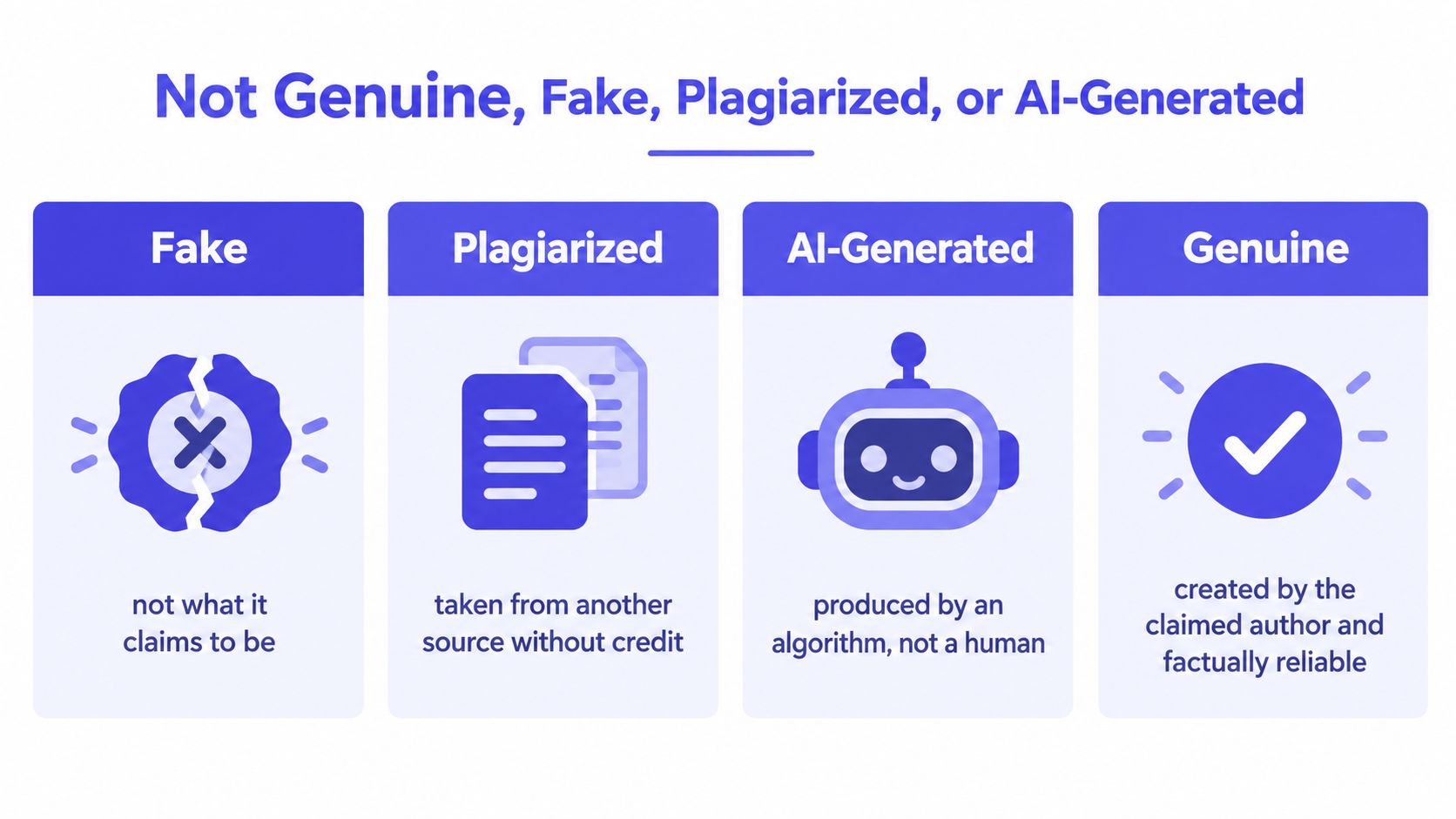
Read these categories as separate questions, not mutually exclusive boxes. As the earlier authorship distinction shows, a genuine resource can still contain errors.
Apply Separate Tests
- Authorship: Did the claimed author create the material?
- Reliability: Are its explanations, answers, and citations accurate?
- Distribution rights: Does the uploader have legal permission to share it?
- Permitted use: Does the institution or instructor allow this use?
An original summary may include copyrighted material that its author lacks permission to distribute. An accurate AI-assisted draft may still breach assessment rules. An invented past paper can misrepresent both its origin and its contents.
That's why a careful definition of academic integrity matters more than a catch-all accusation of fakery.
Don't Infer the Process From Appearance
In a digital-trust survey, 21% of respondents reported high confidence in identifying AI-generated images, text, or video, while 50% said they first checked uncertain content against multiple sources, according to the Human Clarity Institute's digital-trust report (opens in a new tab). These are self-reported judgments, not measured detection accuracy.
In a 2025 survey of 1,041 students, 18% reported inserting AI-generated text directly into academic work, and 51% cited false results or hallucinations as a concern, according to HEPI's Student Generative AI Survey (opens in a new tab). Those findings don't establish that a particular polished submission is AI-generated.
Evidence first: Identify the unsupported citation, missing acknowledgment, or prohibited assistance. Don't treat your impression of the writing style as proof.
Quick Phrasing Tips for Better Writing
On revision day, focus on what your reader needs to understand. A precise criticism should identify the problem without overstating the evidence.
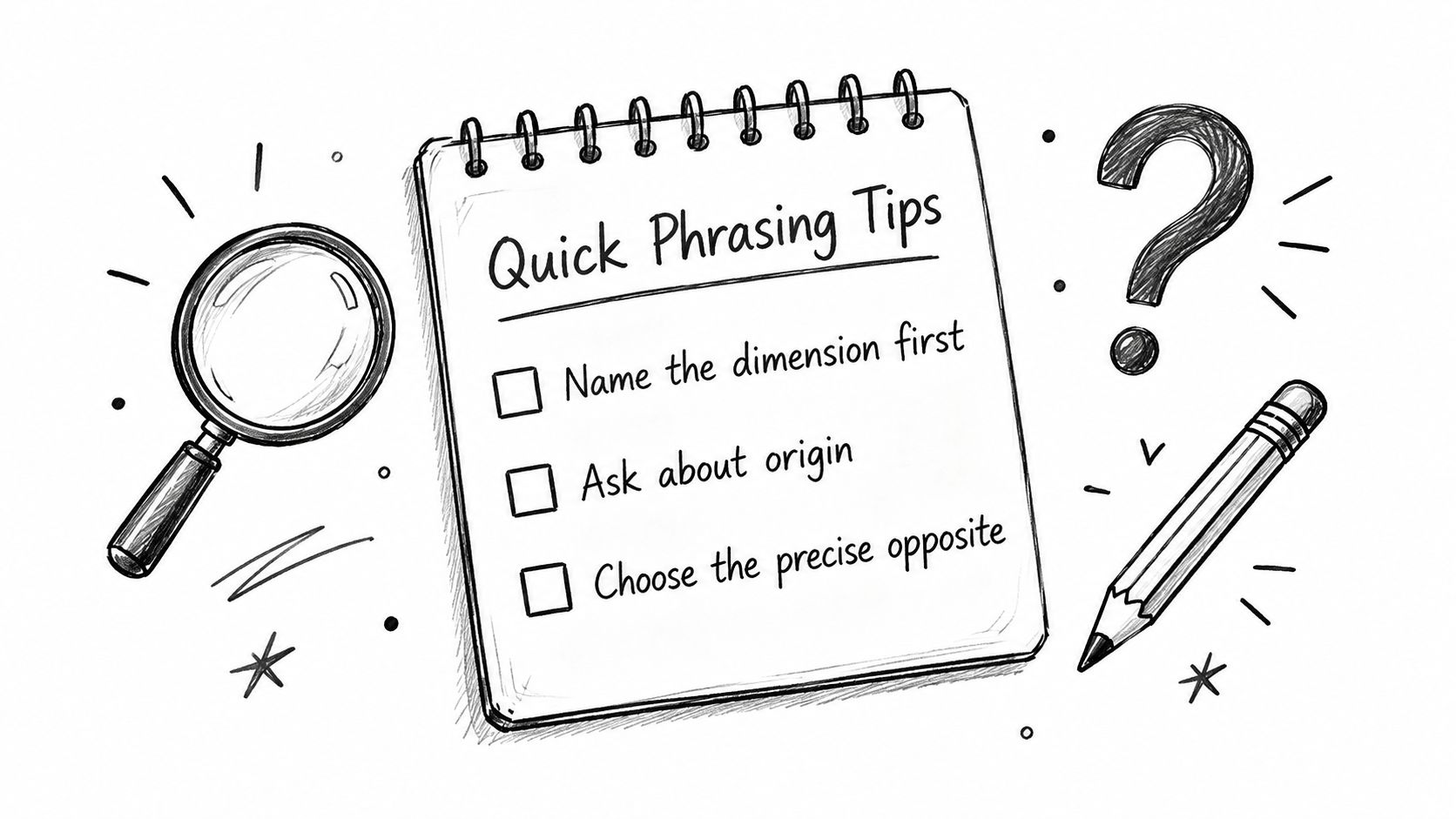
Keep This Editing Checklist Nearby
- Name the dimension first. Identify whether you're discussing origin, accuracy, emotion, or permission before replacing genuine.
- Choose specificity over intensity. A stronger accusation isn't necessarily a clearer sentence. “Missing attribution” gives readers more information than “fake work.”
- Match the register. Phony may fit a personal reflection. In a formal review, name the false credential or unsupported assertion instead.
- Preserve uncertainty. Use unverified or unauthenticated when the check remains incomplete. Don't imply that failure to confirm something proves deception.
- Reread the whole sentence. Ask what motive, certainty, or wrongdoing the replacement suggests. Remove implications you can't defend.
A Compact Vocabulary Reference
Keep these core choices in mind: fake for broad misrepresentation, false for incorrect statements, counterfeit for deceptive imitations, artificial for manufactured rather than natural things, insincere for dishonest expressions of feeling, fabricated for invented evidence, inauthentic for mismatches of identity or self-expression, and phony for informal descriptions of pretense.
When reviewing study materials, write about the observable mismatch first. A wrong academic year, incomplete preview, or unconfirmed institutional origin calls for its own description, not an automatic label of fake.
The best opposite of genuine is the word that makes your meaning unmistakable. If no single word does that, use a short explanatory phrase.
CramShare offers a community library and marketplace for course-specific notes, summaries, revision guides, and practice materials. Visit CramShare to search by institution, course code, module, or academic year, and use premium document previews to check whether a resource matches what you need before purchasing.