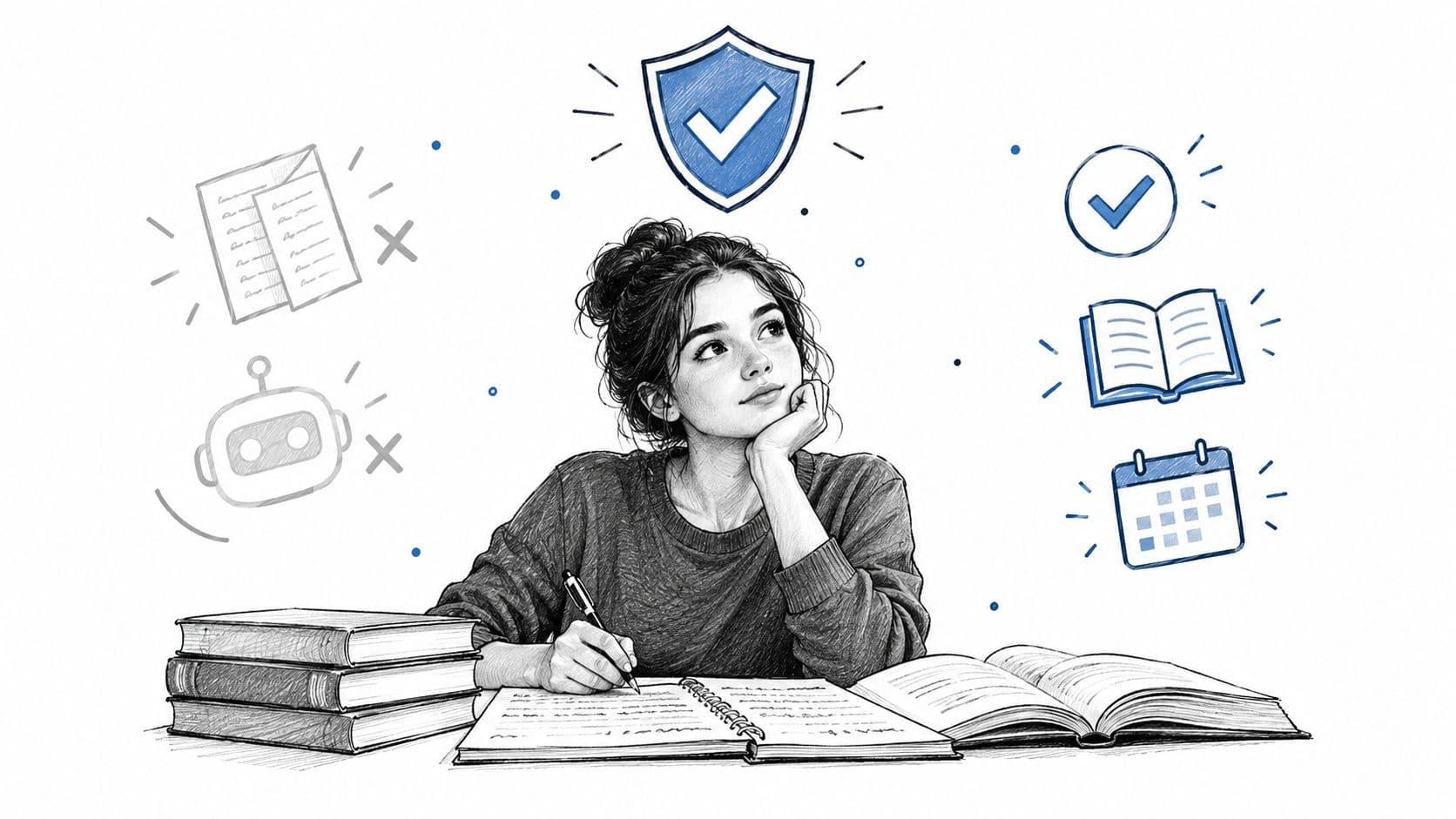
Why Academic Integrity Is Important Today
Discover why academic integrity is important for your degree and career. Learn how to navigate AI tools, avoid accidental plagiarism, and study ethically.

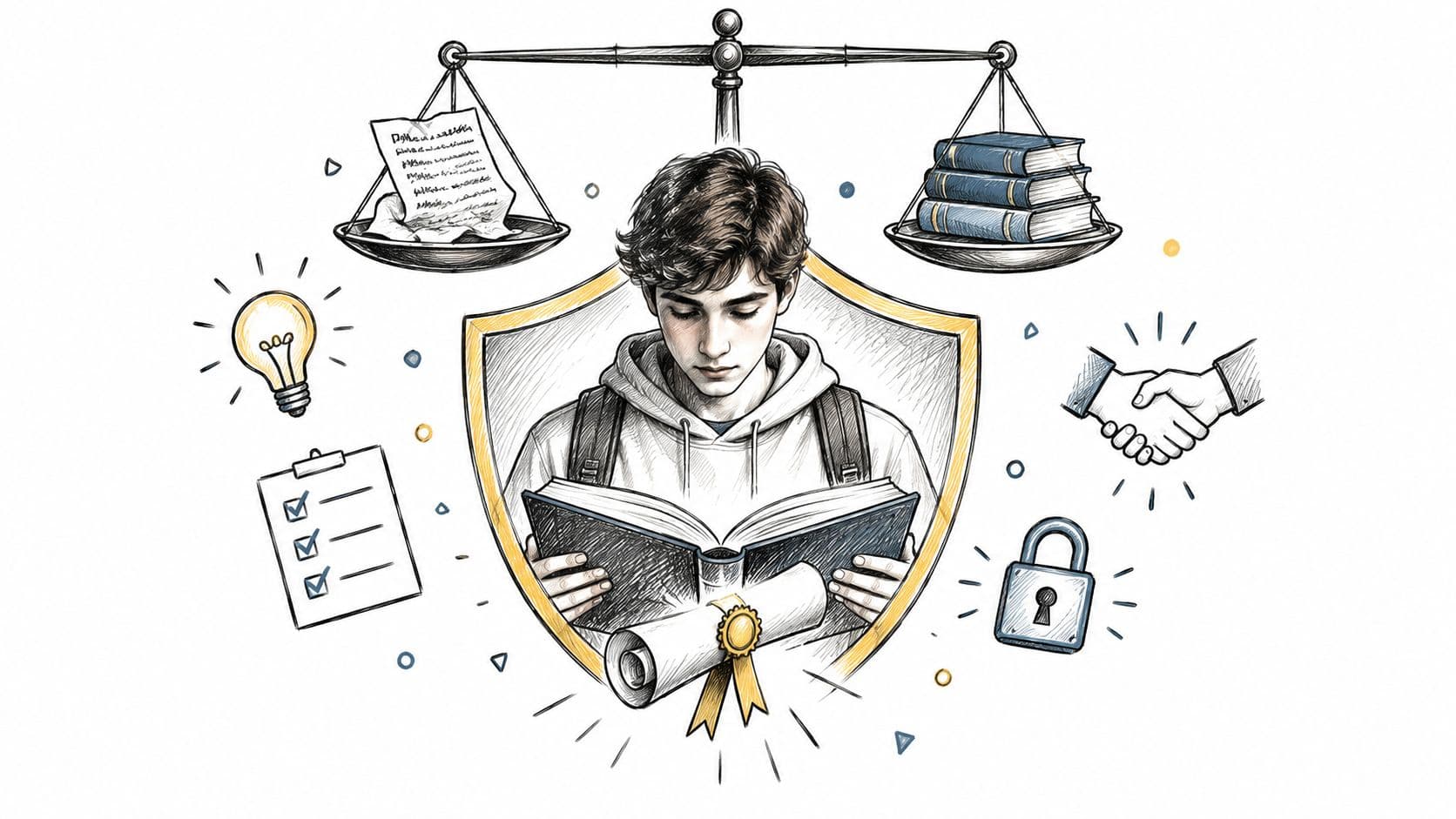
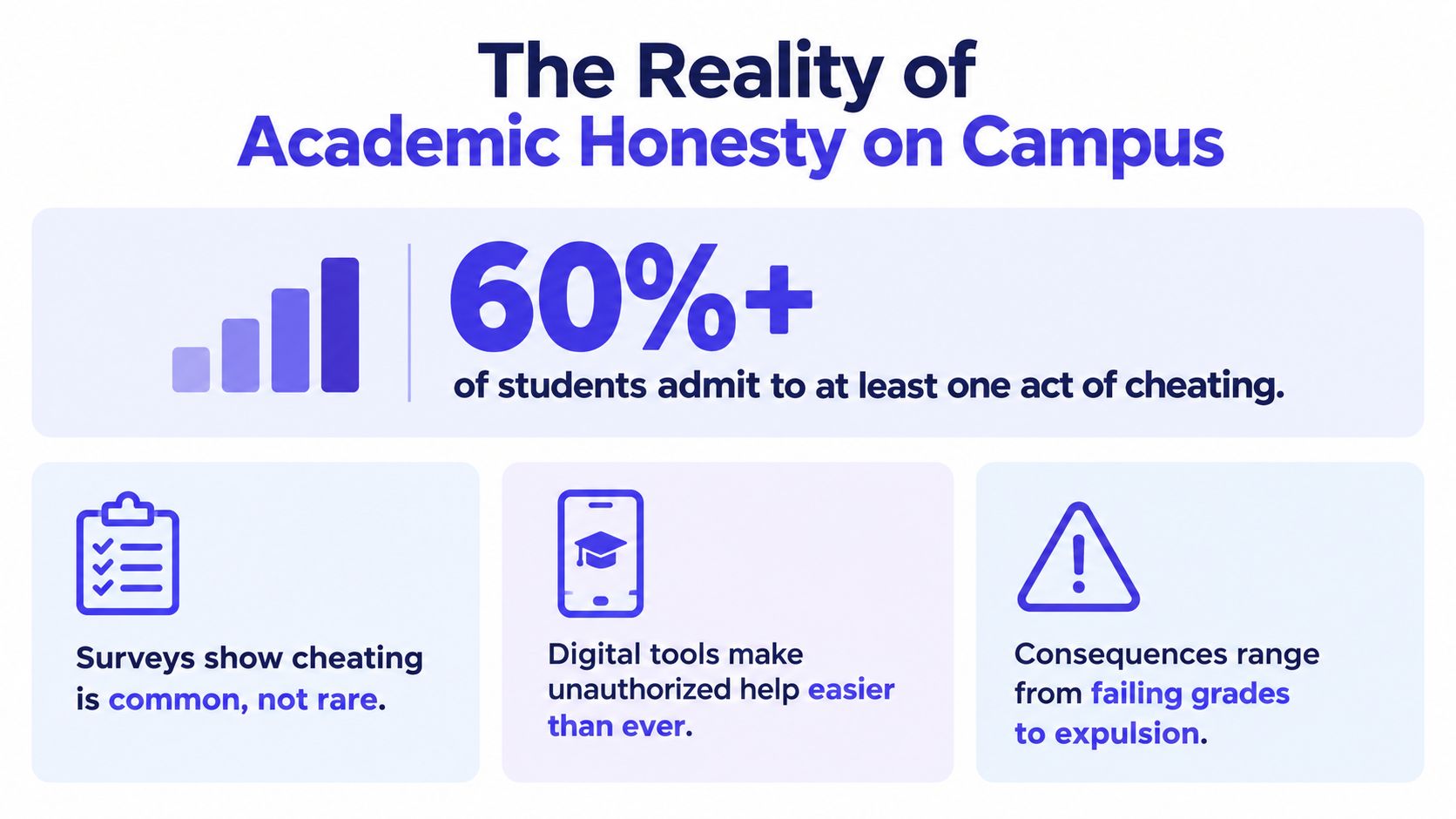
More than 60% of university students admitted to cheating in some form in Donald McCabe's academic-integrity research, according to the International Center for Academic Integrity's summary of the findings (opens in a new tab). That figure changes the question. Academic honesty is not important only because a small number of students break rules. It matters because universities need a trustworthy way to show what students know, what they can do, and which skills they have developed.
The pressure behind a shortcut can be real. Deadlines collide, difficult material piles up, and unclear rules about collaboration or artificial intelligence can leave students guessing. Still, a degree has value only when grades represent genuine learning under shared conditions. Academic integrity protects that connection while giving students a practical framework for using notes, peer support, digital tools, and AI without misrepresenting someone else's work as their own.
The Reality of Academic Honesty on Campus
A survey of more than 70,000 U.S. high school students found 64% admitted cheating on a test, 58% admitted plagiarism, and 95% said they had taken part in some form of cheating, according to this academic-integrity research summary (opens in a new tab). The figures point to a widespread challenge rather than a small group of unusually dishonest students. They also explain why academic integrity protects the value of a degree: grades must remain credible signals of what students can understand and do.
The pressure behind a shortcut can be intense. Deadlines overlap, difficult material accumulates, and instructions about collaboration, paraphrasing, or AI may leave students uncertain. A student can cross a boundary through deliberate misconduct, such as buying completed work or using prohibited help during an exam. Another may make the same kind of error after copying a paragraph without recording its source, sharing answers that were meant to be individual, or assuming that AI-generated text is acceptable because it sounds polished.
Intent affects how an institution responds, but the academic problem remains. If outside assistance replaces the thinking an assessment is designed to measure, the result no longer shows the student's independent knowledge.
Why institutions need integrity policies
Universities use academic policies, reporting processes, assessment controls, and student guidance because grades function as shared signals. A mark should help an instructor judge whether a student understands the material. It should also show whether that student is prepared for more advanced courses or professional responsibilities.
Common standards protect students who do their own work. Without them, a student who spends hours developing an argument, solving a problem, or practicing a method may compete against work produced through copying or unauthorized assistance. Integrity rules therefore protect the credibility of genuine effort, not only an institution's reputation.
Practical rule: If an assessment measures your individual understanding, assistance that replaces your thinking changes what the grade means.
A copied paragraph, an unauthorized exam message, or a shared answer file may seem minor alone. Across a cohort, such actions make results harder to trust and can disadvantage students who follow the rules. For an explanation of possible violations and reporting processes, students can review this guide to academic-integrity violations alongside their institution's policy.
Protection rather than moral judgment
Academic integrity policies do not label students as good or bad. They set conditions for fair assessment and provide boundaries when stress makes a quick solution tempting. Clear rules also help students distinguish permitted study support from work that must be completed independently, including assistance from peers, online resources, and AI tools. When expectations are clear, honest students are less likely to feel that breaking rules is the only way to keep up.
Core Principles of Ethical Scholarship
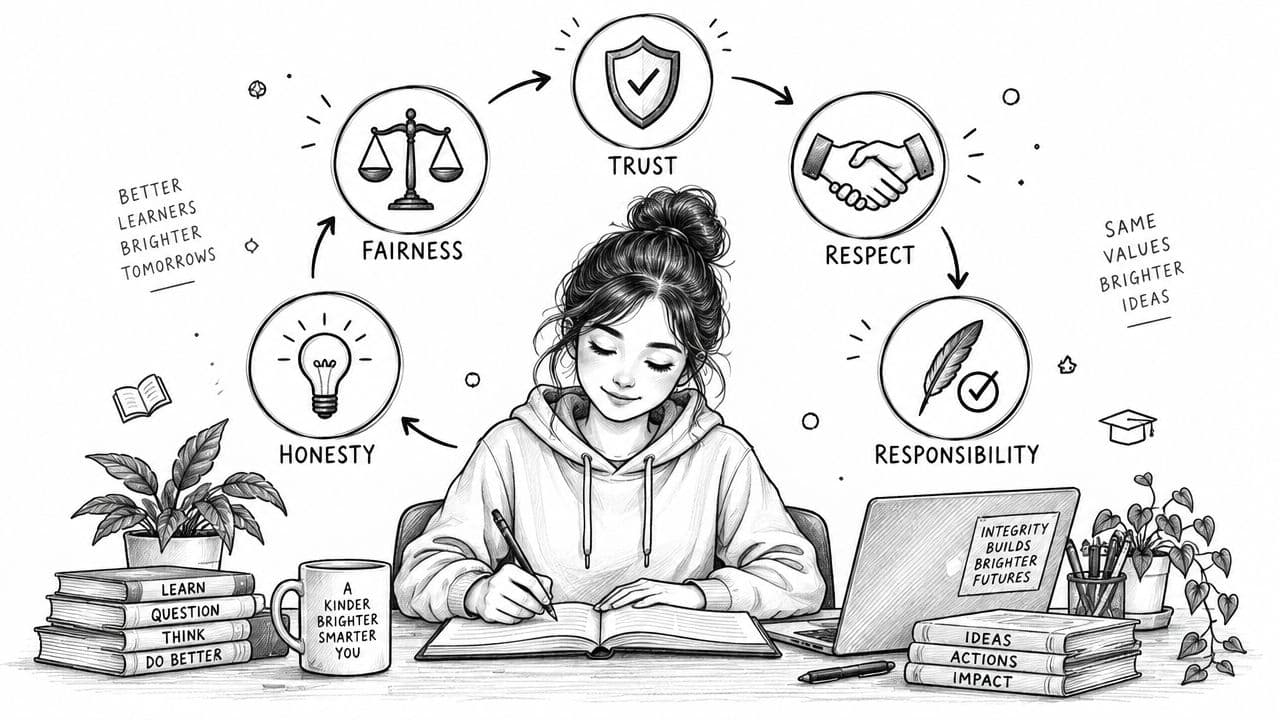
Academic integrity becomes easier to apply when you treat it as a set of working habits rather than a vague moral instruction. The central question is simple: Does the submitted work accurately represent what I did, what I understood, and what support I used?
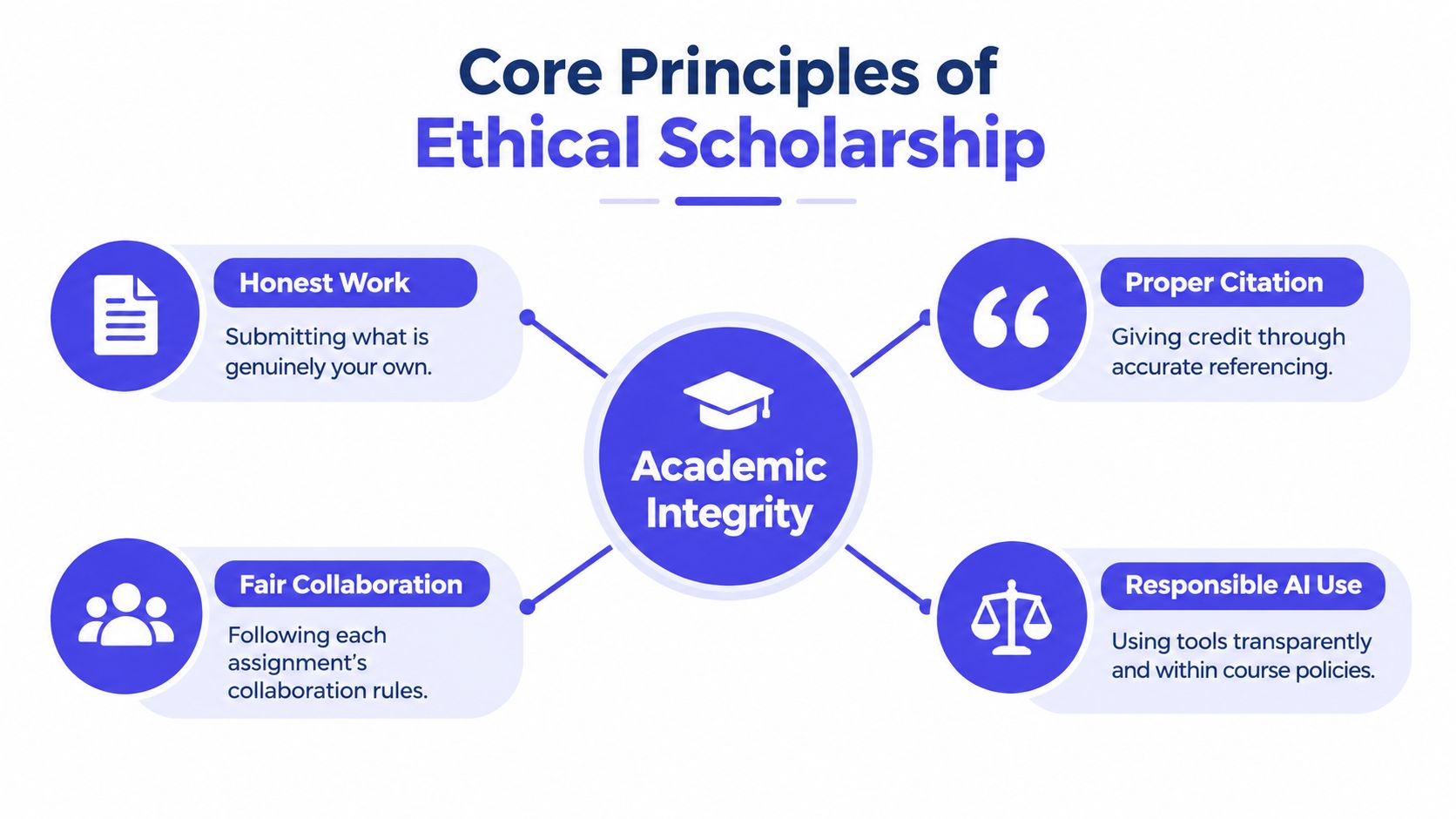
That question leads to four connected principles. You need honest authorship, accurate attribution, fair collaboration, and responsible use of digital tools. None of these principles requires you to study alone. They require you to be truthful about where ideas, words, calculations, and assistance came from.
Four principles in daily student work
Studying together versus submitting together
Two students can discuss a difficult concept, test each other with questions, or compare approaches to a problem and still produce independent work. The boundary changes when they create one answer for an individual assignment, exchange drafts that shape each other's final wording, or divide the task and combine the results without permission.
A study guide works similarly. Reading a summary to identify a confusing topic can support revision. Copying that summary into an assignment, or using it instead of learning the material you're expected to explain, misrepresents your work. The resource can be legitimate while the use is not.
Citation is not merely a formatting exercise. It shows the path from an existing idea to your own analysis. If you paraphrase a source, you still credit it because the underlying idea isn't yours. If you use a direct quotation, you identify the exact borrowed language. Keeping source notes separate from your draft can prevent accidental copying later.
Academic integrity doesn't ask you to avoid help. It asks you to make the help visible and keep ownership of the assessed thinking.
When a rule feels unclear, check the assignment sheet, rubric, and course policy before working. A useful plain-language explanation of academic-integrity definitions can help you identify the issue, but your instructor's instructions always control the specific assignment.
How Integrity Protects Your Degree Value
A degree is more than a record of completed courses. It communicates that you developed knowledge and demonstrated skills under an institution's assessment standards. Employers, professional bodies, and future educators rely on that signal even when they never see the individual assignments behind it.
Academic integrity protects the connection between the credential and the capability it represents. If a student submits work they didn't understand, the immediate result may be a higher mark. The longer-term result is a gap between the transcript and the student's actual preparation. That gap often appears later, when an exam, placement, interview, laboratory task, or workplace responsibility requires unaided performance.
Assessment only works when the evidence is trustworthy
A grade gives useful information only when the assessed work reflects the student's knowledge under the permitted conditions. A review covering 3,379 courses and more than 27,000 learning outcomes found that only 782 courses, about 23%, had a clear academic-integrity component in their learning outcomes, as reported in this multi-institution review of integrity in course design (opens in a new tab). The finding points to a design problem as well as a student-behavior problem. If integrity expectations aren't built into course outcomes, assessment controls can become inconsistent.
For students, the practical lesson is to read the task as a measurement tool. Ask what the instructor is trying to observe. Is the assignment testing your ability to form an argument, apply a method, interpret evidence, or solve a problem independently? Any help that performs that specific task for you may undermine the purpose of the assessment.
The hidden cost of bypassing practice
Students often focus on formal penalties, but the educational cost starts before a university investigates anything. When someone copies a solution or relies on unauthorized generated text, they lose information about their own weaknesses. They may not discover that they misunderstand a formula, cannot defend an argument, or have confused two central concepts.
That missing feedback can affect later work. Learning usually builds in layers. A weak foundation makes advanced material harder, while an honest mistake gives an instructor a chance to correct the problem. Submitting polished work that hides confusion removes that opportunity.
Protecting professional credibility
The value of a qualification depends partly on public trust. In fields where decisions affect health, safety, finances, rights, or vulnerable people, employers need confidence that graduates can perform the work their credentials imply. Ethical study habits don't guarantee professional success, but misrepresented academic work can leave students unprepared for responsibilities they appear qualified to handle.
This is why integrity is a personal investment, not merely an institutional demand. Completing the thinking yourself takes effort now, but it produces a degree you can defend later. You should be able to explain how you reached a conclusion, which sources informed it, and what you still need to learn.
Navigating AI and Modern Study Gray Zones
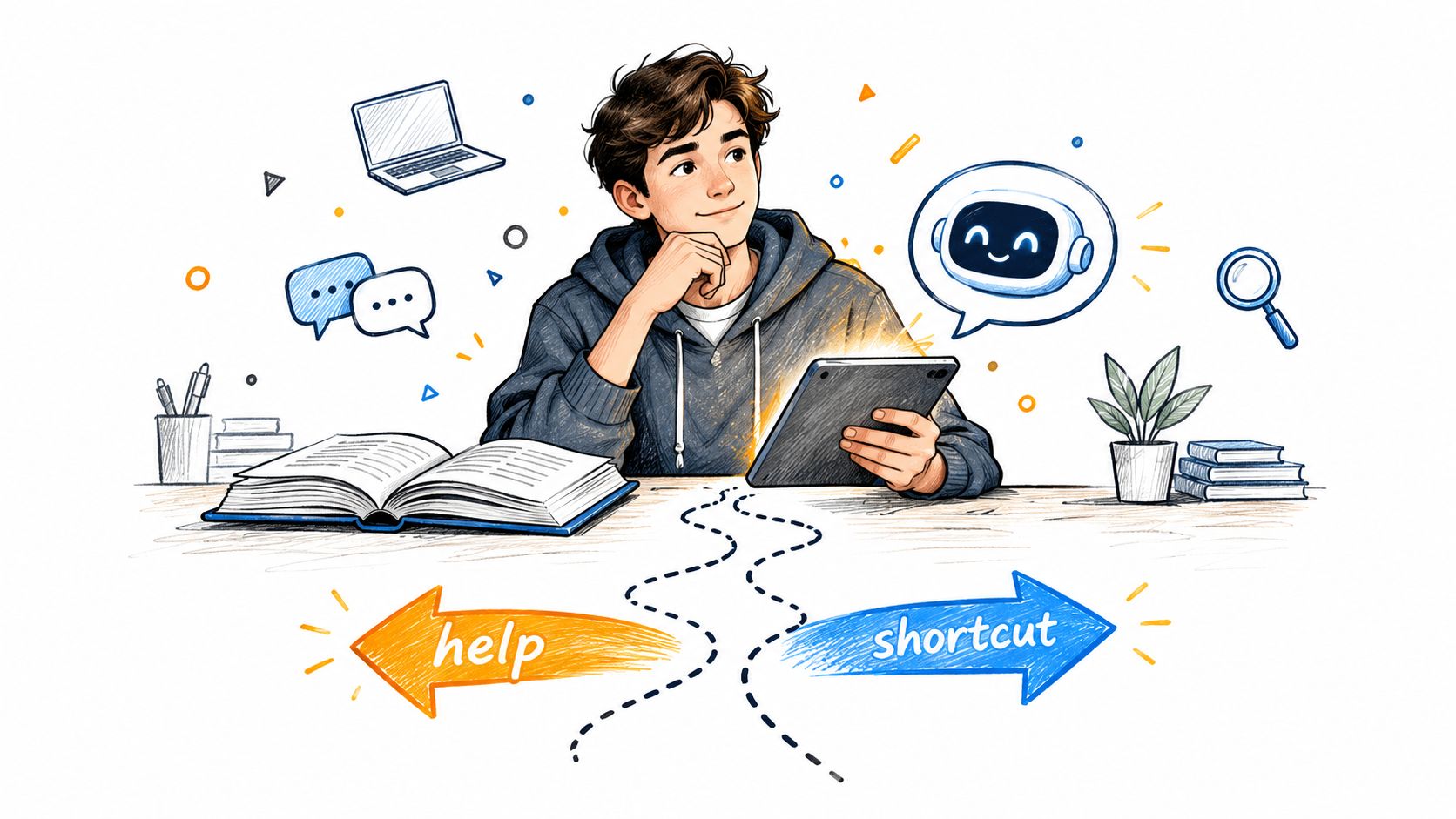
The difficult question today isn't whether students may ever use technology. It's what the technology is doing in relation to the assessed task. An AI tool that turns your own lecture notes into practice questions may support revision. A tool that writes the final answer for an individual essay may replace the exact reasoning the assignment is meant to measure.
Recent student data shows why simple warnings are not enough. A 2025 survey of 1,041 undergraduates found that 92% had used AI in some form and 88% had used it for assessments, while 80% said their institution had a clear AI policy and 76% believed it would detect AI use, according to the ERIC record for the survey (opens in a new tab). These findings describe a policy environment where use is widespread, rules may exist, and students still need help interpreting the boundary.
A useful distinction between support and substitution
Consider the task you're being assessed on. If you're expected to write an original analysis, AI may perhaps help you generate questions for research or identify areas you should clarify, if the course allows that use. It shouldn't produce the analysis that you submit as your own.
Policies differ by instructor, department, and assessment. Don't assume that permission in one course applies elsewhere. Save the relevant policy, ask a specific question, and keep a record of any required disclosure.
Before you use AI: Can I explain exactly what the tool did, and would my instructor consider that role permitted for this task?
The pressure created by unclear enforcement deserves attention too. The 2025 study on AI and academic integrity in education (opens in a new tab) reports that 76% of surveyed faculty believed generative AI had increased plagiarism. Related student evidence indicates that fear of being accused of misconduct and fear of false or biased results can deter AI misuse. Strict enforcement without clear instruction may therefore increase anxiety, especially for students who are new to local academic conventions or studying in a second language.
If the policy is vague, ask before submitting. A message such as “May I use an AI tool to create practice questions from my notes, and do I need to disclose that use?” gives the instructor something concrete to answer. Clarity protects both your learning and your academic standing.
Watch the video on YouTube (opens in a new tab)
Aligning Study Resources with Course Outcomes
The safest study resource is one that supports the learning outcome without impersonating your assessed performance. If a course asks you to compare theories, use a revision summary to identify the theories and their differences. Then close the resource and construct the comparison yourself. If a module tests problem-solving, use worked examples to understand the method, then practice with a new problem rather than reproducing the example.
Course-specific materials are particularly useful because they reflect the vocabulary, sequence, readings, and emphasis of a particular module. A broad resource on biology may explain a topic accurately while missing the terminology your lecturer uses or the method your assessment expects. Matching resources to the exact course helps you spend time on relevant gaps.
Read the outcome before choosing the resource
Start with the course outcome or rubric. Look for the action verb:
- Describe often calls for accurate explanation in your own words.
- Apply requires you to use a method in a relevant situation.
- Analyse asks you to break evidence or concepts apart and interpret relationships.
- Evaluate requires a reasoned judgment supported by evidence.
- Create asks you to produce an original response, design, argument, or solution.
A summary can support any of these activities, but it can't replace the activity itself. Notes may remind you what to revise. They shouldn't become a ready-made submission.
Use a three-stage resource workflow
First, preview. Check the university, course code, module, academic year, author, and scope. A document that matches only the broad subject may not match your assignment.
Next, convert information into effort. Turn headings into questions, explain a concept without looking at the page, or solve a related problem from memory. These actions reveal whether the material has become understanding rather than passive recognition.
Finally, separate revision from submission. Keep study notes, summaries, and practice answers in a revision folder. Write assessed work in a separate document, using the original sources and the assignment rules. Don't paste material into a submission just because it is well written.
You can use this course-specific study material download guide to think through how to find relevant revision resources. Whatever platform you use, verify that the material is intended for study, respect copyright, and follow the course's rules about outside assistance.
Why alignment improves integrity
Course outcomes, rubrics, and assessment instructions tell you what evidence the instructor needs. When your resources match those requirements, you can prepare deliberately instead of searching for a finished answer. That reduces the temptation to submit someone else's work because you have a clearer route from resource, to practice, to independent response.
A Practical Checklist for Compliant Studying
Integrity becomes less stressful when you check your process before a deadline rather than trying to reconstruct it afterward. Use the following routine for essays, problem sets, presentations, lab reports, and online assessments.
Before you start
Know the rules. Read the syllabus, assignment brief, rubric, and any separate AI or collaboration policy. Look specifically for instructions about group discussion, proofreading, translation tools, calculators, websites, and generative AI.
Ask targeted questions. Don't send a vague message saying you're confused about the rules. Ask whether a named action is permitted, such as discussing an outline with a classmate or using software to check grammar. Keep the answer with your assignment documents.
Plan for independent work. Identify which parts must be your own reasoning and schedule them before you consult optional tools. Starting with your own attempt makes it easier to distinguish assistance from replacement.
While researching and drafting
Mark direct quotations immediately. Add the author, title, page or location, and other citation details while the source is open. If you write a paraphrase, look away from the original first, build a new sentence structure, and cite the source afterward.
Keep a simple source log with three labels: my idea, source idea, and direct quotation. This small separation helps prevent copied wording from slipping into a later draft. It also makes your reference list more accurate because you know exactly which works you used.
For peer collaboration, define the boundary before you begin. Discussing concepts may be allowed, while exchanging completed answers may not be. Don't share a file that contains the exact language or solution you intend to submit if the task requires independent work.
Before submitting
Run an authorship check. Can you explain every paragraph, calculation, image, dataset, and reference? If not, pause and investigate the gap.
Run a citation check. Compare each borrowed idea and quotation with your in-text citations and reference list. Remove sources you haven't used and verify sources you mention. Never include a citation just because it makes the bibliography look authoritative.
Run a tool-use check. List any AI, editing, translation, coding, or answer-generation tools you used. Compare that list with the course policy and disclose use in the required format. If the policy doesn't address the tool, ask the instructor before submission.
Final question: Would I be comfortable showing my draft, source notes, and tool history to my instructor?
If the answer is no, that discomfort is useful information. It doesn't prove misconduct, but it tells you to stop, clarify the rule, revise the work, or remove assistance that crossed the assignment boundary.
Building a Sustainable and Ethical Study Routine
A student who studies ethically doesn't need to work in isolation or distrust every resource. The aim is to create a routine where honest work is the easiest path, even during a difficult term.
Start each module by turning the syllabus into a working map. Note the learning outcomes, assessment conditions, key readings, and questions you need to ask. After class, write a short explanation from memory before reviewing polished notes. That first attempt shows what you understood and gives you a focused reason to consult additional material.
A routine that reduces last-minute risk
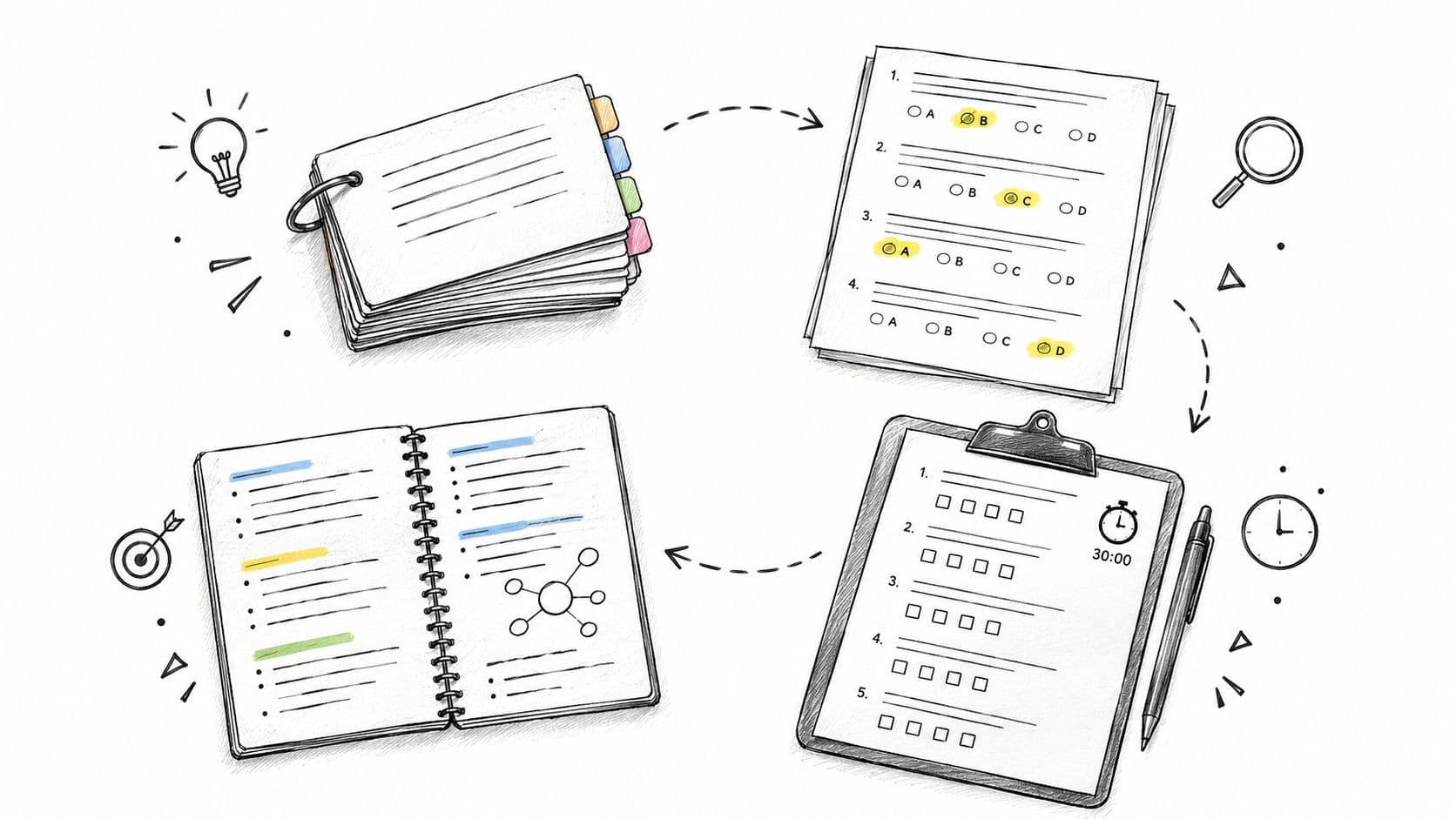
Use a weekly cycle that separates learning tasks from submission tasks:
- Review: Revisit lecture notes and identify unclear concepts.
- Retrieve: Test yourself without looking at the answer.
- Discuss: Ask classmates or a tutor about ideas, not about copying responses.
- Apply: Solve a new problem, outline an argument, or explain a method independently.
- Audit: Check sources, collaboration rules, and permitted tools before submitting.
This approach helps because it replaces panic with visible, manageable decisions. If you fall behind, contact an instructor, advisor, learning center, or counseling service early. Seeking support is compatible with academic integrity. In many cases, it is what makes an honest choice possible.
Sharing resources responsibly
Students can contribute to a healthier study community by sharing materials that they created and have the right to distribute. Remove private information, copyrighted pages, answer keys that aren't yours, and anything that could be mistaken for a submission. Label summaries and notes clearly as study resources, not completed coursework.
A sustainable routine also includes rest and realistic planning. Exhaustion makes it harder to track citations, distinguish a paraphrase from copied wording, or interpret a complicated AI policy. Protecting your degree value doesn't require perfection. It requires enough structure to notice uncertainty before it becomes a submission problem.
Academic integrity matters because it keeps your grades meaningful, your learning visible, and your qualification credible. Use support to understand the work, ask questions when policies are unclear, and submit only what you can explain and defend.
CramShare offers course-specific lecture notes, summaries, revision guides, past papers, and practice materials that students can use to support independent study. Visit CramShare to find resources matched to your course or share original study materials responsibly.