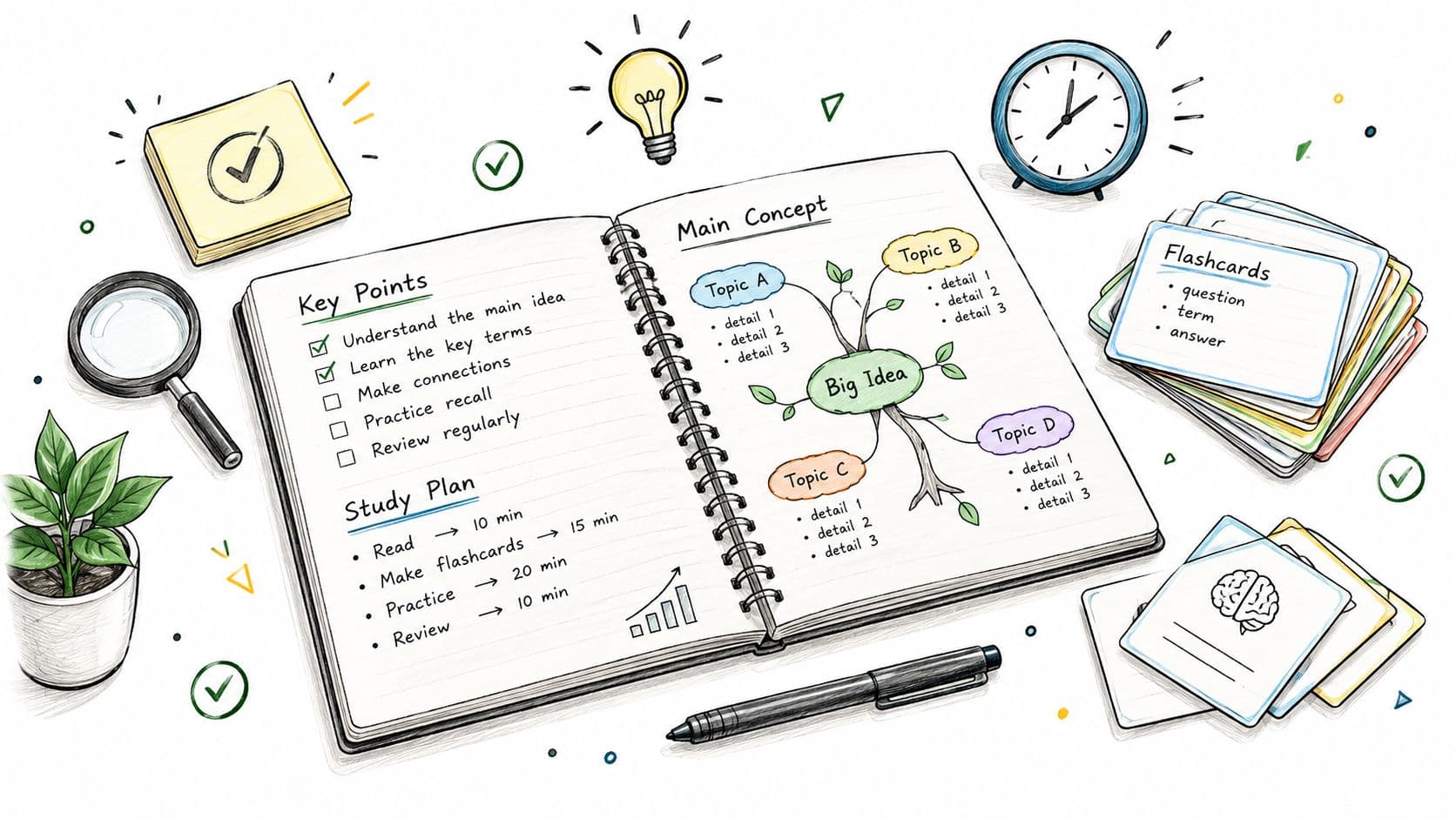
Chapter 5 Summary: Study-Ready Guide
Master your chapter 5 summary with a structured revision approach. Learn how to create, verify, and use summaries for deeper understanding and stronger recall.

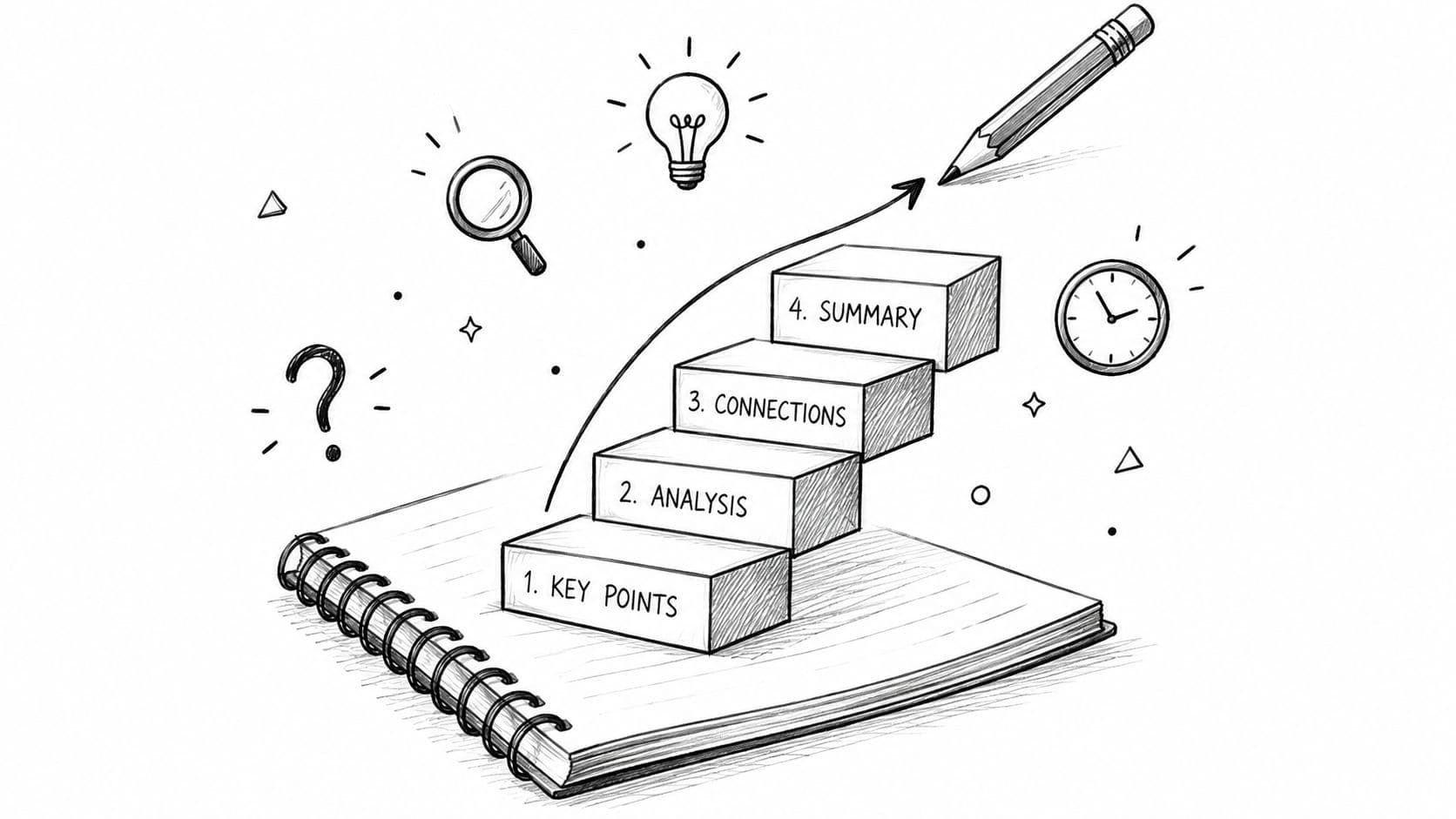
Most students are told to summarize a chapter because it feels like proof of learning. You read the pages, rewrite the important parts, and end up with a neat document that looks exam-ready. But a chapter 5 summary can give you confidence without giving you reliable recall.
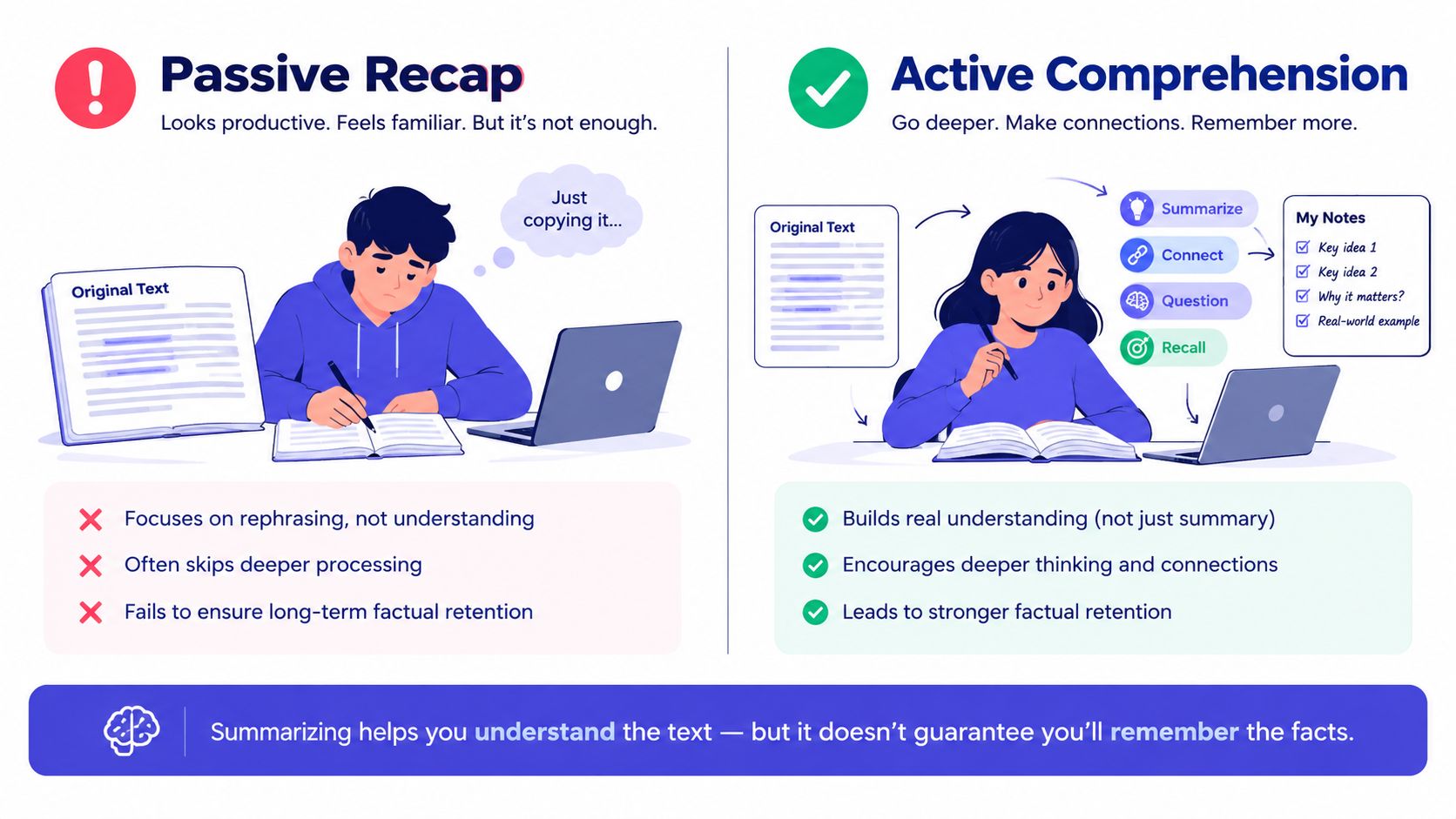
The problem isn't summarizing itself. Summarization can help you understand a chapter's structure, arguments, and meaning. The problem is treating that understanding as if it were the same as remembering facts under exam pressure. A useful summary should be a map for active retrieval, not a shortened copy of the textbook.
The Hidden Trap of Passive Summarizing
A summary isn't automatically an effective revision tool just because you wrote it yourself. In a 2023 classroom study comparing summarization, factual retrieval practice, and restudy, summarization produced a stronger positive effect on text comprehension than factual retrieval practice and a similar effect to restudy. Factual retrieval practice, however, produced a stronger positive effect on text retention than both summarization and restudy according to the classroom study on summarization and retrieval (opens in a new tab).
That distinction matters. Comprehension means you can follow the chapter's central argument, see how its ideas relate, and explain its general meaning. Retention means you can reproduce specific definitions, dates, formulas, mechanisms, or examples later, without the page open in front of you. Exams often require both.
Why your own notes can still mislead you
Rereading a polished summary creates familiarity. The terms look recognizable, the paragraphs flow smoothly, and you may feel that you know the material. Yet recognition is easier than reproduction. In an exam, the question won't always provide the wording, order, or context that helped you recognize the answer during revision.
A strong summary should therefore answer questions such as:
- What is the chapter's central claim?
- Which concepts support that claim?
- What evidence or examples make those concepts clear?
- Which terms must be defined precisely?
- How does Chapter 5 connect with earlier material?
For younger learners in authentic classroom settings, the same 2023 study found that summarization had a stronger effect on text comprehension than factual-question retrieval. That finding reinforces the useful role of summaries, but it doesn't turn them into complete memory systems. Use the summary to understand the material first, then test whether you can retrieve and apply it.
Practical rule: If you can only understand the summary while looking at it, you haven't finished studying it.
Building a Summary That Maps to Outcomes
Start with the course, not with the chapter's paragraphs. Before writing, check the assigned textbook edition, lecture slides, module description, and learning outcomes. Your lecturer may use a term, example, or model differently from a generic online overview.
Begin with the chapter's thesis
Write one sentence answering: What is Chapter 5 mainly trying to explain, prove, or help me do? Don't begin by copying the first paragraph. A chapter's thesis may appear in its introduction, conclusion, learning outcomes, or repeated transitions between sections.
Next, turn every major heading into a question. “Market segmentation” becomes How does market segmentation divide a target market, and why does that matter? “Cellular respiration” becomes How does the process convert stored energy into a usable form? Questions force you to identify what a section is doing rather than merely recording what it contains.
For each question, capture three layers:
- The answer in your own words. This demonstrates comprehension.
- One important definition, relationship, or piece of evidence. This preserves examinable precision.
- One example, implication, or possible confusion. This helps you apply the idea beyond the chapter's exact wording.
Technical subjects need an additional structure. For each major concept, record:
- The governing concept, or the rule or model involved.
- The causal chain, showing what changes what and why.
- A representative example, preferably one connected to lectures or tutorials.
- A common misconception, such as confusing correlation with causation or reversing a process.
The result shouldn't include every sentence. Remove repeated explanations, decorative examples, and details that don't connect to a learning outcome or assessment task. But don't force the document to be as short as possible.
A slightly longer summary is more useful when every point helps you answer a question, explain a relationship, or solve a problem.
Finish by closing the textbook and writing the chapter framework from memory. Then compare your version with the source and mark omissions. Those omissions are more valuable than another passive rereading because they show you where your mental map is incomplete.
Why You Need Retrieval Practice Alongside Summaries
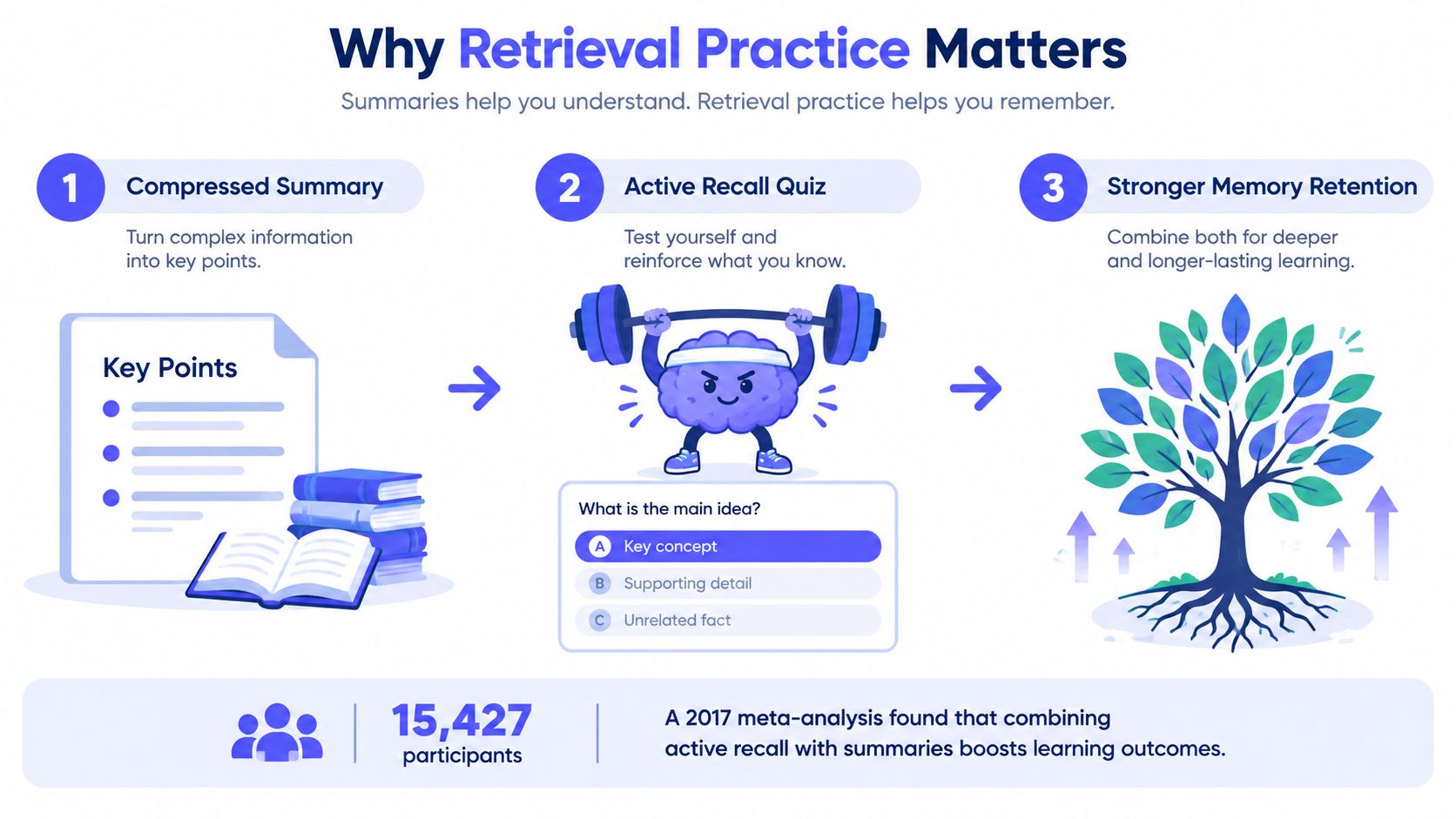
A summary organizes knowledge. Retrieval practice strengthens access to it. The difference is simple: rereading asks your brain to recognize information, while retrieval asks you to produce it without support.
A 2017 meta-analysis brought together nearly a century of research, including 15,427 participants and 272 comparisons between learning with and without retrieval practice. It reported an average effect size of 0.70, with a 95% confidence interval from 0.63 to 0.78, indicating a substantial advantage for recalling information from memory in the meta-analysis of retrieval practice (opens in a new tab).
Use the summary as a map
Read a section of your chapter 5 summary, then cover it. Answer questions such as:
- What is the chapter's main argument?
- Which terms need exact definitions?
- Which dates, formulas, stages, or mechanisms matter?
- What evidence supports the central claim?
- How does this material connect with an earlier chapter?
- Can I apply the idea to a new example?
Write or speak your answer before checking the summary. When you check, don't reread everything automatically. Identify the missing point, correct the error, and test that specific point again.
This two-part system works better than choosing between summarizing and testing. Summarization helps you organize meaning. Retrieval practice exposes whether that meaning is available when support disappears. For more practical revision methods, use these exam study techniques alongside your summary.
The short video below reinforces the difference between recognizing notes and actively recalling knowledge.
Watch the video on YouTube (opens in a new tab)
Turning Your Summary Into a Self-Test Engine
The best test of a chapter 5 summary is not whether it looks concise. It's whether you can use it to answer questions with the original chapter closed.
A large review covering 242 studies, 1,619 effects, and 169,179 participants found that summarization had weaker overall support than practice testing and distributed practice, although summarization still produced positive learning effects in the review of learning techniques (opens in a new tab). Build your summary so it naturally leads to testing.
Convert headings into prompts
Take each major heading and rewrite it as a question. Then create different prompt types rather than repeating one format:
- Definition prompt: What does the central term mean in this chapter?
- Explanation prompt: Why does one variable affect another?
- Comparison prompt: How are the two models similar and different?
- Application prompt: How would the concept work in a new case?
- Correction prompt: What mistake would a student commonly make here?
For example, a heading such as “Supply and demand” might become: What causes a movement along a demand curve, and what causes the curve itself to shift? That question demands a distinction, not a copied definition.
Test reproduction, not recognition
Cover the answer and respond from memory. Short-answer questions are especially useful because they require you to organize an answer rather than identify a familiar option. Flashcards can work well when each card contains one clear prompt and one answer, but avoid putting an entire section on one card.
A useful summary should let you:
- Answer the prompt without opening the chapter.
- Explain the concept in plain language.
- Give an example or apply the idea.
- Identify what you got wrong.
- Retest the failed point later.
If you can't do these things, the summary needs clearer prompts or better explanations. More highlighting won't solve the problem.
Course-Specific Summaries vs Generic Overviews
A generic Chapter 5 overview may explain the broad topic correctly and still be wrong for your exam. Textbook editions, module terminology, lecturer emphasis, assigned case studies, and assessment formats vary. University study guidance recommends mapping headings and subheadings to learning outcomes, then turning those outcomes into questions in this university study guidance (opens in a new tab).
The shortest summary isn't necessarily the most useful. A course-specific document can be longer if each point earns its place by supporting an outcome, definition, calculation, comparison, or application.
Before relying on any shared resource, check the textbook edition, course code, module title, and academic year. If those details don't match, treat the document as background support rather than as your definitive Chapter 5 guide.
Using AI for Summaries Without Losing Accuracy
AI can help you study, but speed doesn't remove the need for verification. A 2025 HEPI student survey reported that 92% of students used AI in some form, up from 66% in 2024, while 88% had used generative AI for assessments, up from 53% in the HEPI student survey (opens in a new tab). The same evidence identifies concerns about false or biased results and academic misconduct.
Use AI as a study assistant, not as an unverified authority or a substitute for your own assessed work. Asking it to explain a difficult concept, compare two theories, generate practice questions, or identify gaps in your draft may be permitted. Submitting generated prose as if you wrote it yourself may violate your institution's rules.
Run every summary through a verification checklist
- Check definitions: Compare every key term with the assigned textbook and lecture materials.
- Check quotations: Confirm the exact wording, author, and page before using any quotation.
- Check statistics and formulas: Recalculate or verify each numerical detail against the original source.
- Check page references: Make sure the cited page exists in your edition.
- Check omissions: Compare the AI output with learning outcomes and lecture headings.
- Check permissions: Read your institution's policy and document AI use when required.
Label the document clearly as human-created, AI-assisted, or another accurate description. Your final study material should be something you understand and can defend, not text you accepted because it sounded confident. For a fuller discussion of responsible study conduct, read why academic integrity is important.
Creating a Spaced Retrieval Workflow
Turn your chapter 5 summary into a repeated cycle:
- Read for structure. Identify the thesis, major concepts, relationships, and evidence.
- Close the source. Reconstruct the framework from memory.
- Test factual detail. Recall definitions, formulas, dates, stages, or mechanisms.
- Test transfer. Explain a causal link or apply the model to a new case.
- Check and correct. Record only the omissions and errors.
- Repeat after increasing intervals. Test immediately, later the same day, after roughly 24 hours, and again several days later.
The exact interval should respond to your performance. If recall is weak, test sooner. If you can explain the framework and apply it accurately, widen the gap. This is the logic behind spaced repetition tools, but you can also use paper cards, a document, or a simple question list.
Mix factual and transfer prompts. “Define the model” checks precision. “Explain why variable A changes outcome B” checks relationships. “Apply the model to a new case” checks whether you can use the concept outside the wording of the chapter.
Don't repeatedly reread the complete summary after every mistake. Mark the failed concept, repair it with the source, and retest it. CramShare offers course-specific summaries, lecture notes, revision guides, past papers, and practice materials that students can search by institution, course code, textbook, module, and academic year, which can help you compare your own Chapter 5 materials with resources matched to your course.
Build your Chapter 5 summary around questions, verify it against your exact course materials, and test yourself with the source closed. Browse CramShare to find course-specific study resources that can support your revision without replacing your own learning or your institution's academic-integrity requirements.