Academic Integrity Definition Explained for Students
Learn the academic integrity definition, its 6 core values, and what counts as plagiarism, cheating or AI misuse. Clear examples for students.
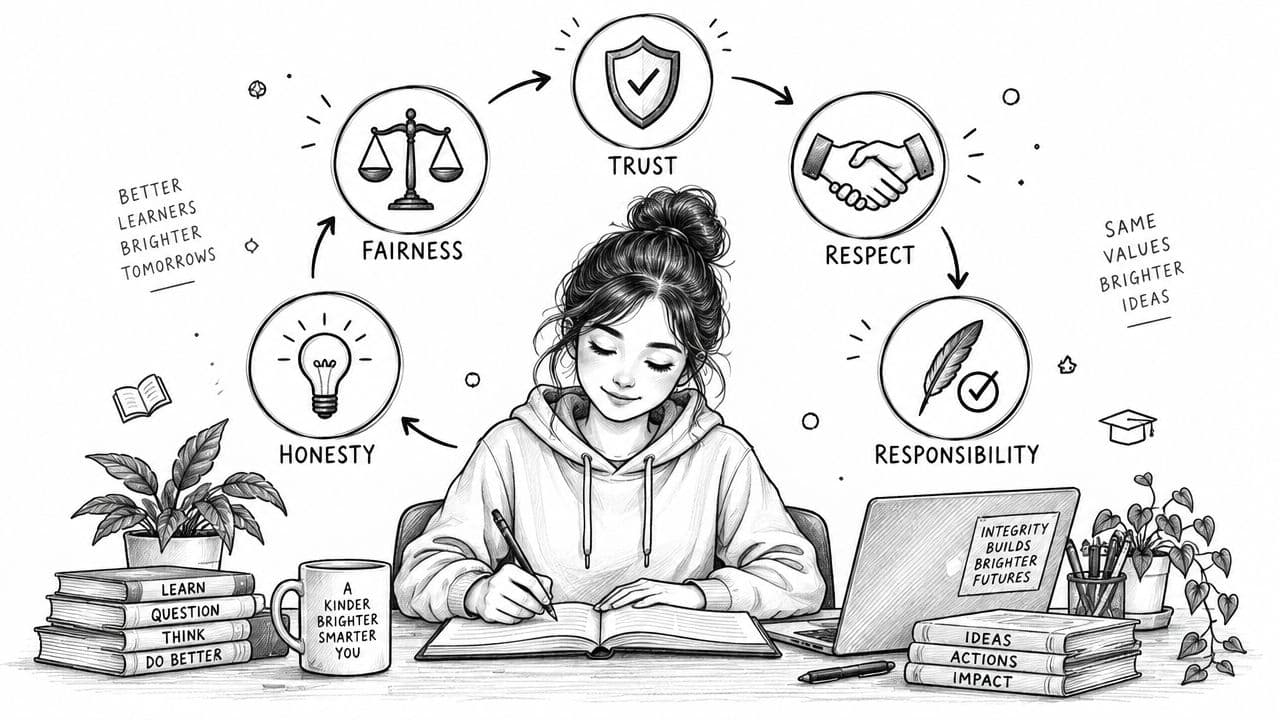
Academic integrity is the commitment to honesty, trust, fairness, respect, responsibility, and courage in learning, and it means work submitted for credit must be original, properly attributed, and produced under permitted conditions. In practice, that covers far more than avoiding copy and paste, because students also run into questions about paraphrasing, collaboration, and AI use.
You've probably had the moment already. You're staring at an essay draft, wondering whether a reworded paragraph still needs a citation, whether group notes count as shared authorship, or whether the AI tool you used to brainstorm just crossed a line. The reason this feels confusing is that academic integrity is not only a moral idea, it's also a set of assessment rules that universities use to protect the credibility of grades and credentials, and those rules shape what counts as acceptable work in essays, labs, code, exams, and group projects (university reporting and policy context (opens in a new tab)).
A plain definition helps, but a useful one goes further. It connects values to everyday decisions, so you can tell the difference between legitimate study support and a submission that misrepresents your own effort. For a course-specific example of how students organize legitimate support materials, see study resources for university courses.
Introduction What Academic Integrity Really Means for Students
A student can follow the rules in one area and still slip in another. A paragraph that is too close to a source, an idea used without credit, or AI help that replaces the student's own thinking can all create integrity problems. The clearest academic integrity definition starts with real student work, not a dictionary entry.
A useful way to read it is this. Academic integrity means your submission shows your own effort, your own understanding, and the assignment's rules. It also means being honest about where words, ideas, data, code, and outside help came from. Universities treat those rules as part of a system for judging work and responding to misconduct, which is why policy context matters (university reporting and policy context (opens in a new tab)).
A short rule helps here. If an assignment expects independent work, anything that replaces your authorship needs permission or disclosure.
The boundaries shift by task. In an essay, the key question is attribution. In an exam, the key question is whether a source, device, or note was allowed. In coding, the issue is whether borrowed logic, generated code, or teammate help stayed within course rules. In group work, the issue is who contributed what, and whether the final submission makes that clear.
Study aids fit the same pattern. Notes, summaries, revision guides, and practice materials help when they support learning. They stop being legitimate when they take the place of the work you were meant to produce yourself. For students comparing support materials and course expectations, study resources for university courses can be useful as a guide, as long as the final submission still reflects your own work.
The Core Academic Integrity Definition in Plain English
A student opens the assignment sheet, sees a take-home essay, and wonders what counts as help. That question gets to the heart of academic integrity. It is the set of rules that keeps student work honest, comparable, and tied to the right person's effort. Like traffic rules on a busy road, it only works when everyone follows the same signals.
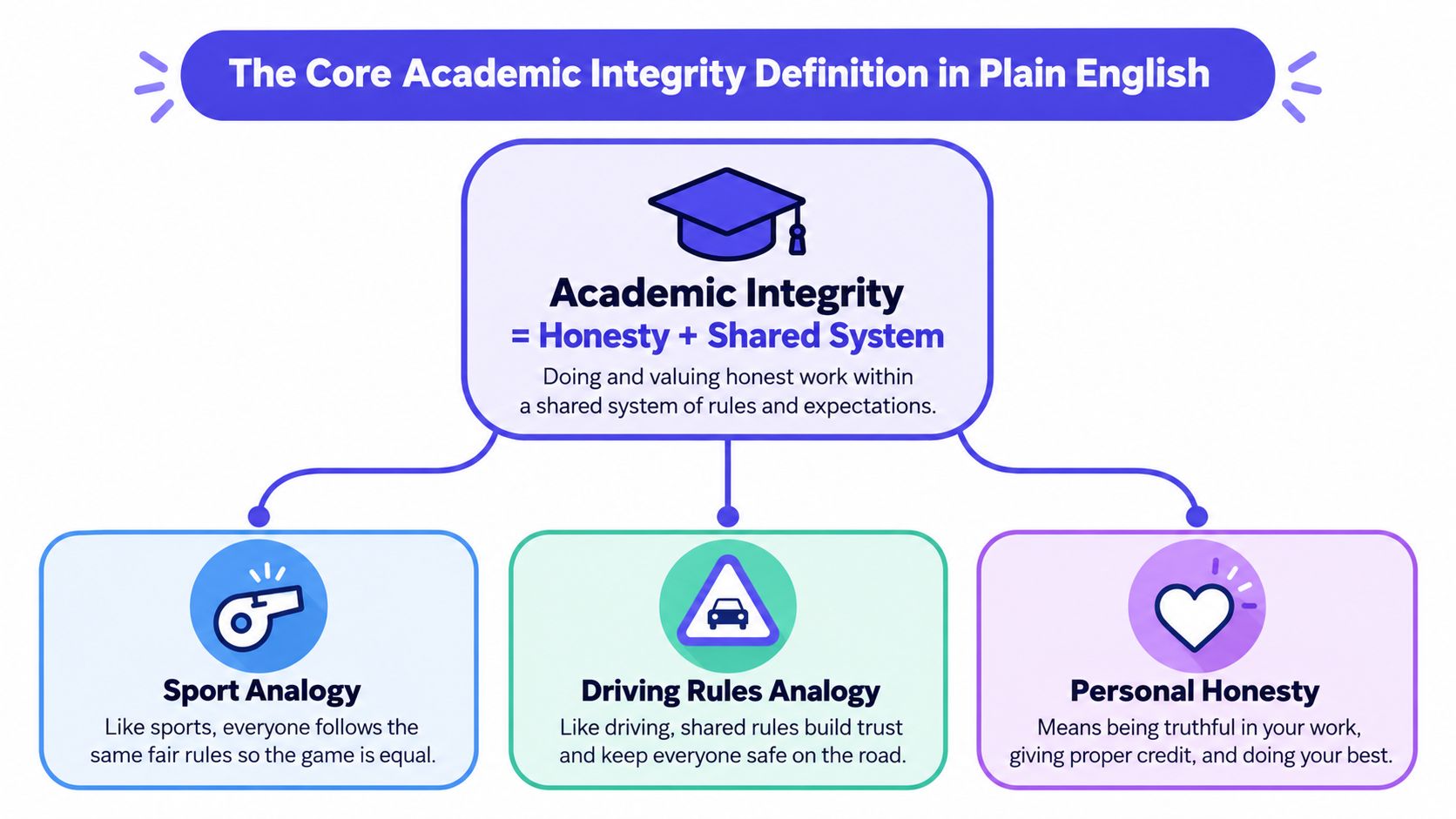
Personal honesty plus shared rules
The plain-English version is simple. Academic integrity means doing your own work, giving credit where it belongs, and following the conditions the assignment allows. University policy frames this idea the same way, original work, clear authorship, and no unearned advantage in submitted work for credit (student policy definition (opens in a new tab)).
That definition is broader than plagiarism. It also covers cheating, collusion, and unauthorized assistance, because each one can make work appear valid when it is not fully the student's own. So instructors are not only asking, “Did you copy text?” They are also asking, “Did you use a banned resource?”, “Did you work with someone when the task required independent work?”, and “Did you make it clear what came from you?”
The boundary depends on the task. In an essay, attribution matters most. In an exam, the key question is whether notes, devices, or outside help were allowed. In coding, the issue is whether borrowed logic, generated code, or teammate support fit the course rules. In group work, students need to show who contributed what, so the final submission reflects the assignment's expectations.
Study aids follow the same rule. Notes, summaries, revision guides, and practice materials support learning when they help you prepare. They cross the line when they do the work for you or replace the submission you were meant to produce yourself. A tutor, a classmate, or an AI tool can all be helpful, but only when the assignment allows that help and you present it the way the course asks.
Why universities treat it as a system
Course policy acts like a set of guardrails. It tells you what sources you may use, how much collaboration is allowed, and whether tools such as calculators, generators, or shared solution sets are permitted. Clear guardrails reduce guessing and make the rules visible before you submit.
Integrity, then, is both ethical and practical. The principle is honesty. The system is the assessment rulebook that tells you how honesty must appear in a specific task.
The Six Core Values That Shape Academic Integrity
The six-value framework gives the academic integrity definition its structure. It's often summarized as honesty, trust, fairness, respect, responsibility, and courage, and each value does a different job in protecting scholarly work (six-value framework (opens in a new tab)). That framework is useful because it turns a broad ideal into something you can test against a real assignment.
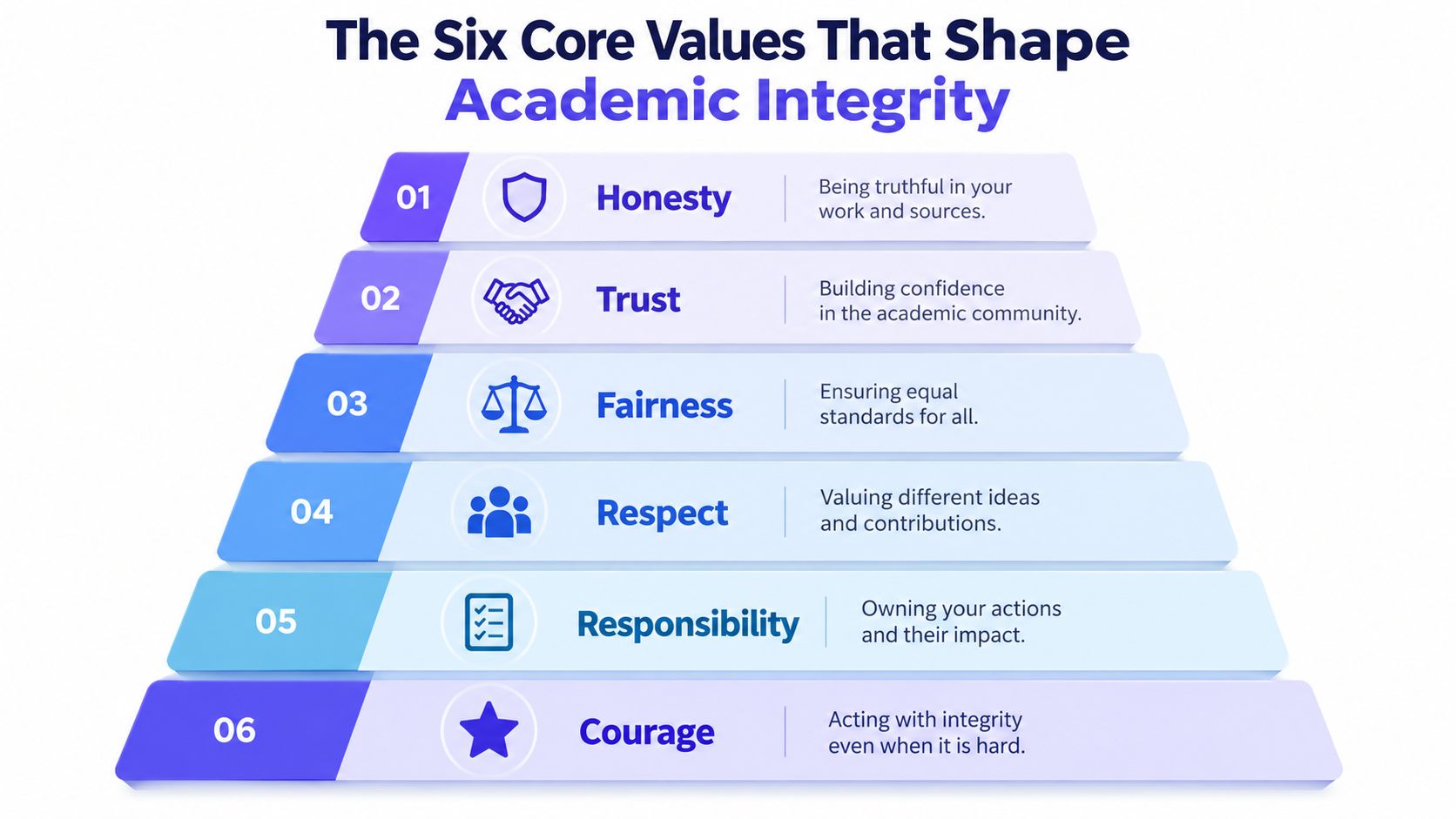
What each value protects
Honesty keeps your work from misrepresenting what you know or did. If you claim an argument, calculation, or paragraph as your own, honesty demands that it really is yours.
Trust lets instructors and classmates rely on the work submitted. Without trust, grades stop meaning anything because every submission becomes suspect.
Fairness protects equal standards. Students should have the same opportunity to succeed under the same rules, not gain hidden advantages through unauthorized help.
Respect protects authorship and contribution. When you cite properly, you show respect for the people whose ideas, words, and data shaped your work.
Responsibility means owning your methods. That includes checking sources, following citation rules, and understanding what your course allows.
Courage is the hardest one to explain, but often the most practical. It means choosing to do the right thing when a deadline, pressure, or competition makes shortcuts tempting.
The six values matter because they work together. If one drops out, the whole structure weakens. A student can be well-intentioned and still violate a rule by misunderstanding attribution, or by assuming collaboration is allowed when it isn't.
Plain version: honesty tells the truth, trust makes the truth usable, and responsibility keeps the process visible.
The framework also shows why academic integrity is broader than plagiarism. A student can be honest about copying text and still violate fairness through unauthorized collaboration, or violate responsibility by using a source without checking whether it can be reused. Those aren't separate moral universes, they're different ways the same definition can break in practice.
Watch the video on YouTube (opens in a new tab)
How Academic Integrity Applies to Real Student Work
A student paper, lab report, presentation, or exam is where academic integrity becomes visible. The policy language may sound formal, but the practical test is simple. Does the work show your own thinking, with outside help clearly marked and allowed by the assignment? The main misconduct categories are plagiarism, cheating, collusion, and fabrication, and each one appears in different ways depending on the task.
Legitimate help versus violations
Where students usually get stuck
The hardest part is the boundary between support and substitution. Study aids are fine when they help you understand concepts, organize revision, or check your memory. They cross the line when they provide the content your assignment was supposed to produce.
A simple way to sort it out is to ask whether the help stayed in the background or took over the work. If a source or tool only helps you think, it can fit within normal study practice. If it starts supplying the wording, structure, answers, or evidence that should come from you, the assignment is no longer showing your own academic work.
Plagiarism is wider than copied sentences. It can include uncredited ideas, paraphrased passages that stay too close to the source, reused data, and material that is not text at all. Cheating is also broader than hiding answers in an exam. It includes any unauthorized resource or device that changes the conditions of the task.
Collusion needs special care because group effort can look harmless from the outside. If the assignment requires individual authorship, even friendly peer help can become a problem when it hides who wrote, solved, or planned the work. The policy description of misconduct categories (opens in a new tab) treats these boundaries as part of the rule, not an afterthought.
Rule of thumb: the assignment instructions decide what help is allowed, not the convenience of the moment.
That is why course rules matter more than general internet advice. A resource can be useful for learning and still be the wrong thing to submit as your own work.
Examples That Clarify Attribution and AI Use Boundaries
A lot of students don't struggle with the idea of integrity, they struggle with the edges. “Did I cite enough?” “Is this paraphrase too close?” “Can I use AI to brainstorm?” Those are the right questions to ask, because the boundary usually lives in the details rather than in the general principle (student-focused discussion of attribution boundaries (opens in a new tab)).
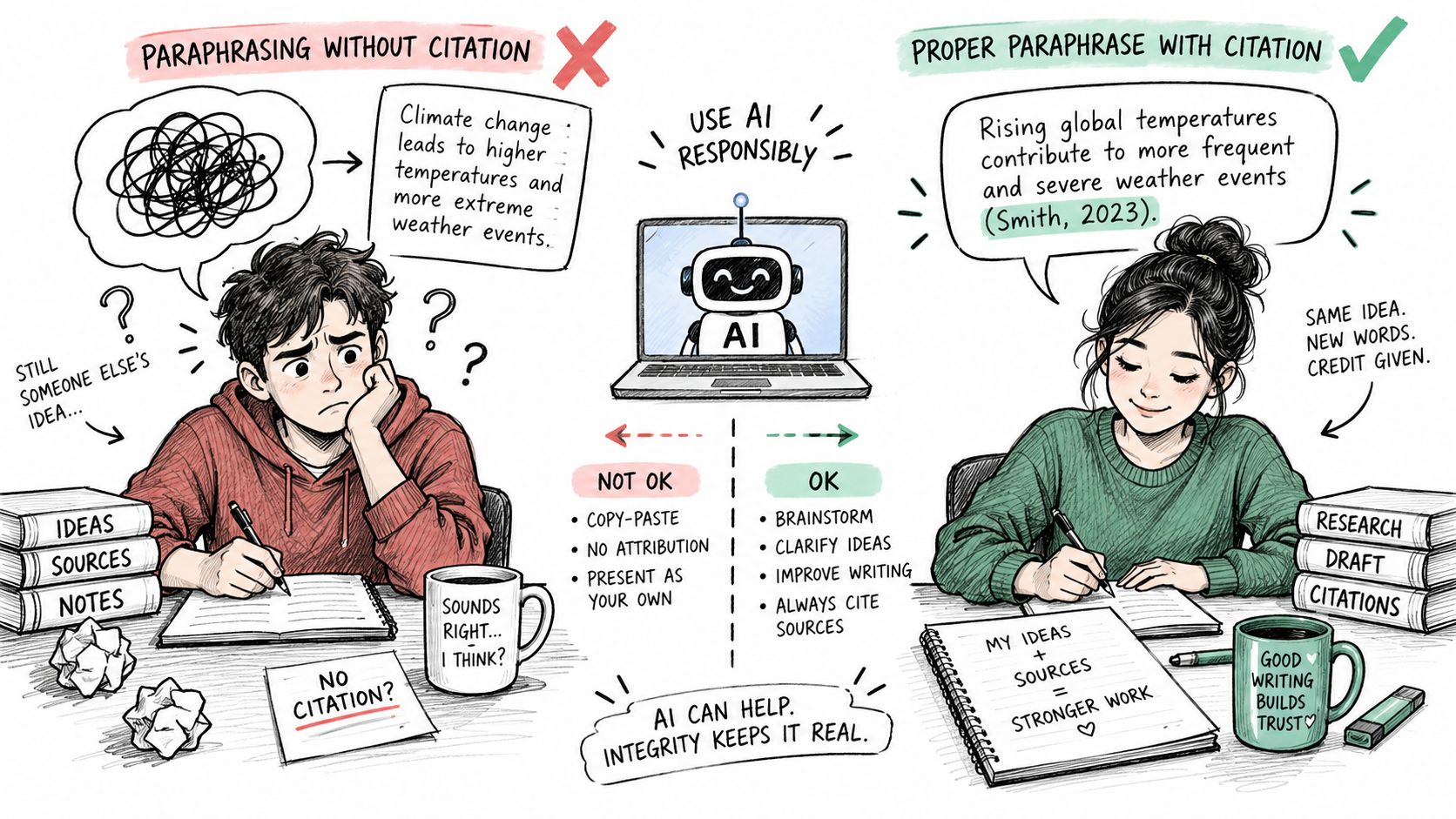
Paraphrasing and idea use
If you change a few words but keep the same structure and meaning from a source, that's still too close to count as independent writing. If you use the source's idea, argument, or example in a meaningful way, you still need to cite it. In other words, changing wording doesn't erase ownership.
A better paraphrase does two things. It restates the idea in your own sentence pattern, and it still gives credit to the original source. The same logic applies to summaries, because a summary is still built from someone else's reasoning.
AI use and disclosure
AI is where the confusion has grown fastest. Recent policy language has framed inappropriate AI use as work that subverts the aims of the assignment or gives the student an unfair academic advantage, and some policies now say plagiarism can include AI-generated material used without acknowledgement (policy framing on AI use (opens in a new tab)). That means the question isn't only whether AI helped. The question is whether the help was allowed, disclosed, and consistent with the assignment's purpose.
Short task examples
- Essay: AI brainstorming might be allowed if your course says so, but submitting AI-written paragraphs as your own isn't the same thing.
- Lab report: using AI to polish grammar can be different from using it to generate analysis or results.
- Code assignment: asking a tool for syntax help is not the same as submitting AI-generated code without permission.
- Group project: a teammate's contribution may be valid, but it still needs to match the course's collaboration rules.
If you're unsure what your class expects, the safest move is to treat AI as a tool for support, not substitution, unless the instructions clearly say otherwise. For a practical reminder about sharing and reusing study materials responsibly, see copyright and original study resources.
Putting Academic Integrity Into Practice Before You Submit
The easiest way to use the academic integrity definition well is to check your draft before you hand it in. That check should be simple and repeatable, because integrity is a habit, not a one-time speech about values. It also helps you catch the small mistakes that turn into big problems later.
A quick pre-submission check
- Originality: Is this your own thinking, your own wording, and your own structure?
- Citation: Did you credit all words, ideas, data, images, and code that came from elsewhere?
- Collaboration: Did any group help match what the course allowed?
- AI Use: If you used AI, did you follow the course rules and disclose it when required?
- Proof Check: Did you review the final version for missing citations, unclear authorship, or accidental reuse?
Those five checks are enough to catch most avoidable problems. They also keep you focused on the purpose of the assignment, which is to show what you can do under the stated conditions.
If you use notes, summaries, or past papers to prepare, use them as learning tools, not as material to recycle into your submission. The safest approach is to study from them, close them, and then write from your own understanding. For students who create and organize their own revision materials, selling study notes online raises the same core question, how do you share helpful learning support without crossing into misrepresentation?
Integrity protects both sides of your academic life. It protects what you're learning now, and it protects the value of the credential you're working toward.
If you want course-specific study materials that help you revise without replacing your own work, visit CramShare to explore notes, summaries, revision guides, and past papers organized by exact course and module. It's a practical way to support your learning while keeping your submissions honest, original, and within the rules that matter.