Academic Integrity Violation: A Practical Student Guide
Understand what counts as an academic integrity violation, see real examples, learn institutional procedures, and discover practical ways
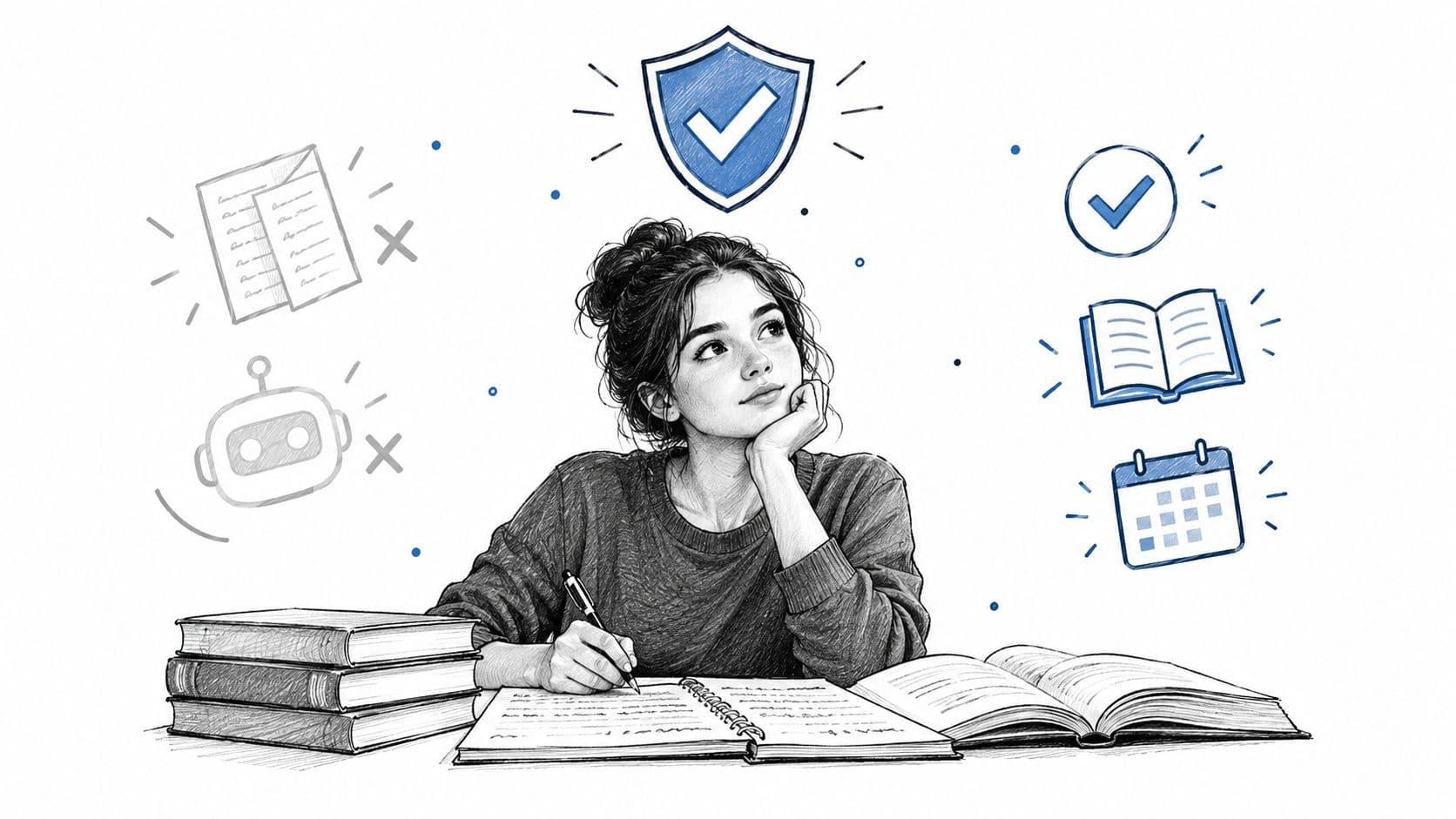
You're staring at a draft due tonight, a shared folder full of old class materials, and a classmate who says, “Everyone uses AI for this.” That's exactly where academic integrity violations stop being abstract policy language and start feeling personal. The tricky part is that the line between smart studying and a problem isn't always obvious, especially when course-specific resources, AI tools, and time pressure all collide.
An academic integrity violation usually means doing course work in a way that breaks your school's rules about authorship, attribution, collaboration, or evidence. It can be obvious, like copying a paper, but it can also be accidental, like reusing an old assignment without permission or relying on a study resource that crosses into prohibited sharing. CramShare's academic integrity guide can be one useful reference point if you're trying to understand how policies describe these boundaries in plain language.
The bigger picture matters too. The International Center for Academic Integrity cites landmark research showing 64% of students admitted to cheating on a test, 58% admitted to plagiarism, and 95% said they participated in some form of cheating, including tests, plagiarism, or copying homework (ICAI facts page (opens in a new tab)). That doesn't mean everyone is dishonest, it means these mistakes are common enough that every student needs a clear framework.
What Is an Academic Integrity Violation
A student submits a discussion post, lab report, or take-home quiz after “cleaning up the wording” and assumes the change is harmless. It may become an academic integrity violation if the final work no longer represents the student's own contribution, sources are not credited, or course rules prohibit the help used. The same action can be acceptable in one class and prohibited in another, so the assignment instructions matter alongside the university handbook.
The practical definition
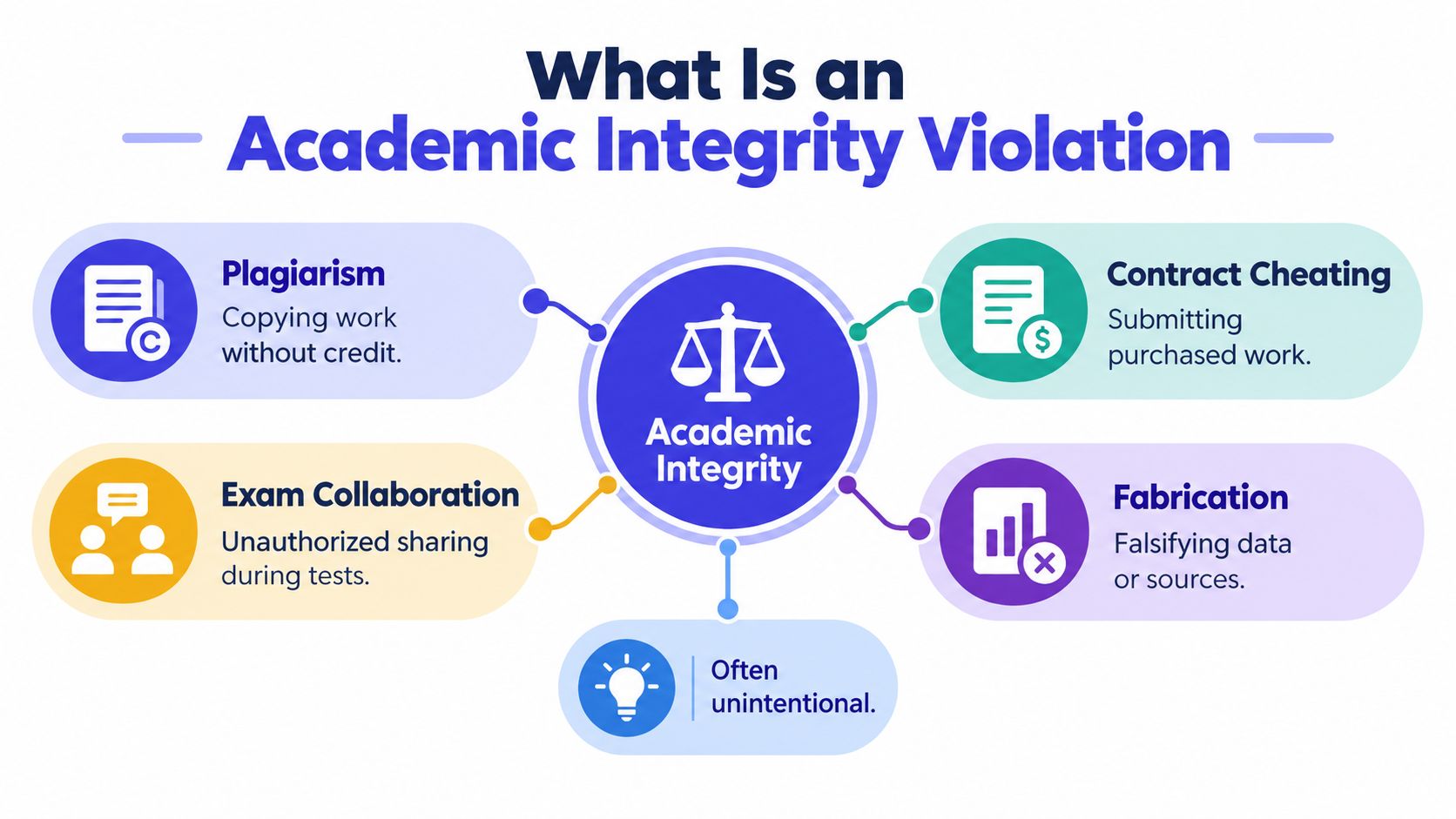
An academic integrity violation is an action that misrepresents your work, sources, collaboration, or data. Examples include plagiarism, unauthorized collaboration, exam cheating, contract cheating, and fabrication. These rules protect fair assessment. A grade has meaning only when students are evaluated under the same stated standards.
The issue has a long history. Earlier research summarized in the ICAI fact sheet found that 75% of university students had engaged in academic misconduct at least once during college (ICAI facts page (opens in a new tab)). University records show that violations remain a present concern. UC San Diego reported about 6,433 alleged violations involving 5,761 unique students over five academic years, while the University of Pennsylvania recorded hundreds of academic integrity cases across recent academic years (UC San Diego reporting data (opens in a new tab)).
A plain-language explanation of the term is available in CramShare's academic integrity guide.
Practical rule: If your submission gives the impression that you produced it independently when you did not, pause and check the policy before submitting.
Why students get tripped up
The difficult cases often begin with an assumption that a resource is “just for studying.” A past paper, solution format, shared document, or AI rephrasing tool may seem similar to ordinary study support. Yet a course might allow general review materials while banning old exam questions, reconstructed answers, or generated text in submitted work.
Course-specific resources can work like a map with restricted areas. Notes may be allowed, while a document containing likely quiz answers is not. A tutor may explain a method, while rewriting the argument for submission crosses the line. The difference depends on what the instructor permits and how much of the final work remains yours.
If another person supplied writing, answers, data, or the structure of your response, look for permission or attribution requirements before using it. When the instructions are unclear, ask the instructor and keep a record of the guidance. Checking first is safer than relying on an assumption after submission.
Common Types and Real Examples
A student opens a shared folder to review notes before an exam. One file contains last year's questions, another includes a polished answer outline, and an AI tool offers to improve a paragraph. Each resource looks like ordinary study help, yet any of them could create an academic integrity problem if the course restricts its use.
Obvious cases are easier to identify. Copying a paragraph without credit is plagiarism, and exchanging answers during a timed quiz is unauthorized collaboration. The harder decisions involve materials that sit between studying and completing assessed work. Where Section 1 defined the categories, the examples below show how each one appears in everyday choices involving AI, classmates, and course-specific resources.
Violation types and examples
A large meta-analysis of higher education contract cheating included 54,514 students across 54 samples. 1,919 students self-reported commercial contract cheating, and the historic average prevalence was 3.52%. In studies from 2014 onward, 15.7% admitted paying someone else to complete work, according to Frontiers in Education (opens in a new tab). The findings support a practical warning: outsourcing services and answer providers deserve careful scrutiny, even when they present themselves as study support.
Directly submitting AI output is an obvious risk. Grammar correction, brainstorming, or rewriting can also breach the rules when the course policy does not permit those uses.
Course-specific resources work like a map with marked boundaries. A general study guide may be allowed, while a file containing likely quiz answers may not be. A tutor can explain a method, but rewriting the argument for submission may transfer authorship away from the student. A past paper can support practice, yet using a leaked or restricted version to predict graded questions changes the situation.
Before using shared notes, solution manuals, old assignments, or AI assistance, check both permission and authorship. If another person supplied the wording, answers, data, or structure, look for an attribution requirement or ask the instructor. Keep the guidance you receive. A short question before submission can prevent an assumption from becoming a violation.
How Universities Investigate Violations
You submit an assignment, then receive a notice saying a professor has raised an academic integrity concern. The message can feel alarming, especially when the issue involves a shared study file, an AI tool, or wording that resembles another source. The investigation gives both the university and the student a structured way to establish what happened.
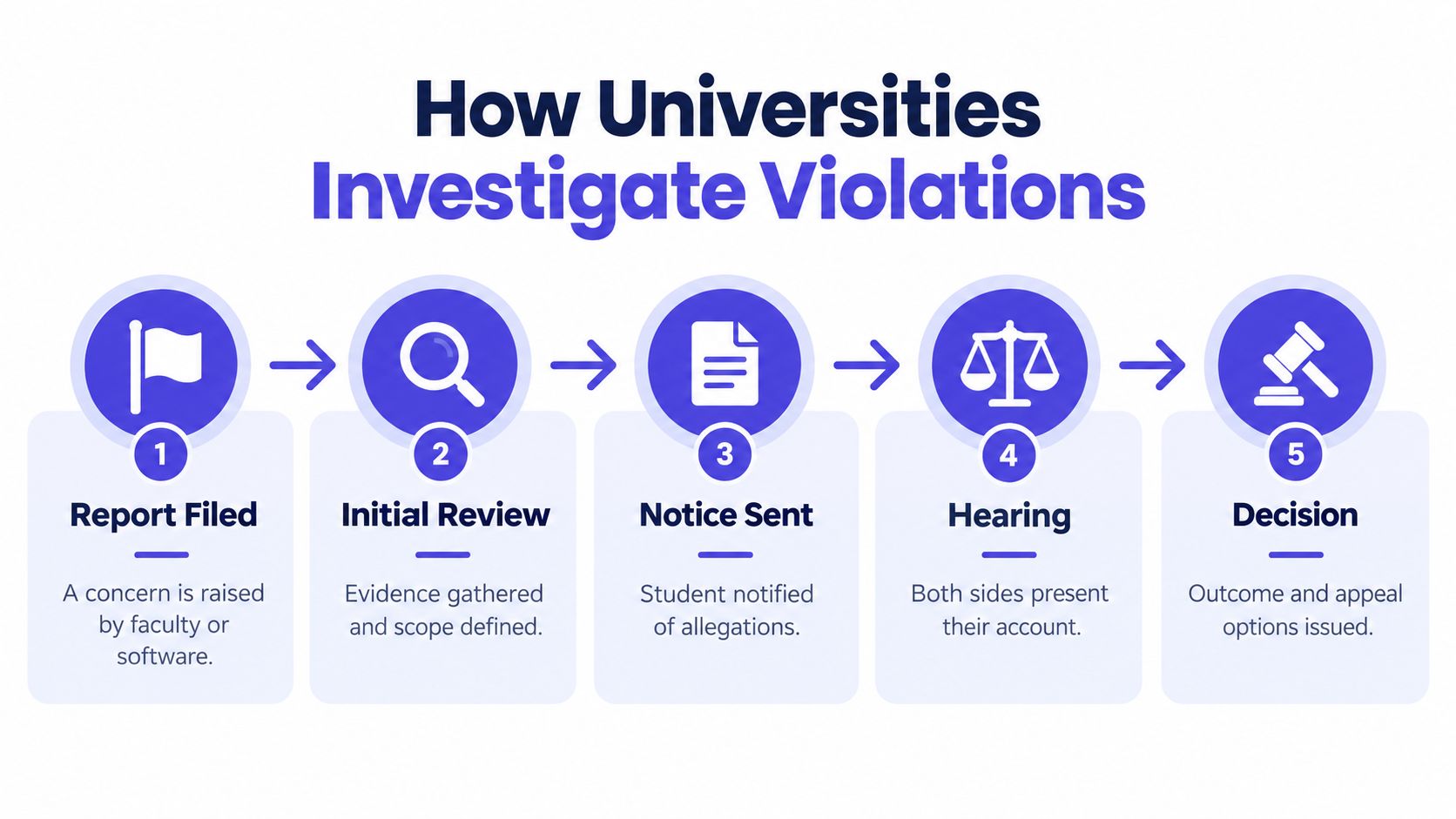
Universities handle these cases through an administrative process. A professor, teaching assistant, or system may raise a concern, an office may review the evidence, and the student usually has an opportunity to respond. UC San Diego's records show that academic integrity caseloads can rise sharply during disruption periods before moving closer to earlier levels (UC San Diego reporting data (opens in a new tab)). This context matters. A report begins a review, not an automatic finding of responsibility.
What usually happens first
The initial concern may involve matching text, unusual exam behavior, an answer pattern, or material that appears to come from a restricted course resource. Text-matching tools compare work with academic and web sources, so they can identify possible copying in written assignments. A systematic review on detection (opens in a new tab) also helps explain why detection tools require human judgment. A match can point to a question, but it does not by itself establish intent or show whether the wording came from an allowed source.
The university then identifies the assignment, relevant instructions, policy language, and available evidence. The student receives notice and a chance to explain. In gray-area cases, the central question is often how a resource was used. A general concept guide may support learning, while a file containing likely quiz answers may undermine the assessment. A tutor's explanation may be permitted, while rewriting the submitted argument may change who authored the work.
What students should pay attention to
Read the notice closely. Check the evidence, the rule cited, the response deadline, and whether the concern involves permission, attribution, or authorship. Describe shared notes, solution manuals, AI assistance, or personal help precisely. Keep drafts, notes, source lists, and messages that show how your work developed.
A clear explanation is more useful than a defensive one. If the course policy was unclear, identify the exact point of confusion and ask how the rule applies. The process is meant to determine whether the submitted work fits the course requirements.
Watch the video on YouTube (opens in a new tab)
Consequences and Potential Penalties
If a case is confirmed, the outcome depends on the policy and the seriousness of the violation. A minor first-time issue might lead to a warning, a reduced grade, or a chance to resubmit. More serious cases can bring failing grades on the assignment, failing grades in the course, notation in the institution's record system, or stronger sanctions.
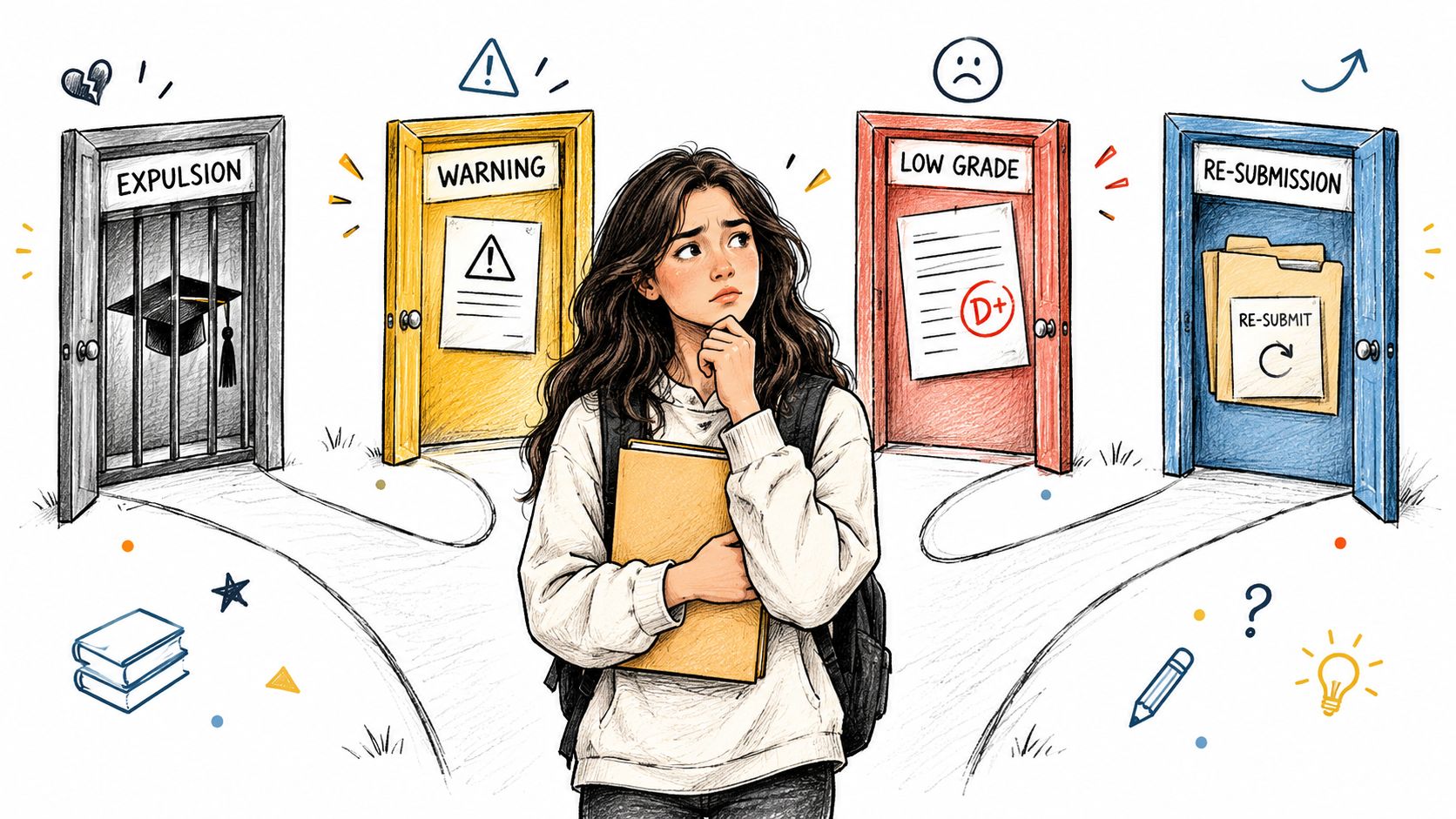
The exact penalty usually depends on intent, prior history, the amount of work involved, and whether the student cooperated. A student who misunderstood a citation rule may be treated differently from someone who purchased an assignment. Schools also think about course level and whether the misconduct affected a major assessment.
Why the stakes extend beyond one class
An academic integrity violation can shape more than a grade. It may affect scholarships, academic standing, eligibility for certain programs, and how a record looks if a pattern develops. Even when the sanction stays inside one course, the stress can spill into future registration and advising.
Appeals are usually limited to specific grounds, not a general request to “try again.” That's why students should keep drafts, notes, source lists, and assignment instructions from the start of the term. Those records can help show what you did, when you did it, and whether the misunderstanding was honest.
The best response is calm and prompt. Read the notice, preserve evidence, and answer the exact allegation rather than every fear that comes with it. Students often make their situation worse by guessing, overexplaining, or deleting materials that could have helped them.
How to Avoid Unintentional Violations
Most students do not wake up planning to break the rules. They get rushed, confused, or unsure about what counts as acceptable help. That means prevention isn't about paranoia, it's about building habits that keep small misunderstandings from becoming formal cases.
Read the assignment like a policy document
Start with the syllabus, the assignment sheet, and any class announcements. If the instructor says no AI, treat that as no AI unless they clarify otherwise. If the instructions are vague, ask a direct question before you start. A quick message is easier than a misconduct meeting later.
Useful habit: keep a running note of every source, every borrowed idea, and every tool you used while the work is still fresh.
Treat study resources as permission-based, not free-for-all
Past papers, exam banks, shared notes, and solution manuals can be legitimate study aids in some settings and prohibited shortcuts in others. That's why it helps to use a course-specific resource platform such as CramShare's study material download guide as a reminder that access and permission are not the same thing. If a document clearly belongs to a course you're enrolled in, still check whether the assignment allows reuse or whether the material itself was meant to stay private.
A few checks can save you trouble:
- Plan ahead: start early so you're not tempted to copy or over-rely on outside help.
- Cite as you write: don't wait until the final draft to remember where an idea came from.
- Secure your work: protect shared drives and documents so nobody can edit your files without you noticing.
- Ask when unsure: ask the instructor, not a rumor-heavy group chat.
- Understand the rules: read the honor code and the AI policy before you submit.
The practical goal is to make honest work easier than risky work. If you leave citation until the end, keep sloppy notes, or share files too loosely, you create the exact conditions where unintentional violations happen.
Building a Personal Integrity Framework
Academic integrity gets easier when you stop treating it as a last-minute compliance task and start treating it as part of your study system. That means deciding in advance how you'll take notes, when you'll cite, what tools you'll use, and what you'll never submit without checking. A personal rule set turns unclear moments into quick decisions instead of panicked guesses.
One useful habit is to create a simple checkpoint before every submission. Ask yourself whether every borrowed idea is cited, whether every source is allowed, whether every collaborator is permitted, and whether any AI or study aid matched the course policy. If the answer is fuzzy, pause and verify before sending the file.
This is also where smart resource use matters. Platforms like CramShare's page on selling study notes online show that student-created materials can have value when they're original and properly shared, but that same idea depends on clear authorship and permission. Your own notes, drafts, and study guides should support learning, not blur the line between help and substitution.
A clean academic record protects more than your GPA. It protects your reputation with instructors, your confidence in your own work, and the trust that future programs or employers place in your achievements. That's why the safest approach is to build habits that make the right choice the easy choice.
If you want a practical place to look for course-specific study materials while staying mindful of academic rules, CramShare can help you find and organize resources by course, module, and academic year. Use it as a study aid, keep your own institution's policies in view, and choose materials that support your learning without crossing the line into misconduct.