Example of Classification Essay: 7 Samples Explained
See 7 example of classification essay samples with thesis, categories, and paragraph breakdowns to write a clear, structured essay fast.

You've opened your assignment brief, typed a possible title, and listed a few categories. Then you notice the problem: some examples fit everywhere, others fit nowhere, and your outline looks more like a shopping list than an essay.
A strong example of a classification essay shows more than a set of labels. It identifies what's being grouped, explains the rule for grouping it, and uses examples to show why the distinctions matter. Tidewater Community College's classification guidance (opens in a new tab) distinguishes classification, grouping related items, from division, breaking an item into its component parts. Classifying study resources therefore differs from describing the sections inside a study guide.
Start with the boundary: Your reader should understand not just why an example belongs in a category, but why it doesn't belong in the neighboring category.
The samples below use familiar coursework situations, from lecture notes to research proposals. Each offers a thesis, a workable classification system, and sample prose with commentary you can apply to your own draft. Treat them as models for reasoning, not submission-ready assignments. Your module's instructions, required readings, and marking criteria should determine the final scope.
1. Classification of Note-Taking Methods
Your notebook provides a useful starting point because you can classify actual pages rather than make assumptions about students. For this sample, classify notes by their dominant visual structure, not by how effective you think they are.
Sample thesis: Lecture notes can be grouped into sequential, spatial, and partitioned formats according to how writers arrange information, and each format makes different relationships available for later review.
Build Categories Around Observable Features
Use named methods as examples within broader categories:
- Sequential formats: Place outline notes and sentence-based notes together when the writer records information in a reading sequence.
- Spatial formats: Group mind maps and comparison charts by their use of position, branches, rows, or columns.
- Partitioned formats: Use a Cornell-style page as an example when separate areas hold notes, prompts, and a summary.
Sample body paragraph: Sequential notes arrange a lecture as an ordered record. In a hypothetical history outline, a student places a political event beneath a broader theme and adds supporting details below it. The page belongs in this category because sequence and indentation organize the information, rather than a network of connecting branches.
The paragraph defines the category, supplies a concrete example, and explains the classification decision. Follow that pattern for the remaining groups, keeping the same module topic wherever possible so readers can compare the formats fairly.
For layout ideas you can inspect and adapt, consult these note-taking layout examples. Don't classify the same page by structure in one paragraph and by subject difficulty in another.
Use the video as a visual prompt, then describe the features you can identify in your own notes.
Watch the video on YouTube (opens in a new tab)
2. Classification of Study Resources
A folder containing lecture notes, a textbook chapter, and a practice paper gives you material for a classification essay. The challenge is deciding whether you're grouping documents by format, origin, or learning purpose.
For this sample, choose primary learning purpose. Your categories might be explanation resources, condensed review resources, and practice-and-feedback resources.
Sample thesis: Resources for a statistics module can be classified by their main learning purpose into materials that explain concepts, condense content, and support practice, helping students identify what their current study collection lacks.
A document's title isn't enough to classify it. Inspect what the reader is actually asked to do.
Explain the Difficult Cases
Sample body paragraph: Condensed review resources select and reorganize material for focused revision. A student-authored summary of probability rules belongs here when its main content is a compact explanation of concepts already introduced in the module. If the document instead consists mainly of unanswered problems, it belongs with practice materials, even if its cover calls it a revision guide.
This paragraph makes the boundary usable. It also avoids assuming that every resource has only a single function.
Follow the same pattern for explanation and practice materials: define the purpose, examine a document, and justify its placement. Finish by explaining how the collection could become unbalanced, such as containing extensive explanations but little opportunity for independent practice.
When adapting the sample, check the course code, textbook edition, and academic year against your assignment materials. These study guides for students offer a starting point for thinking about resource selection.
Use solution manuals or exam banks only when authorized. Explain how you would attempt questions independently before consulting permitted answers, rather than treating access to answers as evidence of understanding.
3. Classification of Bloom's Taxonomy Levels for Exam Questions
Consider the difference between defining a concept and defending a decision that uses it. For this sample, classify exam questions by the cognitive task required for a complete answer, using the Bloom's taxonomy labels specified in your course materials.
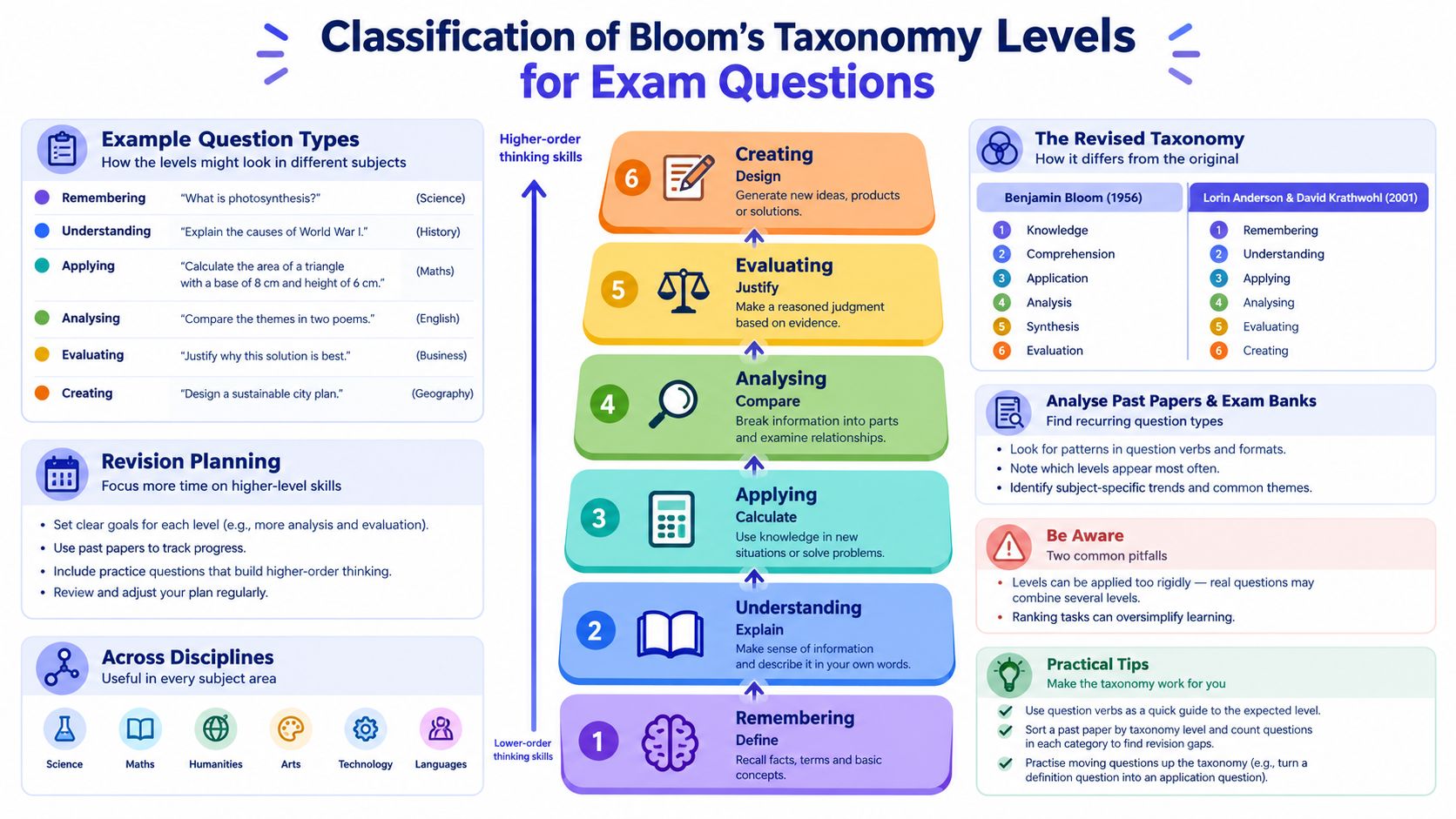
Sample thesis: Questions in a business revision set can be classified as remembering, understanding, applying, analysing, evaluating, or creating, revealing the different kinds of responses a revision plan should prepare students to produce.
Classify the Answer Required
Build your sample around invented practice prompts, clearly identified as illustrations:
- Remembering and understanding: Define market segmentation, then explain the concept in your own words.
- Applying and analysing: Use a supplied segmentation framework, then examine how the proposed groups differ.
- Evaluating and creating: Defend a segmentation choice, then design an alternative approach for the scenario.
Sample body paragraph: An evaluation question requires a defended judgment within this classification. A hypothetical prompt asking students to justify a marketing method belongs here because an adequate answer must connect a choice to explicit criteria. Naming the method alone wouldn't satisfy the task.
The commentary matters: a command verb is a clue, not a complete classification rule. Read the whole question, including its scenario and required evidence, before assigning a label.
For coursework, explain how you'll handle questions containing several tasks. You might classify each subtask separately or use the most demanding required task, provided you state that rule consistently.
Adapt the essay by sorting an authorized past paper and comparing its demands with your revision activities. Use your module's assigned taxonomy reference for formal definitions rather than treating this illustrative outline as the authority.
4. Classification of Research Methods
A dissertation proposal offers a practical setting for a classification essay: the writer needs to explain why a design belongs in a particular methodological group. Keep the categories at the same level instead of placing a broad approach beside a narrower technique.

Sample thesis: Proposed studies of students' study-resource choices can be classified as qualitative, quantitative, or mixed methods according to the evidence they collect and how they combine it to answer the research question.
Show the Reasoning Through a Proposal
For an illustrative outline, use a survey collecting numerical responses, an interview project exploring students' explanations, and a proposal combining both. Confirm the formal category definitions against your assigned methods reading before drafting.
Sample body paragraph: The proposed interview project belongs in the qualitative category because it examines how participants describe their resource choices. The researcher would ask students to explain why they selected particular notes and interpret the resulting accounts. Within this outline, the emphasis is on participants' meanings rather than numerical comparisons between response options.
Follow with a paragraph on the numerical survey. For the mixed-methods category, explain how the evidence would connect, rather than listing separate activities.
A real model for examining that connection is the mixed-method study of genre-based writing instruction (opens in a new tab), which combined writing assessment with an instructional intervention involving model texts, collaborative writing, and feedback. Use it as material to inspect, not as proof that every combined design is automatically well planned.
For a dissertation-focused adaptation, give every category parallel treatment: research question, proposed evidence, analysis plan, and limitations. Don't invent sample sizes or declare a method superior without support.
5. Classification of Revision Strategies
A weak outline might list flashcards, spaced repetition, past papers, and highlighting as equivalent categories. The problem is logical: a student could use flashcards during a spaced schedule, so the categories describe different aspects of studying.
The Portland Community College classification handout (opens in a new tab) supports using a consistent organizing principle and developing categories through examples. Apply that principle by choosing what students do during revision, rather than mixing activities with scheduling decisions.
Sample thesis: Revision activities can be classified by their immediate task into reviewing available information, retrieving information without support, and explaining connections, making it possible to examine the balance of activities in a study plan.
Revise the Mixed-Criterion Outline
- Reviewing available information: Reading an annotated anatomy page while the explanation remains visible.
- Retrieving without support: Answering an anatomy prompt before checking notes.
- Explaining connections: Writing an explanation linking a structure to its function.
Sample body paragraph: Retrieval activities require the student to produce an answer before consulting supporting material. In an illustrative statistics session, a student attempts a practice problem with the worked solution hidden. The activity belongs here because the student must generate a response, regardless of whether the problem appears on paper or a screen.
The paragraph classifies observable behavior without claiming an unsupported improvement in exam results. A separate paragraph can explain that timing and question arrangement are additional dimensions, not competing categories in this particular system.
Boundary test: If your categories answer different questions, such as what students do and when they do it, revise the classification before drafting.
Adapt the sample using your own revision log and these exam study techniques. Describe each activity accurately, then evaluate any effectiveness claims using evidence required by your course.
6. Classification of Academic Sources
A diary, a biography, and an encyclopedia entry can support a classification exercise, but their labels need context. Begin with a defined research question so you can explain the role each source plays in your investigation, rather than sorting documents by appearance alone.
Sample thesis: For an investigation of a historical event, the selected reading materials can be classified as primary evidence, secondary interpretation, and tertiary orientation according to their relationship to the research question.
Make the Category Depend on the Investigation
Use the following as a proposed outline, checking disciplinary definitions against your library or module guidance:
- Primary evidence: A diary examined for its account of the event.
- Secondary interpretation: A biography examined for its interpretation of that period.
- Tertiary orientation: An encyclopedia entry used to establish background and locate further reading.
Sample body paragraph: Within this investigation, the diary serves as primary evidence because the essay examines its account of the event. The writer would identify the relevant passage and explain what it contributes to the research question. Classifying it as primary evidence wouldn't remove the need to consider its perspective, omissions, or suitability.
This paragraph separates source role from source quality. Your remaining paragraphs should do the same, explaining both why the source fits and what a reader should examine before using it.
Don't add “peer-reviewed articles” as a neighboring category without reconsidering your organizing principle. That label asks a different question from the source's relationship to your investigation.
For adaptation, annotate your actual reading list with a proposed category and a sentence defending it. Check publication details, author information, and any peer-review claims through the publication's information rather than assuming the document's appearance establishes its status.
7. Classification of Essay Types by Purpose
Before planning an essay, write down what the prompt requires you to accomplish. For this sample, classify writing tasks by their dominant communicative purpose, while acknowledging that an individual assignment may combine several purposes.
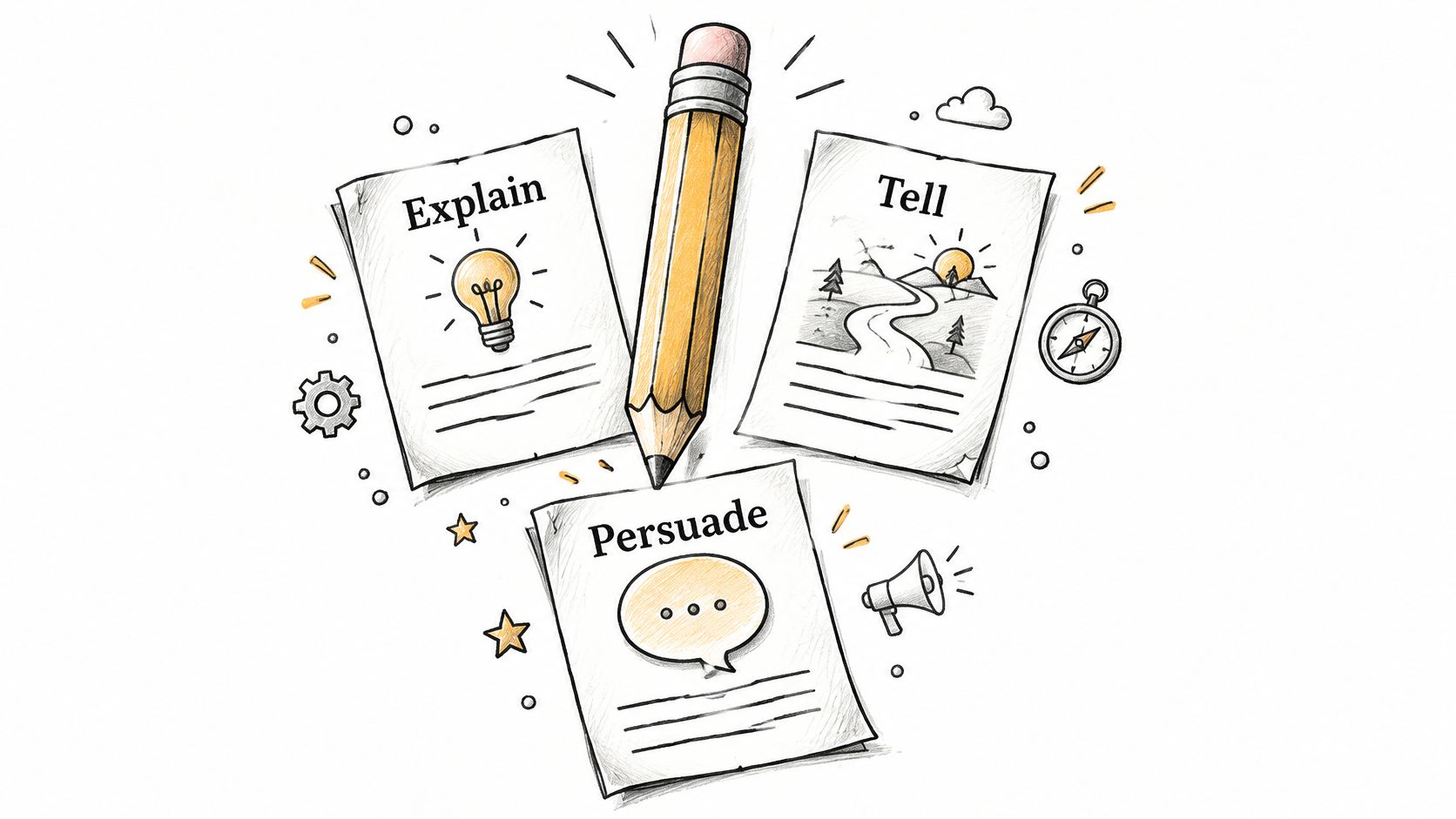
Sample thesis: The selected coursework prompts can be grouped into explanatory, descriptive, narrative, argumentative, and comparative tasks according to their dominant purpose, helping writers align their plans with the requested response.
Match Each Category to a Task
Use hypothetical prompts rather than implying that every department uses identical labels. An explanation of a historical event, a narrative account of a placement experience, an argument about genetic-testing ethics, and a comparison of economic theories provide contrasting material.
Sample body paragraph: Argumentative tasks require the writer to defend a position within this classification. A hypothetical bioethics prompt asking whether a genetic-testing policy should be adopted belongs here because the response must justify a judgment. Background explanation would support the argument, but it wouldn't replace the need for a defensible position.
The paragraph establishes purpose before discussing structure. Develop the other categories with the same distinction between the main task and supporting techniques.
Classify the assignment by what the reader must receive, not by every writing technique the student might use.
To adapt the sample, underline the command words in your actual prompts and read them alongside the marking criteria. Then draft a sample thesis and outline for each category.
Avoid stereotypes such as treating descriptive writing as merely decorative or argumentative writing as personal opinion. Explain what evidence your particular assignment requires, and state how you'll classify prompts that combine comparison with evaluation.
Comparison of 7 Classification Essay Examples
Each sample below uses a distinct organizing criterion. Use the focus column to identify what separates the categories, then check how the practical requirements and essay takeaway follow from that choice.
Turn These Samples Into Your Own A-Grade Essay
Choose a topic you can examine through actual course materials, then narrow the population. “Study resources” may be too broad for your assignment, while “resources used to revise the probability unit” gives you a collection you can inspect and discuss.
Build your thesis around subject, criterion, categories, and significance. A usable formula is: Within the selected scope, the subject can be classified by the organizing criterion into the named categories, revealing a meaningful distinction.
Check the System Before Writing
Use these questions to test your plan:
- Consistent criterion: Does every category answer the same organizing question?
- Clear boundaries: Can you explain why each example belongs where you placed it?
- Adequate coverage: Have you accounted for the collection your essay promises to classify?
- Meaningful insight: Does the grouping explain something beyond the category names?
When an example fits several categories, don't hide the problem. Refine your definitions, narrow the scope, or establish a transparent rule based on dominant purpose. If that still feels arbitrary, reconsider the organizing principle.
Draft each category around a definition, a concrete example, and an explanation of fit. Give comparable attention to neighboring categories, then write a conclusion that explains what readers can understand through the distinctions.
Revise the Reasoning and Preserve Authorship
Review classification logic separately from sentence-level accuracy. Check the thesis and category boundaries first, then examine evidence, transitions, vocabulary, grammar, and mechanics. Read each paragraph against the thesis to catch criteria that changed during drafting.
If your institution permits generative AI, set a boundary before using it. You might ask for questions that test overlap while keeping the actual classification decisions and submitted prose your own; an adaptable disclosure could state, “I used an AI tool to suggest review questions, then checked the categories and wrote the essay independently.”
Use that wording only when it accurately describes your process and satisfies your institution's requirements. The research on student perspectives and motivations around AI use (opens in a new tab) provides context for this discussion, not permission to bypass local rules.
A polished example of a classification essay succeeds through decisions readers can follow. Choose a meaningful criterion, defend the difficult placements, and make every example contribute to the explanation.
CramShare offers a community library and marketplace for course-specific notes, summaries, revision guides, and practice materials. Visit CramShare to find resources matched to your institution, module, course code, or academic year, then use suitable materials to build and test your own classification outline.