Note Taking Method Zettelkasten: A Student Guide
Learn the note taking method Zettelkasten for course-specific study. Discover principles, workflows, and templates to build a lasting knowledge network.


You open a folder from week three, convinced the answer is in there somewhere. There are highlighted slides, a half-finished summary, and pages copied from the lecture in the order they were delivered. You recognize everything, but you can't rebuild the argument from memory. That gap is exactly where the note taking method Zettelkasten helps, because it doesn't ask you to store more material. It asks you to turn material into ideas you can find, connect, and reuse.
Why Your Notes Are Not Working
Most students don't have a storage problem. They have a retrieval problem. You attend a lecture on memory, write down definitions in sequence, file them under the week number, and move on. Two months later, an exam question asks you to compare two explanations of forgetting. Your notes contain both explanations, but they're buried in different weeks, written in the lecturer's phrasing, and never placed side by side.
Ordinary notes preserve the order of delivery. That's useful for reliving a lecture, and it's much less useful for answering a new question. The textbook chapter decided the sequence, not your understanding. When you reread those pages, familiarity feels like mastery, right until you have to produce the idea without the page in front of you.
The Difference Between Storing and Building
A Zettelkasten makes a different choice from the start. You break a topic into individual claims, write each claim in your own words, and link it to related claims wherever they came from. A definition from October can sit next to an example from January and a criticism from a seminar reading, because the connection is conceptual rather than chronological.
That shift sounds small, but it changes what revision means. Instead of hunting for the right document, you start from a question and follow relationships. If you're curious about what the evidence says more broadly, research on note taking and learning offers helpful background on why active processing beats passive copying.
Think of your current folders as a filing cabinet and a Zettelkasten as a conversation. In a cabinet, a note succeeds if it's put away correctly. In a conversation, a note succeeds if it can answer back when you bring a new idea to it.
A note you can't find, explain, or connect later hasn't failed as handwriting. It's failed as knowledge.
You don't need to discard your lecture notes to make this work. Treat them as raw material. The value appears when you extract the ideas inside them and rebuild those ideas into a network that reflects how the subject fits together.
The Core Principles of Zettelkasten
Start with one rule that explains almost everything else. Each lasting note should contain one self-contained idea, get its own stable address, and link explicitly to other notes. The introduction to the method at Zettelkasten.de on the hypertext structure of linked notes (opens in a new tab) describes the system as hypertext-like, because unique identifiers make individual claims referable and links create paths you can follow later.
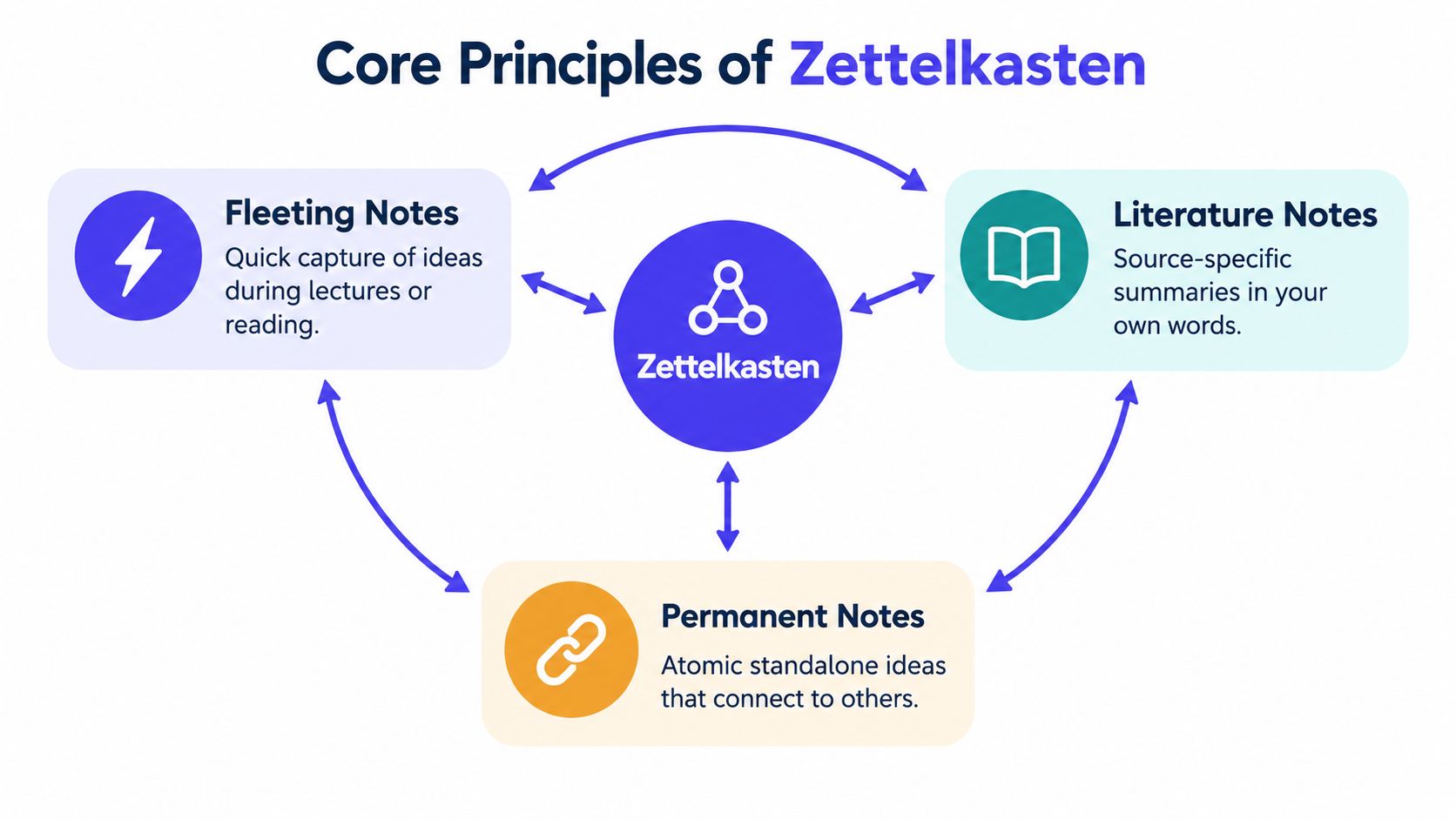
The diagram below maps how the three note types feed into each other, rather than sitting as separate piles.
Three Kinds of Notes With Three Different Jobs
Confusion usually starts when every note tries to do every job. Keeping these roles separate keeps the system light:
- Fleeting notes: You capture a thought quickly during a lecture or while reading, before it disappears. Messiness is fine here, because these notes are temporary prompts, not finished knowledge.
- Literature notes: You summarize what one specific source says, in your own words, and keep its bibliographic details and page location. That record lets you later separate the author's claim from your interpretation.
- Permanent notes: You state one idea clearly enough that it makes sense months later without the original source open beside it. These are the notes you link, revise from, and build essays around.
An atomic note is a permanent note kept to one idea. Suppose you're studying economics. A long lecture summary might define price elasticity, explain revenue, and give an example all in one page. In a Zettelkasten, you'd write one note that defines elasticity and a separate note that explains how elasticity affects revenue, then link both to an empirical example note.
Links That Say Why They Exist
A link shouldn't just mean these two things feel related. Name the relationship. Does this note support, contradict, apply, or extend the other one? That small act of labeling forces you to understand the connection, and it makes the path useful when you're revising under time pressure.
Identifiers do quieter work. Whether you use a date-based code or your app assigns one, a unique identifier gives each idea a permanent address other notes can point to. Categories then grow from the bottom up. You don't decide your folder structure in September and hope the subject cooperates. Structure emerges from links you made.
Golden rule: A note is only valuable if it can be found again and connected to something else you know.
What the Luhmann Archive Teaches Us
The most famous Zettelkasten belonged to German sociologist Niklas Luhmann, and it's useful to students less as inspiration and more as a long-running test of the method. His estate was acquired by Bielefeld University in 2010, with a later scholarly digitization project making the card index accessible for research, as documented in the Cologne Center for eHumanities project on Luhmann's estate.
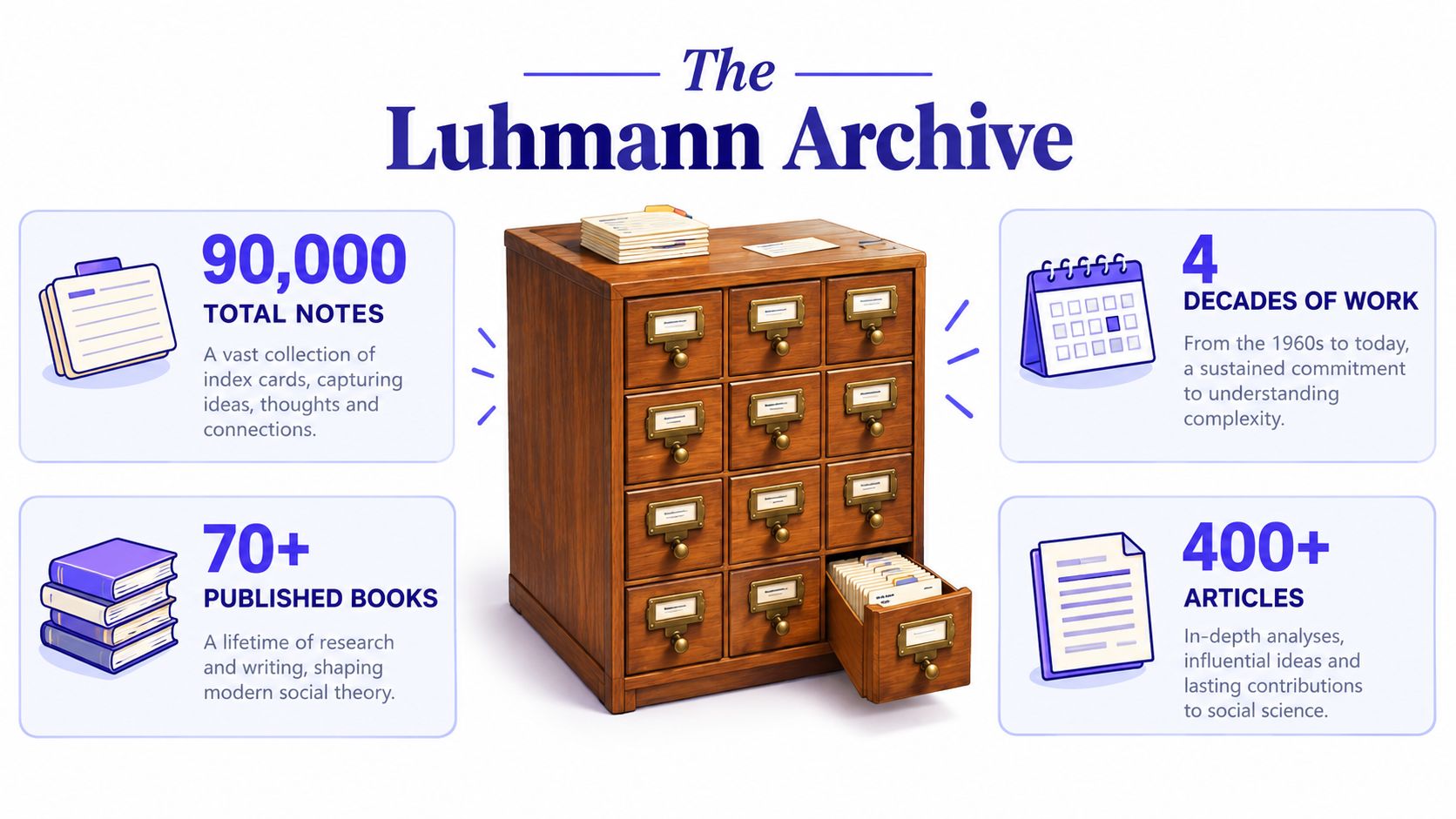
That project records roughly 22,000 notes in the first collection from around 1952 to 1960 and about 67,000 notes in the second from 1961 to early 1997, spread across 27 physical sections of mostly 2,500 to 3,500 cards each. Read those figures carefully: the second, later collection holds the large majority of the archive, which tells you the system matured over decades rather than arriving finished in one organized weekend.
The visual below puts that scale in context.
What Those Numbers Mean for a Student
Luhmann wrote mainly on DIN A6 cards and organized them into linked sequences instead of filing them under broad subjects. Bielefeld University characterizes the collection as his central working and thinking instrument and as an intellectual autobiography, a description you can explore through the University of Bielefeld Luhmann Archive (opens in a new tab). Individual cards became starting points for later arguments and manuscript sections because earlier thinking stayed addressable and connectable.
Your own coursework works on the same principle at a fraction of the scale. A definition you write well this term can support an essay next term if it lives outside the folder for one module. A method, example, and criticism kept as separate linked notes can recombine in ways a chronological summary can't.
Students sometimes ask whether a small collection is worth building at all. It is, because the mechanism works before the network gets large. Ten well-linked notes on one difficult topic already force you to decide what each idea is, how it relates to the others, and where your understanding breaks down. Luhmann's archive matters here precisely because it proves accumulation works: each new note has somewhere meaningful to land, and the value grows with every connection you add.
How to Build Your First Zettelkasten
Don't begin by reorganizing everything you own. Pick one current module and run a small three-stage pipeline on this week's material. You'll learn the method by completing the loop once, not by designing a perfect system in advance.
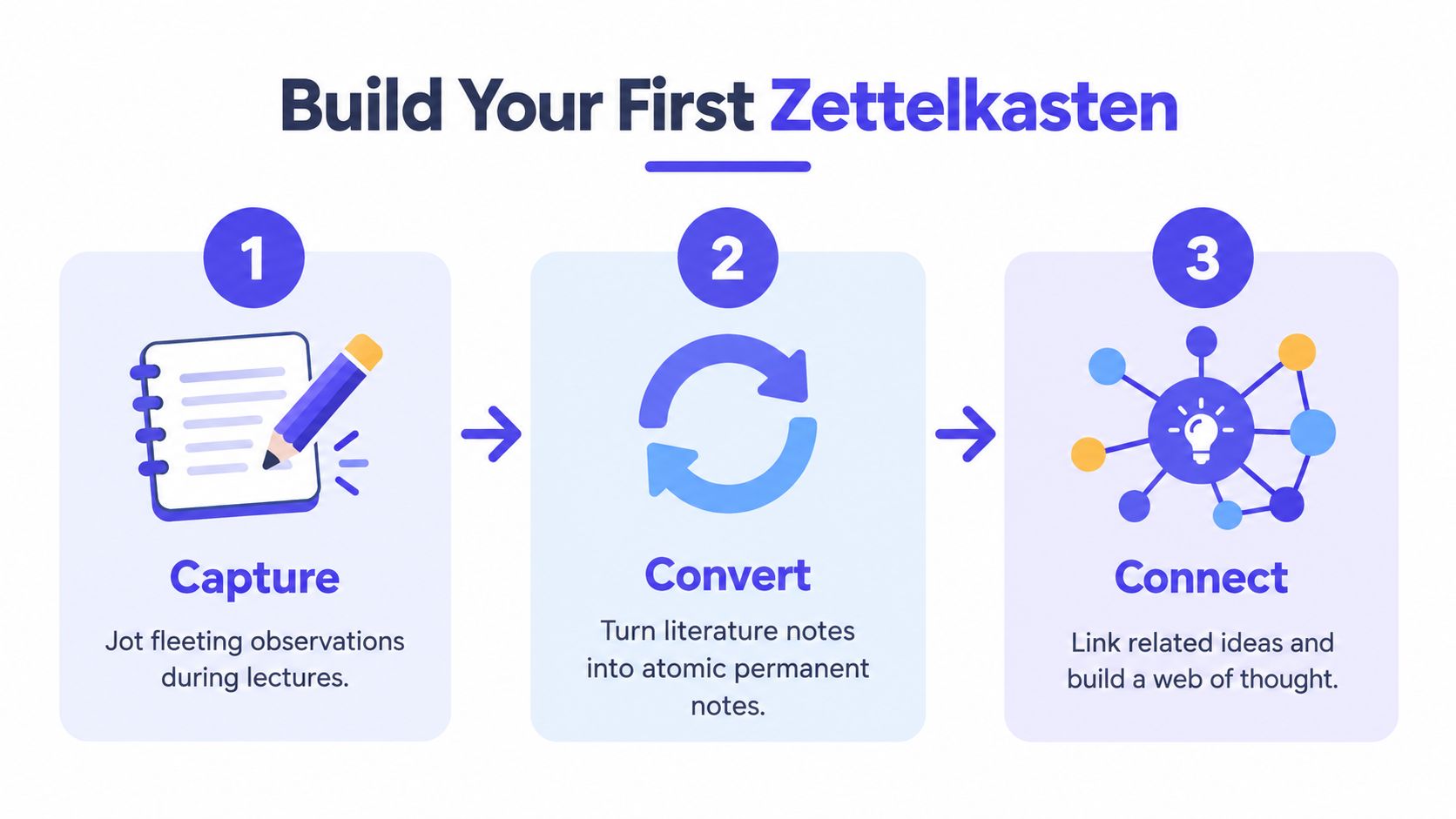
The flow below shows the three stages in the order you'd use them during a study week.
Stage One Capture Without Polishing
During the lecture, jot fleeting notes freely. Catch the phrase you didn't understand, the example that made a definition click, and the question you'd ask in a seminar. Don't stop to format. You're collecting candidates, not writing the final record, and some candidates should be discarded later without guilt.
Stage Two Convert One Source at a Time
After class, take one source, perhaps the lecture or one textbook section, and write a literature note in your own words with its citation and page or slide location. Then close the source and draft permanent notes from memory. Open the source again only to verify accuracy, because that order exposes gaps that copying hides.
Here's the economics case in miniature:
- Note A: Price elasticity measures how strongly quantity demanded responds when price changes.
- Note B: When demand is elastic, a price rise can lower total revenue because the drop in quantity outweighs the higher price.
- Note C: A course example, such as a transport fare change discussed in class, shows the claim operating in a specific setting.
Each note gets a unique identifier, perhaps the date plus a short sequence number your tool can keep stable. Write titles as claims rather than vague topics. A title stating the idea helps future you judge relevance from a link list without opening every note.
After you've completed a first pass, this walkthrough is worth watching with your own notes open beside it, pausing to compare each step against what you produced.
Watch the video on YouTube (opens in a new tab)
Stage Three Connect With Intent
Finish by linking every new permanent note to at least one earlier concept and one application or open question. Note B above links back to Note A as an extension and forward to Note C as an application. If another reading disagrees about when that revenue effect holds, link it as a contradiction and state the condition that resolves the tension. That final step is where storage becomes study.
Analog vs Digital Workflows
Students often stall on tool choice, as if the note taking method Zettelkasten lives in a particular app. It doesn't. Luhmann's system was physical, but the requirements he relied on, stable addresses, explicit links, and one idea per unit, can be met on cards or on screen. Your choice should match how you study, not how you imagine studying.
Paper cards slow you down in a useful way. Writing by hand makes you select, and spreading cards on a desk lets you see clusters and gaps physically before an essay. The costs show up later. Searching means remembering addresses, links must be maintained by hand, and carrying several modules across campus gets impractical.
Comparing the Trade-offs Directly
Digital tools such as Obsidian or similar linked-note apps reverse most of those trade-offs. You gain full-text search, quick linking, backlinks, and portability. You also gain new temptations, especially collecting highlights and tweaking plugins instead of rewriting ideas in your own words. If you're weighing options, a comparison of note taking apps for students can help you match features to your course load.
A hybrid workflow suits many students well. Capture fleeting notes on paper in class, where a notebook is fastest and least distracting. Convert the survivors into permanent digital notes afterward, where linking and search do the heavy lifting. The medium matters less than consistency. A simple tool you process daily will outperform a powerful one you only admire.
Choose based on your bottleneck. If you never review because notes are scattered across rooms and bags, go digital. If screen tools pull you into copying and organizing endlessly, start on cards until the writing habit is solid.
Real Examples of Linked Course Notes
Abstract advice only goes so far, so let's make three small clusters concrete. Notice that each note below makes one claim, carries a simple identifier, and links for a stated reason. You could write these on cards or in an app without changing their logic.
The image below sketches how separate subject notebooks become more useful once their key concepts point to each other.
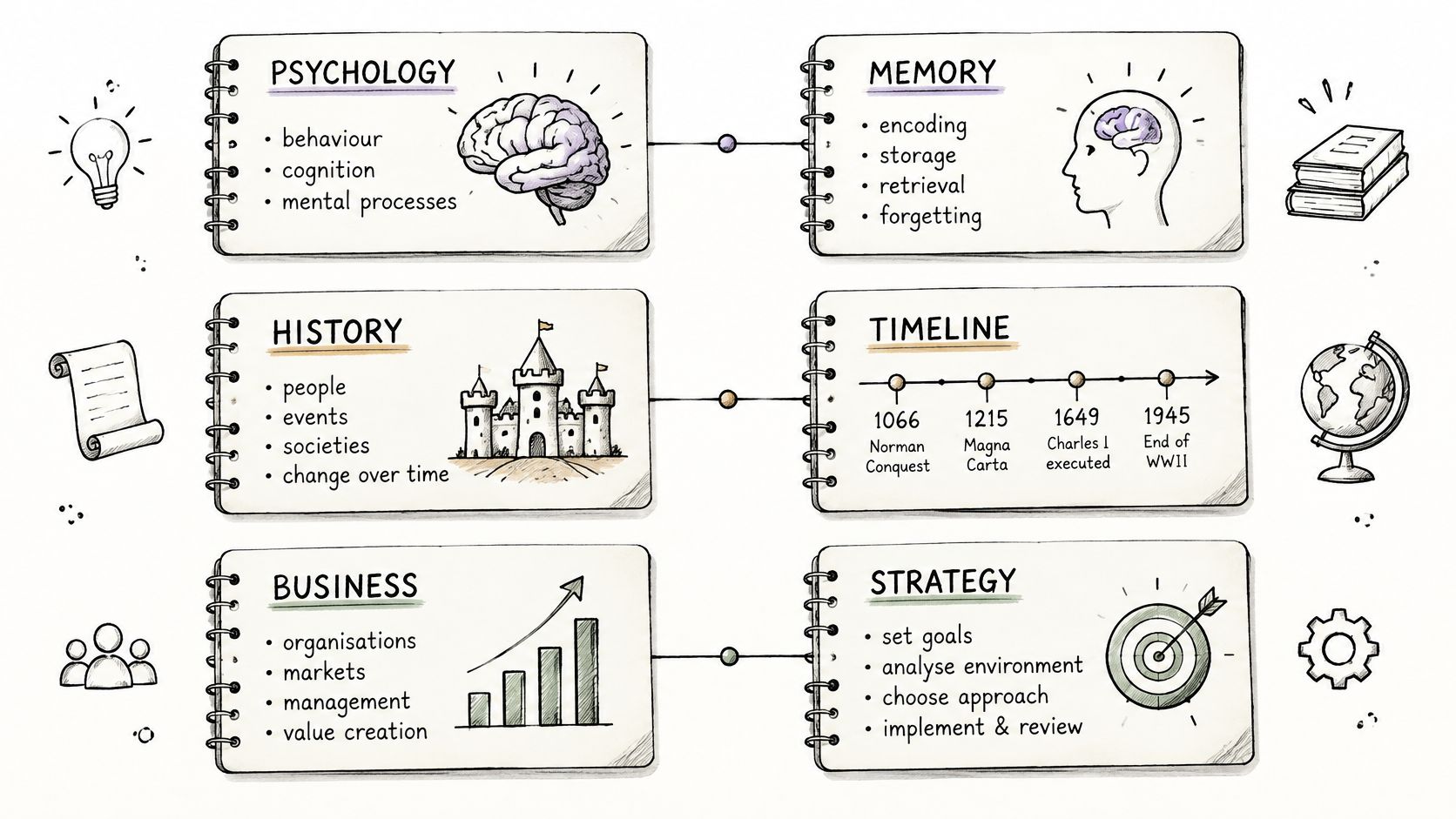
Psychology Working Memory
PSY-014 Working memory holds information briefly while you use it. The note explains in your own words that this temporary holding supports tasks like following multi-step instructions. It links to PSY-015 on capacity limits as an extension, and to a seminar example note as an application.
That pair already gives you essay material. One note defines the mechanism, the next supplies its constraint, and the example shows the constraint affecting a real task. During revision, the title of PSY-014 becomes a prompt. You try to state the definition and the limit before opening either note.
History Causes and Interpretations
HIS-022 A long-term cause creates conditions, while a trigger sets timing. This note separates two ideas students often merge in rushed essays. It links to a source-specific literature note that preserves the historian's evidence and page location, and to a second interpretation note marked as a contradiction.
Now your revision path mirrors how historians argue. You don't just recall events in sequence. You reconstruct which factors made change possible, which event made it happen when it did, and where scholars disagree about the weighting.
Business Index Notes as Doorways
BUS-INDEX Pricing decisions isn't a claim at all. It's an index note, a short entry point listing your best notes on elasticity, costs, competitor response, and one open question you haven't resolved. Index notes solve the cold start problem. When an assignment lands, you enter through the index, then follow links outward to evidence and counterarguments.
Read those three clusters again and you'll see the pattern. Definitions stay separate from examples, evidence stays tied to its source, and disagreements get named rather than smoothed over. That separation is what lets one note serve an essay, a presentation, and an exam without being rewritten from scratch each time.
Using Zettelkasten for Exam Revision
A Zettelkasten earns its keep in revision only if you stop rereading it passively. Pair it with retrieval practice, the habit of putting slides, notes, and textbooks aside and recalling information from memory. Guidance collected in the Graduate Institute library toolbox on Zettelkasten (opens in a new tab) connects the linking workflow to that recall and feedback cycle, with Zettelkasten supplying the prompts and paths for what you retrieve.
Use it like this. Open an index note and read only the titles. For each title, say or write the definition, mechanism, assumptions, and one example before opening the linked note. Then check yourself, correct what's wrong, and mark any link you couldn't explain. An unexplained link isn't a minor flaw. It's a signed confession that two ideas sit near each other in your system but not yet in your understanding.
Turning Links Into Exam Questions
Examiners rarely ask only for isolated definitions at university level. They test relationships, so revise relationships directly:
- Support links: Ask what evidence backs this claim and whether that evidence has limits.
- Contradiction links: Ask under which conditions each side holds, since that's usually the analytical answer.
- Application links: Ask yourself to move the claim into a fresh example the lecturer never used.
- Extension links: Ask what the idea predicts next, or what breaks if an assumption changes.
Two pitfalls weaken this process. First, creating fleeting notes faster than you convert them turns the system into another inbox you dread. Process small batches after each study session instead. Second, over-tagging creates the feeling of organization without the thinking that a written link requires. Fewer tags and better links will serve you better.
If you also want a structured way to condense topics before exams, guidance on making effective revision notes pairs naturally with this approach. Your condensed guide can then be built from permanent notes you've already tested, rather than assembled in a panic from raw lectures.
Why This Method Changes How You Study
Return to the folder you opened at the start of this article. Nothing was wrong with your effort. You attended, you wrote, you highlighted. The problem was structural. Your notes preserved the lecturer's sequence, so your memory had to do all the work of rearranging ideas whenever a question arrived in a different order.
The note taking method Zettelkasten moves that rearrangement into your study process, while there's still time to notice confusion. Writing one idea in your own words tests whether you understand it. Linking it to an example tests whether you can use it. Linking it to a contradiction tests whether you know its boundaries. By exam season, those tests have already happened many times, in ordinary weeks.
Start Smaller Than You Think
Don't rebuild last semester. Take tomorrow's lecture and run the full loop on just that material:
- Capture quickly: Keep fleeting notes rough during class and resist formatting.
- Convert carefully: Write a few permanent notes from memory, then verify them against the source.
- Link deliberately: Connect each note to one earlier idea and one question or application.
That's a working Zettelkasten, even at a handful of notes. Its strength will compound as concepts recur across modules and academic years, because new material gets attached to thinking you've already done instead of starting cold beside it. Course-specific resources from other students can support this process too, particularly when you use them as sources to convert into your own literature and permanent notes rather than as substitutes for that conversion.
You aren't building an archive of everything you were told. You're building a network of everything you can explain.
Write one atomic note today. Link it to something you learned last month. That single connection is the method working as intended, and everything after it is repetition with better material.
When you need source material worth converting, CramShare helps you find lecture notes, study guides, summaries, and past papers matched to your exact university, course code, module, and academic year. Use those course-specific resources as literature notes for your own Zettelkasten, preview premium documents before you commit, and publish your original notes to help future students on the same course.