How to Study from Notes: A Recall Method That Works
How to study from notes with a 30-minute recall routine, spaced reviews and a quick check of course-specific notes.
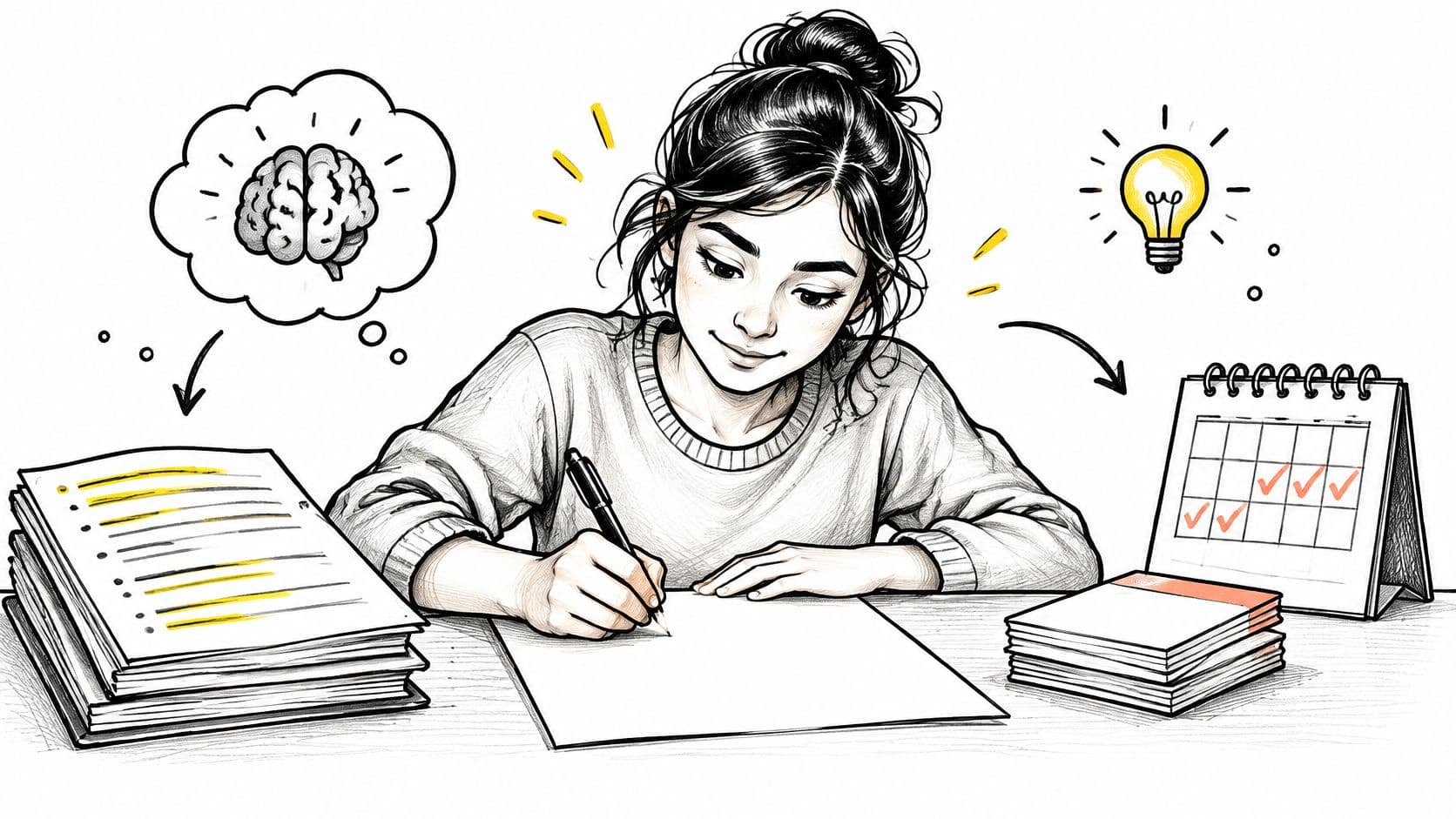
You've opened your lecture notes, found your highlighter, and read the same page again. The sentences look familiar, but you're not sure you could explain them without looking. With an exam approaching, it's hard to tell whether you're learning or just getting better at recognising the page.
Learning how to study from notes starts with changing what you ask those notes to do. Treat them as raw material for questions, explanations, and practice problems, not as text you need to reread until it feels comfortable. Check that they fit your course, then use them to test what you can produce independently.
The 30-Minute Recall Session, Step by Step
-
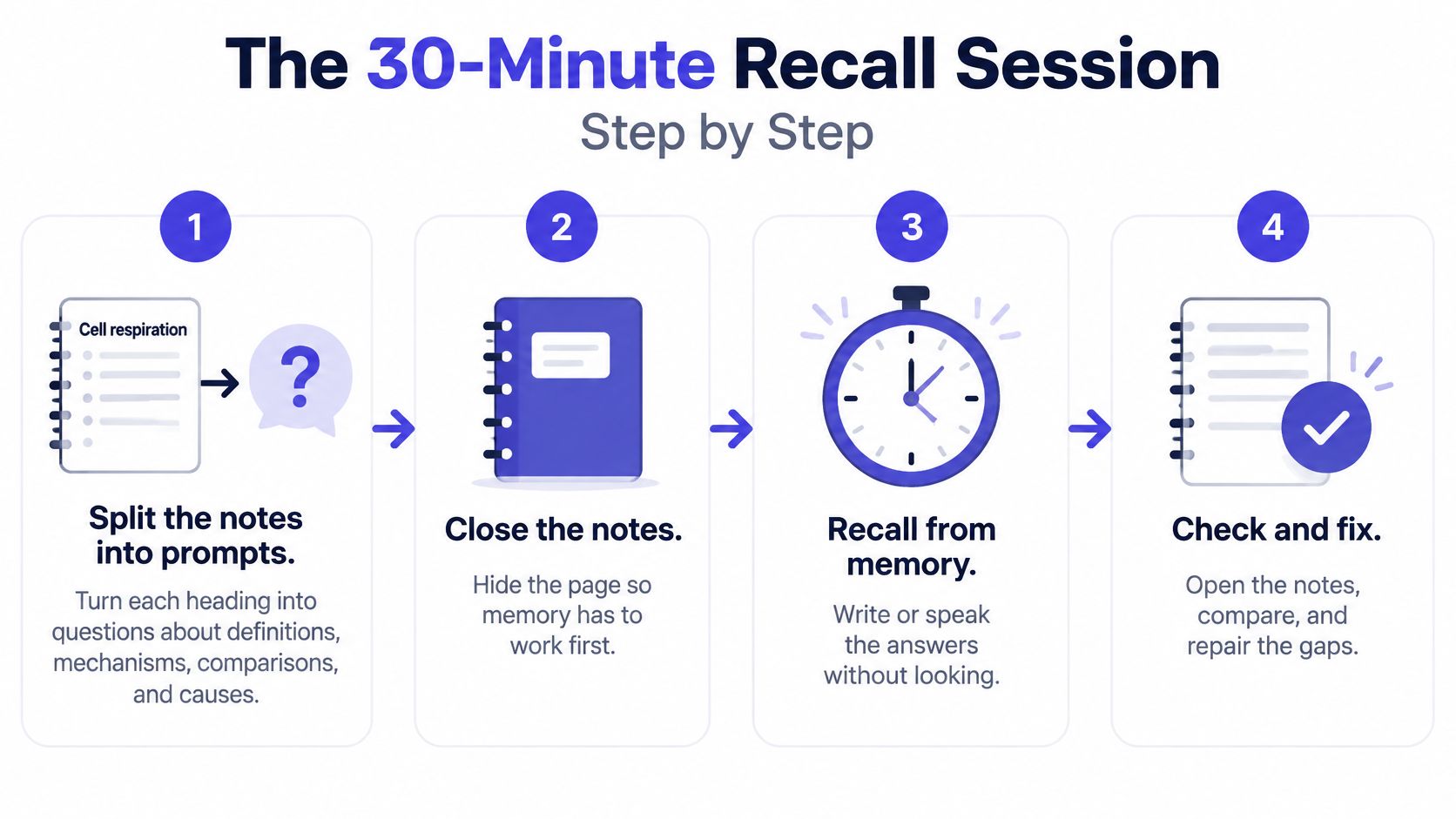
Split the notes into prompts, about 5 minutes. Turn headings into questions about definitions, mechanisms, comparisons, worked steps, and applications. For a heading on enzymes, ask what an enzyme does, how temperature affects its activity, and how you'd interpret an unfamiliar activity graph.
-
Close the notes and answer from memory, about 15 minutes. Write your answers on a blank sheet or explain them aloud without opening the original page. Give each prompt a genuine attempt, including any reasoning or working, so you can distinguish a missing detail from a missing explanation.
-
Check and correct, about 5 minutes. Reopen the notes and mark omissions or mistakes in a different colour, then write the corrected answer beside your attempt. Don't just tick a paragraph because it looks close; compare the definition, causal steps, terminology, and example separately.
-
Create application questions, about 5 minutes. Write two questions that change the example or require you to choose when an idea applies. If your notes explain a formula, ask what would happen if an input changed and what conditions must hold before you can use it.
This suggested 30-minute routine adapts the closed-note retrieval and feedback workflow described alongside Karpicke and Roediger's work on repeated retrieval (opens in a new tab). Treat the timing as a practical starting point, not a deadline that forces you to rush through difficult material.
Keep the sequence visible while you work:
Make the score useful
Before answering, decide what a complete response needs. A definition might require the correct term and its distinguishing feature; a calculation might require the method, working, units, and result. Use those requirements consistently rather than awarding yourself credit because you meant something similar.
Log your percentage correct without prompts, alongside the topic and the gaps you found. Keep partially correct answers visible, but don't count an answer you completed after checking the page as independent recall.
The easiest slip is glancing at the notes after remembering the opening word. That changes the task from retrieval into copying without you noticing. If you need a cue, record that you needed one, finish the attempt, and check afterward.
A useful first session produces a clear gap list, not a beautiful replacement notebook.
A low opening score isn't a reason to abandon the method. You've identified what needs attention while there's still time to work on it. Save the missed prompts for your next session, and keep the corrected explanations available for checking.
Why Closing Your Notes Beats Rereading
Rereading isn't useless, but recognising a sentence isn't the same as being able to produce its meaning. You can follow an explanation while it's in front of you and still struggle when an exam question removes that support.
In Jeffrey Karpicke and Henry Roediger's 2008 word-pair experiment (opens in a new tab), participants in conditions requiring repeated retrieval correctly recalled approximately 80% of the word pairs on the final test. That result came from a controlled word-pair task, not a university module, so it supports the direction of the method rather than promising a particular exam score.
The practical distinction is whether you're checking recognition or asking memory to supply an answer. For a broader explanation of how study activity changes the usefulness of notes, see our guide to note-taking research.
When familiarity becomes misleading
Say you spend Sunday evening rereading your economics notes. Every equation looks familiar, and you remember where the lecturer placed the graph. Then you attempt a closed-book question involving a formula from an earlier lecture and can't explain which quantities belong in it.
You didn't necessarily misunderstand the page while reading. You hadn't yet checked whether you could select and use the information without seeing it.
Watch for these signs that your review has become passive:
- Your eyes move faster than your thinking. You reach the end of a paragraph without explaining its main point.
- You nod at sentences you couldn't reconstruct. Recognition substitutes for an answer you've produced.
- You highlight without testing. You mark important information but never check whether you can retrieve or apply it.
This illustration captures the difference between looking at information and attempting to retrieve it:
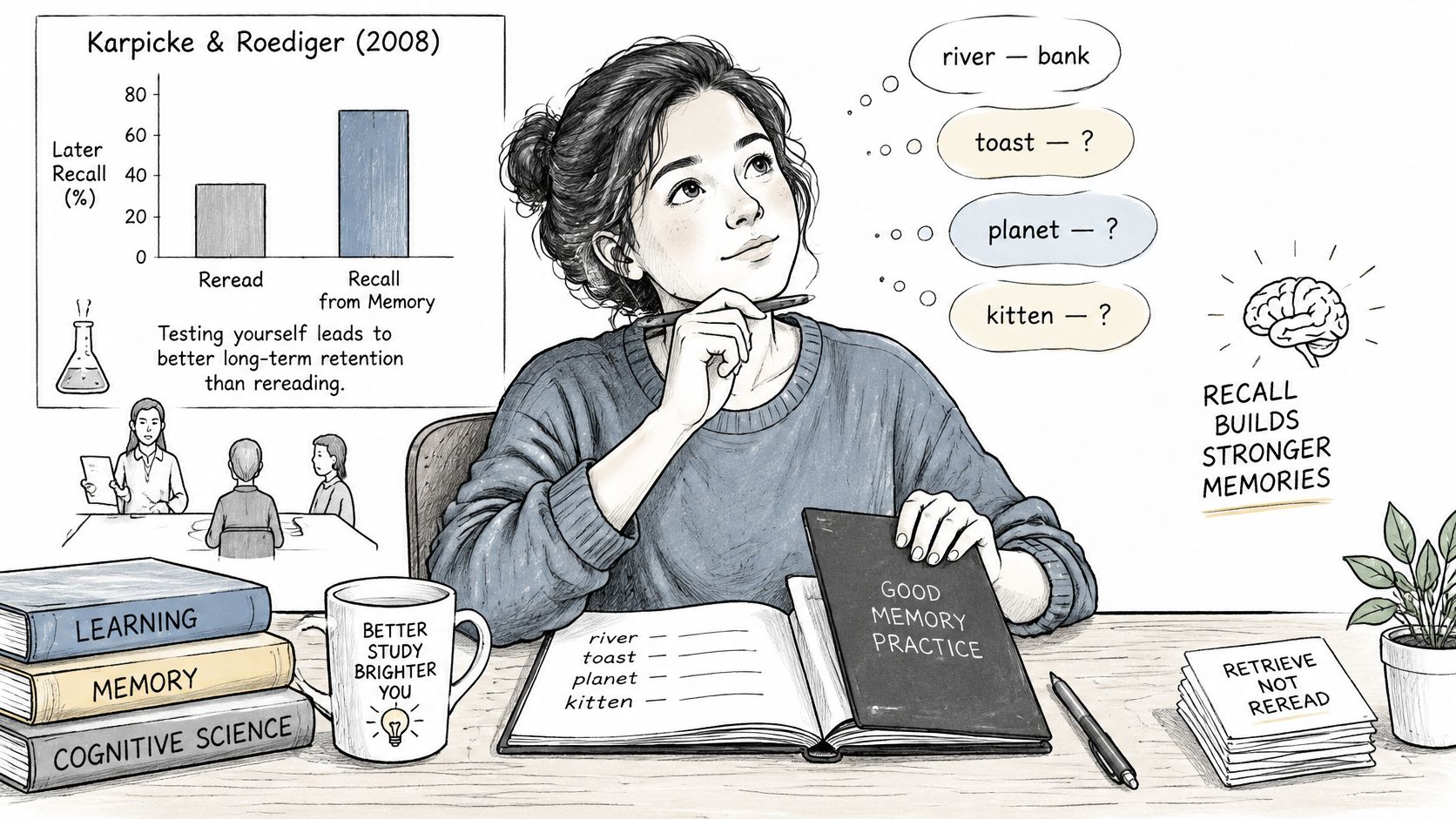
Use rereading to repair a specific gap after an attempt, rather than as your only study activity. Judge what you know by what you can produce, not by what looks familiar.
Turning Different Note Types Into Questions
A weak prompt asks whether you recognise a topic. A stronger prompt specifies what you must explain, draw, calculate, or argue. Asking yourself whether you understand inflation leaves room for a vague yes; explaining how a price-level change affects a particular household requires an answer.
Use this visual reminder when choosing the task your prompt should demand:
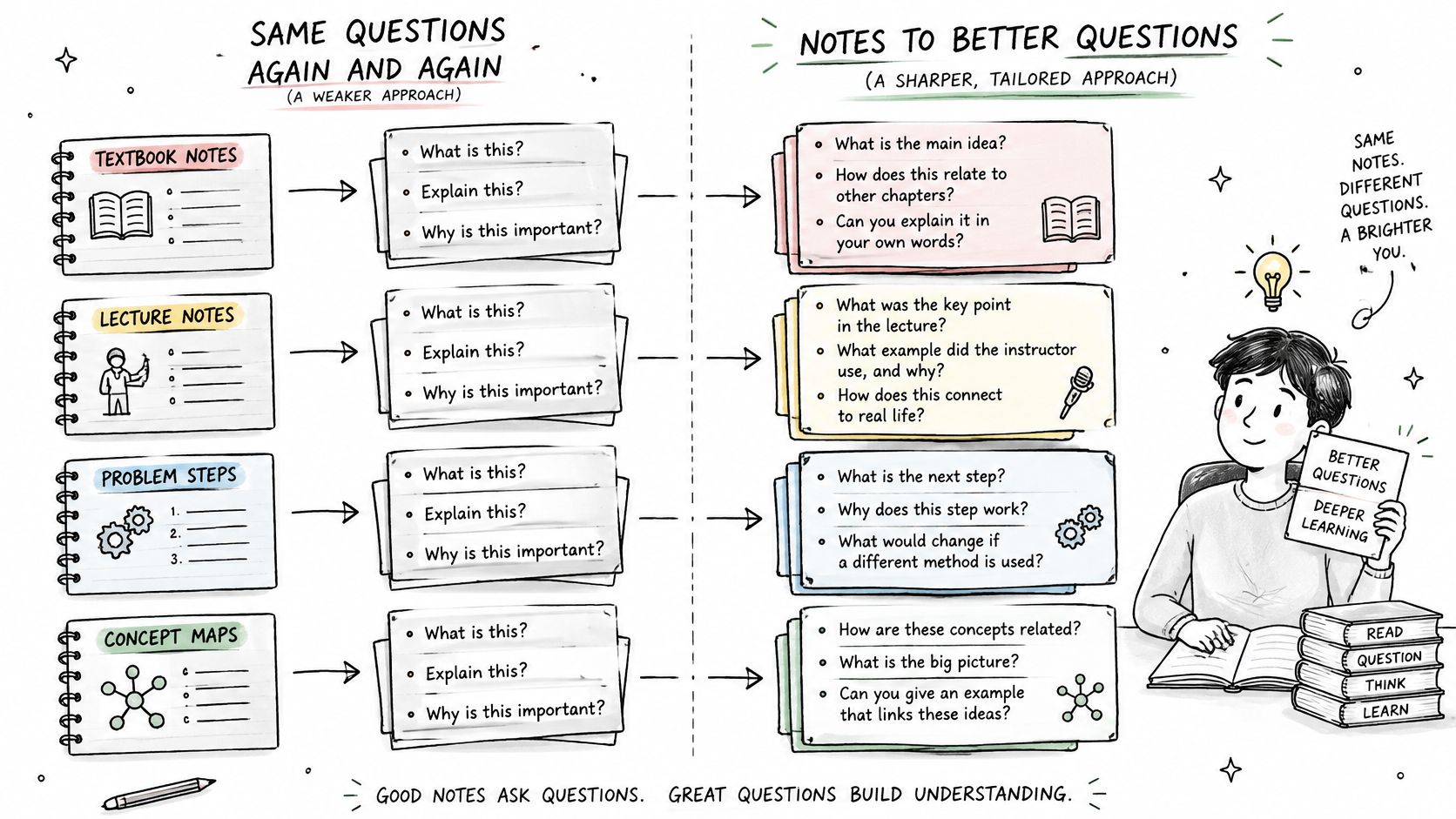
Prompt type by kind of note
The numbers in these example prompts are writing constraints, not learning thresholds. Adjust the answer length to the complexity of the material and your assessment.
For a nursing student, a weak question might ask whether the signs of dehydration look familiar. A stronger question asks which findings in a course-approved patient scenario support dehydration, which need clarification, and how the notes justify that interpretation. Check the response against your teaching materials rather than treating a study prompt as clinical guidance.
For an economics student, move beyond naming a demand curve. Ask how a change in income differs from a change in the good's own price, and require a labelled graph plus an explanation of the assumptions.
Work with the material you actually have
Lecture slides may contain headings without the spoken explanation. Add a short account of the lecturer's reasoning before turning the slide into a question.
With textbook summaries, use headings and key terms as cues, but hide the explanatory paragraphs. For diagrams, remove both the picture and labels before redrawing. With past-paper solutions, attempt the question first, then identify the earliest step you couldn't reproduce.
Use the video as a separate study resource, then return to your own material and build a prompt you can check:
Watch the video on YouTube (opens in a new tab)
A good prompt makes you produce an answer while the explanation is hidden. It doesn't reveal the answer inside the question.
Spacing Your Reviews Across Days and Weeks
Review schedule after the first lecture
Use this as a suggested calendar template, not a fixed prescription for every module.
The day-and-week intervals are a practical way to distribute retrieval with feedback; the experimental evidence discussed in this review of testing and learning (opens in a new tab) includes 21% greater recall after a week for repeated testing than repeated studying in one experiment. The calendar slots are suggestions, not experimentally established optimal intervals for your course.
Make each return count
A later attempt can feel less comfortable than immediately repeating an answer. Don't interpret that discomfort alone as failure. Check whether you can retrieve the core explanation, identify what's missing, and repair it accurately.
At each review, answer first and inspect the notes second. Put missed prompts back into the next session, but also retain some previously successful questions. Otherwise, you won't check whether answers remain available after you've stopped practising them intensively.
Choose a mastery rule before you start, such as requiring accurate answers on separated review days. For a worked problem, correct arithmetic isn't enough if you can't explain why you chose the method. For an essay prompt, recalling names without connecting evidence to an argument isn't a complete response.
Keep occasional cumulative tests even after a topic feels secure. A mixed test asks you to select the appropriate idea rather than assuming every question uses the method you've just practised.
Mix deliberately, not randomly
Technical modules need more than calculations of the same type. Combine a calculation with a diagram, a conceptual explanation, and a question about when the method wouldn't apply.
For essay modules, alternate factual recall with thesis-building and evidence selection. Ask not only what happened, but which evidence would support or challenge a particular interpretation.
Avoid these habits:
- Saving everything for the night before. Put review appointments in your calendar while the lecture is still recent.
- Reviewing only new material. Keep earlier topics in the question pool.
- Using one format for every task. Match practice to the performance the assessment requires.
A calendar or spreadsheet is enough to begin. If managing due prompts becomes awkward, compare spaced-repetition tools and choose one that lets you record errors and revisit older material.
Judging Whether Your Notes Are Worth Studying From
Before committing a document to memory, check whether it deserves that trust. Apply the same standards to your own notebook, shared notes, instructor materials, and generated summaries.
- Course identity. Match the institution, module code, academic year, and current learning outcomes.
- Terminology. Check that definitions and symbols agree with your lecturer and assigned textbook.
- Completeness. Look for formulas, assumptions, worked steps, examples, and labelled diagrams, not just headings.
- Assessment fit. Look for argument-building material for essay exams and reproducible methods for calculation papers.
- Traceability. Resolve uncertain claims using lecture recordings, official materials, or the relevant textbook passage.
Keep these core checks beside any document you're evaluating:
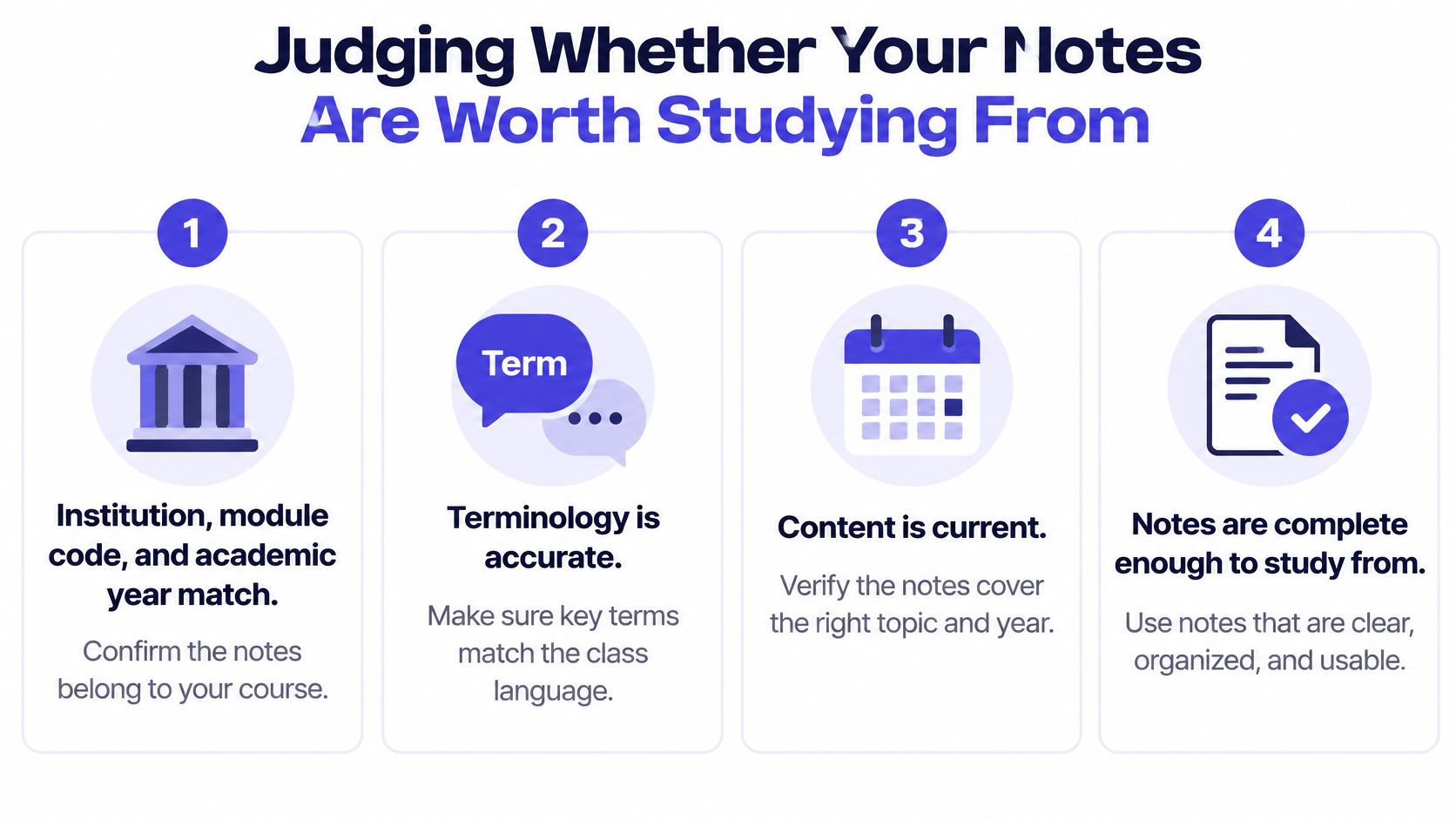
Judge the explanation, not the device
The Association for Psychological Science account of note-taking studies (opens in a new tab) describes a 2014 study involving 65 college students in which laptop users recorded more words and more verbatim material but performed worse on conceptual questions; the accompanying evidence also includes a 2021 replication that found no reliable quiz advantage for either medium.
The useful principle isn't that you must switch to handwriting. Check whether you've transformed the lecture into explanations you understand. A polished transcript can still leave you unable to explain why a process happens.
If you can't locate the assumptions or supporting examples, improve the document before making prompts from it. Our guide to organising notes for study can help you keep explanations, examples, and unresolved questions distinct.
Check shared and generated material
Every document on CramShare is tagged to the course, exam, or textbook it was written for, and we review documents for course match. Still, compare the tag and preview with your current syllabus, especially where teaching emphasis or assessment requirements have changed.
For an AI-assisted summary, verify each generated point against the lecture, slides, or textbook before using it as an answer key. Specifically check for missing definitions, formula conditions, caveats, and claims presented without support.
Mark unresolved statements as unverified rather than practising them as settled facts. Notes should support attendance, independent work, and your institution's academic-integrity rules, not replace them.
Schedule Your First Recall Session This Week
Choose a single module and its most recent lecture. Open your calendar before opening another document, and reserve a manageable session you can commit to. You don't need to reorganise the entire semester before beginning.
Prepare a blank sheet, your checked notes, and a different-coloured pen or text colour for corrections. Work through the recall routine, then save the application questions and error list where you'll find them at the next appointment.
Leave yourself a clear next action
Before closing your laptop, make sure you have:
- A dated review appointment. Schedule an early return and another later in the week.
- An honest record. Log independent answers separately from answers completed with help.
- A short priority list. Identify the explanations, steps, or distinctions that need another attempt.
Track the trend across sessions rather than treating a difficult day as a verdict on your ability. If a prompt keeps failing, inspect the cause: unclear wording, an incomplete explanation, missing prerequisite knowledge, or a method you haven't yet practised.
If you don't have trustworthy notes, evaluate a candidate document against your syllabus before studying it. Anything that fails the checks belongs on your verification list, not in your answer key.
Your target this week is usable knowledge: answers you can produce, gaps you can name, and appointments you'll keep.
By the end of the week, aim to have a shorter list of unresolved questions and a clearer view of what still needs exam practice. That's a more useful outcome than another folder of highlighted pages.
Browsing notes on CramShare is free, and you can search by subjects, exams and certifications, universities, course codes, and textbooks. Visit CramShare to find material for your module, check its course fit, and turn a relevant section into recall questions. Free and premium documents are for your own study: you may download and print them, but you may not share or republish them.