AC Before Meals: Meaning, Timing and Safe Dosing
AC before meals means a dose is taken before eating, often about 30 minutes ahead. Learn the timing, food effects and when to check your label.

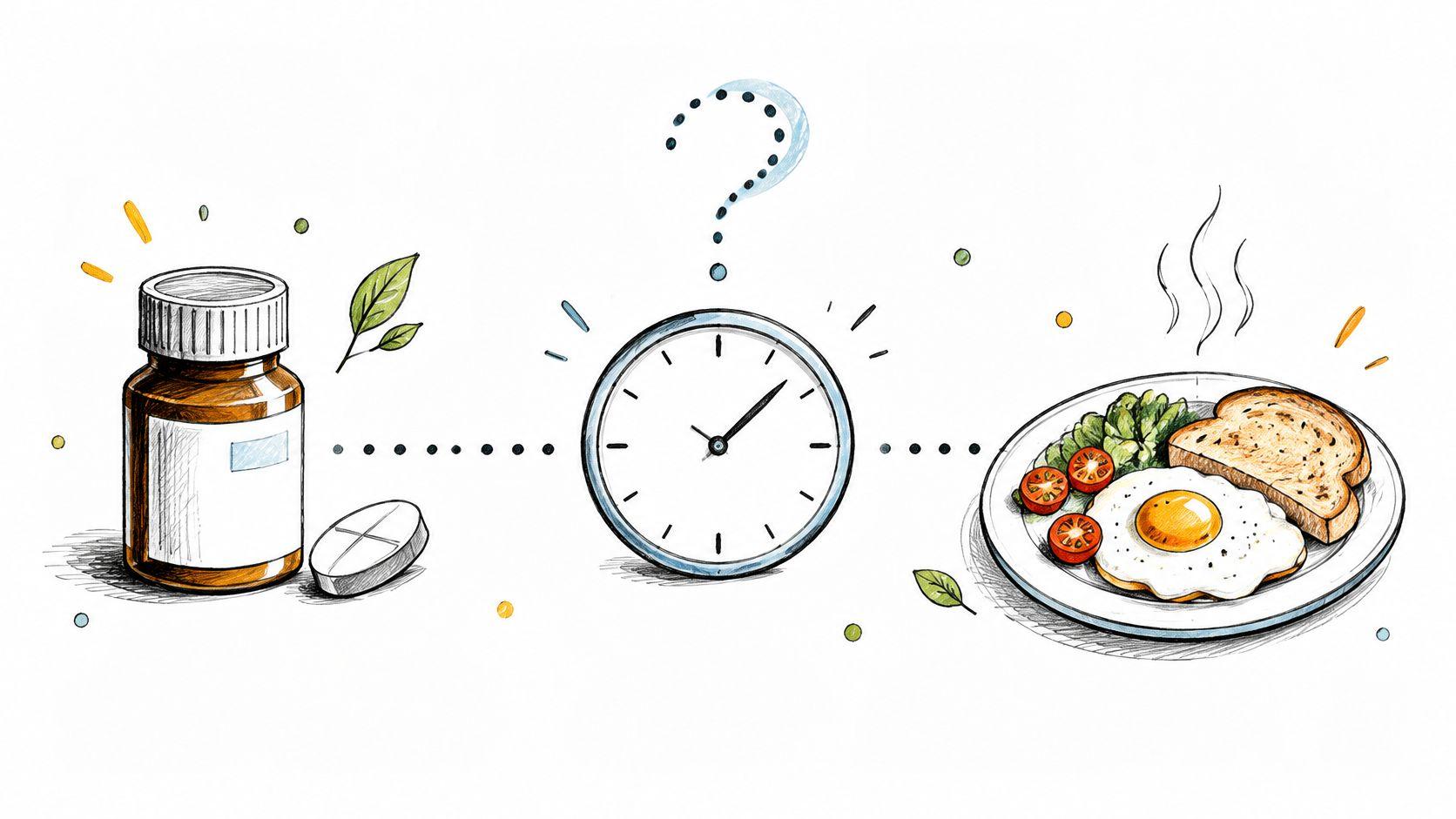
AC is short for ante cibum, Latin for before meals, so you take the dose before eating, usually about 30 minutes ahead unless the label states a different interval. That's the popular advice, and it's incomplete. Treating AC before meals as a fixed 30 minute rule for every medicine can put a dose too close to food, too far from it, or in the wrong place entirely. The abbreviation tells you the order, dose first and meal second. It doesn't always tell you the exact gap, whether a snack counts, or what to do when lunch moves.
What AC Means on a Medicine Label
AC or a.c. means before meals, from the Latin ante cibum. It's a scheduling instruction, not a clock time and not part of the drug name. The interval attached to it depends on the medicine and the prescriber, so the letters alone don't finish the instruction.
Read the Term Before You Read the Minutes
Start by matching the exact words or letters on your label. Before meals, with meals, and on an empty stomach describe three different relationships between a dose and food, and they're not interchangeable. If you swap them, you may change how much medicine is absorbed or how well it's tolerated.
The Maryland Department of Health medication timing policy (opens in a new tab) defines before meals as approximately 30 minutes before the meal and empty stomach as approximately 1 hour before a meal. That same policy uses administration windows of roughly 70 minutes around breakfast, lunch, and dinner, because staff have to tie doses to real mealtimes rather than to any point in the morning. A Canadian medication safety resource pairs ac with pc, meaning after meals, which helps you spot the opposite instruction.
If your label says only AC and gives no minutes, don't invent the gap. Ask a pharmacist or prescriber to confirm it.
Students and caregivers often juggle several bottles at once. Treat each label term separately, because one medicine's food rule doesn't transfer to the next bottle on the shelf.
How Long Before Eating a Dose Should Be Taken
For medicines labeled before a meal, Austria's Federal Office for Safety in Health Care stated in 2024 (opens in a new tab) that they should generally be taken 30 to 60 minutes before eating. Treat that span as a working range. It is a shared label convention that gives you a starting point, while your own drug's leaflet provides the precise number.
The Minute Lookup Readers Ask For
Each label term lands in its own window of minutes, and the usual values sit in the table below. A number printed on your label outranks every row here.
Hospitals lean on the 30 minute convention because nurses need a workable window around tray delivery, and one minute on the clock cannot serve a whole ward. That scheduling logic explains where the convention came from. It says nothing about whether 30 minutes is right for your drug at home.
The drug itself can rewrite the gap. A medicine such as repaglinide is designed to act as the meal arrives, so its printed instruction ties the dose tightly to eating rather than to a fixed 30 minute habit. The size of the meal in front of you can pull the answer in yet another direction for other drugs, which is why the table stays a starting point and the leaflet stays the referee.
A Worked Example With a Real Breakfast Time
Say breakfast is at 8:00 and your confirmed instruction is AC at about 30 minutes before eating. Your dose lands at about 7:30, not when you sit down and not when the toast pops up. If breakfast slides to 8:45, the dose slides with it, because the instruction is pinned to the meal rather than to the clock.
Practical rule: use the minutes on the label first, the general convention second, and your pharmacist to settle anything the label leaves blank.
Why Food Changes How a Medicine Works
Two people can swallow the same tablet at the same minute and end up with different amounts of medicine in their blood. Food changes both how much of a dose reaches your bloodstream and how fast it gets there, and those are separate problems. A dose absorbed too slowly may start late, while a dose absorbed in a larger amount may act more strongly than intended.
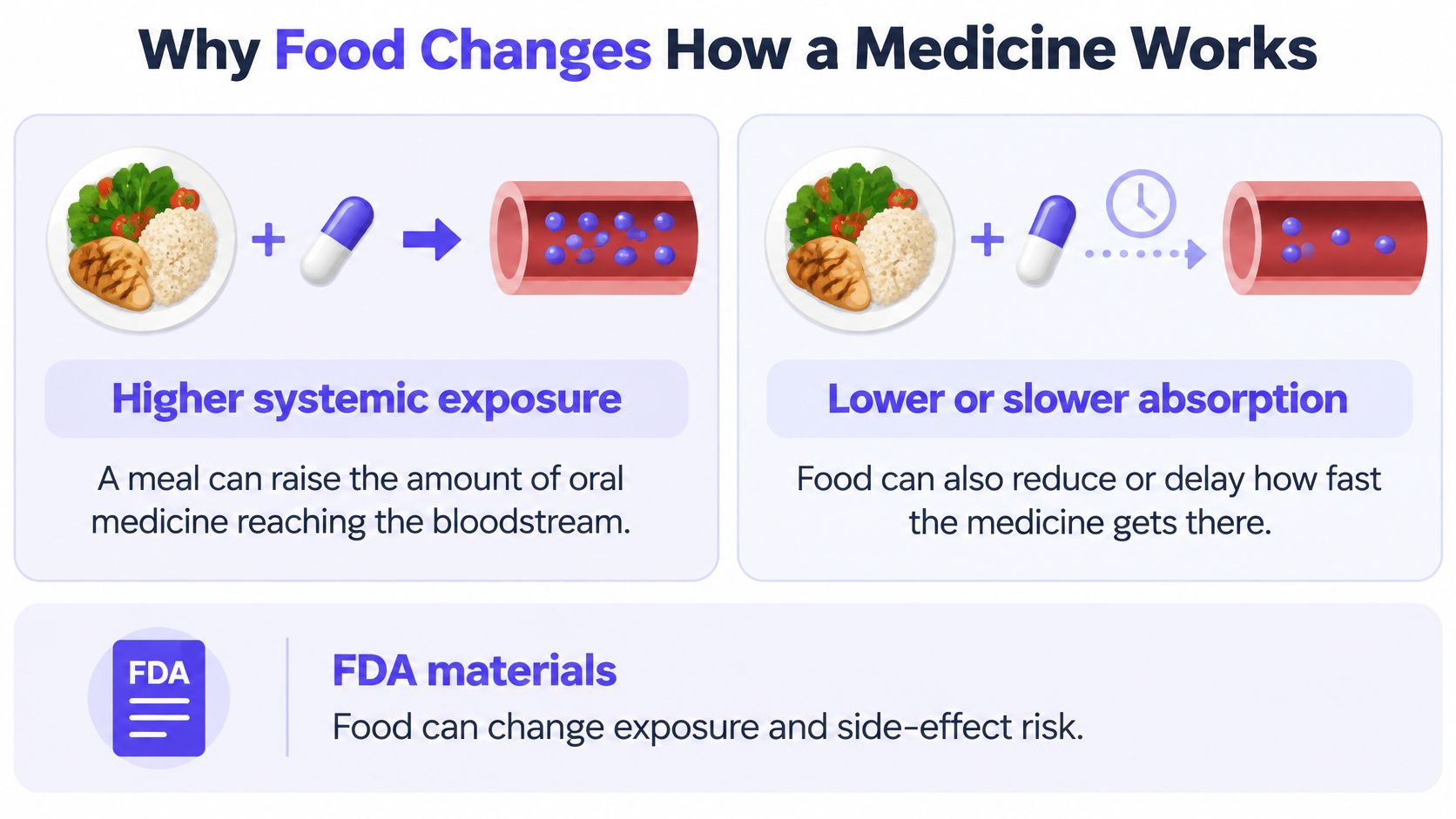
FDA food effect guidance materials (opens in a new tab) explain that food may increase systemic exposure, potentially raising safety risks, or decrease exposure, potentially reducing efficacy, and they give an example where a high fat meal increased peak concentration by 57% and total exposure by 45%. A shift that large can be enough to justify fasting instructions for that drug. It also shows why a prescriber cares about what was on the plate, not just whether you ate that day.
Meal Size and Fat Matter Alongside the Clock
High calorie and high fat meals alter stomach emptying and gut conditions more than a light bite does. A large fried breakfast works like a slow-release barrier between the tablet and your gut wall, while a few crackers barely change the setting, even though both count as eating in everyday language. Fibre, fat, and specific foods or drinks each pull in a different direction, so milk, juice, coffee, a protein bar, and a supplement are not the same as water around a dose.
The minute on the label is only half the instruction. The Maryland medication timing policy puts a general AC order at about 30 minutes before eating, empty stomach guidance runs roughly 1 hour before a meal or 2 hours after, and some labels print their own interval such as at least 2 hours around food. Two medicines can carry the same AC style instruction and still have different tested food effects behind them.
Repaglinide shows why the drug itself can override the general convention, because DailyMed prescribing information in 2024 (opens in a new tab) stated a recommended dose range of 0.5 to 4 mg before meals and a maximum daily dose of 16 mg. Each dose attaches to a particular meal rather than one fixed morning slot, so the timing question repeats at breakfast, lunch, and dinner. For any AC medicine, the useful questions are whether a snack counts as the meal, whether fat content changes the instruction, and whether an unusually large meal calls for a different plan.
Why AC Is Easy to Misread
AC doesn't always mean before meals. The Institute for Safe Medication Practices electronic communication guidelines (opens in a new tab) warn that AC may mean before food or meals or, in oncology, Adriamycin and Cytoxan, a chemotherapy combination. Same two letters, completely different meaning, depending on context.
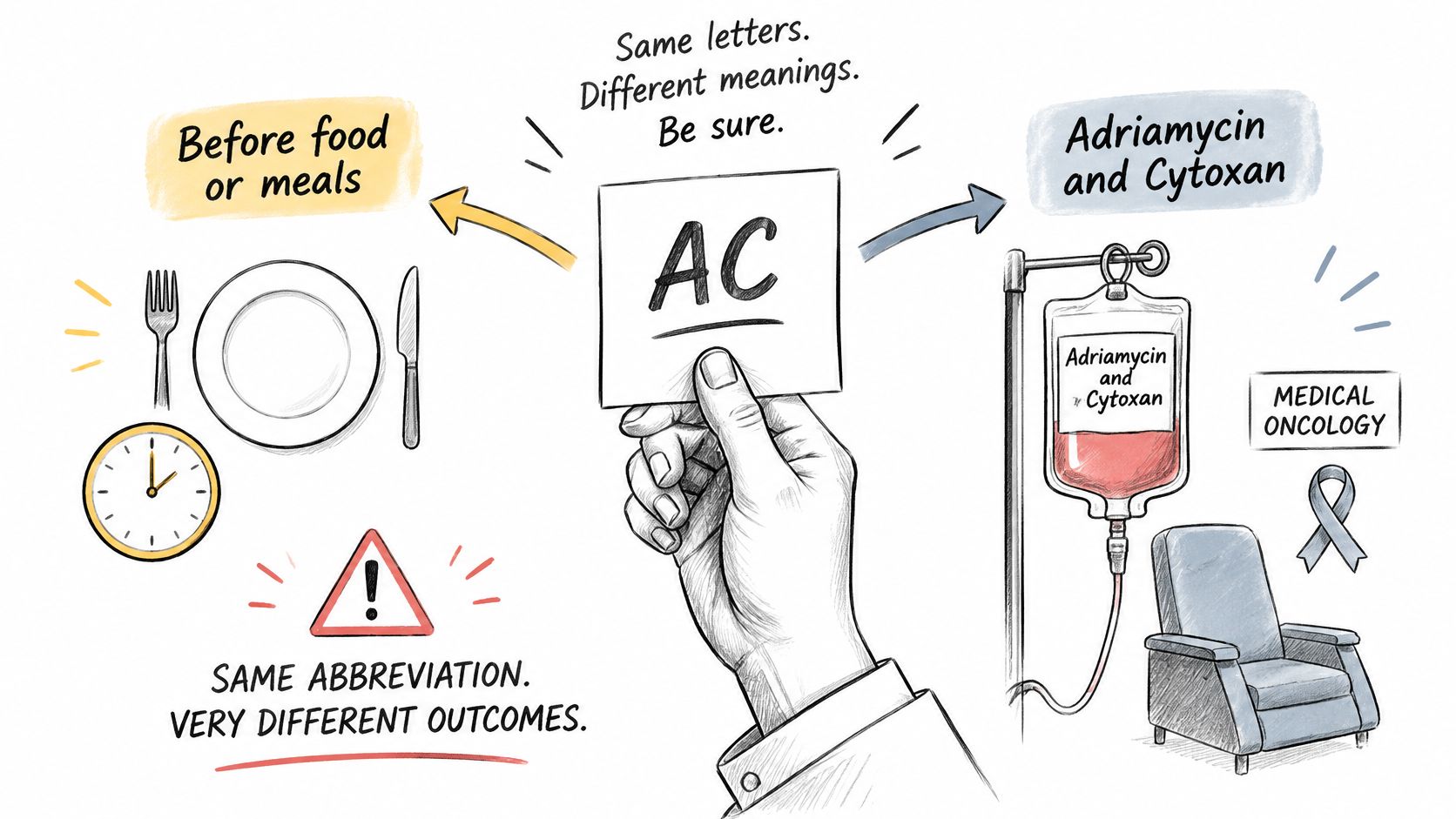
That's why many health systems now prefer plain language such as take 30 minutes before breakfast. Plain wording leaves less room for a patient, caregiver, or student clinician to decode Latin under time pressure. The tradition came from Latin as a shared professional language, but clear instructions protect people better than tradition does.
Four Misreadings and the Correction for Each
- Immediately before the first bite: AC usually means ahead of the meal by a stated or confirmed interval, not with the fork in your hand.
- Any time in the morning: A before breakfast dose is tied to breakfast, so a dose at 6:00 for a 9:00 meal isn't automatically correct.
- One fixed slot for every medicine: Two AC labels can carry different minutes, food limits, and drink limits.
- Hospital order equals pharmacy label: A chart abbreviation and a bottle instruction serve different readers, and the bottle should spell out what you do at home.
Most uses of AC don't cause an error. Risk rises when the setting is ambiguous, the handwriting or screen text is rushed, or you're reading an order outside its original context.
Confirm the meaning, confirm the timing, and confirm the context before you act on the letters AC.
If a dose timing looks wrong or you've already eaten, don't fix it by doubling or retiming on your own. Call a pharmacist and describe what happened, including when you ate.
How to Check an AC Instruction Before Each Dose
A short routine prevents most AC mistakes, and it works even when you're tired or rushing between classes. Run through it in order, because each step answers a different question.
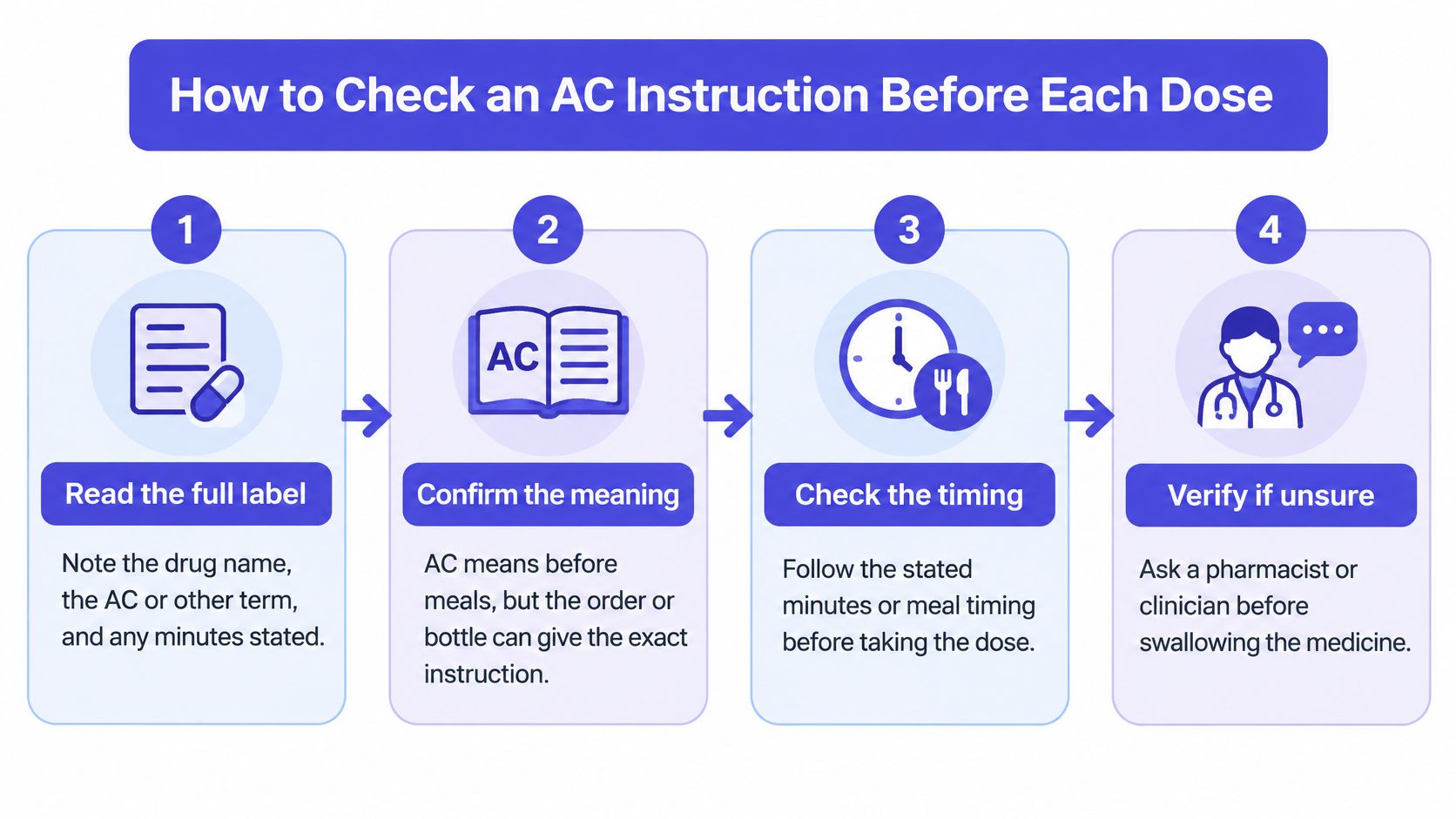
- Read the full label: Note the drug name, strength, AC or other term, and any minutes printed. The full wording controls the dose, so don't stop at the abbreviation.
- Confirm the meaning: Check that AC here means before meals for a medicine you swallow. In a hospital record, the same letters can refer to a different treatment.
- Find the timing: Use the stated minutes when the label gives them. When it doesn't, treat about 30 minutes before a meal as a reference point to confirm, not as a final answer.
- Check the food rule: Look for limits on fat, specific foods, milk, juice, coffee, alcohol, or supplements. Water is the default drink unless the leaflet says otherwise.
- Plan around real meal times: Anchor the dose to the meal you'll eat and set a phone reminder for the start of the window. A dose planned around a lunch you regularly skip will keep failing.
- Confirm anything unclear: Ask a pharmacist before you swallow the dose if the term, minutes, or food rule is missing. A two minute call is safer than a confident guess.
Build the Habit Into Study and Clinical Practice
Nursing and pharmacy students meet these abbreviations in drug guides, case questions, and placement paperwork at the same time. Working through a reference such as Mosby's Drug Guide for Nursing Students on CramShare alongside real labels helps you connect the abbreviation to the drug specific food sentence. That connection is what examiners and preceptors are really testing.
Write the confirmed instruction in plain words on your schedule, for example 7:30 dose, breakfast 8:00, water only. Plain words travel better between home, campus, and clinic than two Latin letters do.
Real Schedules Where AC Timing Breaks Down
A delayed lunch is the most common failure. Your AC dose is planned for 30 minutes before a 12:30 lunch, then a meeting pushes lunch to 1:30 and you're holding a tablet at noon. Don't decide alone whether to take it now or wait, because the right move depends on the drug. Phone the pharmacist, state the usual time, and state the new meal time.
A skipped breakfast creates a different trap. You wake late, skip food, and wonder whether an AC dose still counts as before meals if there's no meal. Check the exact wording first, because an empty stomach instruction and an AC instruction can lead to different answers. If the dose is tied to eating, skipping the meal may change the plan.
Irregular class schedules break memory based routines. A student with a 9:00 lecture on Monday and a noon start on Tuesday doesn't have one stable breakfast time. Anchor the dose to a meal you eat on both days, keep a written schedule, and use reminders that name the meal rather than only the clock time.
When Two Labels Disagree and When a Dose Is Missed
Two medicines both labeled AC can still conflict. One may allow a light snack nearby while the other needs a longer gap from a high fat meal or a supplement. Follow each label separately and list both on one schedule so the conflict becomes visible instead of hidden. Practice questions like those in Dosage Calculation RN Fundamentals practice material reward that same habit of checking each order on its own terms.
A missed dose close to a meal tempts people to double up or squeeze the dose in anyway. Don't. Note the time you remembered, whether you've eaten, and what you ate, then ask a pharmacist what to do for that specific medicine.
Bring three questions to that call. Does a snack count as the meal for this drug, how many minutes before food should I take it, and what should I do when the meal is delayed or skipped?
Confirm the Timing With Your Pharmacist Before Your Next Dose
Call or message your pharmacist before the next dose if your label says only AC and gives no minutes. Use this script: For this medicine, should I take it 30 minutes before the meal, 30 to 60 minutes before, or at another time, and does a snack count as the meal? It's short, and it forces a drug specific answer.
Say the drug name, read the exact words on the label, and give your usual breakfast, lunch, and dinner times. Bring the bottle or a photo of the label, a list of every medicine and supplement you take, and any hospital order that also uses the letters AC. Those details let the pharmacist spot a context problem you'd never see from the bottle alone.
Ask the prescriber to rewrite the instruction in plain language with a number of minutes if the abbreviation is your only timing clue. For today, write the confirmed clock time beside the dose or set a phone reminder for that window. If breakfast is at 8:00 and your confirmed window is 30 minutes, set the reminder for 7:30, not at the first bite, and don't double a missed dose or slide it against a meal until the pharmacist answers.
Visit CramShare to find course specific nursing, pharmacy, and health science notes, drug guide summaries, and practice materials matched to your institution, module, and textbook. Use them to revise prescription abbreviations like AC alongside real dosing scenarios, preview premium documents before you buy, or share your own original study resources with students taking the same course.