10 University Past Papers Sources for Better Revision
Find legitimate university past papers through official archives, libraries, and study platforms, then use them effectively for focused revision.
The hardest part of revising with university past papers often isn't solving them. It's finding the right one in the first place. You search a module title, open a promising PDF, and then notice too late that it belongs to a different academic year, a different assessment pattern, or even a different institution with a similar course name.
That mismatch matters more than most students realise. A paper can look relevant while training you on the wrong format, weighting, or level of difficulty. The safest search sequence usually starts with official university archives and library systems, then expands to open repositories, and only then moves to community or marketplace platforms when your institution's archive is thin, restricted, or hard to search.
That order isn't just about trust. It's about course alignment. The strongest sources for revision are the ones that make it easy to confirm institution, course code, module, syllabus version, and academic year before you invest time in practice.
Throughout this list, each source is evaluated on six practical criteria: authority, course alignment, archive depth, access conditions, document quality, and ethical use. Some platforms are strongest when you need exact institutional papers. Others are better for extra practice once you've exhausted the official set. A few are useful mainly because they reduce search friction when broad subject searches stop being enough.
1. CramShare
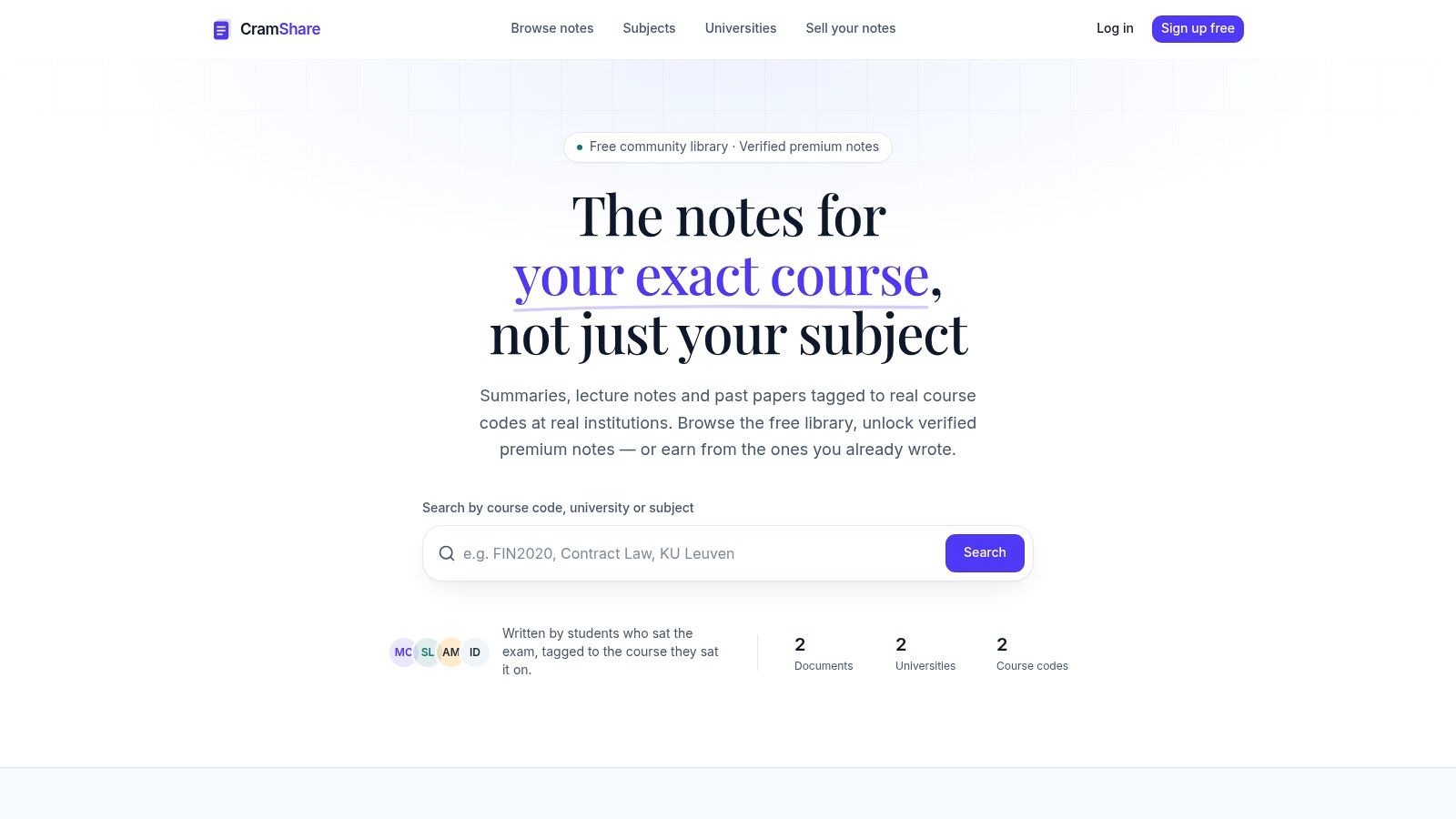
You find a paper labeled with your module title, then realise the useful question is not whether it exists, but whether it matches your course code, academic year, and assessment format. CramShare is built around that filtering problem. Its main advantage is not institutional authority. It is course-level organisation by university, module, textbook, and year, which makes it easier to screen for likely relevance before you spend time revising from the wrong file.
That gives it a different role from an official archive. Official university collections are still the benchmark for legitimacy because they define what was set and assessed. CramShare is more useful as a matching layer and a supplementary practice source, especially when your institution's archive is hard to search or light on supporting material.
Its access model also matters. The platform mixes a free library with paid, user-supplied documents that can be previewed before purchase. For revision, that preview step has practical value. You can check legibility, completeness, paper format, and whether the upload appears tied to the right course before relying on it. If you are comparing what useful supporting materials look like around a paper set, CramShare's guide to study notes for exam revision shows the kind of adjacent resources students often look for.
How useful is it for past-paper revision?
CramShare is strongest when the official paper exists elsewhere, but you need material around it. That may include notes, summaries, worked examples, or additional practice documents attached to the same course. In that sense, its revision usefulness is broader than a pure archive, but its legitimacy is narrower because the material is uploaded by users rather than issued by the university.
That distinction affects how to use it well. If you need exact exam wording for your institution, start with the university source. If you need extra practice, clearer organisation by course, or context that helps explain what a paper is testing, CramShare can fill gaps that official repositories often leave open.
Legitimacy, access limits, and academic integrity
The platform's credibility comes from process controls rather than institutional status. It reviews premium uploads for issues such as completeness, legibility, and course match, and it gives buyers signals such as previews and ratings. Those checks reduce search friction, but they do not remove the need to verify module code, assessment type, and syllabus version against your own course documents.
There is also a clear coverage trade-off. Popular undergraduate modules are more likely to have depth than niche electives, small postgraduate seminars, or recently redesigned courses. A sparse result page does not always mean the course lacks papers. It may only mean the platform has limited uploads for that specific module.
Academic-integrity concerns are manageable if the platform is used for revision rather than substitution. Past papers and revision notes are legitimate study aids in many departments. The risk appears when students treat user-uploaded answers or summaries as authoritative without checking them against lecture materials, marking criteria, or official guidance. Used carefully, CramShare is most effective after you have confirmed what your course assessed, and before you broaden out to less course-specific practice sources.
2. Studocu
Studocu is one of the stronger user-uploaded platforms when your main problem is finding materials attached to a specific university and course rather than browsing broad subject categories. Its search structure makes it easier to narrow by institution and class, which reduces the classic problem of finding a paper that is technically on the same topic but built for another syllabus.
For revision, that means Studocu is often better as a matching tool than as an authority source. You may find multiple versions of class notes, practice papers, and exam-style materials for the same course, which helps when you want to compare how different students prepared for the same assessment.
Where it helps and where it doesn't
Studocu also adds AI-driven study modes that can turn uploaded material into quizzes or mock-style prompts. That's useful if you've already found relevant documents and want a quicker way to drill concepts, but it doesn't solve the first-order problem of whether the source file itself is accurate or complete.
Its main strengths are practical:
- Course-level filtering: Searching by university and course usually produces more relevant results than generic web search.
- Document variety: You can often find past exams, practice questions, summaries, and lecture-derived revision material in one place.
- Multiple versions: Popular courses may have uploads from different years or cohorts, which can reveal changes in emphasis.
The weaknesses are equally clear. Quality varies by uploader, and full access to many files typically depends on Premium access or some form of earned access. For that reason, Studocu is best used as a secondary layer after official archives, not as the place where you determine what your exam looks like. You can browse the platform directly at Studocu (opens in a new tab).
3. Course Hero
Course Hero sits in a similar category to Studocu but feels more like a course repository plus support ecosystem than a pure past-paper search destination. It lets users search by school, course code, and textbook, which makes it useful when a module is known by a shorthand code among students and that code matters more than the full course title.
That search pattern is worth paying attention to. Official systems at several universities also rely heavily on course-code or module-based lookup, and Oxford's exam archive specifically allows searching by title, examination, or academic year through the University of Oxford Exam Paper Archive (opens in a new tab). Course Hero mirrors that behavior in a commercial, user-uploaded environment.
Best use case
Course Hero tends to work best when you need surrounding material as much as the paper itself. Past tests, quizzes, study guides, Q&A threads, and tutoring options can help if you've found a likely exam document but need clarification on topics or worked examples.
Use Course Hero to answer, "What kinds of materials do students in this exact class study from?" Don't use it to assume a document is official just because it looks polished.
Its access model can be a barrier. Full downloads usually require paid membership or uploads, and coverage varies sharply by institution and course. Some classes have rich archives; others barely register. The platform is still worth checking when course-code search matters, especially for large lecture courses and common textbook-driven modules. Visit Course Hero (opens in a new tab) to assess whether your class is represented.
4. Docsity
A common Docsity search starts with uncertainty: you know the subject area, perhaps even the university, but the exact paper title or archive location is unclear. In that situation, Docsity can be useful because it sits between an official archive and a general document library. It offers more structure than a broad upload site, but less institutional certainty than a university-run exam repository.
That trade-off defines its value. On legitimacy, Docsity is still a user-uploaded platform, so a document should not be treated as official unless the file itself clearly shows institutional origin. On course match, it can perform better than broad repositories because searches can be narrowed by university and subject. On access, availability depends on credits or Premium features, which matters if you need several papers in a short revision window. On revision usefulness, its strongest material is usually not a single paper but a cluster of related files tied to the same module.
A practical way to assess Docsity is to read the listing before opening the file. The useful signals are specific, not cosmetic:
- the university and module naming convention
- the exam year or session
- whether the upload is a full paper or only selected pages
- whether the file is accompanied by notes, solutions, or summaries from the same course
That last point matters more on Docsity than on an official archive. Official archives are better for authenticity. Docsity is better for building practice volume once you already know what your own course expects. If your university provides past exams only sporadically, or restricts access after a few years, Docsity (opens in a new tab) can fill gaps with additional papers, exam-style questions, or multilingual material from related courses.
Use it selectively. A near-match from the wrong institution can still help with timing, question format, or topic coverage, but it should not override your own syllabus, assessment brief, or lecturer guidance. That makes Docsity more useful as a secondary source than a primary one.
5. Scribd
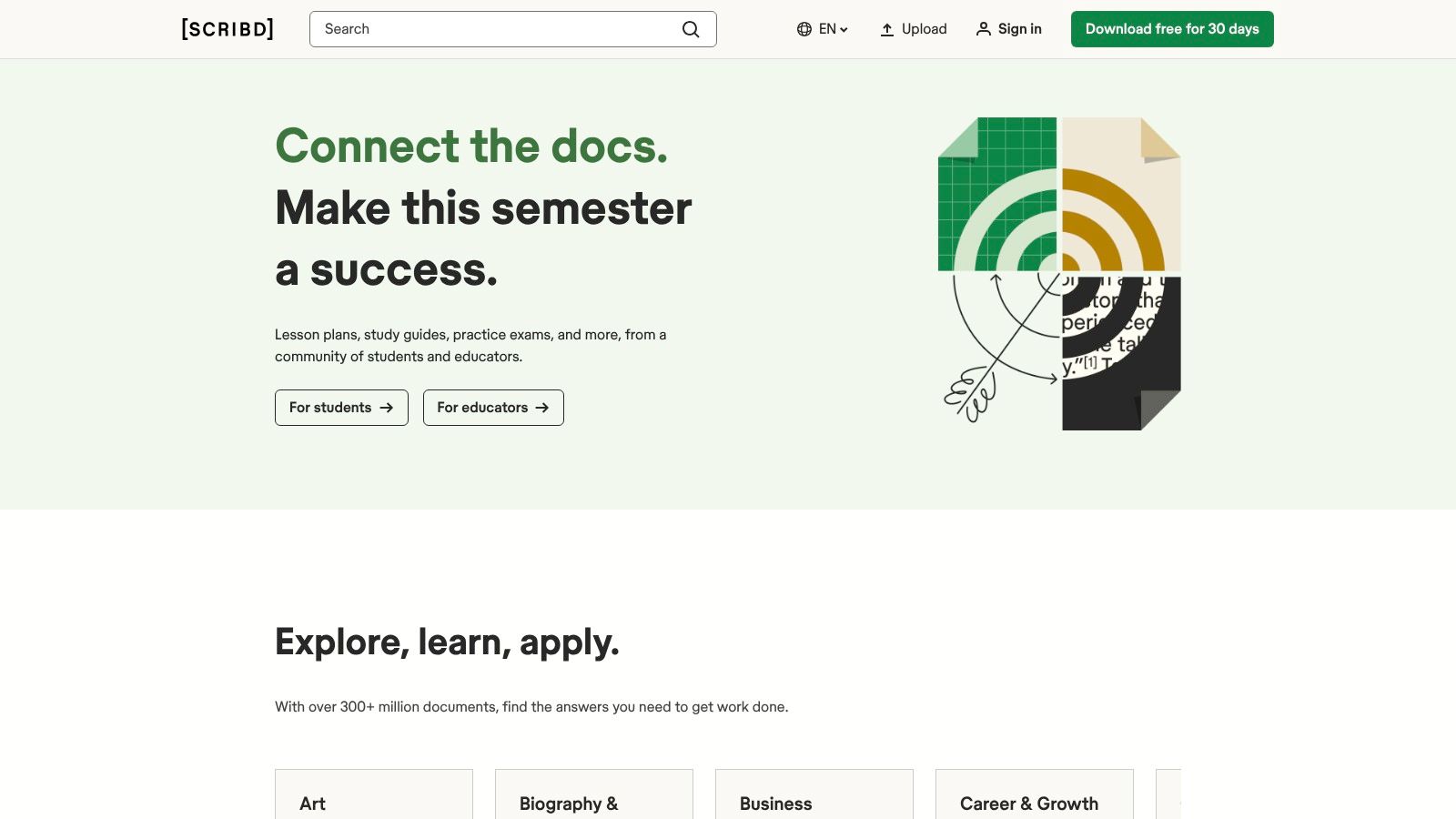
Scribd isn't a past-paper platform in the narrow sense. It's a broad subscription document library where exam papers, solutions, lecture notes, and study guides often appear because users upload them alongside many other document types. That makes it messy, but sometimes surprisingly useful for niche searches.
Its advantage is breadth. If you're studying a less common module, a regional qualification, or a specialist topic where dedicated study platforms return nothing, Scribd may still surface exam-like materials through keyword search. It's also convenient for reading across devices and saving material for offline review.
A broad net, not a precise filter
The trade-off is precision. Because Scribd isn't built around structured course-code matching, you'll spend more time validating whether a document belongs to your syllabus. Mislabeling and loose categorization are real risks, especially where exam papers and generic study guides are mixed together.
That's why Scribd works best later in the search sequence, after official and course-specific options. If you're trying to build a personal bank of revision material from several sources, it can still help. Students doing that kind of collection work may also benefit from CramShare's guide on downloading study material responsibly, especially when sorting legitimate resources from low-value uploads.
Broad repositories are for expansion, not confirmation. Confirm your exam format elsewhere, then use Scribd to widen your practice set.
Access conditions can also change, and the best material is often tied to subscription access. Still, as a backstop for unusual queries, Scribd (opens in a new tab) is worth testing.
6. Academia.edu
A common late-stage revision problem looks like this: the official archive has only one or two past papers, student-uploaded sites keep returning generic notes, and the module itself is too specialized for broad repositories to match cleanly. In that situation, Academia.edu can still produce useful material, but usually not in the form students first expect.
Its main value is proximity to teaching and research communities rather than exam-archive completeness. On Academia.edu (opens in a new tab), you may find lecturer-uploaded handouts, departmental reading packs, sample assessments, methods exercises, or seminar materials that reflect how a subject is taught. That makes the platform more legitimate than a random user upload, while still falling short of an official university paper archive.
The trade-off is relevance control. A document can be academically credible and still be a poor revision match if it comes from the wrong department, level, or curriculum sequence.
A useful way to judge Academia.edu is to separate four questions:
- Legitimacy: Who uploaded the file? A lecturer, department, or named researcher carries more weight than an anonymous account.
- Course-match potential: Topic matching is often possible. Module-code matching is often weak.
- Access model: Some material is viewable quickly, while other files sit behind account prompts or partial access limits.
- Revision usefulness: It works better for understanding how a field frames questions than for assembling a clean set of timed past papers.
That profile gives Academia.edu a narrow but real role. It is strongest in theory-heavy disciplines, postgraduate modules, area studies, and research-led courses where official public archives are thin and commercial study platforms skew toward mass-market subjects. In those cases, a departmental problem sheet or sample essay prompt may be more useful than a mislabeled "past paper" from a broader repository.
Use it as a second-layer source. Confirm exam format, marking expectations, and course coverage through your university or department first. Then use Academia.edu to add context, extra practice prompts, or instructor-style framing. That approach also reduces academic-integrity risk, since some uploads may be teaching materials shared outside their original course context and should be treated as revision support, not as a substitute for assigned assessment guidance.
7. MIT OpenCourseWare
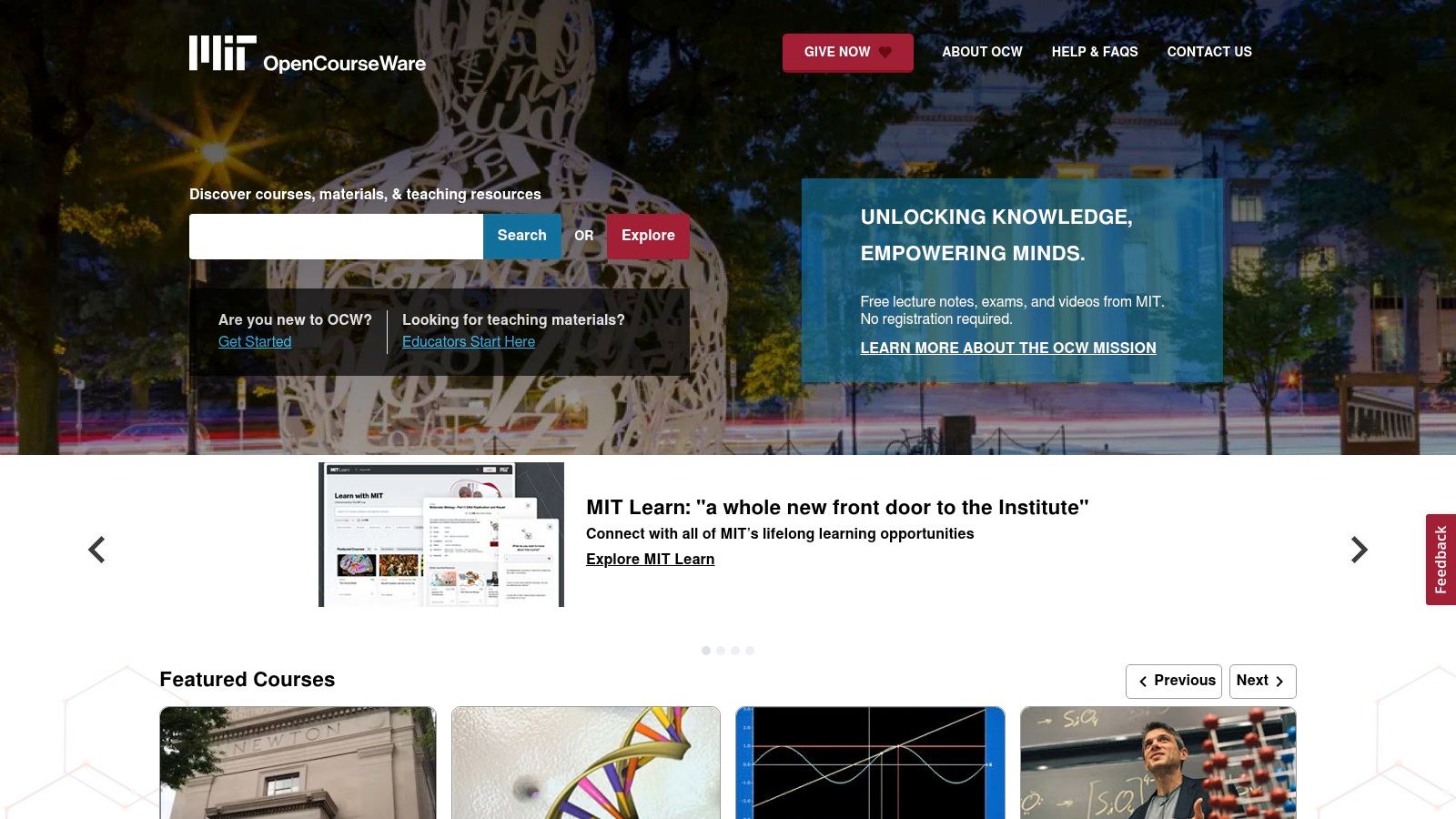
A common revision problem looks like this: your department releases only a small set of old exams, but you still need more timed practice in calculus, mechanics, microeconomics, or algorithms. MIT OpenCourseWare fills that gap better than user-uploaded paper sites because it is an official institutional archive with openly shared course materials, including exams, assignments, and solutions for many courses, all accessible through MIT OpenCourseWare (opens in a new tab).
Its legitimacy is high. The materials come from MIT courses rather than anonymous uploads, and the access model is unusually clear. No account is typically required, and the licensing context is far easier to assess than on commercial document-sharing platforms. That matters if you want revision material with a known origin and fewer copyright or academic-integrity doubts.
Course match is the limiting factor. MIT OCW is strongest when your module overlaps with MIT's syllabus structure, mathematical level, and problem style. In quantitative subjects, that overlap can be good enough to make the papers useful even outside MIT. In essay-based or tightly prescribed professional courses, alignment is often weaker because question framing, reading lists, and marking expectations vary more by institution.
Evidence on open educational resources supports that narrower use case. A synthesis covering 121,168 students and faculty (opens in a new tab) found equal or better learning outcomes for students using OER, alongside positive faculty and student responses. For revision, the practical conclusion is specific. Open materials help when they match the skills and content you are being examined on.
That makes MIT OCW a second-source archive rather than a substitute for your own university's papers. Use official departmental exams first for format, weighting, and course sequence. Then add MIT papers for extra problem volume, harder variations, or worked examples in adjacent topics. If you're organizing downloaded materials into a usable study set, CramShare's article on study notes PDFs can support the filing side without changing the source hierarchy.
8. OER Commons
A common revision problem looks like this: your department has released one or two old exams, the format is still unclear, and the remaining user-uploaded options raise questions about origin, licensing, or course fit. OER Commons (opens in a new tab) sits in a different category from both official university archives and commercial upload platforms. It is an open repository built for shared educational use, which gives it stronger legitimacy than anonymous document pools but a weaker guarantee of exact exam alignment than institution-run paper banks.
That difference shapes its value. OER Commons is usually most useful when you need additional practice material that matches a topic, skill, or learning outcome, rather than a verified copy of your own university's past paper. For modules assessed through problem sets, short-answer questions, or concept checks, that can still be enough to improve revision quality.
A practical way to assess OER Commons is to separate four questions:
- Legitimacy: stronger than user-uploaded paper sites because materials are openly shared for educational reuse.
- Course-match potential: moderate and uneven. Matching depends on how closely the resource level, subject coverage, and assessment style track your module.
- Access model: open access is a real advantage, especially for students who cannot use paywalled repositories.
- Revision usefulness: high for extra practice and teaching reuse, lower for predicting your institution's exact exam format.
The trade-off is search precision. OER Commons does not function like an official archive organized by faculty, year, and paper code. You often need to search by discipline, qualification level, and assessment type, then screen results for syllabus overlap. That takes more judgment than using an institutional repository, but it also broadens the pool beyond one university's exam history.
Academic-integrity concerns are lower here than on many upload platforms because the platform's model is based on openly reusable educational content. Still, students should avoid treating any third-party assessment resource as a leaked substitute for course guidance. The safer use case is clear: start with official papers if your university provides them, then use OER Commons to add topic-specific practice where your archive is thin or absent.
9. IGNOU Previous Year Question Papers
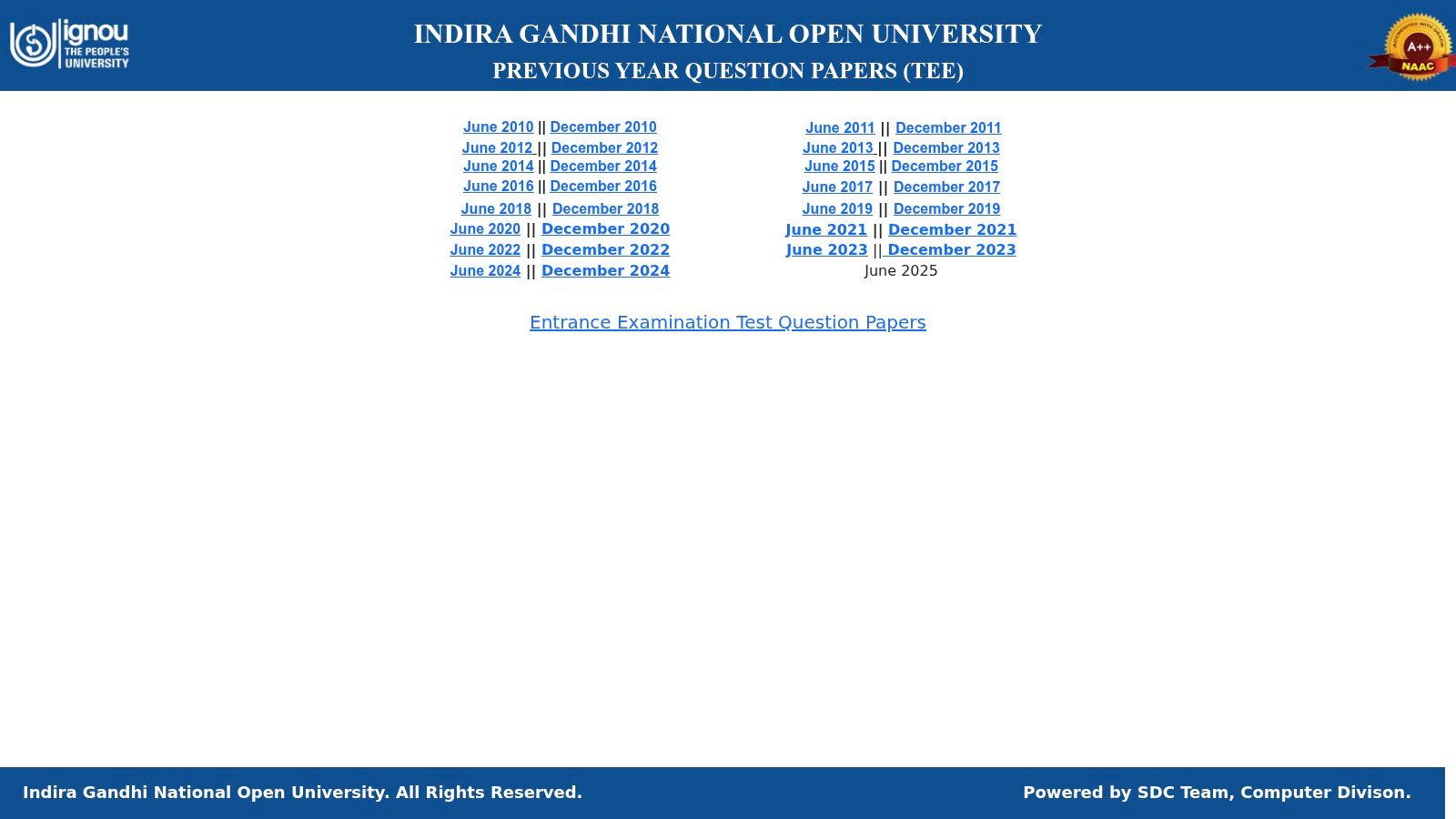
A student preparing for an IGNOU exam often faces a simple choice first. Search broad paper-sharing sites for anything that looks similar, or start with the university's own archive and match by course code. For IGNOU, the second route is usually the sounder one because the archive is official, course-specific, and organized around the institution's actual assessment structure.
That matters for more than trust. It affects four practical questions at once. Legitimacy is high because the papers come from IGNOU itself. Course-match potential is also high for enrolled students because the archive is built around IGNOU programmes rather than approximate subject tags. Access is direct through the university portal, which removes many of the paywall and upload-quality problems seen on user-contributed platforms. Revision usefulness is strongest for format recognition, paper selection, and timed practice under the same institutional logic used in the exam.
The limits are narrower, but still important. An official archive does not automatically solve marking and interpretation. If the portal lacks answer keys or examiner commentary, students still need to check responses against block materials, tutor feedback, and assignment expectations. That makes IGNOU papers strong for exam rehearsal, but less complete as a self-contained revision system.
A better way to use the archive is to treat it as the anchor source, then add outside material only for specific gaps. If a student needs more practice on a topic after working through matched IGNOU papers, broader repositories can help with extra questions. They should not replace the official set for predicting wording, paper balance, or course emphasis.
For non-IGNOU students, the value changes. The portal remains legitimate, but transferability falls because similar module titles across universities often hide different syllabus boundaries and assessment conventions. In other words, these papers are highly reliable and sometimes poorly portable.
Use the official archive first: IGNOU Previous Year Question Papers portal (opens in a new tab).
10. University of Cambridge Faculty of Mathematics Past Examination Papers
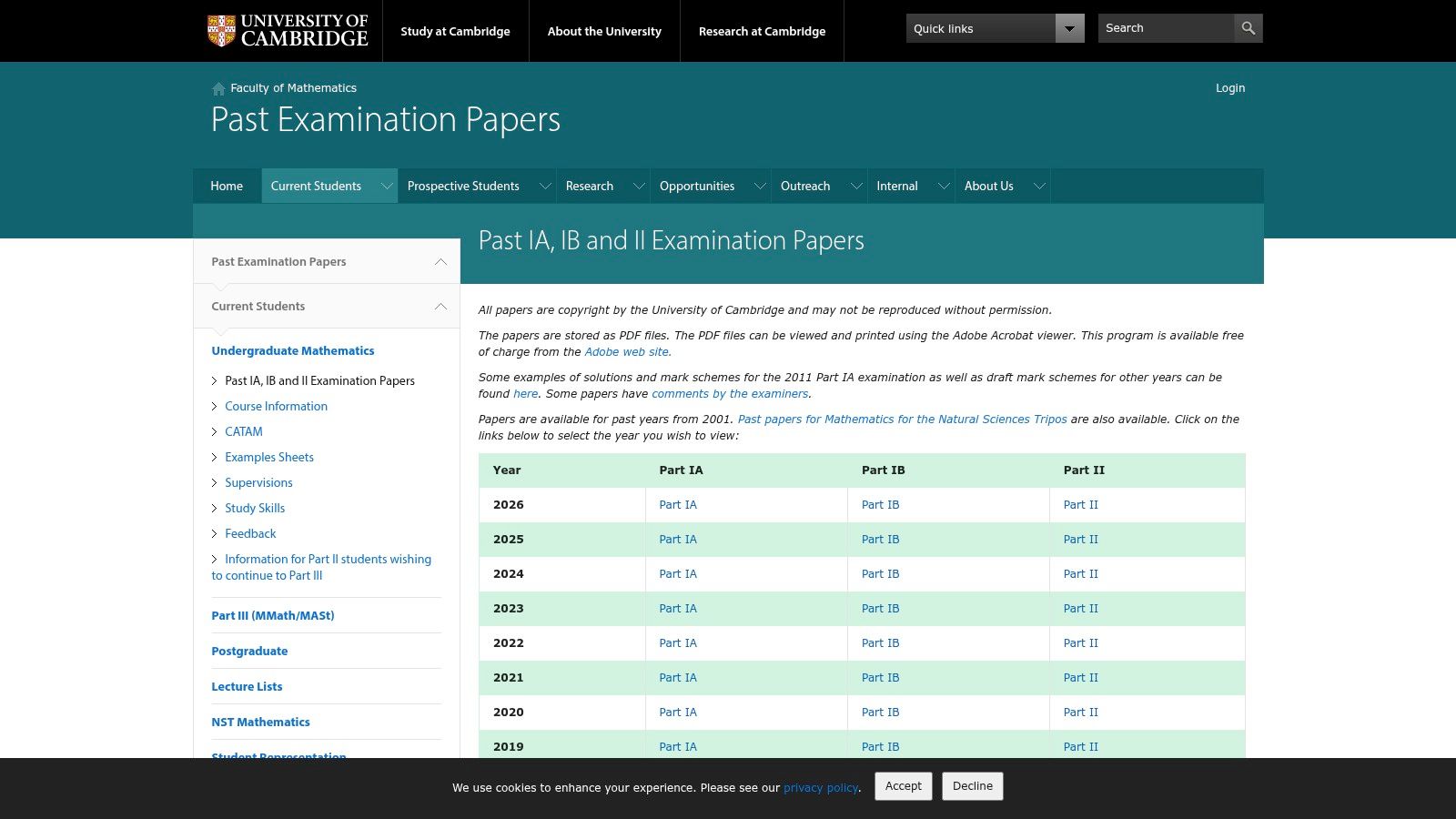
The University of Cambridge Faculty of Mathematics archive is a specialist source, but a valuable one. It offers open access to past Mathematics Tripos papers organized by part, giving students a clean run of official, consistently formatted exam material for serious mathematical practice.
This is the kind of archive that shows why discipline-specific official repositories still matter. In mathematics, exact notation, proof style, and problem structure all shape revision quality. A generic "calculus past paper" found on the web often isn't a substitute for a well-curated university mathematics archive.
Best for deep timed practice
Cambridge mathematics papers are demanding. That makes them useful beyond Cambridge itself, especially for students who want harder practice in proof, problem-solving, and multi-step reasoning. If your own institution's papers are sparse or less challenging, these can stretch you productively.
Harder official papers can be more useful than loosely matched easy ones, but only after you've learned your own course format.
The limitations are clear enough. The archive is discipline-specific, and many papers don't include official solutions. So it works best for students who already have a marking strategy, such as supervision notes, course texts, or tutor feedback.
If that fits your needs, the University of Cambridge Faculty of Mathematics past papers archive (opens in a new tab) is one of the best open specialist exam banks available.
Top 10 University Past Paper Resources Comparison
Turn a Paper Archive Into a Revision System
Finding university past papers is only the first step. The more important skill is turning a pile of PDFs into a repeatable revision system that improves performance.
Start by confirming five things before you attempt any paper: institution, course code, academic year, syllabus version, and assessment format. If any of those are unclear, the paper may still be useful for extra practice, but it shouldn't shape your expectations about the exam. Students often waste revision time not because they didn't practise, but because they practised against the wrong pattern.
Once you've identified the most authoritative source available, collect several papers from it. Official archives should come first whenever possible, because they give you the strongest signal about wording, structure, and scope. Open repositories come next when they offer clearly licensed, high-quality materials. User-uploaded and marketplace platforms are most useful when they help you recover missing context, find course-specific notes, or add extra practice around a thin official archive.
A practical sequence that works
Use a simple workflow:
- Verify the match: Check the module title, code, year, and paper type before downloading.
- Attempt one paper cold: Sit one under timed conditions without notes so you can measure recall, pacing, and question selection.
- Mark with the best available standard: Use an official solution if one exists. If it doesn't, use reliable course materials, model answers, or lecturer guidance.
- Classify mistakes: Separate content gaps from exam-technique problems. Forgetting a formula isn't the same as misreading a command word or running out of time.
- Target the weak areas: Revise by topic and question type before repeating the cycle with another paper.
That classification step is where many students improve fastest. A low score on a past paper doesn't tell you much by itself. A pattern of errors does. If most mistakes come from one topic, revise that topic. If most come from structure, timing, or misinterpreting prompts, your issue isn't knowledge alone.
Use broader platforms carefully
Community libraries and user-uploaded platforms can save a lot of search time, especially when your university archive is incomplete or awkward to use. But they require a different mindset. Treat them as discovery and support tools, not automatic proof that a document is official, current, or complete.
That also means respecting copyright, access conditions, and your institution's academic-integrity rules. Don't upload documents you don't have the right to share. Don't rely on shared material to replace attending classes, completing your own coursework, or following exam instructions. The best use of these platforms is supportive and selective.
CramShare fits that role well when you need course-specific supporting material around a paper. If an official archive gives you the exam but not enough guidance to understand the module's recurring themes, a course-matched set of notes, summaries, or revision resources can close that gap. Used properly, that's not a shortcut. It's a way to make official papers more teachable and more useful.
Revision gets better when you stop asking, "Where can I find any past paper?" and start asking, "Where can I find the right paper, for the right course, from the most reliable source, with enough context to learn from it?"
If your university archive is thin or hard to search, CramShare can help you find course-specific past papers, revision notes, and practice materials by university, course code, module, textbook, and academic year. It's most useful when you already know the exact course you're preparing for and need supporting resources that match it more closely than a broad subject search can.