How to Make Revision Notes That Actually Stick
Learn how to make revision notes that boost exam performance with proven methods for active recall, spacing, and course-specific organization across any
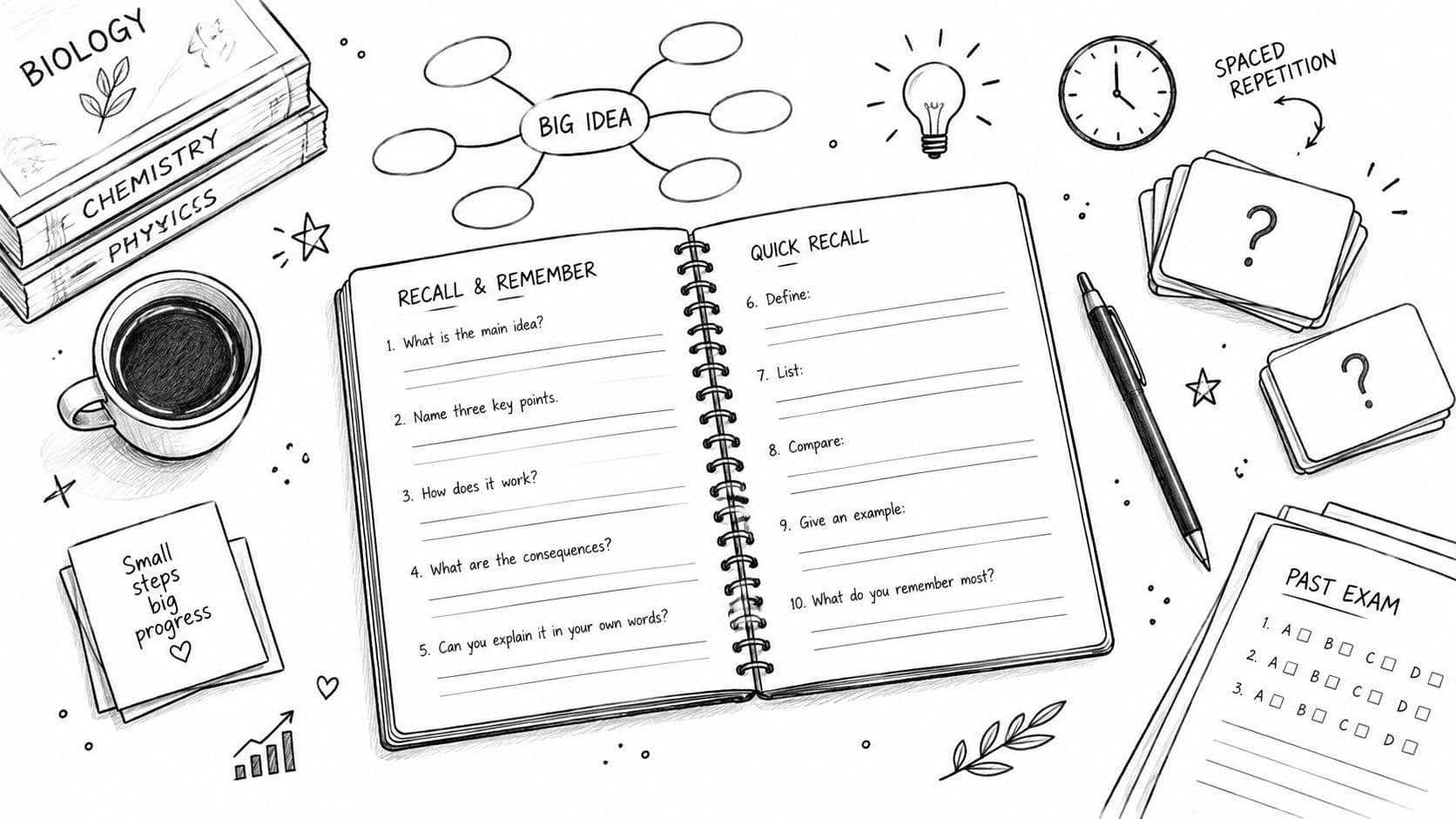
You've made a neat summary of your lecture slides, highlighted the key terms, and read the whole thing twice. Then you close your notes and try to explain the topic without looking. The details don't come easily. That frustrating moment doesn't mean you're bad at revision. It often means your notes are designed to help you recognize information, not retrieve it.
Effective revision notes do more than make a course look organized. They help you check what you can recall, spot what you've misunderstood, and practise the kinds of thinking your course assesses. To make revision notes that stick, start with your course's requirements, turn topics into questions, and return to those questions over time.
Why Most Revision Notes Stop Working Before Exam Day
A polished page can feel like progress because the information looks familiar. But familiarity while reading isn't the same as being able to produce an answer from memory, explain a mechanism, or solve a problem under exam conditions. If the answer is always visible, you can mistake recognition for knowledge.

In a 2008 experiment published in Science, Jeffrey Karpicke and Henry Roediger found that repeated studying after initial learning produced little benefit for delayed recall, whereas repeated testing produced a large positive effect on later memory (Karpicke and Roediger's experiment on retrieval practice (opens in a new tab)). The practical lesson is that revision notes should ask you to bring information to mind, not just present information for another read.
Two design principles follow. First, treat notes as retrieval prompts, such as questions, blank diagrams, short-answer tests, and “explain why” tasks. Second, treat them as a system you revisit, not a document you complete once and put aside. A sheet that only looks finished can't tell you what you've forgotten.
A useful test: Hide the answer. If the page gives you nothing to do except read, it's a summary, not yet a revision tool.
This doesn't make summaries useless. A concise explanation can help you understand a difficult idea before you test yourself. But once you've understood the material, your notes need to make you do the work of remembering it. That's what makes them useful when the exam question is in front of you and the answer isn't.
Designing Notes Around Your Actual Course
Start by deciding what your notes need to help you answer. Lecture order can be convenient for recording material, but exams are built around course outcomes and assessment requirements. If you summarize every slide equally, you may spend hours preserving details that don't help you meet the module's objectives.
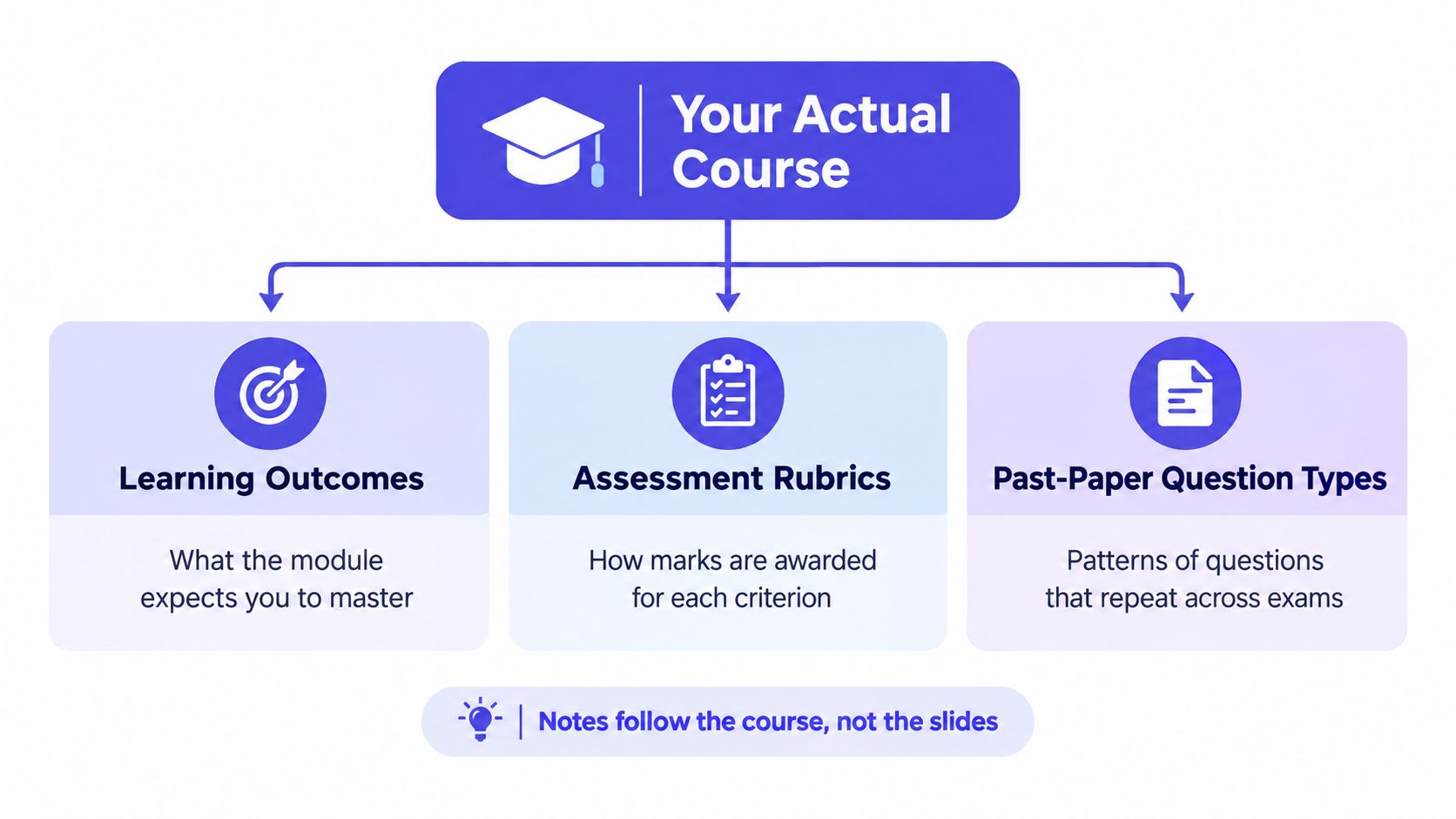
Use the current official materials to build a map before you start writing:
- List the learning outcomes. Turn each outcome into a plain-language task, such as define, compare, calculate, evaluate, or explain.
- Check how marks are awarded. Look at the assessment rubric or guidance. If answers need evidence and evaluation, a set of isolated definitions won't prepare you to meet those criteria.
- Review question formats. Past papers can show whether you'll need to interpret a diagram, work through a calculation, compare theories, or construct an argument. Use them to understand the format, not to assume an old question will be repeated.
- Match each topic to reliable course materials. Check lectures against the textbook, official readings, and any corrections or updates from your instructor.
Suppose a lecture transcript contains several pages on a biological process, including a definition, a sequence of stages, a clinical example, and a side discussion. If the outcome asks you to explain the stages and apply the process to a case, preserve the definition accurately, make the stages a recall prompt, keep the relevant example, and leave out material that doesn't support an outcome or assessment skill. Mark anything uncertain as an unresolved question rather than turning a guess into a confident-looking note.
Note-taking research indicates that learning depends partly on selecting relevant information, not merely recording more of it. Aligning notes with module outcomes and past-paper question types can produce more useful revision material than making full transcripts (research on note-taking and course-relevant selection (opens in a new tab)).
Keep the source details with your notes, especially if you're using material made by someone else. Record the institution, course code, module, lecturer or source, academic year, and date you checked it. If you're building a broader course guide, this guide to study guides for students can help you think about how to structure supporting material.
Turning Topics Into Recall Prompts
Once you know what belongs in your notes, give each learning outcome a job: it should make you answer a question, complete a diagram, or solve a problem without seeing the solution. Keep the answer hidden until you've tried. If the answer is always in view, it's too easy to skim and mistake recognition for recall.
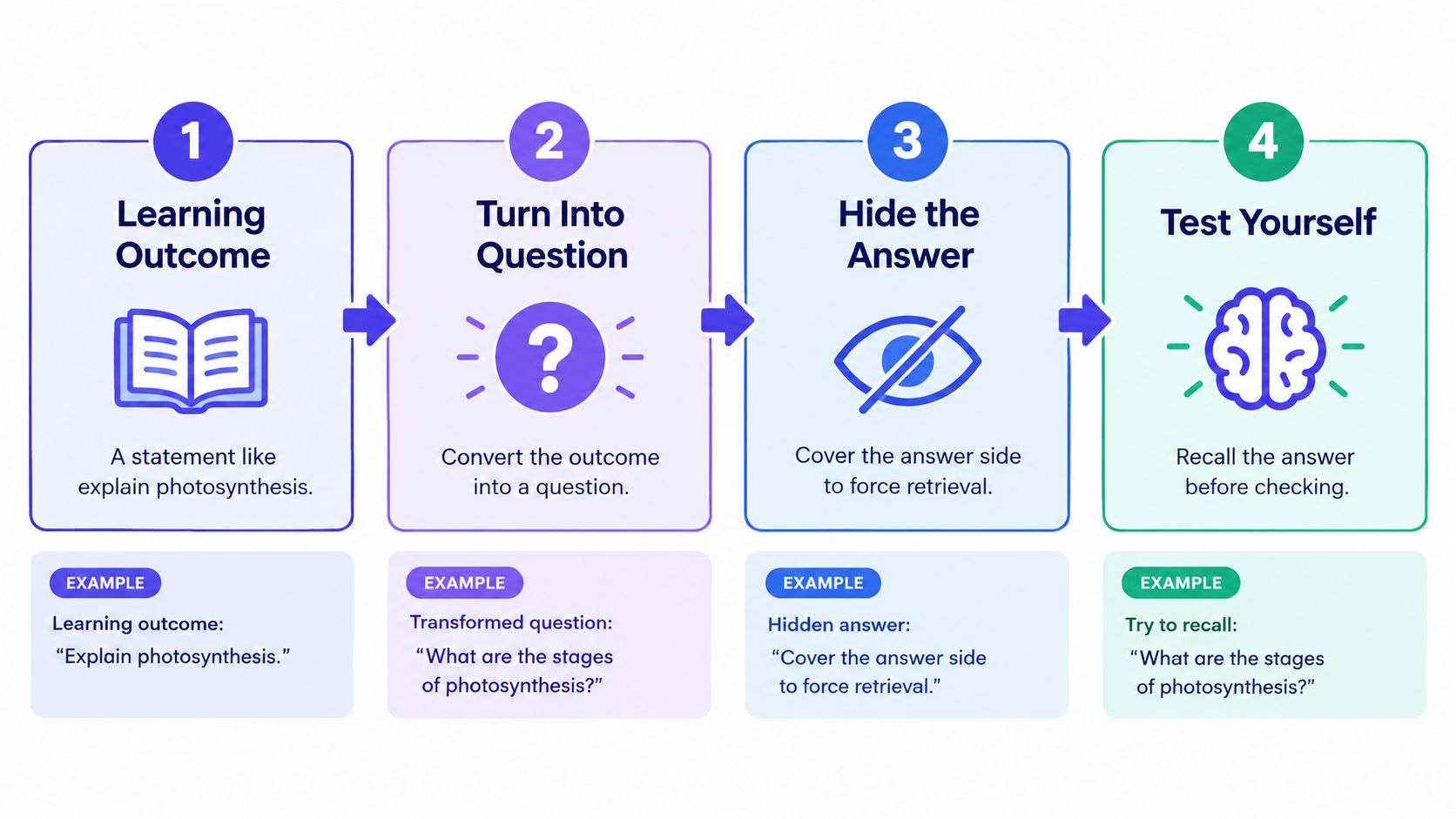
For a quantitative topic, take an outcome such as “apply the formula for calculating density.” Don't just copy the formula and a complete worked example. Instead, create a prompt that asks which formula applies, then leave the substitution and one or more calculation steps blank. Add a common-error line: Check that mass and volume use compatible units before calculating. When you practise, you'll need to choose the method and complete the work, not merely recognize a finished solution.
For a discursive subject, turn an outcome such as “evaluate competing explanations of a historical change” into a prompt: What is your main argument, what evidence supports it, and what counterargument must you address? Below it, leave space for a thesis and three claims to justify. This helps you rehearse building an argument rather than recalling an isolated list of facts.
Aim for an answer short enough to reproduce in your own words, but complete enough to meet the prompt. A definition may need a precise phrase; a process may need ordered steps; an essay question may need an argument and supporting reasons. Formulas, dates, and terminology can all be tested through questions rather than copied as a block.
Retrieval practice has outperformed elaborative concept mapping in a controlled study: students who practised retrieval achieved a mean final-test score of 0.67 versus 0.45, and 101 of 120 students performed better following retrieval practice (study comparing retrieval practice and concept mapping (opens in a new tab)). The figures support a practical choice: make your notes ask you to produce an answer. For more examples of question-led practice, see this guide to the active-recall study method.
The Build, Close, Retrieve, Compare Cycle
A student preparing for a mid-semester biology exam can build a useful topic sheet without rewriting the whole lecture. After class, they choose one learning outcome, gather the relevant lecture and textbook explanations, and write a concise answer in their own words. They might organize it under the headings core idea, steps, example, and common confusion.
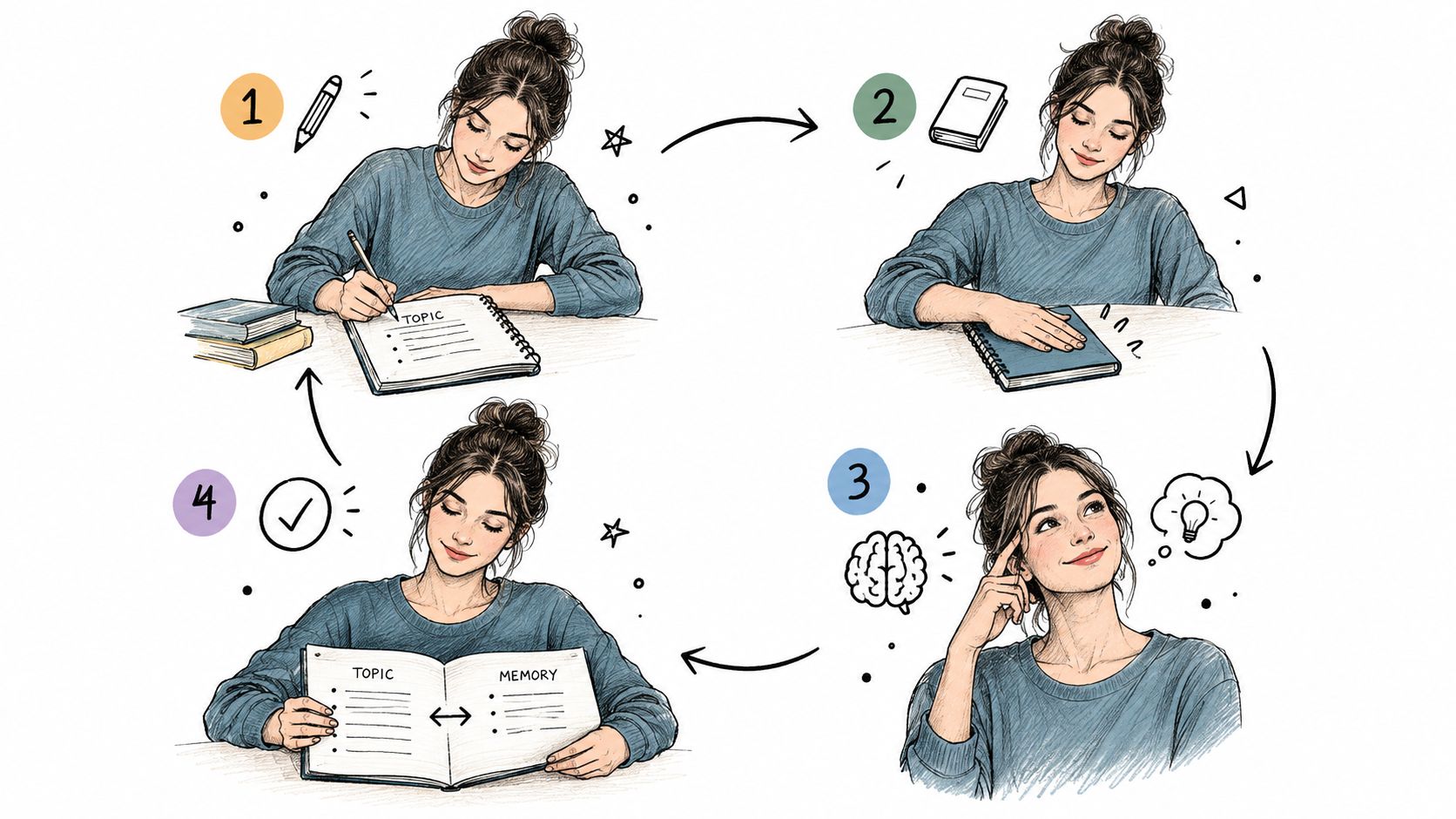
Then the student closes the lecture and covers the answer. From memory, they write what they can recall about the process, including the order of the steps. Only after attempting the response do they compare it with the course source or mark scheme. That comparison matters: it reveals whether a missing step reflects a memory gap, whether an example is inaccurate, or whether a misconception has made the answer sound plausible but wrong.
The tempting alternative is to highlight the page and read it again. That can make the material feel more familiar, but it doesn't show whether the student can retrieve it without help. The part most often skipped is the correction: after checking the response, the student records the omission or error directly on the prompt so it can be tested again.
For each discrete learning outcome, aim for one clear question, an answer you can reproduce without copying, and a line for the most likely error. If the topic is still confusing, pause to study a worked example or ask for feedback before relying on a recall prompt alone. Retrieval can help you diagnose what you know, but it can't replace understanding or guidance on a complex explanation.
Scheduling Your Notes With Expanding Intervals
A question you answer today may be much harder to retrieve after time has passed. That's why revision notes need a schedule as well as good prompts. Try a first recall attempt soon after making a topic sheet, then revisit it after progressively longer gaps. One workable example is roughly 1 day, 3 days, 7 days, 14 days, and 30 days. Adjust the timing to the exam and how well you're recalling the material.
A major review of spacing research found that the optimal gap is approximately 10–20% of the intended retention interval, with the best proportion near 20% when retention is needed for several weeks and around 5% when it's needed for a year (review of spacing and retention intervals (opens in a new tab)). These are guideposts, not a calendar that every student must follow exactly. The useful principle is that your review gaps should make sense for how long you need to retain the material.
Track each question after you attempt it:
Don't spend every session reviewing the topics that already feel comfortable. Recognition isn't the same as being able to answer from memory, and leaving your first retrieval attempt until the night before the exam gives you little time to correct gaps. A simple calendar or flashcard app can help you keep track; this overview of spaced-repetition tools offers another place to compare options.
Adapting the Method to Different Subjects
The prompt should match the kind of answer your course expects. A calculation-heavy subject calls for a problem to solve, while a humanities course may ask you to build and defend an argument. In a lab course, a blank diagram can test whether you can locate structures or reconstruct a process. The format changes, but each prompt should still require you to produce something without looking at the answer.
For a calculation course, don't stop at memorizing a formula. Include a prompt that makes you identify when it applies, choose the values, and show the working. For a theory course, keep the question open enough to test your reasoning, not just your ability to repeat a reading. For a lab, leave labels blank and include questions about what each structure does, so you practise both identification and explanation.
The same choice applies to the medium. In the original studies reported in a 2014 paper, laptop note-takers recorded more words and showed greater verbatim overlap with lectures, while longhand note-takers performed better on conceptual questions. The broader lesson is not that handwriting always wins. A later replication and related research questioned whether there's a universal advantage, so whether you type or write by hand, aim for notes that are selective and organized in your own way (research on laptop and longhand note-taking (opens in a new tab)).
A Weekly Revision Notes Routine and an Audit Checklist
A useful routine can be simple. After class, identify what the session covered and connect it to your course outcomes. Condense the material while it's fresh, but don't aim to create a perfect set of pages. Your first goal is to make prompts that match the questions and skills your course expects.
Try this weekly rhythm:
- After class: Choose the relevant outcomes and make concise notes from current course materials.
- At your next study session: Hide the answers and attempt a first recall pass. Compare your response with the source and record what you missed.
- During later sessions: Revisit prompts at expanding intervals. Change the format when useful, for example, move from free recall to a short-answer question or a worked problem.
- When something doesn't make sense: Go back to a reliable explanation or worked example before testing it again. Don't turn an unresolved idea into a memorization task.
Before keeping an old page in your revision set, ask whether it has a question instead of only a paragraph, whether the answer is hidden, and whether the prompt maps to a current learning outcome. Check that it uses course-appropriate examples and includes a correction for a common mistake. Finally, confirm that you've given it a place in your revision schedule.
The usual traps are easy to spot: rewriting everything, studying only familiar topics, trusting recognition, and making notes that don't match the current module. Pick one topic and ask yourself, Could I answer this cold right now, without looking? If not, your next task isn't to make the page prettier. It's to find the gap, turn it into a clear prompt, and give yourself another chance to retrieve the answer.
CramShare is an online study resource marketplace and community library where students can find course-specific notes, revision guides, and past papers matched by institution, course code, module, and academic year. Use CramShare to compare relevant materials with your own course requirements, then turn the ideas you need into prompts you can test from memory.