10 Study Guides for Students: Types, Templates and Tools
Explore study guides for students by type: course-specific, textbook-linked and past-paper guides, when to use each, and how to judge relevance.
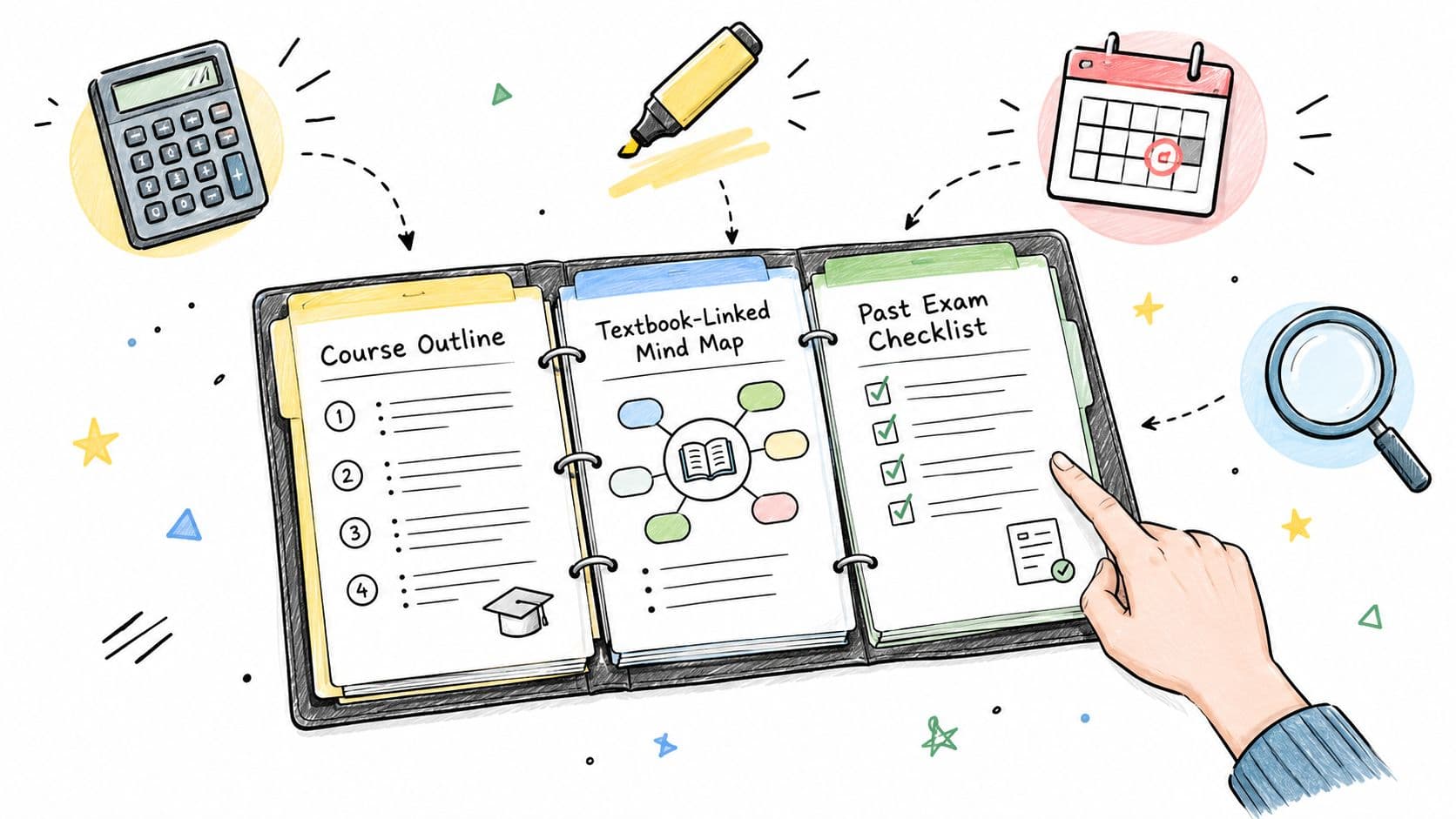
You spend a weekend with a polished summary, underline half of it, and still walk into the exam with the wrong material. That's the most common failure mode with study guides for students. The guide looked good, but it didn't match the course code, textbook edition, or academic year you were being tested on. That mismatch matters more than page count or design, because students consistently want learning resources that are easy to access, easy to revisit, and tied to the right class context, not just generic notes (McKinsey's cross-country survey of higher-education students (opens in a new tab)).
The list below groups tools by the kind of guide they produce, course-matched, textbook-linked, past-paper, concept-first, or quiz-based. That's the only filter that really matters when you're under pressure. A guide is useful if it lines up with your syllabus, helps you verify what's covered, and makes revision easier before the actual question format shows up.
1. CramShare
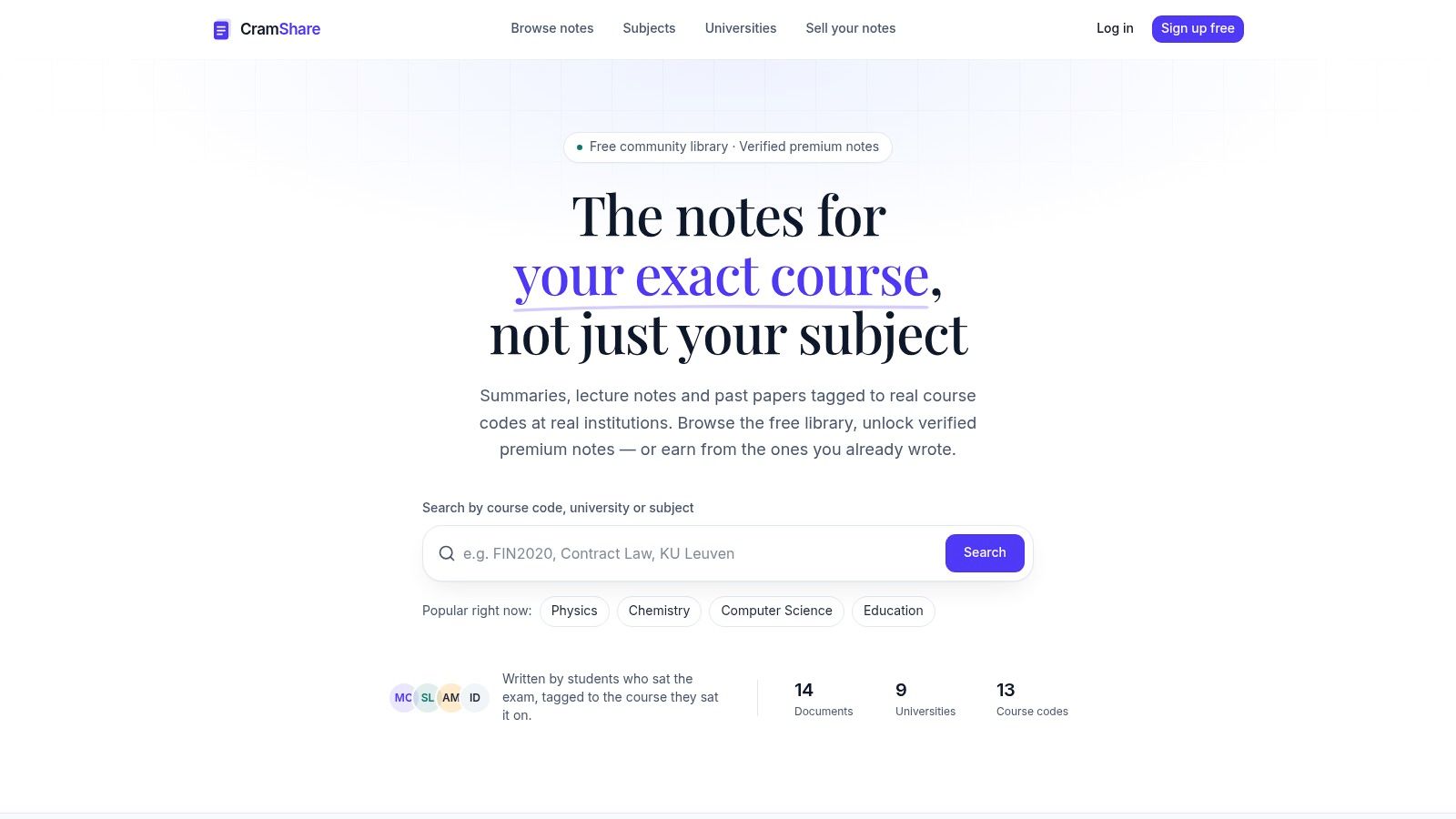
CramShare is the closest fit here for course-matched study guides because it sorts materials by the details students check, including university, course code, module, textbook, and academic year. That makes it a better choice than a broad subject library when you need help for one lecture sequence or one assessment brief. It also suits students who revise asynchronously and on mobile, which aligns with the flexible-learning demand highlighted in the McKinsey survey linked above.
Why it stands out for syllabus-matching
The free community library is easy to browse without a page cap, watermarks, or daily access limits. Premium documents open to multi-page previews before purchase, which helps you see whether a guide really matches your module before you commit. Premium uploads are reviewed for completeness, legibility, and course relevance, a useful filter when open document dumps leave students sorting through a lot of weak material.
Practical rule: If a guide does not show its course tag, preview, and academic year up front, verify it against your syllabus before you rely on it.
CramShare also gives student authors a direct route to sell their own materials. Sellers keep ownership, set their own price, receive 70% of eligible sales revenue, and get paid monthly with no minimum payout threshold. Coverage is still growing, so some modules will be thin or missing, but that is the trade-off when relevance matters more than volume.
- Best for: Exact syllabus matches, revision packs, and students who want to preview before buying.
- Watch out for: Newer coverage means some modules will still be thin.
- Website: CramShare
2. Quizlet
Two days before a terminology-heavy exam, Quizlet's Learn mode is often the fastest way to drill definitions instead of rereading notes. It belongs in the quiz-based study guide group, so its value comes from repeated retrieval, not long explanations. For short revision blocks between classes, the web and mobile tools are easy to keep open.
Fast recall first, accuracy second
Quizlet works well for definitions, terms, and short prompts. You can usually find public sets for common intro courses, then reshape them into a cleaner deck for your own class. That speed is useful, but it comes with a real trade-off.
User-made sets vary a lot. Some are tight and accurate. Others miss key ideas, use outdated wording, or include simple errors. If your syllabus is specific or your lecturer uses unusual terminology, a random public set can waste time.
Treat Quizlet as a starting point, not the final authority. It fits students who already know the course content and want repetition before a test. It is a weaker choice when you need a guide that matches one lecture sequence exactly. Premium features add more practice options, but they only make sense if you will use them often.
- Best for: Fast recall, vocabulary, and test-style drilling.
- Watch out for: Mixed quality across community-made sets.
- Website: Quizlet (opens in a new tab)
3. Chegg Study Pack
When your grade depends on problem sets, Chegg's value is the reasoning chain, not a generic summary. The textbook-linked format works best in math, science, and engineering courses, where the assigned book and homework shape how you study.
Use it to work through one assignment at a time
Chegg Study Pack is strongest when you are stuck on a specific problem and need a step-by-step path that matches your course text. That makes it useful as a guided companion for assignments and revision, especially when a fast answer would leave you confused later. It is a paid service, so the cost is harder to justify if you only need occasional help.
The trade-off is academic integrity and self-reliance. Chegg should support your own work, not replace it. Use it to compare methods, check your steps, and clear a blocker, then solve the same problem again without looking.
A paid guide is worth it only when it shortens the path to understanding your actual assignment.
- Best for: Problem-solving courses and textbook-based revision.
- Watch out for: Short-term use can get expensive.
- Website: Chegg Study Pack
4. Course Hero
A broad “biology notes” search stops being useful when your lecturer assigns a specific reading list. Course Hero is built for that moment. It fits the course-matched document library category, with materials organized by school, course, and textbook so you can check what people in the same class are using.
What to check before relying on it
Its size is the main advantage. You can find summaries, notes, and study documents for many courses, which helps when you want more than one student-made take on the same topic. The drawback is consistency. Some uploads line up closely with the syllabus, while others are thin, outdated, or too general to trust without checking against your course outline.
Use it to compare how different students handled the same class, not to replace your own syllabus. If several documents repeat the same definitions or emphasize the same chapters, that can tell you where the exam focus probably sits. If you need a polished guide with clear course tagging and reliable previewing, Course Hero is less comfortable than a more tightly edited resource.
- Best for: Course-specific browsing and document hunting.
- Watch out for: Many items sit behind membership and quality is uneven.
- Website: Course Hero (opens in a new tab)
5. StudySmarter
If your lecture notes are already decent, StudySmarter's job is to turn them into flashcards and a revision plan. That makes it useful for students who need structure without rebuilding everything from zero. It works best as a course-matched revision tool when you already know what belongs in your guide.
Start with your own notes
The workflow is the main advantage. Import raw notes, clean them into study sets, then revisit them with reminders and progress tracking. That suits students who do not need more content, only a better way to reuse the content they already have.
Shared material can help, but only when it matches your module's wording and depth. If your class follows a specific textbook or lecture order, check that alignment before trusting a community deck. A loose match can waste revision time, especially before an exam built around one syllabus.
A good study app should sharpen the notes you already have.
- Best for: Turning class notes into revision sets.
- Watch out for: Community content still needs checking.
- Website: StudySmarter (opens in a new tab)
6. Khan Academy
When a lecture moved too fast and you need to rebuild an idea from the ground up, Khan Academy is the place to do it. It sits in the concept-first category, so its value comes from clarity rather than course matching.
Use it for understanding, not matching
The platform's structured lessons, practice problems, and mastery checks work well for math, science, economics, computing, and test prep. Use it when you need to understand the logic behind a topic before you try to memorize it for an exam. If a class session left gaps, Khan Academy gives you a clean way to fill them.
The trade-off is course specificity. If your professor uses unusual notation, a different chapter order, or a niche application, you still have to map the material back to your syllabus yourself. Khan Academy gives you the concept, but not always the exact framing your class expects.
- Best for: Concept repair and foundational practice.
- Watch out for: You have to align it to your own syllabus.
- Website: Khan Academy (opens in a new tab)
7. SparkNotes
A Shakespeare seminar tomorrow and 300 pages still unread is exactly the situation where SparkNotes earns a look. It gives literature students a quick route into plot, theme, character, and language, with quizzes and study aids that help before class or an exam. For syllabus-specific reading, it works best as a fast first pass.
Use it for literature, not every subject
SparkNotes is strongest when the assignment is a novel, play, or poetry unit and you need the core ideas in plain language. It handles summaries and analysis well enough to get you oriented, and the modernized Shakespeare material is especially useful if the original text is slowing you down. For AP English-style review, the quizzes and flashcards help you check whether you remember the passages, not just the plot.
The trade-off is scope. It is not a fit for advanced STEM or technical modules, and that limitation shows quickly outside the humanities. If your course is literature-heavy, SparkNotes is efficient and easy to scan, and the SparkNotes alternatives guide is worth a look if you want a wider mix of study guide types.
- Best for: Literature, Shakespeare, and AP English-style revision.
- Watch out for: Limited value outside the humanities.
- Website: SparkNotes (opens in a new tab)
8. CliffsNotes
Short on time the night before a literature exam? CliffsNotes strips a text down to plot, theme, and character first. That makes it useful for syllabus-matched reading that needs a fast reset before class, a quiz, or an essay.
Its strongest use is a first pass, not the final word. Start there if you need a plain-language map of a novel, play, or poem, then move back to your class notes and the original text. If you are comparing broader free resources, the free online study guides roundup helps separate quick summaries from guides that fit a specific course better.
The trade-off is clear. CliffsNotes still skews toward literature, and the interface can feel dated next to newer tools. That does not make it a bad choice, but it does make it a poor fit for STEM-heavy modules or for students who need more than a concise overview.
- Best for: Fast overviews of literature and early revision.
- Watch out for: Older interface and limited value outside the humanities.
- Website: CliffsNotes (opens in a new tab)
9. Brainscape
Brainscape asks you to rate your confidence on every card, then schedules weak cards more often. That makes it a practical quiz-based flashcard option for students turning terms, dates, formulas, or definitions into repeatable review. It fits a specific syllabus well when the exam rewards recall, not long explanations.
The main advantage is control. You spend more time on material you hesitate on and less on cards you already know. That works well for certification prep and content-heavy classes, where recall speed matters and the subject matter is already broken into clear facts.
Brainscape is a weaker choice for problem-solving or long written answers. Flashcards can support those subjects, but they do not replace worked examples, essays, or full practice sets. For a closer look at how this study method compares with others, the spaced repetition tools guide is useful context.
- Best for: Term-heavy subjects and structured memorization.
- Watch out for: Limited depth for complex problem-solving.
- Website: Brainscape (opens in a new tab)
10. Study.com
Study.com feels more like a compact online course than a static study guide. Short video lessons, transcripts, quizzes, practice tests, and downloadable study materials sit in one place, so the path from review to checkup stays clear.
Strong for structured prep
That structure is the main advantage. You can move from lesson to quiz to test without hunting across different sites, which helps when you need steady progress rather than a pile of disconnected notes. The platform also covers a wide range of subjects, so it can support college classes, standardized tests, and professional prep.
The trade-off is alignment. Study.com does not center itself on your exact course code, so you still need to compare its material with your syllabus before relying on it. For a single exam, that extra matching work can be worth it. If your class already has a course-matched library, this option may feel less precise. Pricing can also be harder to justify when you only need one subject.
- Best for: Structured study paths and exam prep.
- Watch out for: You need to align the material yourself.
- Website: Study.com
Top 10 Study Guide Platforms: Features Comparison
Match Each Guide to Your Exam Before You Study
The smartest way to choose study guides for students is to start from the exam, not from the platform. Confirm the course code, textbook edition, and academic year first. If any of those are missing, the guide might still help, but you should treat it as support material, not the main source.
Then test the guide against one real past question. If it can't help you answer a question in the format your lecturer uses, it isn't the right guide for that exam. A literature guide may be excellent for themes and summaries, but useless for a technical module that expects worked reasoning. A flashcard deck can be brilliant for recall, but weak for essay structure. A course-matched document library is the better choice when exact syllabus alignment matters more than general popularity.
The pattern is simple. Choose course-matched guides when your class is specific and your professor's wording matters. Choose textbook-linked tools when the assignment is built around the book. Choose past-paper and quiz-based tools when the exam rewards retrieval and repetition. Choose concept-first resources when you're still trying to understand the topic at all.
This week, pick one upcoming exam and audit your current materials. Check the syllabus against the study guide, compare it to one past question, and remove anything that doesn't line up. If your current notes are too broad or too generic, replace them with a guide that matches your actual course instead of your general subject area.
If you want course-specific notes, revision guides, past papers, and practice materials matched to the exact class you're taking, CramShare is built for that kind of search. It helps students find and preview study materials by course code, institution, textbook, and academic year, which makes it easier to separate useful guides from generic ones. Visit it if you want a more precise way to study for the syllabus you have.