8 Note Taking Methods for Students: Choose by Course
Compare 8 note taking methods for students, from Cornell and outlines to Zettelkasten and flashcards, with pros, cons, and how to choose by course.


You and a classmate leave the same lecture with completely different notes. Yours are tidy, with aligned headings and highlighted definitions. Theirs are a messy map of arrows, questions, and examples. At revision time, you can find every definition, but you can't explain how the ideas connect. Your classmate can reconstruct the argument and apply it to an unfamiliar exam question.
The difference isn't necessarily effort. You may have recorded the lecture accurately but organized it for the wrong task. A page of definitions won't prepare you to explain a biological mechanism, just as a sprawling diagram won't help much when you need to compare legal tests precisely.
Choose your notes around what the course asks you to do. That might mean recalling terminology, solving problems, evaluating competing arguments, interpreting observations, or building a literature review.
Useful notes let you do something with the material when the lecturer, textbook, and answer key aren't available.
These eight note taking methods for students serve different purposes. Cornell notes and outlines suit structured lectures; charts support comparisons; mind maps and concept maps organize connections. Zettelkasten supports research, sketchnoting captures spatial information, and the Feynman Technique tests whether you understand what you've recorded. You don't need a permanent favorite. You need a workable method for your next class and its assessment.
1. Cornell Note-Taking System
Best for structured lectures followed by short-answer or explanation-based exams. Cornell notes separate recording from reviewing, so you don't finish the lecture with a page you can only reread.
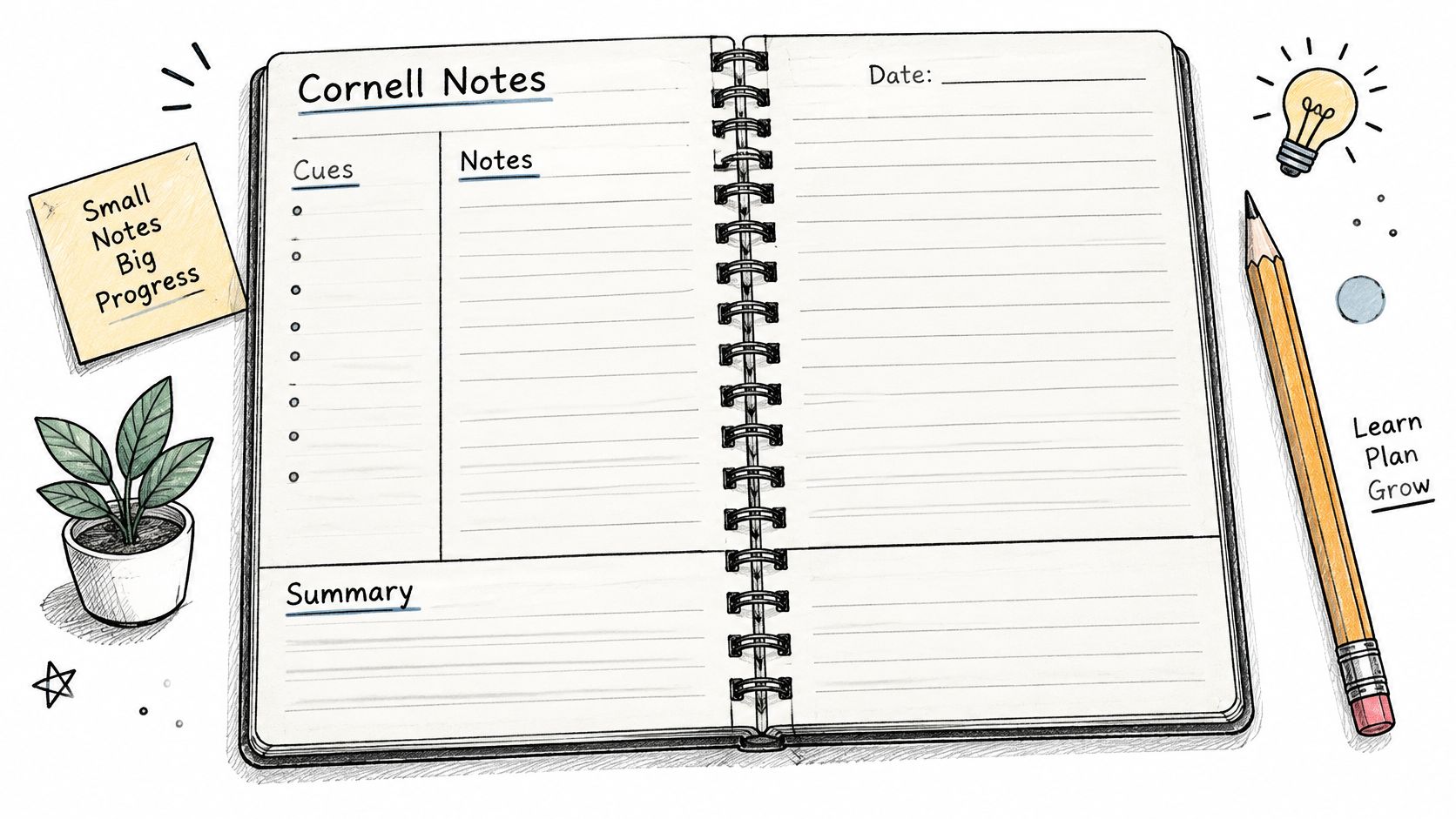
Divide the page into a wide notes area, a narrow cue column on the left, and a summary space at the bottom. Walter Pauk developed the approach at Cornell University, and its record-question-summarize structure is described in the review of the Cornell Note-Taking System (opens in a new tab).
Turn the Cue Column Into an Exam
During a biology lecture, record the stages of mitosis, checkpoint functions, and the lecturer's examples in the main area. Afterward, write questions beside them, such as What happens if this checkpoint fails? A cue like checkpoints is less useful because recognizing a topic isn't the same as explaining it.
- Capture selectively: Record definitions, mechanisms, examples, and uncertainties rather than every sentence.
- Complete the review: Add cue questions and a concise bottom summary after class.
- Test without looking: Cover the main column, answer aloud, then check and correct your response.
- Label clearly: Include the course code, lecture date, and topic so you can retrieve the page later.
A controlled study of higher-education health students (opens in a new tab) reported improvements in note quality and learning performance following Cornell-method instruction, although its institutional setting limits broad generalization. The important distinction is using the questions, not merely drawing the columns.
Cornell notes work poorly when you postpone the review until exam week. For a closer look at how capture and processing differ, use this guide to note-taking research when deciding how to adapt the format.
2. Outline Method
An economics lecturer moves from perfect competition to monopoly, then compares their assumptions and outcomes. An outline fits that structure: put each market structure at the left margin and indent assumptions, diagrams, examples, and qualifications underneath it.
This method suits lectures and readings with a clear hierarchy. It also works for history essays, where you need to distinguish a main explanation from the evidence supporting it. The indentation should show an intellectual relationship, not just make the page look organized.
Separate Claims From Supporting Detail
For a history seminar, give each proposed cause of an event its own heading. Nest supporting evidence beneath it, then add a contrasting interpretation and the source behind that interpretation. You'll have material for an argument rather than a chronological transcript of who said what.
- Use stable heading styles: Keep main topics, supporting points, and examples visually distinct.
- Paraphrase the claim: Explain what a slide means instead of reproducing its wording.
- Leave room for corrections: Add qualifications and missing examples during review.
- Finish each topic: Write a short statement of what you should be able to explain or evaluate.
The danger is efficient copying. In the Mueller and Oppenheimer study, laptop note-takers recorded more verbatim material, while longhand writers performed better on conceptual questions in the initial experiment. That finding supports caution about transcription, not a rule against digital outlines.
If the lecturer jumps between topics, capture rough bullets first and reorganize afterward. Don't spend the discussion wrestling with indentation while missing the argument. For problem-solving courses, attach worked solutions separately, with annotations explaining why each step is valid.
3. Mind Mapping
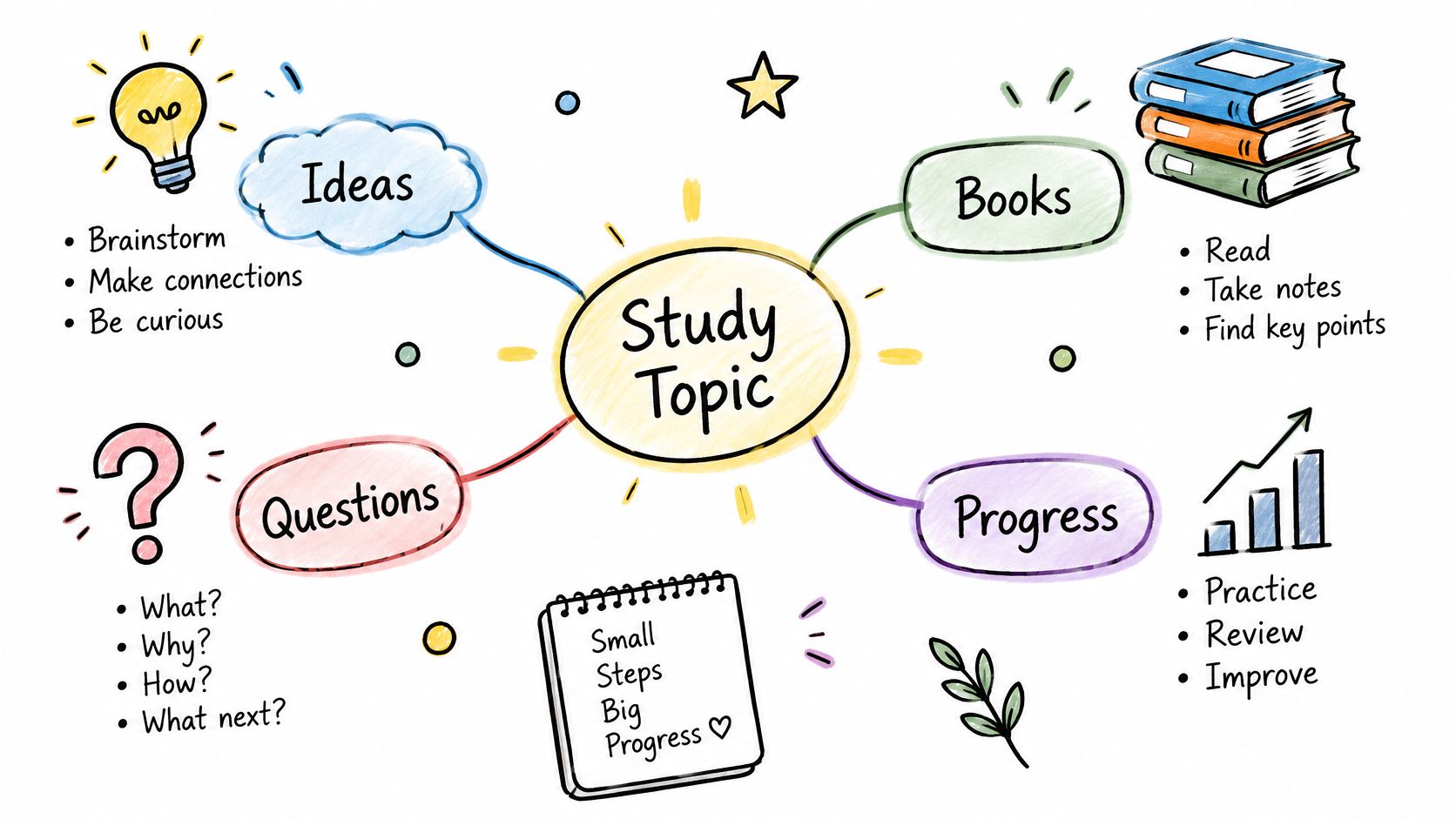
Use a mind map when you need to see a topic's main branches before planning an essay or revising a broad module. Start with a central topic, draw branches for major themes, and add brief supporting ideas beneath them.
For a psychology exam, place memory in the center. Add branches for theories, processes, evidence, and limitations. Under each theory, record its central claim and the findings you'll need to discuss, rather than squeezing an entire lecture onto a branch.
Build the Map After Capture
A blank landscape page, a tablet canvas, or a drawing app gives you room to move ideas. Use short labels, make major branches visually prominent, and reserve colors for meaningful distinctions, such as theories versus evidence. A color scheme that needs constant maintenance is more work than help.
Try building the initial map without looking at your notes. Then check the lecture materials and mark what you missed or misplaced. For an essay assessment, use those gaps to decide which explanations or comparisons need further preparation.
A mind map is an overview, not a substitute for the detailed evidence your answer needs.
The trade-off is precision. A branch connecting a condition with its symptoms doesn't necessarily explain the mechanism behind them. Keep detailed explanations elsewhere, and use a concept map when the relationship itself needs labeling.
Mind mapping is also awkward during fast lectures because you can't predict how much room each branch will need. Capture the content first, without worrying about layout. Reorganize it once you understand the topic's shape, rather than shrinking your handwriting to preserve an attractive layout.
4. Charting Method (Table or Matrix Notes)
When an exam asks you to compare, distinguish, classify, or select, use charting. Set up rows for the things being compared and columns for the criteria that matter.
A pharmacology student might compare drug classes using columns for mechanism, indications, adverse effects, contraindications, and examples. A history student might compare political systems through leadership selection, constitutional limits, and major reforms. Choose headings from learning objectives and practice questions, not from whatever happens to fit neatly across the page.
Make Every Column Earn Its Space
Create the chart in Microsoft Excel, Google Sheets, or a document. Keep cells brief, but attach a reference or note location when an entry needs a fuller explanation. A spreadsheet is convenient when you want to sort topics or filter for gaps before an exam.
- Use comparable categories: Each row should answer the same underlying questions.
- Distinguish missing from absent: An empty cell shouldn't ambiguously mean either unknown or not applicable.
- Record important exceptions: Don't compress a conditional rule into an absolute statement.
- Add an uncertainty field: Mark entries that need checking against course materials or a tutor's explanation.
For revision, hide a column and reconstruct it. Then compare neighboring rows and explain what distinguishes them. In a pharmacology scenario question, go beyond identifying a drug class and explain why another option would be unsuitable.
Charting becomes less useful when every entry needs a paragraph or the categories don't apply consistently. Move those explanations into linked notes rather than building an unreadable spreadsheet. Use the chart to expose differences, then practice writing the comparison in the form your assessment requires.
5. Concept Mapping
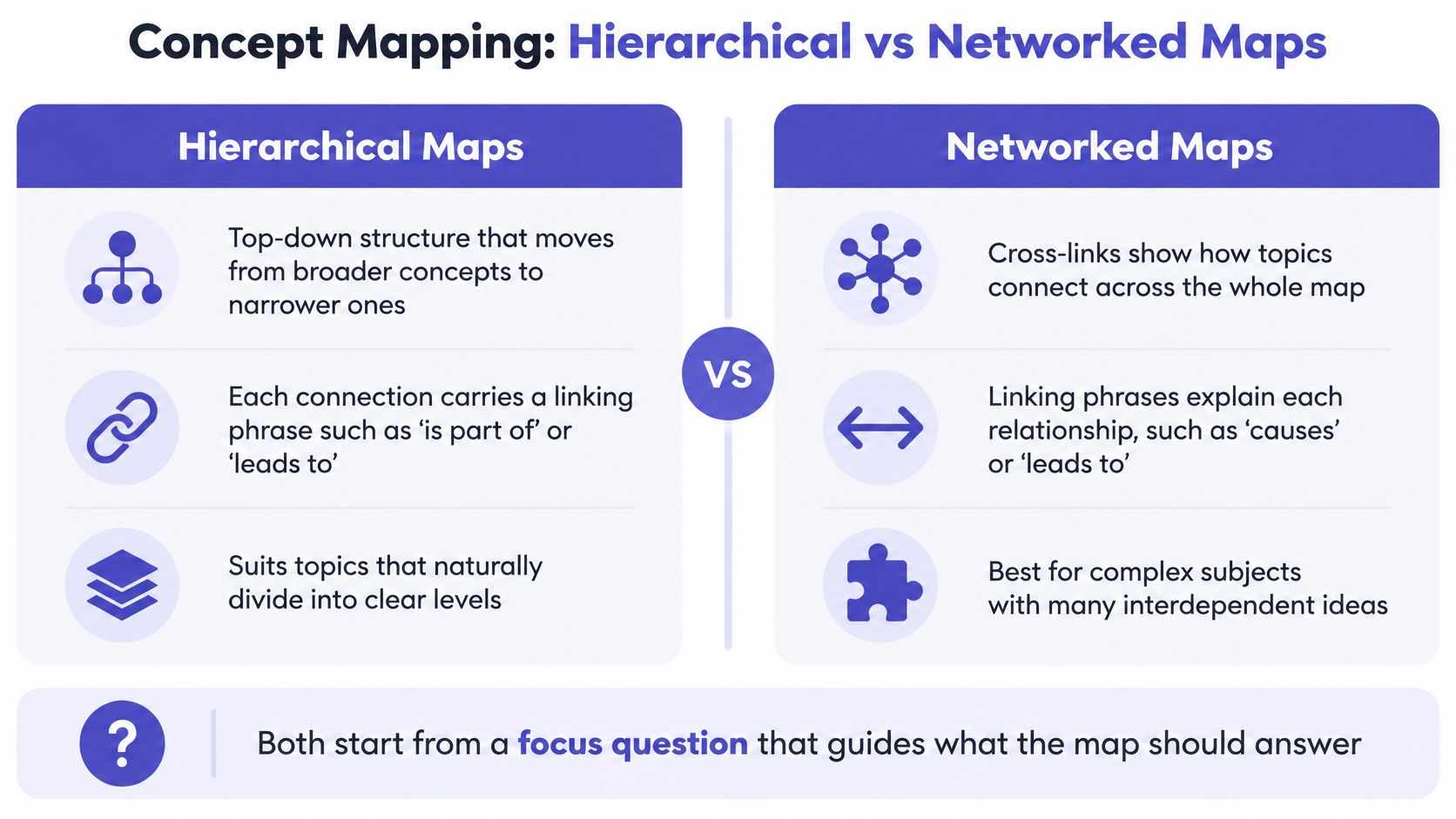
A concept map answers a relationship question. Instead of merely grouping ideas around a central topic, you connect concepts with phrases such as increases, depends on, inhibits, or is part of.
Choose this method for science, nursing, and engineering assessments that require mechanisms or connected reasoning. For a materials science module, connect force, stress, strain, and material properties using the relationships taught in your course. Add the relevant equations and their conditions of use alongside the connections.
Make the Arrows Read Like Sentences
Start with a focus question, such as How does a change in this variable affect the system? Put the main concepts in boxes and label each connecting arrow. Read each connection aloud to check that it expresses a clear, defensible statement.
- Name the relationship: Replace vague links with a specific verb or phrase.
- Show conditions: Identify when a relationship holds and where an exception matters.
- Check direction: Make sure an arrow doesn't reverse cause and effect.
- Rebuild from memory: Compare your reconstruction with the lecture explanation and correct it.
A nursing student could connect a condition's physiological changes, observable symptoms, and treatment targets. The useful work is explaining why those connections exist, not fitting everything onto a decorated page.
Concept maps can become tangled. Split an overloaded network into a general overview and smaller mechanism maps, using CmapTools or a simple drawing app if you need movable boxes.
They also don't replace numerical practice. After mapping a relationship, solve an unfamiliar problem and justify your assumptions. Knowing what connects is different from carrying out the calculation correctly.
6. Zettelkasten Method
Zettelkasten suits dissertations, literature reviews, and research-heavy modules better than rapid exam cramming. Keep small notes containing a distinct idea, then connect them to related arguments, evidence, and questions.
For a philosophy module, you might create separate notes for an argument, an objection, and a proposed reply. For a dissertation, distinguish what an author claims from the evidence they use and your evaluation of it. Don't treat a saved PDF or a copied abstract as a finished knowledge note.
Write Notes You Can Reuse
Give each note a descriptive title that states its point. Write the explanation in your own words and record the author, publication details, page location, and any limitations you'll need when citing it. Keep direct quotations visibly separate from paraphrases.
- Link with a reason: Explain whether another note supports, challenges, qualifies, or applies the idea.
- Create theme hubs: Use overview notes to gather material relevant to a research question.
- Keep source context: Preserve enough detail to revisit the passage and check your interpretation.
- Remove unnecessary duplication: Merge repeated ideas when separate notes add no useful distinction.
Say you're reviewing studies on student participation. Instead of placing everything under a broad participation tag, connect notes about measurement choices, institutional context, and competing explanations. Those connections can help you build an analytical chapter rather than a sequence of source summaries.
Research rule: A link is useful when you can explain why the connected notes belong together.
The cost is maintenance. Obsidian can support linked notes, but its graph view won't decide whether your argument makes sense. Start with a small collection tied to an actual assignment, and don't force unrelated notes together just to create more links.
7. Sketchnoting
An architecture lecture on building materials may require you to record shapes, junctions, and load paths. Sketchnoting combines those drawings with concise text, so you don't have to translate every spatial relationship into prose.
It also fits design critiques, geography processes, and marketing modules where you need to explain a sequence. Sketch a customer journey, for example, then annotate the decisions, evidence, and possible obstacles at each stage. The drawing needs to carry information, not prove that you can illustrate.
Use a Small Visual Vocabulary
Keep repeating symbols consistent. Use arrows for direction, boxes for grouped ideas, and a clear question mark for uncertainty. A guide to note-taking symbols can help you build shorthand without inventing a new visual language during every lecture.
- Label technical drawings: Include terms, units, orientations, and relevant conditions.
- Keep text readable: Decorative lettering shouldn't obscure a definition.
- Separate fact from suggestion: Mark your own interpretation differently from the lecturer's explanation.
- Add a text summary: Include searchable keywords and a short explanation of the main process.
For a demonstration of visual note-taking, use the video alongside a small practice topic.
Watch the video on YouTube (opens in a new tab)
Don't redraw a complex lab apparatus from memory when accuracy matters. Annotate an authorized diagram instead, and keep required procedures, observations, and measurements in the format your lab course specifies.
The trade-off is attention: drawing can become another way to miss the explanation. Capture a rough shape during class and refine only the parts that clarify the content. For revision, explain the sketch without its labels, then restore the missing terminology.
8. Feynman Technique
You've copied a statistics definition accurately, but you can't explain it without repeating the wording. Use the Feynman Technique as a review method, not as your primary lecture-capture format.
Choose a concept and explain it in plain language without consulting your notes. Mark where you hesitate, rely on unexplained terminology, or skip a step. Return to the lecture materials to repair those specific gaps, then attempt the explanation again.
Simplify the Language, Not the Meaning
For a chemistry module, explain enzyme kinetics and then describe how the relevant inhibitors affect the model taught in class. If you can name the inhibitor types but can't explain their differences, your next task is clear. Review that distinction rather than rewriting the whole lecture.
- Begin with a precise question: Choose something you could reasonably be asked to explain.
- Work without the answer visible: Write, speak, or sketch your explanation from memory.
- Check technical accuracy: Compare definitions, assumptions, and exceptions with authoritative course materials.
- Attempt an application: Answer a related unfamiliar question after repairing your explanation.
The law-education analysis of note-taking (opens in a new tab) distinguishes the potential value of capturing more material from the risks of transcription-like notes, supporting a workflow that includes explanation and consolidation rather than capture alone.
This method overlaps with active recall study methods: you attempt an answer before checking it. It's particularly useful for oral exams, short-answer questions, and explaining your reasoning in problem-based assessments.
Don't mistake fluency for correctness. An analogy can sound convincing while hiding an important limitation. Finish by using the technical vocabulary your course requires, and solve actual problems when the assessment tests calculation rather than explanation alone.
How the eight note-taking methods compare at a glance
Choose a format that fits the course material and the kind of assessment. This table compares setup effort, digital use, and built-in review so you can weigh practical trade-offs before choosing a method.
For a lecture with clear headings, an outline takes little setup; Cornell notes add cue questions for exam revision. Use charting when a course asks you to compare cases or classifications. Mind maps suit broad overviews, while concept maps make relationships between connected ideas visible. Research projects benefit from Zettelkasten's linked notes, but maintaining those links takes time. Sketchnotes suit visual material, though they offer no built-in review routine. The Feynman Technique checks understanding through explanation, but it is a study and review method rather than a format for recording a lecture.
Match the Method to the Course, Then Test It on One Lecture
Choose the method that prepares you for the assessed task, not the one that produces the most attractive notebook. Structured lectures usually suit Cornell notes or outlines; comparison-heavy topics suit charting; mechanisms suit concept mapping; research projects suit Zettelkasten. Mind maps help organize a broad topic, sketchnotes capture spatial information, and the Feynman Technique checks understanding afterward.
The same course may need different approaches. A biology lecture might call for Cornell questions, a pathway tutorial for a concept map, and a laboratory session for an accurate procedural record with annotated diagrams. You don't need to force all of them into an identical template.
Match the Format to the Assessment
- Lecture-based exams: Turn headings and learning objectives into questions you can answer without looking.
- Seminars and essays: Preserve claims, evidence, objections, and source references.
- Laboratory assessments: Record procedures, units, observations, deviations, and uncertainty according to course requirements.
- Research modules: Keep retrievable source details and distinguish published claims from your interpretation.
Choose your device on practical grounds. The direct replication and meta-analysis of note-taking replications (opens in a new tab) found no consistent longhand advantage, so a universal pen-over-keyboard rule is too strong. Use typing when it supports accurate capture or accessibility, and handwriting or a stylus when diagrams and selective annotation fit the task.
Your notes also don't have to use only the lecture language. A study of translanguaging in academic listening (opens in a new tab) supports language flexibility in its specific instructional context. Keep technical terms as taught, explain difficult ideas in your strongest language if useful, and practice the final answer in the language your assessment requires.
For your next lecture, pick a method and test it rather than redesigning your entire system. Review it after forty-eight hours using the Feynman Technique, explaining the central ideas before opening the notes. Treat that interval as a practical trial, not a guaranteed learning formula.
Then attempt a relevant past-paper or practice question. Check whether your notes contain the reasoning, distinctions, and examples the question demands, using current course objectives and legitimate course-specific materials to confirm relevance. Adjust the format where it failed: add comparison columns, clearer links, source references, or better recall questions rather than adding more highlighting.
CramShare offers course-specific lecture notes, summaries, revision guides, and practice materials organized by institution, course code, module, and academic year. Visit CramShare to find relevant materials, compare their coverage with your own notes, and identify questions to practice before your next assessment.