10 Exam Study Techniques That Actually Work
Discover 10 evidence-backed exam study techniques, including active recall, spaced repetition, practice testing, and practical ways to use each.
The easiest study method is rarely the most effective. Rereading notes and highlighting passages can feel productive because the page looks familiar, but familiarity isn't the same as recall. The stronger exam study techniques force your brain to pull information out, space it over time, explain it in plain language, and mix it with other topics so you can use it when the test asks for it.
That matters because the evidence base keeps pointing in the same direction. A large 2026 meta-analysis of spaced repetition in medical education pooled 21,415 learners across 14 studies and found a significant advantage over standard studying, with a standardized mean difference of 0.78 (PMC review (opens in a new tab)). A separate review identified 43 studies showing significant benefits for retrieval practice and distributed practice, and a randomized school study found a smaller but real gain from a spaced-learning structure with 24-hour gaps and 10-minute blocks (SAGE review). Students may still prefer rereading, but the strongest revision system usually looks different from the one that feels easiest at the desk.
1. Active Recall
Active recall solves the problem of false confidence. If you can recognize a definition on the page, that doesn't mean you can produce it under exam pressure, where the page is gone and the clock is running. Retrieval practice forces that exact skill, which is why self-testing, flashcards, and blurting work better than passive review when your goal is durable memory.
The simplest way to use it is to close the notes and answer from memory. That can mean a stack of Anki cards, a blank sheet for recall writing, or a set of past-paper questions you try before checking anything. A 2025 college-sample study found retrieval practice improved final exam scores across factual, application, and even unrelated questions, with the largest benefit on rephrased factual items (PMC study (opens in a new tab)).
Make retrieval harder, not just faster
Practical rule: if you can answer correctly by glancing at the page, you're probably not testing recall yet.
A stronger routine is to vary the question format. Use multiple choice for speed, short answer for precision, and essay prompts for explanation. That flexibility matters because exams don't ask in one neat format, and your memory needs practice switching gears. The 2024 global student survey found 96% of students reported re-reading notes to study, which shows how common passive habits still are, even though retrieval practice is more effective (PLOS ONE survey (opens in a new tab)).
Best fit: definitions, formulas, processes, dates, and any topic where you need to produce an answer, not just recognize it.
Trade-off: it feels harder than rereading, and that's the point.
Use it with: spaced repetition, practice tests, and flashcards.
2. Spaced Repetition
Spaced repetition solves a different problem from cramming. A long study block can create quick familiarity, then rapid forgetting. With spacing, each review comes after some forgetting has started, so the brain has to rebuild the memory instead of riding on recent exposure.
That makes it a strong fit for cumulative courses. Lecture notes, summaries, formulas, vocabulary, and chapter overviews all improve when they return across the term instead of being saved for a final week of panic review. Reviews of medical education have found that the effect appears across different institutions and learner groups, which is why the method carries over well to university and professional-exam preparation.
Build intervals around forgetting, not convenience
Start the same day you learn the material, then return to it after a short gap, then again after a longer one. The schedule does not need a perfect algorithm. It needs consistency and a clear record of what has already been reviewed. Tools like Anki or other interval-based flashcard systems help automate that pattern, especially when the syllabus is large.
Review what is weak sooner, and what is solid later.
The method works best when the same content comes back in a new form. A diagram one day, a short-answer prompt the next, and a past-paper question later on usually hold better than reopening the same notes again and again. For students building course-specific decks and review sets, CramShare's spaced repetition tools guide shows how to turn notes into interval-based study material.
One trade-off matters: spaced repetition helps retention, but it is slower to start than a single reread. That delay is useful, because the harder retrieval is what makes the memory durable.
Best fit: facts, terminology, and any syllabus you need to retain for weeks or months.
Trade-off: it requires planning early, not rescue mode in exam week.
Use it with: active recall, flashcards, and past papers.
3. Practice Testing and Past Papers
Practice testing solves the problem of studying the wrong skill. A student can understand a chapter perfectly while still underperforming if the exam demands speed, wording tolerance, or question interpretation. Past papers and mock tests train the whole exam performance, not just content knowledge.
Students often see the gap between “I know this” and “I can answer it under timed conditions.” Practice tests reveal weak topics, but they also show whether you're losing marks because of wording, pacing, or answer structure. Universities, departments, and textbook publishers often provide test-style questions, and course-specific libraries can make those easier to find. For example, students using CramShare's past papers guide can focus on exam-style materials matched to a course code rather than generic subject pages.
Move from understanding to exam performance
Start untimed if you need to, especially early in the term. Once the format feels familiar, switch to timed, closed-book conditions that match the actual test as closely as possible. That progression matters because it lets you learn the material first, then practice performance without notes once the basics are in place.
Use past papers to spot patterns. If a topic keeps appearing in a specific format, your revision should reflect that format. If your mistakes cluster around interpretation, not memory, then more rereading won't help much. The fix is more targeted practice with the kind of prompt the exam uses.
Best fit: high-stakes exams, problem-based courses, and any module with a stable question style.
Trade-off: it can be uncomfortable because it exposes weaknesses quickly.
Use it with: active recall, spaced repetition, and interleaving.
4. The Feynman Technique
The Feynman Technique solves the problem of shallow understanding. Many students can repeat a definition until the page is closed, then freeze when they're asked to explain what it means in plain language. Teaching a concept plainly forces you to find the gaps in your own thinking.
This method works because explanation is a test of understanding, not just memory. If you can explain photosynthesis, supply and demand, or a biology pathway to someone who doesn't know the jargon, you've probably built a stronger mental model than if you only copied notes twice. The process is simple, choose one concept, explain it as if teaching a beginner, notice where the explanation breaks, then go back to fix those gaps.
Use plain language as a diagnostic
Don't start with polished notes. Start with a rough explanation on paper or out loud, and keep the language simple enough that a first-year student could follow it. If you hit a term you can't explain without slipping into jargon, that's usually where your understanding is weakest.
A useful version of this method is to record yourself for a minute or two, then listen back and mark every spot where the explanation becomes vague. Those weak points tell you what to review next. It's especially useful before essay exams or oral assessments, where understanding has to be expressed clearly, not just recognized.
Best fit: conceptual topics, essay-based modules, and any subject where you need to connect ideas.
Trade-off: it takes more time than re-reading a summary, but it shows you what you don't know.
Use it with: elaboration, mind maps, and retrieval practice.
5. Elaboration and Self-Explanation
Elaboration solves the problem of isolated facts. A fact in a vacuum is easy to forget, but a fact connected to causes, examples, consequences, and prior knowledge has more places to stick. Self-explanation pushes that even further by making you ask why a claim is true and how it connects to what you already know.
This is one of the most underrated exam study techniques because it turns passive reading into active reasoning. Instead of highlighting a line and moving on, you pause to ask what the author means, what evidence supports it, and what would happen if the condition changed. That extra work creates stronger memory traces and better transfer to unfamiliar questions.
Make every topic answer two questions
A practical rule is to ask, Why is this true? and How does this connect to something else I've learned? If you're studying economics, that might mean connecting supply and demand to a real market. If you're in biology, it could mean explaining how one system affects another system in the body.
If you can't explain the reason behind a step, you probably don't own the step yet.
Use this technique while reading lecture notes, then convert the explanation into your own summary later. That summary should sound like your voice, not a copy of the slide deck. It's also a strong partner for group discussion, because explaining a point out loud usually exposes the exact place where your logic is thin.
Best fit: conceptual reading, essay prep, and subjects where understanding beats memorization.
Trade-off: it slows you down, so it's best for core material, not every single line.
Use it with: Feynman explanations, mind maps, and practice questions.
6. Interleaving
Interleaving solves the problem of overfitting to one topic. If you do twenty algebra problems in a row, you may get good at that exact pattern without getting good at choosing the right method when the next question looks different. Mixing problem types forces discrimination, which is what real exams demand.
This is one of the few techniques that feels worse while you're using it. The session is less smooth because your brain can't stay in one groove, but that friction is useful. It trains you to notice the structure of the question first, then select the right strategy.
Mix topics after the basics are in place
Interleaving works best after initial learning. If you're brand new to a topic, blocked practice can help you get oriented first. Once you know the material, mix two or three related problem types in the same session so you have to decide which approach fits each one.
That matters in subjects like mathematics, chemistry, physics, language learning, and history, where different question types can look deceptively similar. A mixed set also mirrors the way many exam papers are written, so you're not just learning content, you're learning how to switch efficiently between ideas.
Best fit: problem-solving courses and any exam with mixed question types.
Trade-off: it feels slower and less comfortable than grouped practice.
Use it with: spacing, practice testing, and past papers.
7. The Leitner System
The Leitner System solves the problem of wasting review time on what you already know. A single pile of flashcards makes every card look equally urgent, even though some answers are shaky and others are already automatic. By sorting cards into levels of familiarity, you spend more time on weak items and less on mastered ones.
The logic is simple. Correct cards move to a less frequent review box, while missed cards return to the front of the line. That structure is why digital tools like Anki feel so useful, because they automate the same principle without requiring you to shuffle paper cards by hand.
Keep the decks small enough to finish
A Leitner deck works better when it stays focused. If you dump an entire module into one enormous stack, review becomes a chore and weak cards get buried. Start with a small set of high-value questions, write a clear prompt on one side and a short answer on the other, then add context when you need it.
Use it for facts that need repetition. Vocabulary, formulas, dates, anatomy labels, and key definitions fit well here. But don't let flashcards become your only method. They're strong for retrieval, weak for extended explanation, so they work best alongside past papers and concept-based study.
Best fit: fact-heavy modules and rapid review before exams.
Trade-off: it can flatten context if you rely on it alone.
Use it with: active recall, spaced repetition, and elaboration.
8. Mind Mapping
Mind mapping solves the problem of scattered notes. If your lecture pages are full of disconnected lines, it can be hard to see the structure of a topic, especially before an exam that expects broad understanding. A mind map gives you a visual model of how ideas relate to one another.
This is especially useful when you're learning something for the first time or trying to condense a large chapter. Start with the central topic, branch into main subtopics, then add short keywords rather than full paragraphs. The result is a compact map of the module, not a transcript of the lecture.
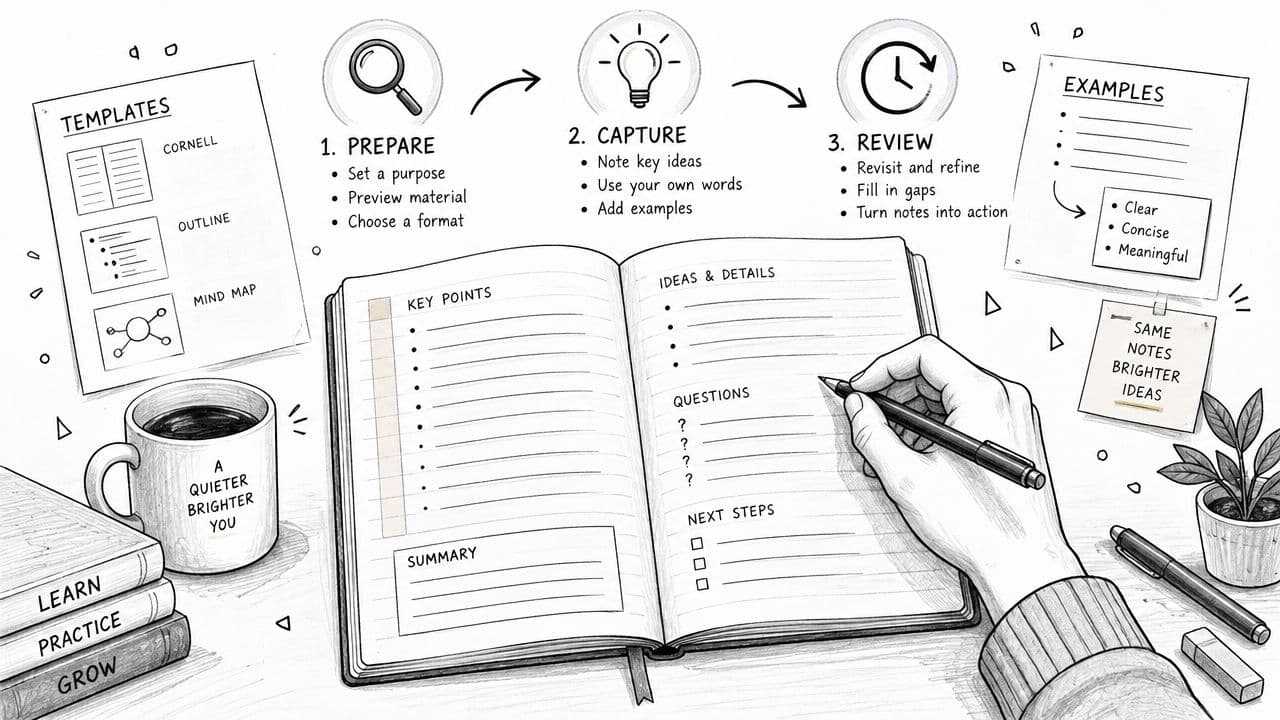
A visual layout can help with both learning and revision, and it pairs nicely with active recall if you redraw it from memory. For note-structure ideas, some students also look at CramShare's note-taking layout guide when they want a cleaner way to organize course material.
Use it to see the architecture of the subject
Mind maps are strongest when they stay simple. Too many branches turn them into clutter, and too much detail makes them harder to remember. Keep the structure lean, use keywords, and add color or symbols only if they help you distinguish categories quickly.
They're also useful for essay planning because they show what belongs together and what needs its own paragraph. If you can redraw the map from memory, that's a strong sign the material is organized well in your head.
Best fit: first-pass learning, big-picture revision, and essay planning.
Trade-off: they're less effective if you try to cram every detail into one diagram.
Use it with: elaboration, retrieval practice, and spaced review.
9. The Pomodoro Technique
The Pomodoro Technique solves the problem of mental drift. Long, undefined study sessions often collapse into distraction, especially when the task feels heavy or repetitive. Timed blocks make the work startable, and the break keeps fatigue from taking over.
The value isn't magic, it's structure. A short interval gives you a clear finish line, which makes it easier to begin, and the break makes it easier to come back. That's why this method often helps students who procrastinate, get distracted, or lose focus during dense reading.
Protect the block, then rest on purpose
Pick one task before each session, such as “make 15 flashcards,” “do one past-paper question,” or “recall chapter three from memory.” Then remove distractions for the full block and take a real break when the timer ends. Don't turn the break into a second screen session if you're already mentally overloaded.
Work in short bursts, then step away fully.
You can also combine Pomodoro blocks with other techniques. One block can be for active recall, the next for spaced review, and the next for checking past-paper errors. That makes the timer a container for better methods, not a method by itself.
Best fit: procrastination, fatigue, and long revision days.
Trade-off: it won't save a weak study plan, it just makes a better plan easier to follow.
Use it with: active recall, spacing, and practice questions.
10. Group Study and Teaching Others
Group study solves the problem of blind spots. Solo study can hide confusion because no one interrupts your thinking when your explanation goes vague. Teaching others makes those weak points visible, and peer discussion adds accountability when motivation dips.
The best version is structured, not casual. A small group with clear roles can quiz each other, teach assigned sections, and compare answers to past-paper questions. That works better than an unfocused meeting where everyone opens a laptop and reads in the same room.
Turn discussion into a test
Assign each person one topic to explain, then let the others ask follow-up questions. If a student can answer without drifting into vague language, the material is probably solid. If not, the group has found a real study gap, which is more useful than everyone agreeing the notes “seem fine.”
This is also where course-specific material helps. If the group is working from the same lecture notes, summary sheets, or past papers, the discussion stays anchored to the syllabus instead of wandering. In practice, that means you can use group time for correction and explanation, not for figuring out what topic you're even on.
Best fit: difficult modules, accountability, and topics that benefit from discussion.
Trade-off: it's only useful when the group is organized and focused.
Use it with: teaching, practice testing, and elaboration.
Top 10 Exam Study Techniques Comparison
Build a Study System, Not a Collection of Tricks
The strongest exam prep systems don't rely on one method. They start by learning new material with elaboration or a mind map, then turn that material into retrieval prompts through flashcards, blurting, or self-questioning. After that, they review it with spacing, mix problem types with interleaving, and use practice tests and past papers to diagnose what's still weak.
That sequence matters because each technique solves a different learning problem. Active recall builds retrieval. Spaced repetition preserves it over time. Practice testing shows whether you can use it under exam conditions. The Feynman Technique and self-explanation make understanding clearer, while interleaving prepares you for question switching and Pomodoro blocks protect your attention so the plan is sustainable. If you study with other people, use group time for teaching and checking, not passive co-reading.
A practical semester plan looks simple. Learn the topic, write or map it in your own words, turn it into recall questions, revisit it on a schedule, and test yourself with mixed questions before the exam. That's a much better fit for durable learning than a last-minute reread, even if rereading feels easier in the moment.
If you want course-specific notes, summaries, past papers, or practice materials, CramShare can be one place to look, but the usual rules still apply. Check that each resource matches your course or module, review the preview carefully, and follow your institution's academic-integrity and copyright policies before using or sharing anything.
If you want course-specific notes, summaries, past papers, and practice materials matched to your module, CramShare is built to help students find them faster. Use it alongside the techniques above to turn passive review into structured, exam-ready practice, and always check that the material fits your course and your school's rules.