10 Exam Preparation Materials for Smarter Revision
Compare 10 exam preparation materials, from past papers to flashcards, and learn how to choose and sequence resources for effective revision.
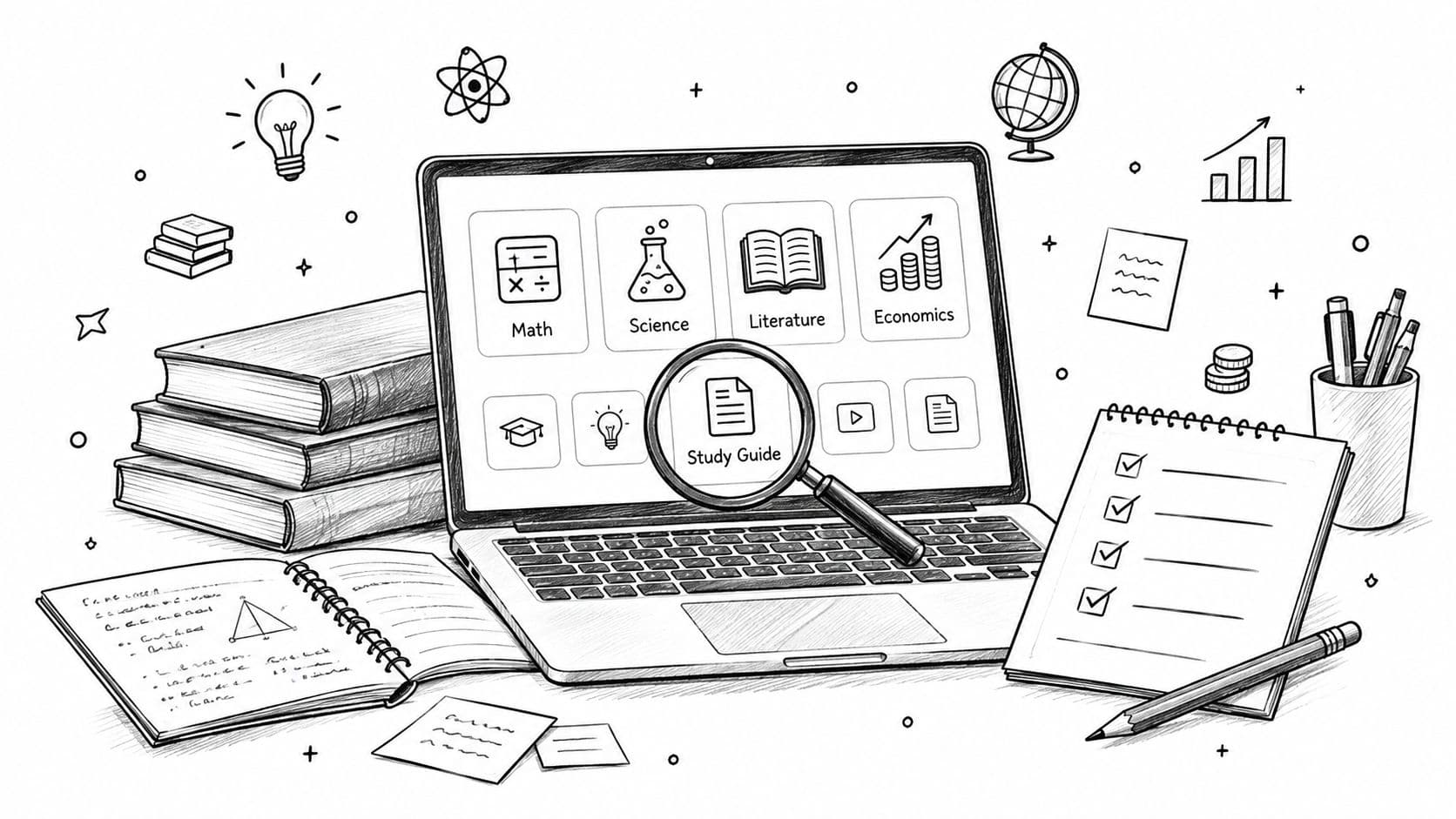
A student can have a laptop full of lecture notes, flashcards, videos, question banks, and past papers, yet still have no idea what to open first. The problem usually isn't a lack of exam preparation materials. It's that each resource serves a different job, and collecting more documents doesn't automatically create a revision plan.
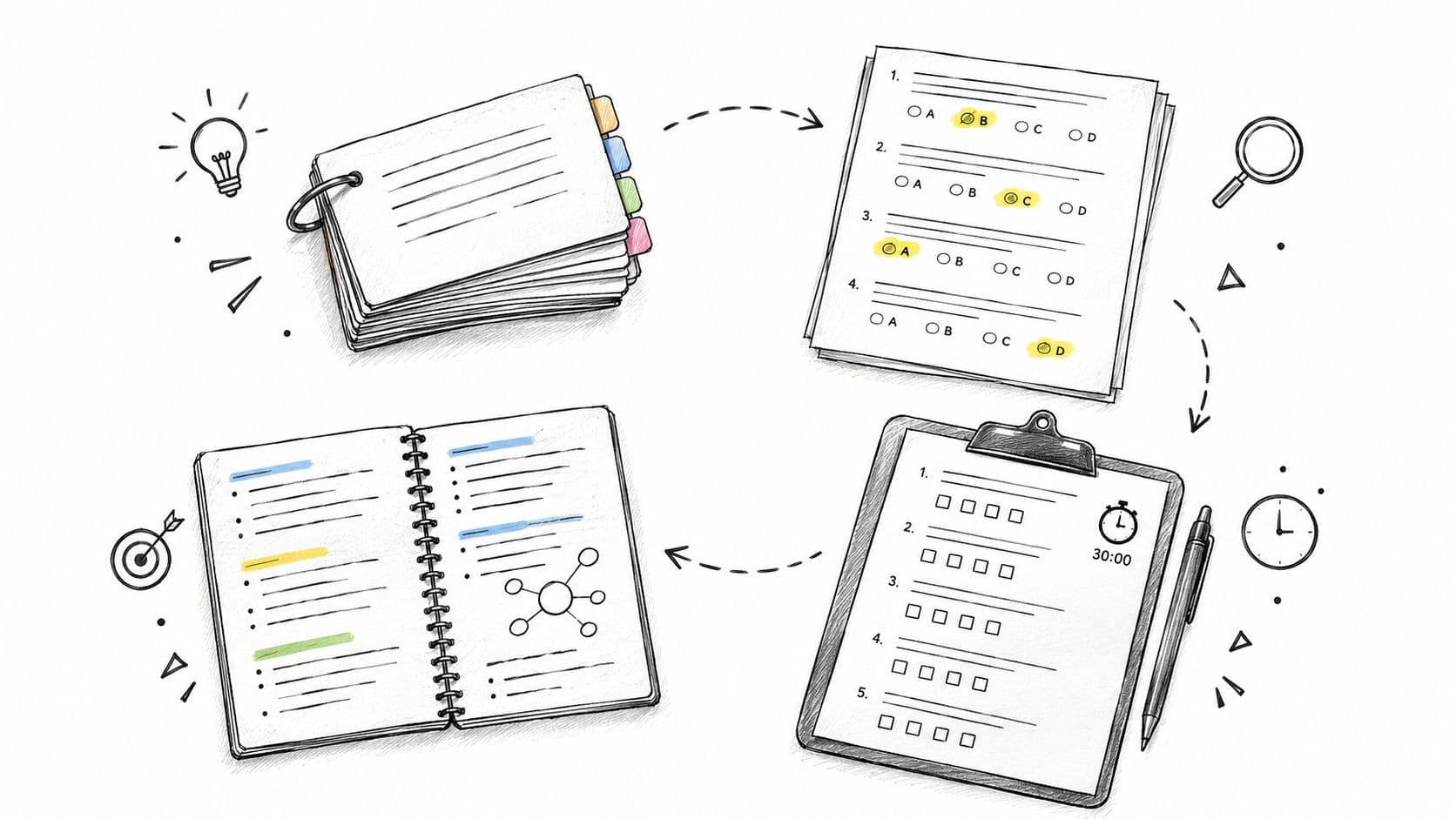
Effective preparation moves in a sequence. You first build understanding, then condense the course, practise retrieving information, diagnose weak areas, and finally apply your knowledge under exam conditions. A 2022 higher-education study found that students used a broad mixture of resources, with practical exercises, lectures, slides, recorded lectures, and exercises all playing important roles in preparation. The study summary (opens in a new tab) supports a simple conclusion: the best toolkit usually combines materials produced for your course with resources designed for a particular type of practice.
The platforms below cover those different roles. Some are useful for exact course matching, while others are better for foundational teaching, memorisation, problem-solving, or high-stakes exam simulation. Course-specific services such as CramShare can help you search by university, course code, module, textbook, and academic year. You should still check your institution's rules, copyright restrictions, and academic-integrity requirements before using or sharing anything.
1. CramShare
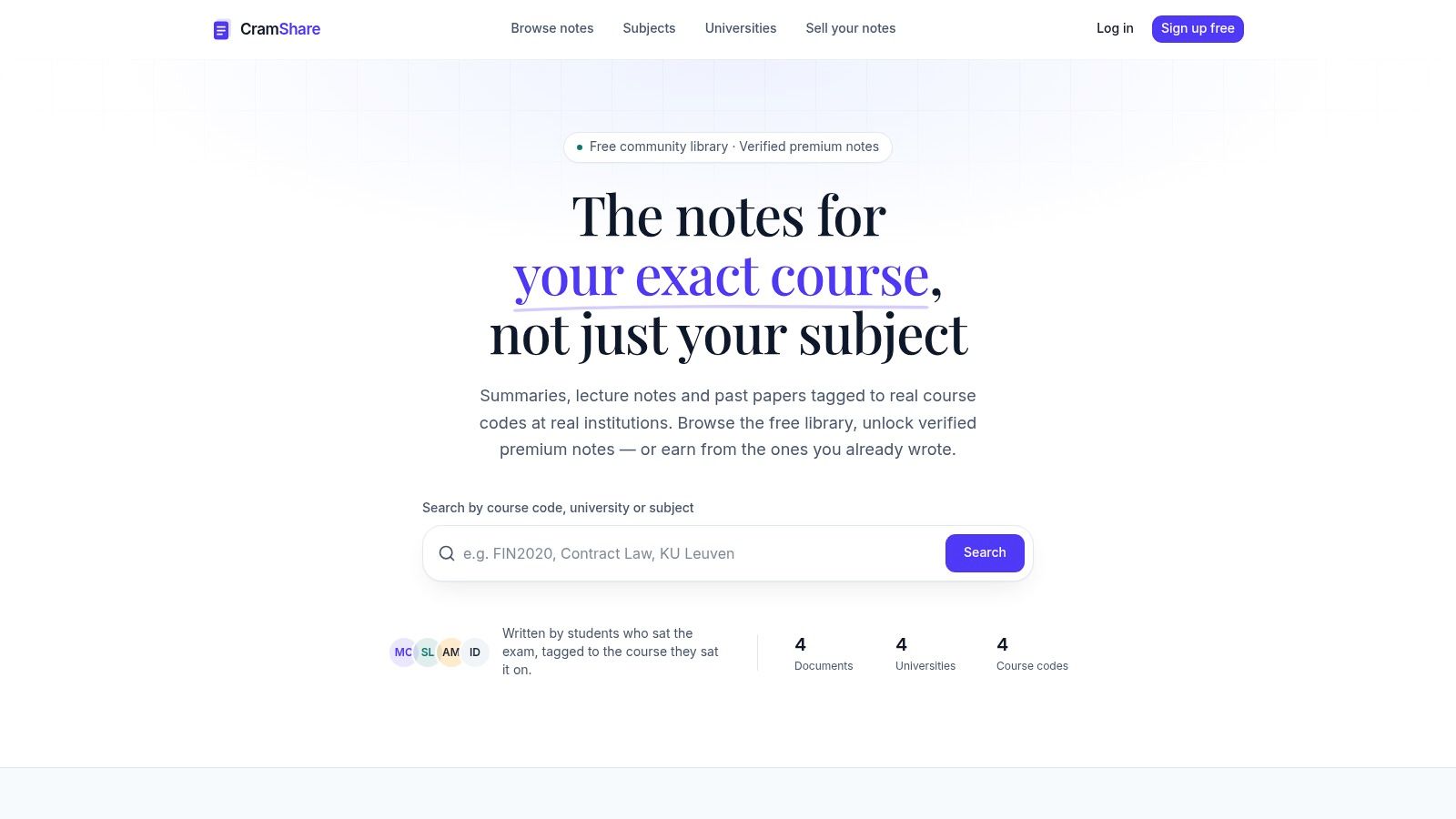
CramShare is most useful when the main problem is relevance. Instead of searching a broad category such as “biology notes” or “economics revision,” you can look for materials connected to a specific university, course code, module, textbook, or academic year. That makes it a strong first stop when you need to understand what your own course expects.
The library includes course notes, lecture notes, summaries, revision guides, past papers, and practice materials. Free community resources can be browsed without page limits, watermarks, or daily access caps. Premium documents include multi-page previews, so you can inspect the writing, structure, completeness, and apparent course match before deciding whether the material is useful.
Where it fits in revision
Use CramShare during the understanding and condensing stages. For example, if your lecture slides cover a topic quickly but leave you unsure how the module is organised, a course-matched summary can help you see the main themes. A past paper or practice set tied to the same course can then show which parts deserve closer attention.
The platform also has trust features that make evaluation easier. Premium uploads are reviewed for legibility and course relevance, and eligible purchases can be refunded when a document doesn't match its preview or advertised course information. Documents are ranked by reopening activity near exams rather than paid placement, and buyer-only ratings can provide another signal.
Practical rule: Treat a course-specific document as a map, not a replacement for your lectures, assigned reading, or independent work.
Pros
- Exact course matching: Search by institution, course code, module, textbook, and academic year.
- Useful previews: Inspect multiple pages before paying for a premium document.
- Open access options: Browse many free student-contributed resources without watermarks or access caps.
- Student authorship: Original creators can publish non-exclusively while retaining ownership.
- Integrity controls: Copyright and takedown concerns are handled through a documented process.
Cons
- Coverage varies: A newer or unusual module may have limited uploads.
- Quality still differs: A preview can reveal structure and legibility, but you must judge whether the explanations suit your learning needs.
- Rules still apply: Only use and share materials in ways permitted by your institution and copyright law.
For course-level exam preparation materials, CramShare is strongest when you need a small number of resources that match the assessment you face, rather than a large collection of generic notes.
2. Quizlet
After a lecture on molecular biology, you may recognise every term in your notes but hesitate when asked to define one unaided. Quizlet turns that hesitation into a quick retrieval check. Its flashcards and short activities are most useful after you have learned the topic, not as a substitute for learning it.
You can create sets from your lecture notes, import information, or browse public sets linked to subjects, textbooks, and courses. Quizlet provides flashcards, tests, learning activities, and game-like practice through its web and mobile versions. Its adaptive learning mode can return you to cards you repeatedly miss, so your next short session targets weak recall instead of repeating material you already know.
Place Quizlet in the revision sequence
Use Quizlet for the recall stage. First, study the explanation in your lecture, handbook, or required reading. Then make or select cards for definitions, formulas, terminology, dates, and processes. Mark difficult cards, revisit them later, and follow successful recall with application questions.
A public set can save time, but check it before relying on it. It may use an old definition, leave out a qualification, or follow another lecturer's syllabus. Compare important cards with your course materials. Quizlet is a general recall tool, whereas a course-specific platform may reflect your module more closely, and a high-stakes exam platform may provide the timed problems or full-answer practice that flashcards cannot.
For guidance on placing this method within a wider revision plan, see spaced repetition tools for students.
Pros
- Fast retrieval practice: Test small groups of facts during short study sessions.
- Broad community library: Find sets covering subjects, textbooks, and professional topics.
- Mobile access: Practise while travelling or between classes.
- Flexible creation: Build cards from your notes, forcing you to process the material.
Cons
- Variable accuracy: Public sets may not match your course or may contain errors.
- Limited depth: Cards check recall, but rarely replace worked problems, data interpretation, or essay practice.
- Paid restrictions: Some advanced functions require a subscription.
Use Quizlet to make knowledge easier to retrieve. Judge complex understanding with the questions and exam tasks your course requires.
3. Course Hero
A student preparing for an accounting exam may understand the basic method in class but still struggle with unfamiliar problems. Course Hero can connect that gap by bringing together class notes, study guides, practice questions, past exams, and worked explanations tied to a particular course.
Use it in stages rather than downloading everything available. Begin with a class note or study guide to rebuild understanding. Then compare it with a worked problem, checking whether the method matches your lecturer's notation and the textbook edition. Tutor questions on some plans can help diagnose a wrong answer by explaining the step where your reasoning changed direction.
A practical checking routine
Before opening a document, confirm the course title, instructor, edition, topic, and assessment period. Those details determine whether the material belongs to your revision sequence or creates noise. Read the visible sections for terminology, notation, and explanation quality. If access is partly blurred, you may not be able to judge every answer first, so consider the likely relevance before paying through a membership or credits.
A document from the right university can still conflict with your lecturer's approach, textbook edition, or assessment format. Treat it as a comparison point, not as proof that an answer is correct. Check important explanations against your own course materials, then use the verified version for practice and recall.
Course Hero offers two access routes: paid membership or credits earned by uploading original content. Upload only work you own or have permission to distribute. Its mobile apps can also help you organise and save materials for offline study, although stored documents are useful only if you have already checked their quality.
A simple sequence keeps the platform focused:
- Build understanding: read one relevant explanation.
- Condense content: extract the method or definitions into your own notes.
- Practise recall: close the document and reproduce the steps.
- Diagnose gaps: use a worked solution or tutor answer to locate errors.
- Simulate conditions: finish with timed questions or a past exam from your course.
For guidance on assessing note quality, see how to choose effective study notes. Course Hero works best as a course-specific supplement, not as a reason to collect more documents than you can verify and use.
4. Studocu
A student who misses part of a lecture may have a recording, incomplete notes, and an exam approaching. Studocu can help fill that early understanding gap through its student-built library, course and university search, and collections of notes, summaries, exam preparation materials, and past papers from similar academic settings.
Its AI lecture recorder can record, transcribe, and summarise a lecture. Quiz generation can then turn an uploaded or discovered document into questions for retrieval practice. This creates a useful path from raw material to active revision, especially when passive rereading has not shown whether the content can be recalled.
Use the output as a draft, not as your final notes. Compare the summary with the original lecture, correct terminology, and restore examples that the automated version removed. Check the quiz against the course learning outcomes, because the tool cannot know which details a lecturer will emphasise unless the source makes that clear.
A practical sequence is:
- Build understanding: use a relevant lecture, note, or document to clarify the topic.
- Condense content: edit the generated summary into notes that match your course.
- Practise recall: answer generated questions without looking back at the source.
- Diagnose gaps: check missed answers against the original material and official guidance.
- Simulate conditions: complete suitable past-paper questions under a time limit.
Studocu also supports Mobile capture, allowing students to record material and practise away from a desk. Premium functions, including unlimited downloads, require a subscription. Decide whether repeated offline access justifies that cost, or whether occasional document discovery is enough.
Its International course discovery can reveal material organised around universities and modules, while Useful conversion tools move documents and lectures into summaries and quizzes. Flexible revision follows when those outputs are checked and reused. Limitations remain: AI needs checking, some download and access options are restricted, and Course alignment varies. A similar module may use different terminology, content, or assessment requirements.
Studocu works best as a starting point for building a revision system. Verify each useful output against official course materials before relying on it for recall or exam practice.
5. Chegg Study and Chegg Study Pack
Chegg is most useful when a revision problem involves method, not only memory. Its Step-by-step reasoning can show how a problem develops from the first decision to the final answer, which suits mathematics, science, accounting, and similar subjects. Multiple study functions in Study Pack may also support mathematical problem-solving and writing tasks.
A statistics student, for example, may know the formula but still be unsure which test to choose. A worked solution can reveal why that method applies and identify where a calculation went wrong. Read the explanation with a pencil, mark the unfamiliar step, then close it and solve a comparable problem without looking back. That turns the platform from an answer source into Targeted remediation.
Use Chegg at the repair stage of revision:
- Attempt the question independently.
- Record the step where your reasoning becomes uncertain.
- Check the relevant Step-by-step reasoning rather than copying the final answer.
- Explain the method in your own words.
- Complete a similar question from your course materials.
The sequence matters. Opening a solution first can create familiarity without reliable recall, so the method may disappear under exam conditions. Chegg can clarify a gap, but it cannot confirm that the explanation matches your lecturer's preferred approach.
Coverage is also incomplete. A textbook may be available while a lecturer's particular question variation is not. Different courses can use different notation, assumptions, or marking expectations. School and university policies may restrict how external homework assistance is used, so check the relevant rules before submitting work influenced by an outside solution.
For guidance on finding legitimate study materials, see how to download study materials responsibly.
Useful for technical subjects when a student needs to see a worked process. Dependency risk increases when answers replace an initial attempt. Policy restrictions may limit acceptable uses, and Incomplete coverage means every explanation needs checking against official course resources.
Chegg works best as a repair tool. Use it after attempting the problem, then test the repaired method with new questions under exam-like conditions.
6. Khan Academy
A blocked prerequisite can make every later practice question look harder than it is. An economics student who has forgotten algebra may struggle with a university problem because the underlying manipulation is rusty. A school student may need to review fractions or equations before course-specific materials become useful. Khan Academy fits this early repair stage.
Its free lessons, exercises, progress tracking, and mastery-oriented practice cover mathematics, science, humanities, computing, and selected test-preparation areas. The Khan Academy (opens in a new tab) SAT preparation, developed with the College Board, is more closely matched to that exam than its general university-course content.
Use the platform to rebuild understanding, then move to your syllabus, condensed notes, recall questions, and exam-style practice. For example, if a calculus attempt fails because function manipulation is uncertain, review the relevant explanation, complete simpler exercises, and then retry examples from your module. This sequence fixes the skill before you diagnose performance with harder questions.
Progress tracking can show which foundational skills need more work, but it does not prove readiness for your actual assessment. A university lecturer may use different notation, assign different readings, or assess the topic through essays rather than short exercises. General lessons also may not provide a full-length simulation of your exam.
Khan Academy therefore works best as a foundation and gap-repair resource:
- Free access: Lessons and exercises are available without a paid subscription.
- Clear explanations: Build understanding before attempting advanced questions.
- Progress tracking: Identify prerequisite skills that still need practice.
- Targeted preparation: Official SAT and AP-related resources offer focused practice.
- Course mismatch: Connect broad explanations to your lecturer's terminology and expectations.
- Limited simulation: Use course materials or a dedicated exam platform for realistic timed practice.
Start here when a prerequisite blocks progress, then use more specific materials to condense, recall, diagnose, and simulate.
7. UWorld
A medical student who misses a question on renal physiology can use UWorld to identify the gap, study the explanation, and test the same concept again. This sequence moves from recall to diagnosis and then to exam-style application.
UWorld is built for high-stakes medical and healthcare examinations, including USMLE, NCLEX, MCAT, and related tests. It focuses on exam-style questions, detailed explanations, visual resources, analytics, and modes for either timed work or guided practice. The explanations usually address both why the correct option works and why the distractors fail, which helps students distinguish related concepts rather than memorise an answer.
Use the platform after learning the basic content. If several questions reveal confusion about a topic, return to a trusted textbook, lecture, or course resource. Write a short explanation in your own words, then schedule another question set. A score dashboard becomes useful when it changes that next study action.
UWorld's strengths are Realistic practice for demanding professional examinations, Detailed explanations that examine correct reasoning and distractors, Exam modes for guided or timed work, and Performance feedback that exposes recurring weaknesses. Its Narrow focus means it does not cover every course or subject, while the Premium cost may be difficult to justify for a low-stakes assessment. Its Question-first design also means some learners will need a separate resource for initial content learning.
Because question practice is its central role, UWorld fits the diagnosis stage of a revision workflow. Use course materials to build understanding, condensed notes to organise it, and recall exercises to check memory. Then use UWorld to find weaknesses and apply knowledge under exam-like pressure. Complete a separate full-length simulation when you need to test pacing across the entire assessment.
8. Kaplan Test Prep
A student staring at a wide syllabus, or delaying practice because the next step feels unclear, can use Kaplan as a built-in study schedule rather than a pile of separate tools. It offers live online and on-demand preparation, instructor support, practice tests, question banks, study plans, and preparation books for admissions and licensure exams such as the SAT, ACT, GRE, GMAT, LSAT, and MCAT.
The main value is order. A scheduled class gives you a fixed pace, while a study plan shows where each task fits, content review first, then drills, then a full practice test. That sequence matters when you are trying to build understanding before you test recall.
Structure comes with trade-offs
Kaplan works well for students who want explanations and accountability from a teacher-led format. It is less practical if your timetable changes often or you already study well on your own. Live sessions can limit flexibility, and the overall cost is usually higher than a self-paced app.
Full-length tests belong near the end of a revision cycle, after enough review to make the results useful. Early scores can still show a starting point, but they should not be treated as the whole picture. A weak result often means a topic needs another pass, not that the exam is already decided.
A useful way to sequence Kaplan is simple. Use it to keep your revision moving, use course notes or textbooks to fill gaps, then return to the practice set and check whether the same error appears again. That loop helps you separate a temporary mistake from a real misunderstanding.
Pros
- Guided planning: Follow a structured path instead of choosing tasks at random.
- Instructor access: Ask questions and receive explanations in live or on-demand formats.
- Broad practice: Combine drills, question banks, and full-length tests.
- Additional materials: Many courses include books, essay feedback, or other support.
Cons
- Higher commitment: Classes require time as well as money.
- Less flexibility: Live sessions may not fit every schedule.
- Potential overlap: You may pay for content that your school or another platform already provides.
Kaplan fits students who need order and accountability more than extra documents.
9. Magoosh
A student revising for the GRE or TOEFL may not need a live classroom. They may need a clear route through the syllabus, a way to test themselves, and explanations they can revisit after a wrong answer. Magoosh is built for that kind of workflow. It is a fully online, self-paced option with a focus on graduate admissions and English-language tests such as the GRE, GMAT, TOEFL, and IELTS.
Its materials cover the main stages of revision in a practical order. Video lessons help build understanding, practice questions turn that understanding into recall, and practice tests show whether the method is holding under time pressure. A study schedule can then organise the week, for example by assigning vocabulary on one day, quantitative work on another, and timed sections later. Video explanations are most useful after mistakes, because they let you see why a choice was wrong instead of just marking it incorrect.
Use it as a planning tool, not a full classroom
Magoosh suits students who want structure without fixed class times. The mobile format helps when study time comes in short blocks, such as a commute or a spare half hour between classes. That flexibility is useful, but it also means the student must keep the routine going themselves. Before subscribing, check the current terms rather than relying on older plan details.
The main limitation is the finite question bank. Repeating the same items can make scores look steadier than they are, like practising on the same short route instead of the full exam journey. Vary the drills, return to missed questions, and use official material where the test provider offers it. Magoosh also offers fewer live-instruction options than larger classroom-based providers, so it is less suitable for students who need real-time teaching.
Pros
- Self-paced access: Fit lessons and practice around your schedule.
- Clear explanations: Use videos and written reasoning to correct errors.
- Study planning: Follow a schedule instead of revising only the topics you enjoy.
- Mobile support: Continue practice away from a desk.
Cons
- Few live classes: Students who need real-time teaching may want another provider.
- Finite practice pool: Familiarity can develop if you repeat the same questions.
- Exam-specific coverage: Check that your exact test and version are supported.
Magoosh works well for students who want a focused online path through a standardised exam and are prepared to manage their own routine.
10. AMBOSS
A medical student preparing for an exam may miss a question on a clinical condition, open the explanation, review the related library entry, and then attempt a similar question. AMBOSS supports this sequence by combining a medical knowledge library, exam-style questions, and clinical reference tools in one platform.
The workflow is straightforward:
- Diagnose the gap: Start with a question rather than reading every topic.
- Build understanding: Follow the explanation and linked library section.
- Practice recall: Answer related questions without looking at the explanation first.
- Check application: Return to the error and identify why the correct option fits.
This approach treats the question bank like a signpost. It directs reading toward a weak area, so broad medical review does not replace testing whether you can apply the information.
Match the platform to your revision stage
AMBOSS can support medical school study through early residency. Its membership options may suit different training stages, while its clinical tools and regularly updated content help with subjects where guidance and terminology change. The library also provides context that a simpler question-first system may leave out.
That breadth creates a practical limitation. If you have not chosen a topic, the amount of available material can slow revision. Students who already use UWorld or another question bank should compare coverage before paying for another subscription. Duplicate questions and explanations may add cost without improving recall.
Integrated workflow links content review, clinical reference, and practice. Medical focus keeps the material relevant to students and clinicians. Flexible memberships let you choose a period suited to your training stage, and an updated library gives you material that reflects current guidance and explanations.
AMBOSS works best when questions direct your library reading. Set a narrow topic, review the explanation, record the gap, and return to practice. Reading the entire knowledge base is unlikely to be an efficient revision plan. Students who prefer a smaller, question-first system may find another platform easier to use.
Top 10 Exam Prep Resources Comparison
Turn Your Materials Into a Revision Sequence
The strongest toolkit is usually small and complementary. Start with your course notes, lecture slides, assigned reading, or a trusted teaching resource. Your first task is coverage. Check the syllabus and learning outcomes, list the examinable topics, and identify what you understand well enough to explain without looking at the page.
Next, condense the material. A course-specific summary can show the structure of a module, while flashcards can turn definitions, formulas, and short explanations into retrieval practice. Don't make a card for every sentence. Create prompts that require you to produce an answer, distinguish between similar ideas, or explain why a method works.
The third stage is application. Use worked examples to understand the correct process, then attempt topic questions without copying the solution. In a statistics course, that might mean choosing the correct test and interpreting the result. In a law course, it might mean applying a principle to a new scenario. In a medicine course, it might mean explaining why one diagnosis fits better than the alternatives.
Move to diagnosis when you can attempt questions with less support. Record the reason for each error, such as missing knowledge, misreading, weak reasoning, poor recall, or time pressure. That record tells you whether to return to a lecture, use a concise note, practise flashcards, or complete another set of questions.
Finally, use past papers, full-length tests, or exam-style question banks under conditions that resemble the assessment. Open educational resources are often organised by qualification, paper type, and syllabus, and long-running archives can reveal recurring topic patterns. Save My Exams' statistics resources (opens in a new tab) illustrate why topic organisation, worked solutions, and exam-style questions remain useful, although you should always confirm that a paper matches your own specification.
Audit every resource before giving it study time:
- Syllabus alignment: Does it cover your actual module or examination specification?
- Answer quality: Are explanations complete, consistent, and easy to verify?
- Academic-year relevance: Does it reflect the current course, textbook edition, or exam format?
- Accessibility: Can you read, search, download, or use it on the device available to you?
- Cost: Does the resource solve a specific problem that a free option doesn't?
- Permitted use: Can you legally access, copy, upload, or share the material?
More technology and more content don't automatically produce better results. Research cited in the educational-resource literature found that purchased resources in one study didn't significantly improve exam performance, which is a useful warning against judging materials by popularity or convenience alone. The study record (opens in a new tab) supports a more demanding question: can you explain the topic, retrieve it later, and apply it to an unfamiliar question?
Choose one resource for understanding, one for retrieval, one for correcting mistakes, and one for realistic simulation. If the course match is the difficult part, use CramShare to find materials tied to your exact module, institution, and academic year. A focused sequence will usually serve you better than a crowded folder full of overlapping documents.
CramShare helps students find free and premium course-specific notes, summaries, revision guides, past papers, and practice materials by university, course code, module, textbook, and academic year. Visit CramShare to build a smaller, more relevant set of exam preparation materials for your next assessment.