Why Study Skills Are Important for Students
Discover why study skills are important for academic success and wellbeing. Learn evidence-based techniques to improve retention and exam performance.

Study longer. That's the advice most students hear when grades disappoint, and it's often the wrong advice. If you're rereading the same notes for hours and still blanking in the exam, the problem usually isn't effort. It's method. Understanding why study skills are important starts with a hard truth many students learn too late. Your brain doesn't store material just because your eyes passed over it. It stores material you retrieve, connect, and revisit over time. Once you grasp that difference, you can stop adding exhausting hours and start changing what happens inside those hours.
The Hidden Cost of Passive Studying
You've probably had this experience. You spend an evening highlighting a textbook chapter, everything looks familiar, and you close the book feeling prepared. Two days later, a practice question asks you to explain the concept from memory and nothing comes. That gap between feeling prepared and being prepared is the illusion of competence.
Familiarity tricks you. When you reread, your brain recognizes the words on the page and mistakes recognition for knowledge. Recognition is easy because the answer is sitting in front of you. An exam removes that support. It asks you to produce the answer, not recognize it, and passive review never practices that skill.
Why Hours Mislead You
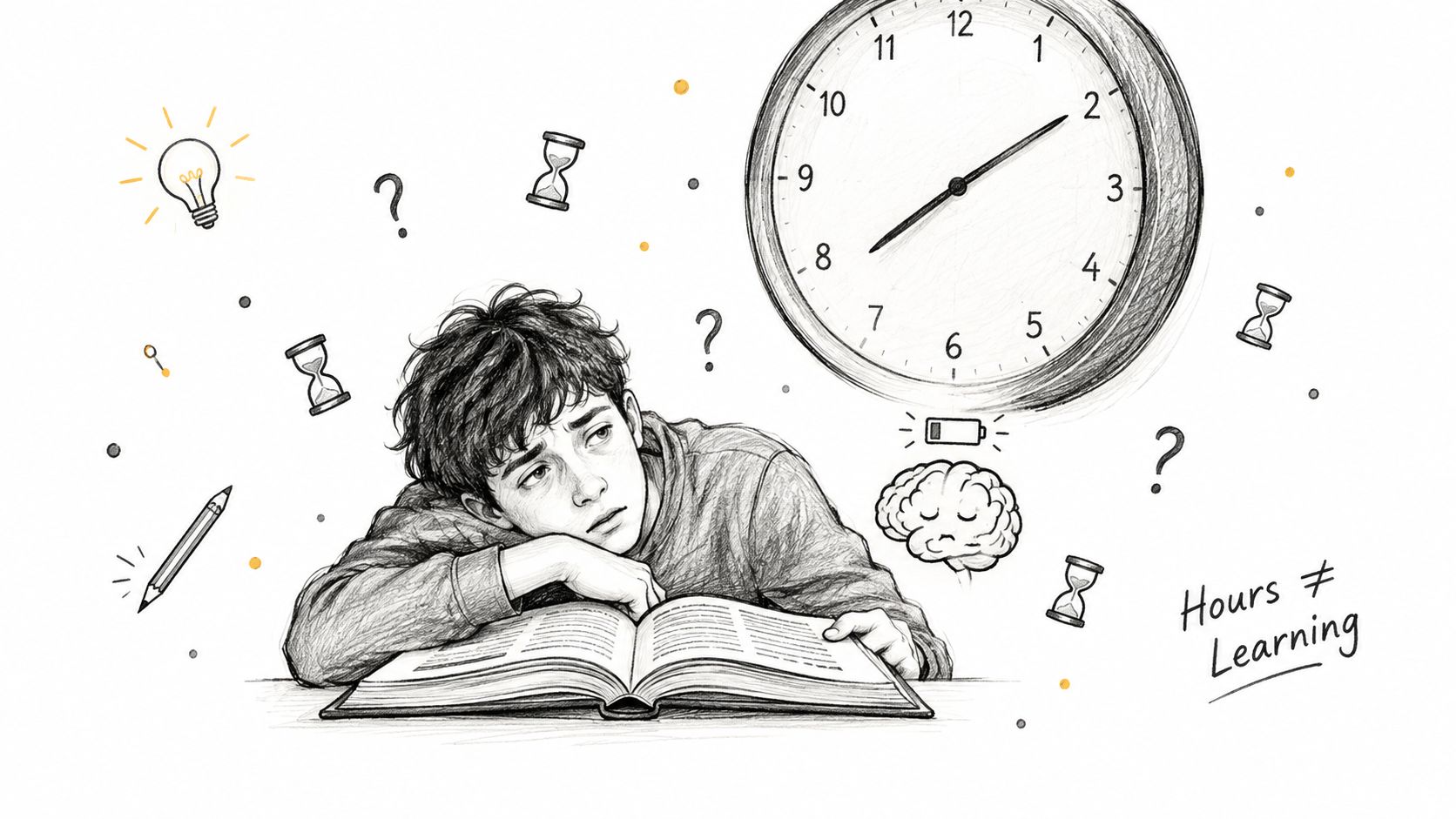
Time is a poor measure of learning because it says nothing about what your brain did during that time. An hour of rereading asks very little of your memory. Twenty minutes of trying to recall, checking your errors, and trying again asks a lot, and that effort is what builds durable memory.
This is also why passive studying feels so draining. You're working long sessions, so you're tired, but you're getting weak results, so you're stressed. Many students respond by studying even longer the same way. The cycle continues until burnout, not mastery, shows up.
If you can recognize it with the book open but can't explain it with the book closed, you don't know it yet.
What Active Engagement Looks Like
Active studying means your brain produces something. You answer a question before checking the notes. You explain a process out loud in your own words. You write down everything you remember about a topic, then compare it against your materials to find the gaps.
That struggle to remember isn't a sign you're failing. It's the mechanism that makes learning stick. When retrieval feels effortful, you're strengthening the path back to that information. That's the core reason why study skills are important. They turn study time from exposure into actual encoding.
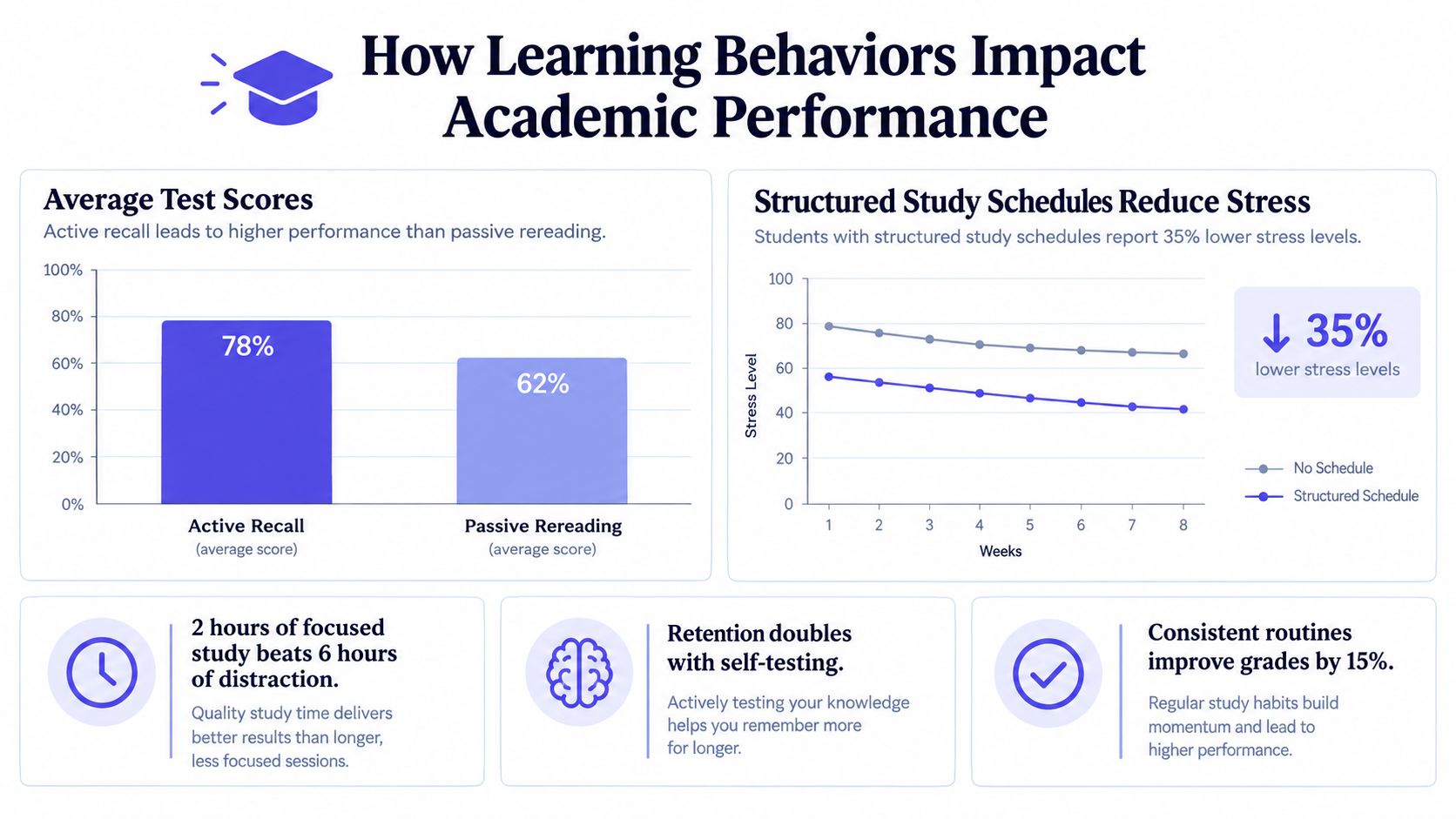
How Learning Behaviors Impact Academic Performance
Study skills aren't a soft extra for organized students. They show up in measurable performance differences at national and international scale. The evidence comes from two directions, large assessment data and controlled research on specific techniques, and both point the same way.
What International Data Shows
The OECD's analysis of PISA 2022 looked at proactive learning behaviours, such as persisting with difficult work and connecting new material to earlier learning. Across OECD countries, students who reported using those behaviours frequently outperformed students who used them less often by an average of 45 points, according to the OECD's PISA 2022 analysis of proactive learning behaviours (opens in a new tab).
That same analysis found only 46% of students said they tried to relate new material to previous mathematics lessons more than half the time. There's an equity gap too. About 52% of advantaged students reported making those connections, compared with 39% of disadvantaged students. Those figures don't prove study habits alone cause higher scores, since teaching quality, prior achievement, and socioeconomic conditions also matter. They do show that how students approach learning tracks closely with how well they perform.
What Technique Research Shows
A major 2013 review evaluated 10 commonly used learning techniques, including highlighting, rereading, summarization, practice testing, and distributed practice. It gave its highest utility ratings to practice testing and distributed practice, as detailed in the 2013 review in Psychological Science in the Public Interest (opens in a new tab).
That conclusion matters for your weekly routine. It means the method you choose can substantially affect how well you retain and apply knowledge, across different ages, subjects, and learning environments. Connecting new ideas to what you already know supports comprehension and transfer, so you can use knowledge in a new question rather than only recalling it in the exact form you first saw it. Students who build those connections aren't memorizing isolated facts. They're building a structure that holds up under exam pressure.
Practical rule: Judge a study session by what you can retrieve and explain afterward, not by how many pages you covered.
High Utility Techniques Versus Popular Habits
Not all familiar habits deserve your time. Some of the most popular methods feel productive because they're comfortable and visible. A page covered in highlighter looks like work. The problem is that visible activity and memory formation aren't the same thing.
Study Technique Utility Comparison
Popular habits aren't useless in every situation. Rereading can help you get oriented when material is completely new, and highlighting can flag passages to return to. They fail when they become the whole strategy. If you stop at highlighting, you've identified information without ever practicing retrieving it.
Matching the Method to the Goal
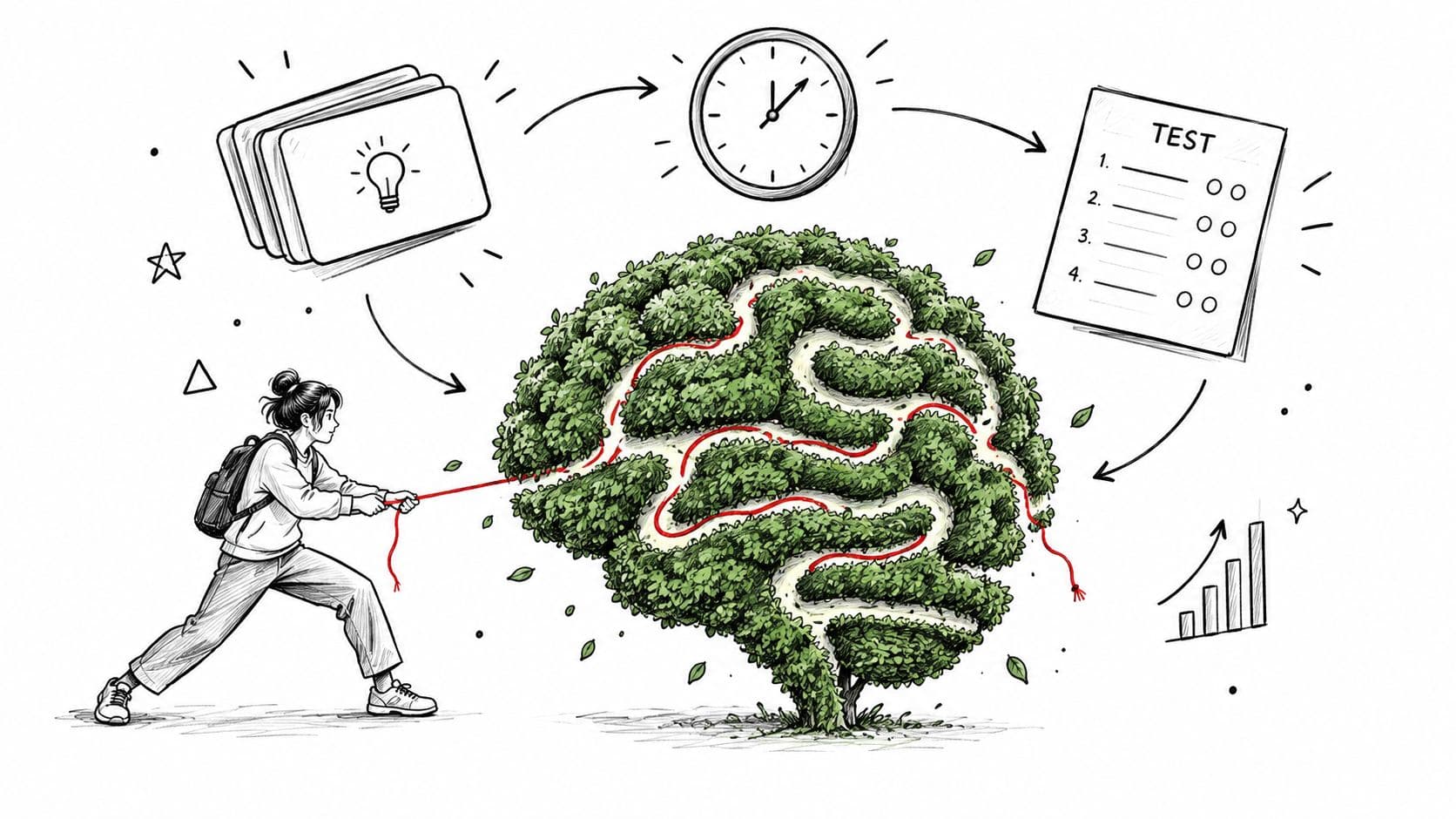
Choose the technique based on what you need. Use retrieval when you need durable recall for an exam. Use elaboration, explaining why something is true and how it connects to earlier topics, when you need understanding. Use spacing when you need material to last beyond this week, and use self-monitoring to decide what deserves your next session.
If you want a deeper walkthrough of retrieval in practice, this guide to the active recall study method shows how to structure self-testing without notes. Start there if rereading is currently your default.
Knowing a technique works doesn't guarantee you'll use it, though. In one higher-education experiment, adding strategy instruction plus follow-up support produced only a small but statistically significant increase in retrieval-practice use compared with a control group, with r = 0.39, p = .005, as reported in research on strategy instruction and retrieval practice adoption (opens in a new tab). That finding should shape your expectations. You don't just need to know about flashcards. You need prompts, routines, and feedback that make retrieval your habit when you're tired and tempted to reread instead.
Building Your Core Academic Toolkit
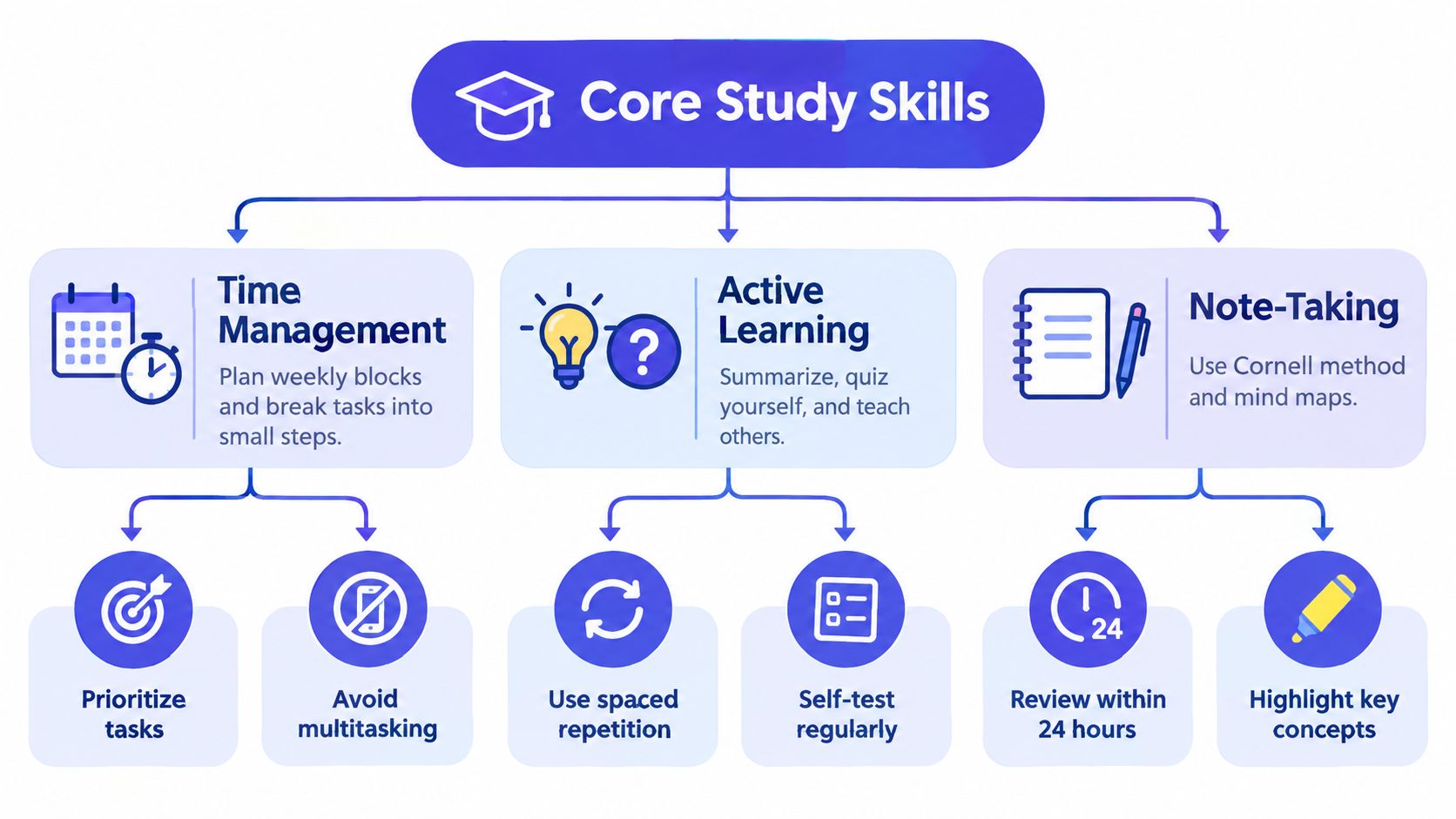
A useful toolkit follows the order learning happens. You capture material, process it, test yourself on it, and revisit it on a schedule. If any stage is missing, the others carry too much weight.
The diagram below maps the three core areas most students need to build first.
Start With Time You Can Actually Use
Distributed practice only works if your calendar allows it. Plan short, repeated sessions for each module instead of saving everything for the week before the exam. Break a large topic into small tasks, such as one lecture's concepts or one problem type, so each session has a clear finish line.
- Schedule the revisit when you first learn it: Add a follow-up session before you close your notes.
- Protect single-task focus: Phone away, one topic open, one clear goal for the session.
- End with a retrieval check: Write three questions you should be able to answer next time.
Take Notes That Force Processing
Good notes aren't a transcript. When you copy slides word for word, your hand moves but your brain doesn't have to decide what matters. Write main ideas in your own words, leave space for questions, and note connections to earlier lectures. Methods like the Cornell layout help because the cue column turns your notes into self-test prompts later.
If you're unsure how note quality affects later revision, this explanation of why note taking matters for learning connects in-class decisions to exam preparation. The key shift is simple. Capture decisions and relationships, not just sentences.
The video below demonstrates how to turn passive notes into active study material you can test yourself from.
Watch the video on YouTube (opens in a new tab)
After watching, try the blank page method on your most recent lecture. Write everything you remember, then open your notes and mark what you missed or got wrong. Those marks become your next study list, which is far more useful than rereading the full chapter again.
Navigating Shared Resources and AI Tools
You now have access to shared notes, online summaries, and AI tools that can explain almost anything in seconds. That access helps only if you protect the cognitive work that produces learning. The risk isn't using resources. The risk is letting resources do the retrieving, connecting, and deciding for you.
Research indicates that while 83% of students use AI regularly in their studies, only 53% receive formal training on it, and students using AI-generated retrieval questions achieved 89% accuracy compared to 73% during standard study weeks, according to a systematic evidence map on student AI use and retrieval practice (opens in a new tab). That gap between use and training is exactly where poor habits form. Students adopt the tool quickly, but nobody teaches them where help ends and substitution begins.
Productive Assistance Versus Cognitive Substitution
Productive assistance keeps you doing the thinking. You attempt a problem first, then ask for an explanation of where you went wrong. You ask an AI tool to generate practice questions from your lecture topic, answer them cold, and check yourself. You use shared course notes to fill a gap in your own notes, then turn that section into flashcards.
Cognitive substitution removes the thinking. You copy an AI summary into your notes without testing whether you understand it. You read someone else's revision guide cover to cover and call it studying. You accept an answer without checking it against your lecture, textbook, or course materials.
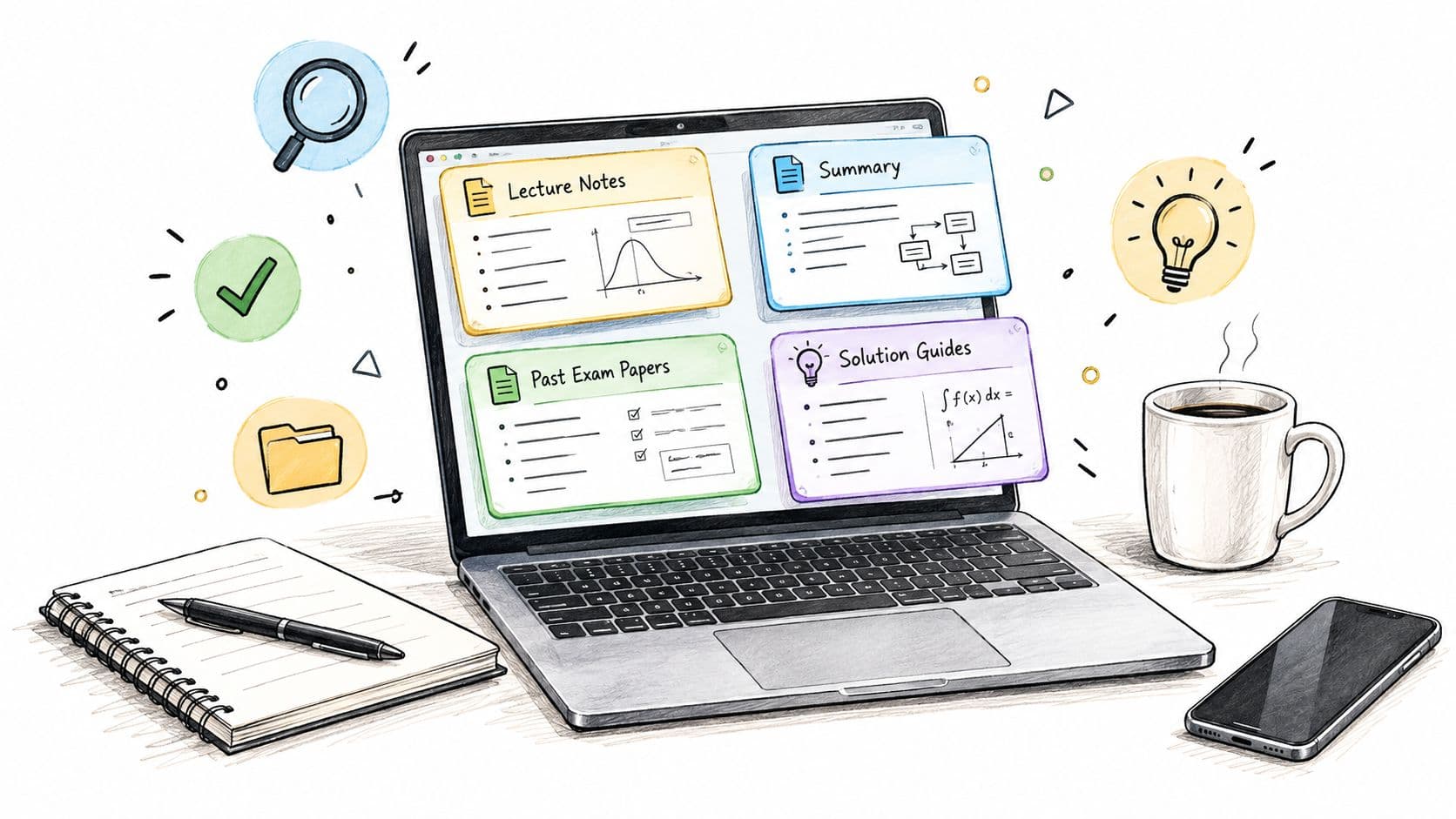
Platforms such as CramShare, which organize lecture notes, past papers, and practice materials by university, course code, module, textbook, and academic year, fit the first category when you use those materials as a base for self-testing. A past paper only helps if you attempt it under timed conditions. A summary only helps if you can reproduce its argument without looking.
Checks Before You Trust Any Resource
- Verify against your course: Compare definitions, formulas, and examples with your lecture slides and required readings.
- Attempt before you ask: Spend real effort on the question first, so feedback lands on your own thinking.
- Protect your integrity: Use resources to learn material, not to produce submitted work, and review why academic integrity matters in shared study if you're unsure where your institution draws the line.
- Watch for confident errors: AI output can sound fluent and still be wrong, biased, or mismatched to your syllabus.
Use every resource to generate a question you must answer yourself. If it only gives you something to read, it hasn't finished the job.
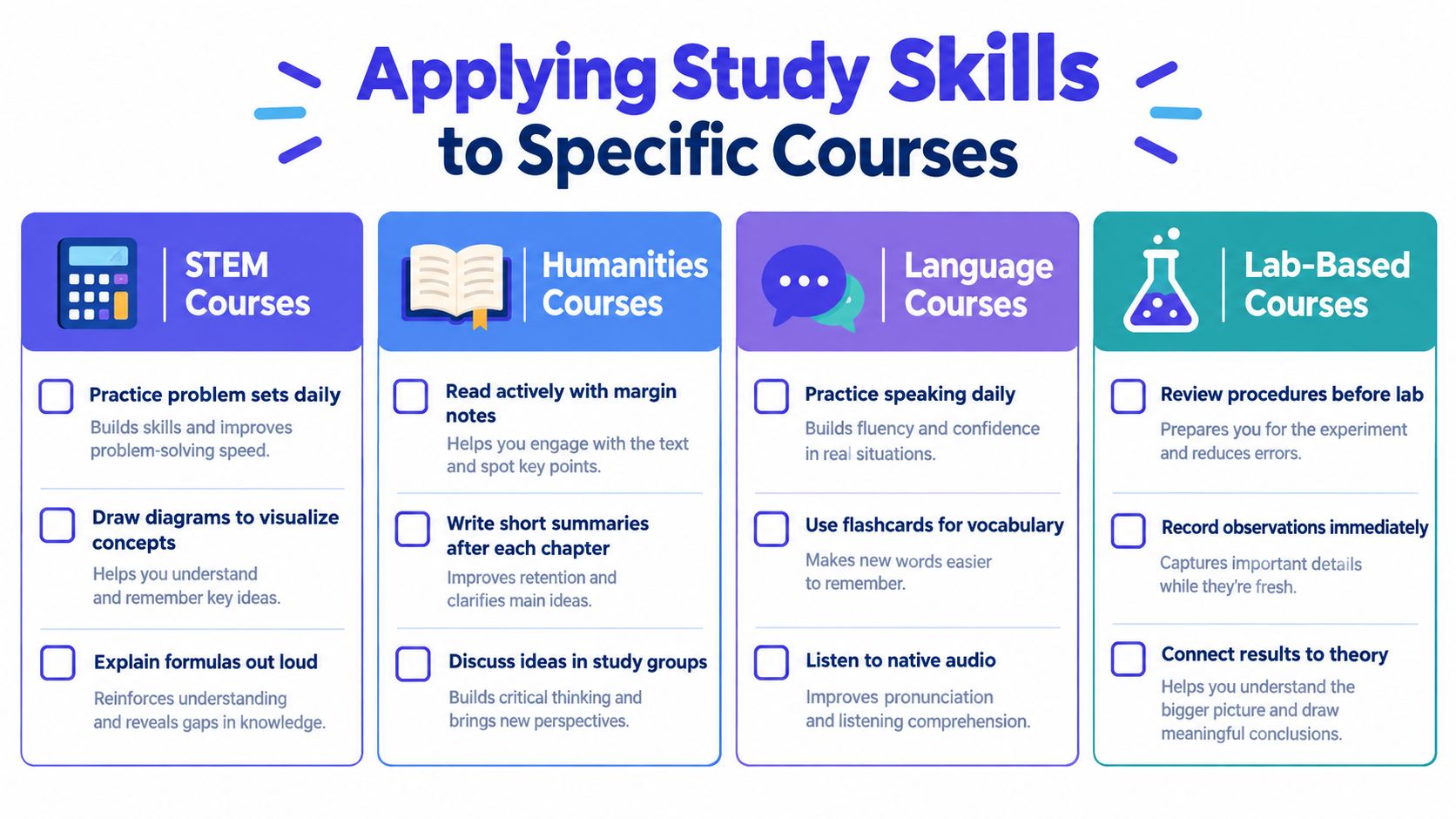
Applying Study Skills to Specific Courses
Generic advice breaks down at module level. A statistics exam, a history essay, and a language oral all reward different kinds of preparation. Your job is to keep the same principles, retrieval, spacing, and connection, and change the form they take.
STEM and Lab Based Courses
For mathematics, physics, engineering, and similar modules, retrieval means solving problems without the worked example open. Cover the solution, attempt the problem, and only then compare steps. Pay special attention to where your method diverged, because that point is usually a conceptual gap, not a careless slip.
Derive formulas instead of only memorizing them. If you can explain where a formula comes from and when it doesn't apply, you can adapt it to unfamiliar exam questions. In lab courses, review the procedure before the session, record observations immediately, and afterward write a short explanation connecting your results to the underlying theory. That final step turns a completed practical into revisable knowledge.
Humanities and Essay Based Courses
For history, literature, philosophy, and social sciences, retrieval looks different. You practice reconstructing arguments, comparing interpretations, and planning essays from memory. After reading a chapter, close it and write the author's main claim, the evidence used, and one counterargument. If you can't do that, you haven't yet understood the reading well enough to use it in an essay.
Build thematic connections across weeks. Create a simple map showing how one thinker responds to another, or how a theme changes across texts. Then test yourself by drafting essay plans against past questions without your notes. A timed plan exposes weak structure and missing evidence far better than rereading your highlights.
Language Courses
Languages reward frequent, short retrieval. Use flashcards for vocabulary, but always produce the word in a sentence, not just recognize its translation. Speak daily, even briefly, and record yourself explaining a topic so you can hear hesitation points. Those hesitation points tell you exactly which grammar or vocabulary needs the next spaced session.
A Readiness Check Before Any Assessment
- Can I answer past paper questions cold: Attempt them timed, without notes, and mark them accurately.
- Can I explain each topic to a beginner: Teach it aloud and note where your explanation breaks down.
- Have I revisited weak areas more than once: One correction isn't enough, so retest errors in a later session.
- Does my material match this module: Check your notes and practice questions against your course code, syllabus, and exam format.
- Can I connect this week's topic to earlier ones: Write two links per topic to confirm your knowledge is cumulative.
If you can say yes to most of those, you're not relying on familiarity anymore. You're relying on evidence from your own practice, which is a calmer and more reliable basis for walking into an exam. That's the practical payoff of understanding why study skills are important. You stop guessing whether you're ready and start proving it to yourself, one retrieval at a time.
Ready to put retrieval and spacing to work on your actual modules? Visit CramShare to find lecture notes, revision guides, past papers, and practice materials matched to your university, course code, and academic year, then turn them into self-tests instead of passive reading. Search for your course today and build your next study session around questions you have to answer, not pages you have to reread.