How to Prepare for Oral Exams: A Step-by-Step Guide
Learn how to prepare for oral exams with a structured rehearsal plan, mock viva scripts, and answer frameworks that build confidence and ease exam anxiety.

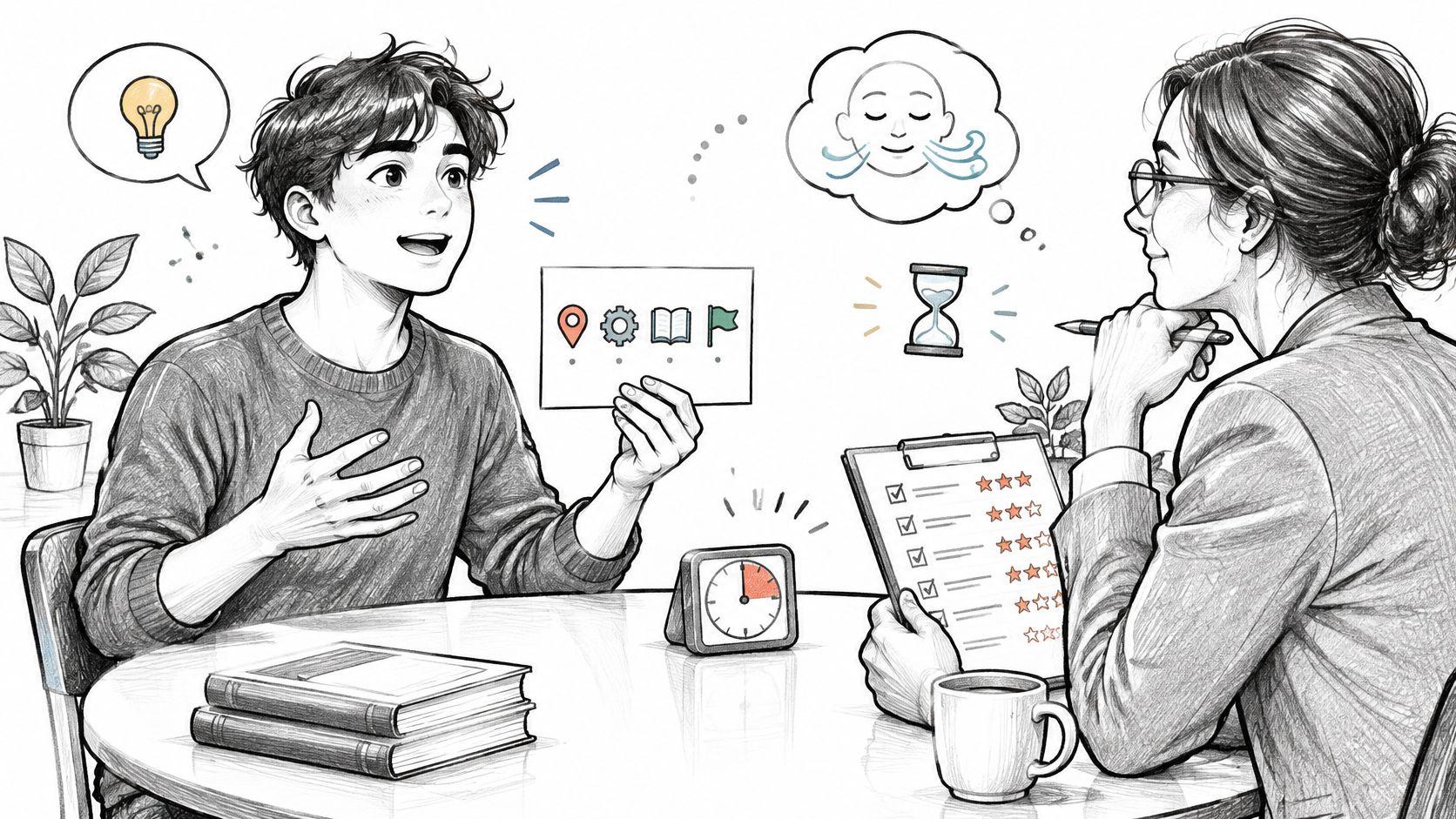
Knowing your notes isn't the same as being ready to discuss them. The familiar advice to revise thoroughly and practise speaking leaves out the hardest part: responding when someone interrupts, challenges your example, or asks a question you didn't anticipate. Effective oral exam preparation means rehearsing that conversation, not just polishing a presentation.
Why Content Revision Is Not Enough for Oral Exams
Prepare for an oral exam by rehearsing timed mock vivas, using a consistent answer framework, and scoring your performance against the marking rubric. A practical starting point is the suggested three-week schedule below. Treat it as a planning template, not a required preparation period, and adapt it to your exam date.
Perfect notes can help you explain a definition. They can't rehearse the moment an examiner asks whether that definition applies to an unfamiliar case. You need both subject knowledge and interactional rehearsal, practice in listening, reasoning aloud, clarifying questions, and recovering when your first answer needs work.
A University of Birmingham case study (opens in a new tab) describes 15-minute individual evaluative conversations using randomly selected questions, a student veto option, and probing follow-ups, with preparation that included practice seminars and peer mock sessions. That offers a useful model: prepare for an exchange, rather than memorising a speech.
Separate retrieval from interaction
Use active recall to check whether you can retrieve an explanation without looking at your notes. Then add a listener who can change the direction of the conversation.
For example, defining opportunity cost is a retrieval task. Explaining why a particular alternative counts as the opportunity cost, after your partner changes the scenario, requires you to adapt.
Organise preparation around these actions:
- Audit: Match your learning outcomes to questions and identify gaps.
- Structure: Build flexible answer outlines instead of scripts.
- Simulate: Answer unpredictable questions under realistic conditions.
- Regulate: Review what happened and adjust your preparation and support.
Practical rule: If your practice never includes an unexpected follow-up, you haven't yet rehearsed the whole task.
Nervousness doesn't automatically mean you lack knowledge or confidence. Sometimes you're attempting an unfamiliar skill without having practised its difficult moments. Make those moments part of preparation rather than treating them as personal shortcomings.
What Examiners Actually Listen For During Oral Assessments
An examiner needs evidence they can assess. A fluent answer may still lack a clear argument; a hesitant answer may contain accurate knowledge and careful reasoning. Your course's marking rubric, not your impression of how confident you sounded, should guide your preparation.
Obtain the rubric and assessment instructions before building your mock sessions. Check whether the assessment prioritises factual knowledge, application, argument, practical judgment, language proficiency, or another outcome. Don't assume that every viva uses the same criteria.
Translate criteria into visible behaviour
Use the following practice checklist alongside your actual rubric. It isn't an official marking scheme, and its categories shouldn't replace your department's descriptors or weightings.
Rubric Criteria and Observable Behaviours
A follow-up question isn't, by itself, evidence that you're failing. An examiner might ask you to justify an assumption, apply your answer, or distinguish between competing explanations. Listen for the task in the question rather than trying to infer a verdict from the examiner's expression.
Visible reasoning matters when the rubric rewards it, but don't assume that a partially correct explanation will always outscore a correct answer. Accuracy and reasoning work together; neither grants permission to bluff.
Treat the exchange as academic discussion
Professional demeanour means engaging respectfully and acknowledging limits, not performing certainty. If you don't know something, distinguish what you can establish from what you're inferring.
Oral assessment isn't necessarily an unpleasant experience for everyone. In a 2024 study published in The Law Teacher (opens in a new tab), 22% of 218 coded student comments reported that students enjoyed participating in a viva.
Before attempting another mock question, review the previous answer against the criteria. Targeted feedback is more useful than just deciding it went well or badly.
Run a Four-Phase Mock Viva Protocol
Use this as a suggested rehearsal schedule, with timings and question counts you can adjust to your course. Match the assessment's rules whenever they differ, especially its preparation time, permitted notes, and questioning format.
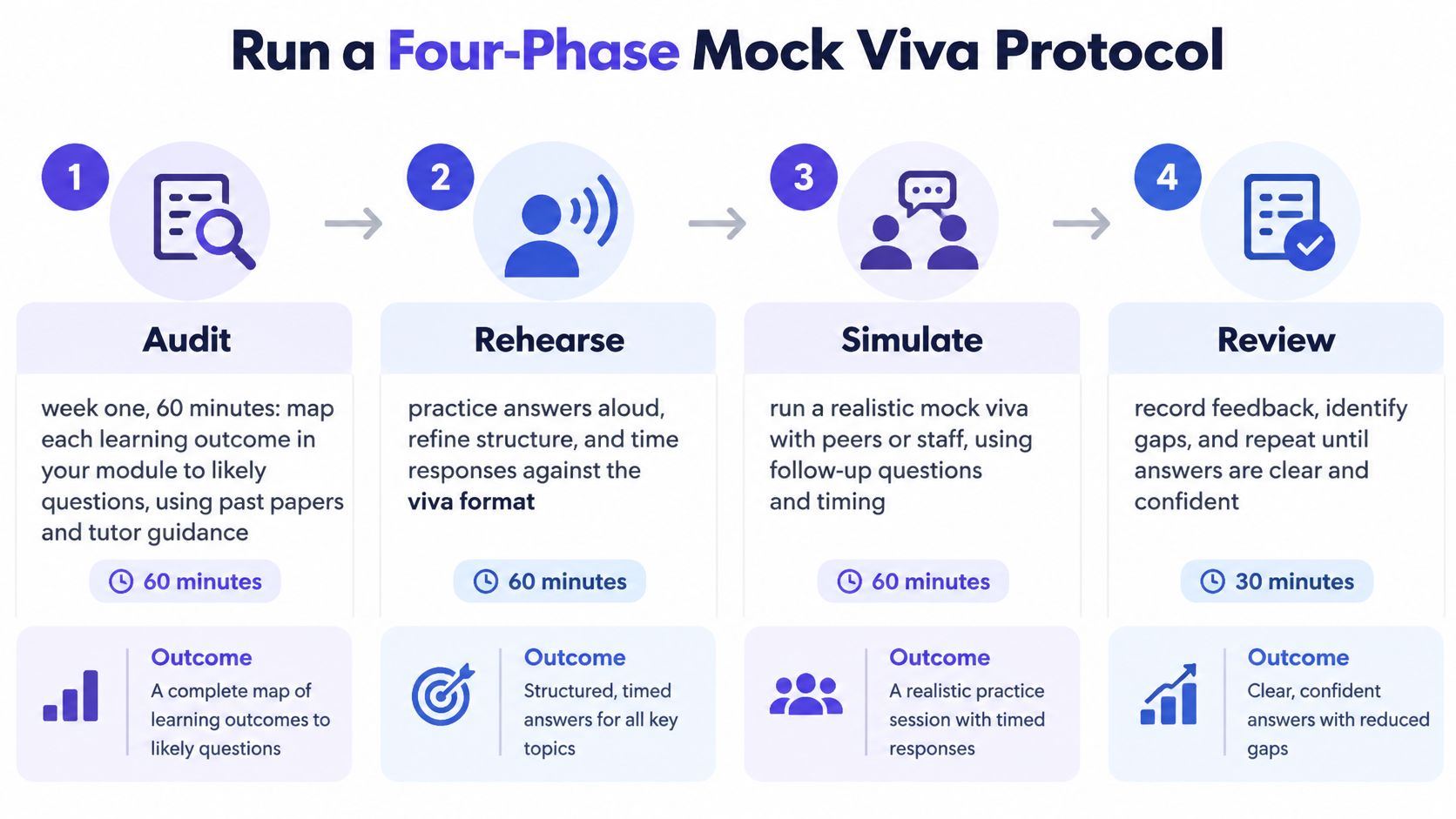
This visual summarises the workflow, with rehearsal corresponding to Structure and review corresponding to Regulate.
Audit and structure your material
Phase 1, Audit: Set aside 60 minutes during your opening week. Copy your module's learning outcomes into a document and turn each into questions asking you to explain, apply, compare, or evaluate. Use authorised past papers, departmental prompts, and tutor guidance to check the level expected.
At CramShare, we offer course-matched study notes written by students who already sat the exam. Our notes can be browsed by subject, exam and certification, university, course code, and textbook. Use supplementary materials to identify possible gaps, then check their coverage against your current syllabus.
Phase 2, Structure: Try a 30-minute preparation block per topic. Write bullet outlines using the PREP framework below, then close the outline and explain the answer aloud. If you can only continue by reproducing exact wording, shorten the outline to concepts and relationships.
Simulate and regulate
Phase 3, Simulate: Run a 15-minute mock with a partner acting as examiner. For this practice format, have them draw five questions randomly and ask a follow-up after each answer, keeping the exchanges brief enough to fit. If your real exam expects longer answers, use fewer questions.
Allow a practice-only veto for a demonstrably out-of-syllabus or defective question, not merely an uncomfortable one. Don't assume you'll have that option in the actual assessment.
Your partner should score the relevant rubric categories and record the time between a stumble and your return to a relevant explanation. Define a stumble consistently, such as losing your thread, making a substantive correction, or requesting clarification.
Phase 4, Regulate: Take a suggested 10-minute reflection period afterwards. Identify whether each difficulty came from missing knowledge, misunderstanding the question, organising the answer, or managing pressure.
Protocol Phases at a Glance
Draw questions unpredictably, include follow-ups, apply the rubric, and log a specific adjustment before repeating the exercise.
For a sample three-week plan, audit and prepare outlines during the opening week. Schedule three mocks during the following week, then two mocks and a recovery-focused rehearsal during the final week, leaving a rest day between sessions. Compare rubric descriptors and recovery patterns, not just the number of correct answers; harder questions can make raw totals misleading.
Verbal Frameworks for Structuring Answers Under Pressure
Say an examiner asks why a business might accept a lower-profit project. You could list everything you remember about profit, strategy, and risk. A stronger approach is to answer the question directly, explain the reasoning, illustrate it, and finish.
PREP, Point, Reason, Example, Point, provides that structure. It's a speaking aid, not a rule that overrides the task: a clinical explanation, mathematical proof, or language assessment may require a different sequence.
Build an answer without writing a script
Use these sentence starters as adaptable practice language:
- Point: The main reason is… State your answer before providing background.
- Reason: This follows because… Explain the relationship that makes your answer plausible.
- Example: A useful example would be… Choose a case that demonstrates the mechanism.
- Point again: So, in this situation… Return to the question, adding a qualification if necessary.
For the business question, your answer might begin: A business might accept lower immediate profit to pursue a longer-term strategic goal. Explain that goal, illustrate it with a hypothetical market-entry decision, then conclude that the choice needs justification against its costs and risks.
The final point shouldn't mechanically repeat the opening. It should show what the explanation has established.
For longer answers, add spoken signposts such as The main distinction is… or The limitation of that argument is…. If listening back helps you notice unclear explanations, adapt the exercises in these study techniques for auditory learners to your rehearsal routine.
Recover without hiding the difficulty
When you need thinking time, state what you're doing briefly. When you need clarification, identify the ambiguity rather than asking the examiner to repeat everything.
The phrases below are practice templates, not quotations from examiners or required wording.
Recovery Phrases for Common Oral Exam Stumbles
Use the last phrase only if you know the principle. Otherwise, acknowledge the limit and ask whether you may approach the problem from a related concept.
For uncertainty, try: I'm considering X because Y, but Z makes that conclusion less certain. That separates evidence from inference and gives the examiner something concrete to question.
A useful correction identifies what changed and supplies the replacement. An apology alone doesn't repair the answer.
Don't narrate every passing thought. Explain the relevant steps, pause when needed, and stop when you've answered. The aim isn't uninterrupted speech; it's an explanation another person can follow.
Managing Nerves and Accessing Equitable Support
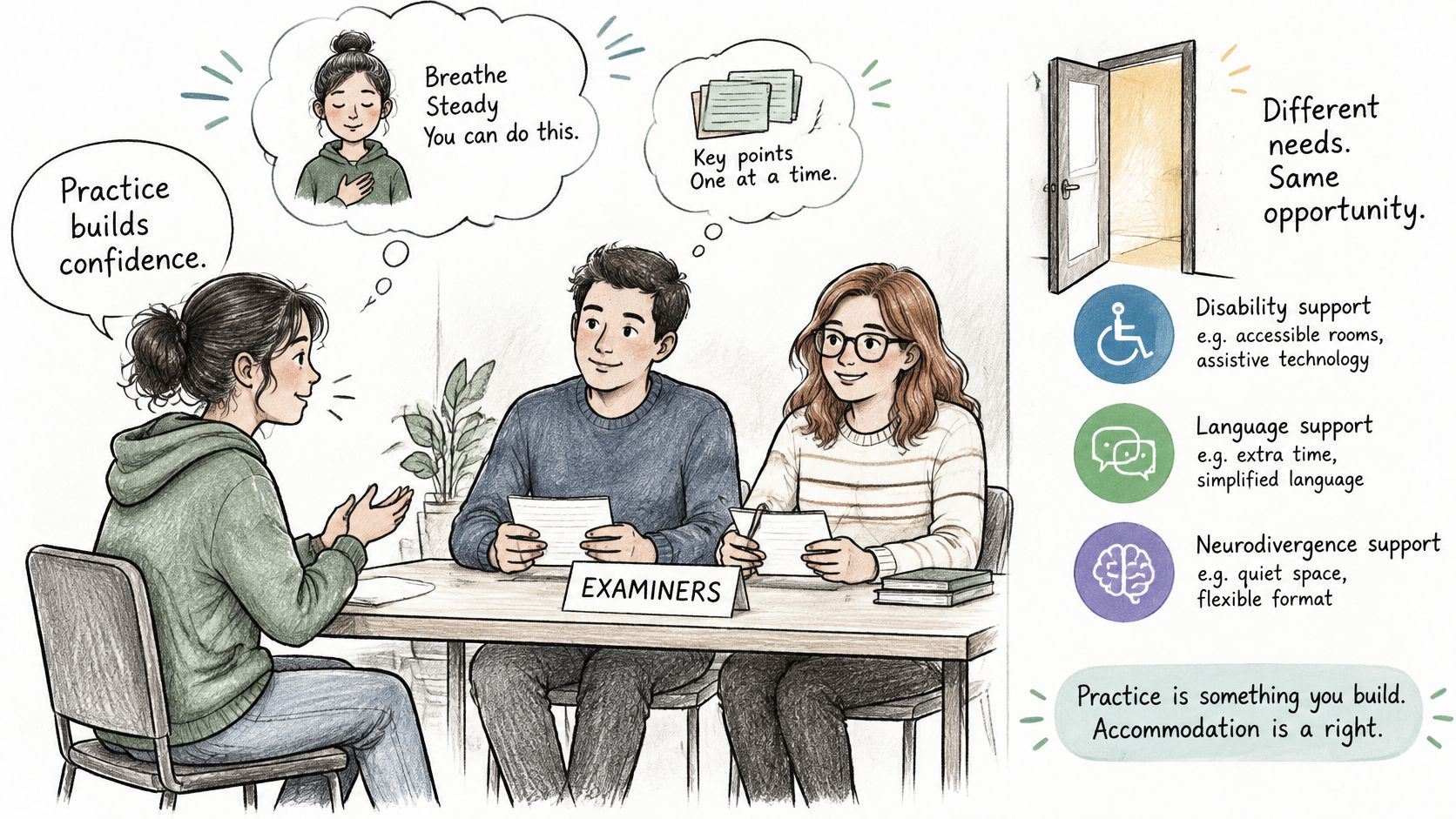
Feeling tense before an oral exam and facing an access barrier aren't the same problem. You might need rehearsal, institutional support, or both. Don't use your apparent confidence as a test of whether your needs are legitimate.
Keep both practical preparation and access arrangements in view.
Choose practice you can tolerate and use
A review in the International Journal of Educational Technology in Higher Education (opens in a new tab) identifies anxiety, accessibility, reliability of judgment, and clear criteria as recurring challenges in oral and dialogical assessment, while reporting mixed evidence for video and virtual-reality tools, particularly for anxiety reduction. Recording yourself is therefore an option, not a requirement for effective preparation.
Start with a trusted peer if a camera makes it harder to concentrate. Ask for feedback on observable behaviour, such as whether your opening answered the question, rather than broad judgments about your personality or confidence.
Before practice, place your feet on the floor, release unnecessary tension in your shoulders, and breathe gently at a comfortable pace. If you use box breathing, keep it comfortable and stop if breath-holding makes you dizzy or distressed. Grounding can be as simple as noticing the chair beneath you and returning your attention to the question.
Treat these as ways to settle into the task, not guarantees that anxiety will disappear. If anxiety is persistent, severe, or disrupting your studies, contact your institution's wellbeing or counselling service.
Use any additional preparation resource selectively rather than turning it into another requirement.
Watch the video on YouTube (opens in a new tab)
Ask about access before the assessment
Contact disability or accessibility services early if a disability, neurodivergence, or health condition affects how you process questions or communicate answers. Language-related support may follow a different institutional process, so ask which service handles your circumstances.
Possible arrangements to discuss include:
- Processing time: Pauses or additional time to understand and formulate an answer.
- Question presentation: Written questions alongside spoken prompts, where compatible with the assessment.
- Assistive technology: Approved tools and an opportunity to test the setup.
- Assessment format: An alternative arrangement where appropriate to the learning outcomes.
- Transparent preparation: Access to the rubric, format guidance, and authorised recorded exemplars where available.
Try this request: My condition affects how I process spoken questions under time pressure. Could we discuss approved arrangements that let me demonstrate the required learning outcomes, including how those arrangements would work during questioning?
An approved accommodation changes access, not the requirement to demonstrate your own learning. Unauthorised notes, concealed prompting, and outside answers remain different matters.
If English isn't your first language, practise technical vocabulary separately from complete answers. Explain each term in plain language, then use it in context. Notice whether a stall reflects an unfamiliar word or an uncertain concept, because those need different preparation.
You don't have to become a different kind of person to participate successfully. Seek clear criteria, suitable practice, and approved support that lets you demonstrate what you know.
Book Your First Mock Viva Within Seven Days
Set a calendar appointment for a first mock within seven days. Use the suggested 15-minute format with a partner, five course-based questions, a timer, your rubric, and a sheet containing the PREP prompts.
Search by your exact course code when gathering supplementary material. Every document on CramShare is tagged to the course, exam, or textbook it was written for; still check relevance against your current syllabus. Pair your rehearsal appointment with a manageable revision plan using these exam preparation tips.
Afterwards, record the three stumbles that took you longest to recover from and choose the next session's focus accordingly.
- Repair first: Check missing concepts before repeating the question.
- Share responsibly: Consider uploading your own refined summaries or original practice questions. Sellers can upload their own materials as PDF, Word, Excel, or OpenDocument files, but only share work you have permission to distribute.
Your first attempt can feel awkward and still be useful. Start before you feel polished.
CramShare offers course-specific study materials to help you build question banks and check gaps before a mock viva. Visit CramShare to find resources matched to your course, then use your syllabus and marking rubric to turn them into spoken practice.