Exam Preparation Tips: 10 Proven Study Methods for 2026
Practical exam preparation tips backed by research, from active recall and spaced repetition to past papers, sleep, and smarter revision.
Rereading your notes shouldn't be the backbone of exam preparation. It's useful when you need to repair a specific gap, but reading a familiar explanation isn't the same as producing that explanation under exam conditions.
The difference becomes obvious when you close the book. You might recognize every stage of a biological process yet struggle to reconstruct its sequence, or follow a worked calculation without knowing how to start a different problem. Familiarity tells you what you recognize. Practice tells you what you can do.
Treat feeling prepared as a hypothesis. Test it with an answer you produce without help.
Useful exam preparation tips start with decisions, not stationery or elaborate timetables. Should you attempt another past paper, revisit a difficult concept, check a solution, or stop studying and rest? The answer depends on what your latest practice attempt reveals.
Before choosing a technique, check your current assessment brief. Identify what you must recall, what you must apply, which resources you can use, and how examiners award marks. Then choose study activities that require those same actions.
You don't need to use every method below every day. Build your revision around attempting, checking, correcting, and returning later, rather than repeatedly reading material you already recognize.
1. Active Recall (Retrieval Practice)
Active recall means producing an answer before looking at the source. Close your notes, respond to a question, then compare your response with the course material. The missing details become your next revision targets.
For biology, draw the Krebs cycle from memory and explain what happens at each stage. For law, outline an answer to a problem question before checking the relevant authorities and marking guidance.
Use AI to ask, not answer
In a survey of UK undergraduates, 58% identified explaining concepts as an AI use, according to the Student Generative AI Survey 2025 (opens in a new tab). For exam preparation, take that explanation a step further: ask for a question, attempt it independently, and verify the feedback.
- Set boundaries: Ask the tool to withhold answers until you submit your attempt.
- Constrain the material: Request questions based on permitted lecture content, not an unrestricted topic search.
- Verify corrections: Check definitions, calculations, and references against your textbook or official course materials.
A plausible AI answer isn't an authoritative answer. If it introduces unfamiliar terminology or contradicts a lecture, investigate rather than memorizing it.
Follow your institution's rules, including restrictions on uploading teaching materials. The useful difficulty is recalling and correcting your answer, not reading an increasingly polished explanation.
2. Spaced Repetition
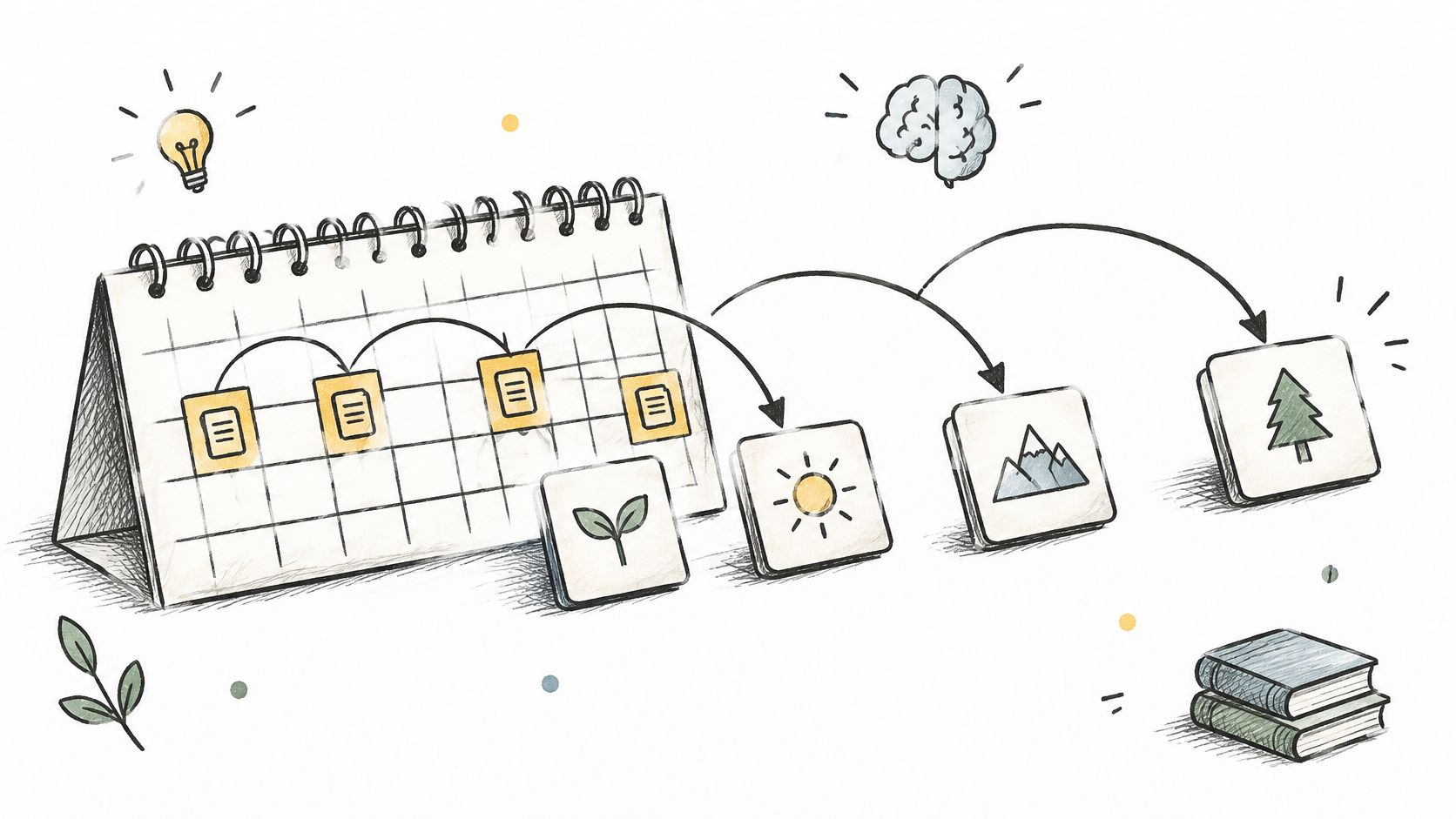
A flashcard you answer correctly immediately after making it hasn't yet tested much. You've just seen the answer. Spaced repetition means returning after a gap, when you must retrieve the material rather than repeat it from immediate familiarity.
Use Anki, a calendar, or a paper card box. The tool matters less than whether you attempt the answer before revealing it and return to difficult material after correcting it.
Schedule around performance
A medical student might turn confusing anatomy terms into focused prompts, then review missed cards sooner than confidently answered ones. A language student can test vocabulary in both directions and add a sentence that requires using the word.
- Keep prompts focused: Ask for a definition, distinction, or decision rather than an entire lecture.
- Make answers checkable: Include the essential wording and a reference to the relevant course page.
- Retire duplicates: Maintain a coherent course deck instead of importing overlapping collections.
- Adjust the workload: Reduce new cards when overdue reviews crowd out exam-style practice.
Compare spaced repetition tools by how easily they support those tasks, not by how many features they advertise.
The trade-off is setup time. Don't spend your remaining revision period formatting cards for everything. Prioritize facts, distinctions, and recurring errors, while keeping substantial time for problems and extended answers.
3. Working Through Past Papers Under Timed Conditions
Check relevance before setting the timer. Match a past paper to your course code, syllabus, academic year, permitted resources, and current assessment format. An old paper can contain useful questions without being a reliable rehearsal for your next exam.
Previous questions are widely used in some settings: 88.4% of respondents in a study of German medical students reported using them to prepare for local exams, according to a 2025 Medical Science Educator study (opens in a new tab). That makes relevance checks important, not optional.
Separate diagnosis from rehearsal
Use an initial paper to locate weaknesses. Later, complete a relevant paper under the actual rules, including resource restrictions and the official time limit.
An accounting student might discover that ratio calculations are accurate but interpretation is vague. The next session should target explaining what the ratios mean, not repeating calculations already mastered.
- Mark against criteria: Use official solutions, rubrics, or examiner comments where available.
- Record lost marks: Distinguish missing knowledge from incomplete reasoning and poor timing.
- Keep an unseen paper: Preserve a realistic rehearsal rather than memorizing every available answer.
Use university past papers selectively. Repeated topics can guide practice, but they don't guarantee future coverage. When the format has changed, reuse relevant questions as exercises rather than treating the whole paper as a prediction.
4. Interleaved Practice
A statistics student who completes a worksheet labelled t-tests already knows which method to use. In an exam, identifying the method may be part of the task. Interleaved practice removes that helpful label by mixing problem types.
Start with basic instruction and supported examples for each topic. Once you can attempt them individually, combine questions that require you to distinguish between related approaches.
Practice choosing before calculating
Mix questions on t-tests, chi-square tests, and regression. Before solving each question, write which method applies and what feature of the question justifies that choice.
For physics, alternate between energy, momentum, and kinematics problems. Don't just rotate chapters. Choose questions whose wording makes you examine the underlying conditions.
- Hide chapter labels: Avoid giving yourself a clue the exam won't provide.
- State the decision: Identify the relevant assumptions, quantities, or relationships.
- Explain rejected options: Note why a tempting alternative method doesn't fit.
- Check reasoning separately: A correct calculation can still follow an unjustified method choice.
If you can solve a problem only after someone names the method, practice identifying the method.
Mixed practice can feel less fluent than completing similar questions together. That discomfort isn't automatically a reason to stop, but persistent confusion is a reason to revisit instruction.
Use blocked practice to establish a method, then mixed practice to test whether you know when to use it. Neither approach needs to replace the other completely.
5. The Feynman Technique
Try explaining inflation without relying on the word inflation. You'll need to describe what changes, how prices relate to purchasing power, and why different causes require different explanations.
That's the useful part of the Feynman Technique: explaining a concept in plain language exposes places where you've memorized terminology without understanding the relationship behind it.

Simplify without losing precision
Choose a concept and explain it aloud or on paper without notes. Mark every point where you hesitate, substitute jargon for an explanation, or make a claim you can't justify.
Then return to the lecture or textbook and repair those exact gaps. Explain the concept again from a blank start rather than editing a paragraph while looking at the source.
For psychology, explain a theory, describe an example, and identify a situation it doesn't adequately explain. That last step checks whether you understand its limits.
- Define technical terms: Keep necessary terminology, but explain what it means.
- Test analogies: Identify where a comparison stops matching the process.
- Check exceptions: Restore qualifications that disappeared during simplification.
A study partner can ask follow-up questions, but they shouldn't supply your explanation for you. For an oral exam, practise answering interruptions and defending assumptions.
Plain language is a test of understanding, not permission to omit the precise terms your examiner expects.
6. Cornell Note-Taking System for Revision
Your notes don't need to be rewritten beautifully before they become useful. The Cornell layout gives existing material a testing function by separating prompts from answers.
Divide the page into a narrow cue column, a wider notes area, and a summary space at the bottom. Put explanations in the main area, questions beside them, and a concise synthesis underneath.
Turn headings into questions
A history heading such as Policy reform offers little direction for self-testing. A cue asking what caused the reform, which groups opposed it, and what evidence supports your interpretation demands a usable answer.
Cover the main notes area and answer the cues from memory. Uncover it only after committing to a response.
- Write question cues: Prefer prompts requiring explanation over isolated topic labels.
- Link to sources: Record the relevant lecture, reading, or textbook section.
- Summarize from memory: Use the bottom space to connect ideas, then verify accuracy.
- Flag unresolved points: Separate genuine uncertainty from information you haven't reviewed.
A nursing student could organize a clinical topic around indications, contraindications, escalation decisions, and rationale. The summary should explain how those decisions relate, not merely repeat the headings.
Compare note-taking methods for students if your subject needs another layout.
The trade-off is conversion time. Apply the structure to difficult or important topics first. Reformatting a complete course archive can become another way to avoid answering questions.
7. Study Sessions, Focus, and Rest
A study block needs a finishable task, not just a duration. Replace revise chemistry with attempt equilibrium questions, mark them, and record the errors. You'll know what progress looks like before you begin.
Time management is a practical obstacle: 47% of surveyed U.S. college students identified procrastination or time management as a major studying challenge in Kahoot!’s 2024 study-habits survey (opens in a new tab). A timer can help you start, but it can't choose the right work for you.
Match the interval to the task
Use a Pomodoro-style timer for tasks you keep postponing. For an essay plan or complex derivation, allow a longer uninterrupted block if stopping would break useful concentration.
A law student might separate case recall from writing an argument. An engineering student might complete a whole problem before taking a break, then return to mark it.
- Remove interruptions: Silence notifications and put your phone beyond easy reach.
- Plan the break: Stand, move, drink water, or step outside rather than opening another demanding feed.
- Set a stopping point: Decide when evening study ends before fatigue makes the decision.
- Leave capacity: Include lighter periods so missed work doesn't force an all-night catch-up.
Rest rule: Don't make sleep the leftover time after an unlimited revision list.
Keep your sleep and wake routine consistent where possible. If a plan repeatedly requires sacrificing rest, reduce or reprioritize the workload rather than treating exhaustion as evidence of commitment.
8. Using Solution Manuals and Worked Examples Ethically
A worked solution can clarify a difficult method. It can also let you mistake someone else's reasoning for your own. The deciding factor is what you do before and after reading it.
For an engineering beam-deflection problem, begin by drawing the diagram, listing assumptions, selecting relationships, and attempting the setup. Even an incomplete attempt gives you something specific to compare with the solution.
Use the smallest useful hint
When stuck, identify the blockage. Is it choosing an equation, applying a boundary condition, or simplifying the algebra?
Reveal only the part that addresses that blockage, then close the solution and continue independently.
- Attempt first: Write your reasoning rather than deciding mentally that you can't do it.
- Compare the divergence: Find the earliest step where your approach differs.
- Reconstruct independently: Put the example away and reproduce the method.
- Transfer the method: Attempt a related problem with changed conditions or wording.
If you still can't begin, study a complete worked example with your course materials open. Explain why each step follows before attempting a fresh question.
Use institution-provided materials, publisher resources, or other authorized copies. Check whether solutions are permitted for the task, particularly when practice work also contributes to assessment.
Being able to explain a solution doesn't establish permission to submit it. Follow the assessment rules, acknowledge assistance where required, and complete assessed reasoning independently. For suspected errors in a manual, compare the method with your lecturer's guidance rather than treating print as proof.
9. Error Logs and Mistake Analysis
Suppose you understand a calculation but repeatedly lose marks because you leave quantities in incompatible units. More theory reading won't directly address that problem. You need a checking routine and another opportunity to apply it.
An error log records the mistake, its cause, the correction, and a retest. Keep it brief enough to use after ordinary practice, not just after a full mock exam.
Record causes, not apologies
An entry saying careless mistake doesn't tell you what to change. An entry saying used centimetres in an equation requiring metres gives you a concrete action.
Useful categories include conceptual misunderstanding, calculation, question reading, incomplete justification, and time allocation.
- Capture the trigger: Note the wording or condition you overlooked.
- State the repair: Write the corrected rule or reasoning in your own words.
- Add a prevention prompt: For example, identify units before substituting values.
- Schedule a retest: Use a different question that requires the same decision.
A medical student who confuses related drug classes might create a comparison covering mechanism, indications, contraindications, and distinguishing features. The follow-up test should require choosing between them in a scenario.
Don't preserve every minor slip indefinitely. Archive resolved entries and keep recurring or consequential errors visible.
A corrected answer isn't yet a corrected habit. Check whether you can avoid the mistake on a fresh problem without consulting the log first. If not, adjust the prompt or revisit the underlying concept.
10. Dual Coding with Diagrams and Visual Summaries
Use a diagram when the relationship is easier to inspect visually than in a paragraph. Dual coding pairs meaningful visuals with words, such as a labelled process diagram and a short explanation of each transition.
For the nitrogen cycle, draw the transformations, label the processes, and explain what each arrow represents. For business, connect elements of a marketing strategy and annotate how a change in one affects the others.
Draw what you need to explain
Start from a question rather than a design template. If the question concerns sequence, use a flowchart; if it concerns change over time, use a timeline; if it concerns relationships, use a concept map.
- Label connections: Replace unexplained arrows with the relationship they represent.
- Keep text purposeful: Add mechanisms, conditions, and exceptions.
- Redraw from memory: Test whether you can reconstruct the structure without copying.
- Check against the course: Correct omissions using authoritative materials.
The video below offers an additional study resource.
Watch the video on YouTube (opens in a new tab)
The trade-off is that drawing can become decoration. Colour coding and polished lettering aren't substitutes for checking whether the relationships are accurate.
After completing a visual summary, answer an exam-style question using it, then try without it. If you can reproduce the picture but can't explain its arrows, add the missing reasoning rather than more visual detail.
How the ten exam preparation tips compare at a glance
Turn These Ten Tips Into a Revision Plan You Can Follow
Choose a small set of methods that addresses your current weaknesses. Past-paper practice, active recall, spaced review, and an error log provide a practical starting combination. Add diagrams, verbal explanations, or mixed questions when they solve a specific problem.
Begin with the current assessment requirements. In the HEPI Student Generative AI Survey 2025 (opens in a new tab), 59% of students agreed that their assessment methods had changed substantially in response to generative AI. Don't assume an older student's revision routine still matches your exam.
Match preparation to the assessment
- Closed-book exams: Practise recall and complete relevant questions without resources.
- Application-heavy exams: Mix problem types and justify your method before solving.
- Open-book assessments: Rehearse locating information and applying it under the official conditions.
- Oral assessments: Explain reasoning aloud, defend assumptions, and respond without a script.
- AI-assisted tasks: Check permitted uses, disclosure requirements, and responsibility for verifying outputs.
Next, attempt a relevant past-paper question or representative task. Mark it carefully and choose your next activity from the result: missing facts call for retrieval practice, confused methods call for comparison, and slow execution calls for targeted timed work.
Write those activities into your weekly timetable around classes, work, meals, and rest. Name the task and its intended output, such as an independently completed answer or a corrected explanation. Avoid filling every available gap, because marking and repairing work also take time.
Review the plan using completed work
After each practice session, update your error log and arrange a later retest. When you return, use a fresh question where possible. Repeating a memorized answer won't tell you whether you can handle a changed scenario.
Keep the methods that expose and repair weaknesses. Reduce activities that mainly produce tidy pages, long decks, or a reassuring sense of familiarity.
For course-matched support, our CramShare library includes notes written by students who have already sat the exam, and every document is tagged to the course, exam, or textbook it was written for. Compare any resource with your current syllabus and lecturer guidance before building revision around it.
Your next step is concrete: select a relevant practice task, attempt it independently, identify the most important error, and schedule the correction and retest. That's a revision plan you can act on today.
CramShare offers course-specific notes, summaries, revision guides, and practice materials searchable by institution, course code, module, textbook, and academic year. Visit CramShare to find relevant resources, check their previews against your current syllabus, and use them alongside independent practice and your official course materials.