Characteristics of Monopolistic Competition: 8 Features
Explore the 8 key characteristics of monopolistic competition, from product differentiation to free entry, with clear examples and market implications.


You walk down one street and pass six cafés. Each sells a flat white, but one has better seats, another opens earlier, another uses beans you prefer, and none charges exactly the same price. None can charge monopoly prices, because you'd cross the road. None has to match rivals to the cent, because loyal customers will pay a little more for what they like.
That's monopolistic competition in action. The framework was established as a distinct model in 1933, when Edward Chamberlin published The Theory of Monopolistic Competition and Joan Robinson published The Economics of Imperfect Competition, as explained in the OpenStax Principles of Microeconomics chapter on monopolistic competition (opens in a new tab). It sits between perfect competition, where identical products leave firms as price takers, and oligopoly, where a few large firms watch each other closely. A monopoly sits further away still, with one seller and no close substitutes.
The characteristics of monopolistic competition form one connected story. Many sellers offer differentiated products, so each firm gains a little pricing power, competes on more than price, and faces new rivals whenever profits look attractive. The eight features below run from the large number of sellers through to excess capacity in long-run equilibrium. Each one uses a familiar market, like cafés, and the market you already use as a student, sellers of notes for the same course.
1. Large Number of Sellers
A monopolistically competitive market has many firms, each accounting for only a small share of total output. No single seller can dictate the market price. A price change or new offer from one firm usually has little effect on any individual rival, so sellers make decisions independently rather than coordinating closely as firms often do in an oligopoly.
A city may have dozens of restaurants, hair salons, and independent clothing boutiques. If one salon raises its haircut price, customers can choose another, and the other salons do not all need to respond immediately.

The same idea applies to course notes. Many sellers may offer materials for one university course, and students can compare options under headings such as Economics study resources. One seller's new summary adds another choice; it does not remove the others.
Practical rule: Count effective substitutes, not just sellers. Five guides for your exact module compete more directly than fifty guides scattered across unrelated subjects.
What it means for outcomes
When each seller holds only a small share of the market, coordinating prices is difficult, and no one seller can dictate what buyers pay. Sellers need to make their offers clear enough for the right customers to find them. Buyers can compare several options for the same course code before paying.
2. Product Differentiation
Each firm sells a product that's similar to its rivals' products, but not identical. Differences can involve quality, design, features, location, reputation, packaging, ingredients, or customer service. This is the defining feature behind the name. Each firm holds a small monopoly over its own version of the product, while still competing with close substitutes.
Toothpaste makes the point neatly. Brands compete on whitening, sensitivity, flavour, and fluoride formulas, even though every tube cleans teeth. You might stay loyal to one formula and ignore a cheaper rival, and that loyalty is exactly what differentiation creates.

Study guides for one course differ in the same way. One gives you short summaries, another works through examples step by step, and a third matches your textbook chapter by chapter. They're substitutes, but they're not interchangeable if one fits your exam and learning style much better.
Real difference versus cosmetic difference
- Course-specific coverage: Matching university, module code, textbook, and academic year makes a guide harder to replace with a generic summary.
- Visible quality: Previews, sample pages, clear structure, and legibility let buyers judge the difference before paying.
- Real value: Better explanations and worked examples justify a premium. A new cover on identical content doesn't.
Differentiation can raise your welfare when products match different preferences more closely. It can also waste your money when branding creates perceived uniqueness without better fit. That distinction matters in exam evaluation. Don't just state that products differ. Explain whether the difference changes usefulness, convenience, or quality for the buyer.
3. Downward-Sloping Demand Curve and Limited Price Control
Because its product is differentiated, each firm faces a ** downward-sloping demand curve**. It can raise price a little without losing every customer, but it will lose some sales as buyers switch to substitutes. That's limited price-setting power, weaker than a monopolist's power because close alternatives exist.
A premium coffee shop can charge more than the standard café next door if customers value its beans, seating, or service. Push the price too far, though, and even loyal regulars start walking. The firm chooses the profit-maximising price and output where marginal revenue equals marginal cost, then reads price from its demand curve.
The OECD methodologies report on measuring market competition (opens in a new tab) identifies mark-up, the gap between price and marginal cost, as a practical indicator of market power, and notes that greater differentiation generally reduces consumers' price sensitivity. In plain terms, the less interchangeable buyers think your product is, the larger the mark-up you can sustain.
Pricing study materials
Premium notes can sit above free alternatives when they offer complete coverage, clearer structure, or verified course matching. A resource such as a past paper document for Edexcel A Level Economics competes with free revision material, so its value has to be visible rather than asserted. Test prices against comparable alternatives, and raise them only where buyers can see added value.
A price premium survives when buyers can point to what they're paying for. Previews, reviews, and a clear refund policy turn a claim of quality into evidence.
You can also widen reach without abandoning differentiation. Offer a free or lower-priced summary alongside a premium full guide. Price-sensitive students still enter, while students who want depth pay for the better fit.
4. Free Entry and Exit
Firms can enter this market with relatively low barriers, and they can leave when they're unprofitable. The prospect of economic profit attracts entry. Losses push firms out. That constant movement is what stops short-run success from becoming permanent dominance.
When new firms enter, they take customers from existing firms and shift each incumbent's demand curve to the left. When firms exit, the survivors gain customers and their demand curves shift to the right. You see this on any high street, where independent cafés, bakeries, and boutiques open in promising spots and close when competition gets too intense.
Online study marketplaces show the same pattern at digital speed. When a subject attracts strong demand before exams, new sellers upload guides for it. Early sellers then share the same pool of buyers with more rivals.
Entry does not always cut prices neatly
Research published through the Izmir Institute of Technology repository on monopolistic competition finds that the second entrant often reduces mark-ups by at least 30%, while the effects of third and later entrants are smaller or statistically insignificant. Entry can also push firms to specialise for narrower segments, so prices can rise even while buyers gain from better variety.
- Monitor your niche: Watch new entrants for your exact module, not just your broad subject.
- Keep costs flexible: Avoid fixed commitments that only work at today's sales level.
- Find gaps early: A missing topic, textbook edition, or academic year is an opening before rivals fill it.
Free entry doesn't mean frictionless entry. Reputation, reviews, and customer trust take time to build, so entering is formally easy but commercially hard.
5. Non-Price Competition
Firms here don't compete only by cutting price. They use advertising, branding, packaging, customer service, loyalty programmes, convenience, and product improvements to win and keep customers. These strategies build identity and loyalty, which makes demand less sensitive to small price changes.
Fast-food chains compete through loyalty apps, promotions, delivery speed, and store design, not just the price of a burger. Clothing brands compete through design, packaging, and social media campaigns that signal style before you ever check a price tag.
The Encyclopedia.com entry on monopolistic competition (opens in a new tab) describes how firms compete through advertising, packaging, service, convenience, quality, variety, and brand loyalty rather than posted prices alone. Advertising matters because it can make similar goods appear distinctive and shift demand toward one firm's product.

Does advertising help or hinder competition
The honest answer is both, depending on what the advertising does. It can inform you about alternatives, encourage price comparison, and make a new entrant visible. It can also build brand loyalty that raises switching costs and works as an entry barrier, even when the underlying product is no better.
For study resources, the strongest non-price tools are honest descriptions, clear previews, reliable support, and reviews from buyers on the same course. Innovation plays the same role, although the UK Department for Business and Trade figures published on GOV.UK (opens in a new tab) show 29.1% of UK firms reported product or service innovation in 2024, compared with 33.1% in 2022. Measure which activities produce repeat purchases, and spend there instead of spreading effort thinly.
6. Limited Interdependence and Independent Decision-Making
Say you're an independent bookshop deciding what to stock for the new term. You'll think about your own customers, your rent, and your margins. You won't build a detailed prediction of how one named rival across town will retaliate if you discount a novel. That's limited interdependence.
Each firm is small relative to the market, so its decisions affect the market as a whole but hit any single competitor only weakly and diffusely. Firms set price and output based mainly on their own demand and costs. This makes monopolistic competition far more predictable than oligopoly, where a few large firms must anticipate each other's reactions and game theory becomes useful.
Freelance tutors show the same independence. Each tutor sets rates based on experience, subject, and available hours, without coordinating with every other tutor in the city. One tutor's new evening slot doesn't trigger a price war.
How to use this as a seller or student
- Focus on your own buyers: Your conversion, refunds, and repeat purchases tell you more than a rival's latest price change.
- Watch market-wide trends: Check periodically for shifts that affect everyone, such as a new syllabus or textbook edition.
- Protect price through difference: A distinctive, well-matched product gives you less reason to chase every competitor's discount.
Exam distinction: Many firms plus independent decisions points to monopolistic competition. Few firms plus strategic reactions points to oligopoly.
Independence doesn't mean isolation. If dozens of sellers enter your module at once, your demand still falls. The point is that no single rival's move dominates your decision, so you respond to the overall market rather than to one opponent.
7. Long-Run Zero Economic Profit
In the short run, a firm in this market can earn economic profit or make losses, just like a monopolist. A distinctive product and strong demand can push price above average total cost. That success contains the seed of its own erosion, because entry is free.
New firms arrive, offer similar but distinct products, and pull customers away. Each existing firm's demand curve shifts left until it's tangent to its average total cost curve. At that long-run equilibrium, price equals average total cost and economic profit is zero.
A popular new restaurant illustrates the timeline. It earns strong margins while it's the novel option, then similar restaurants open nearby and its margins narrow. A novel study resource format follows the same path when other sellers copy it, as you'd expect around high-demand materials like an ECON 2030 final exam resource. The early seller's extra earnings fade as close substitutes multiply.
Zero economic profit does not mean zero income
This is the mistake examiners catch most often. Zero economic profit means revenue covers all explicit costs and all implicit opportunity costs, including the normal return owners could earn elsewhere. The firm earns accounting profit. It just earns no more than its resources would command in their next best use, so there's no signal attracting further entry.
Plan for that compression from the start. Keep improving quality, service, or features so your demand shifts left more slowly than rivals'. Build loyalty through accurate course matching and dependable quality. Track your costs closely, because a firm that only works at short-run margins won't survive the long run the model predicts.
8. Excess Capacity and Allocative Inefficiency
The long-run diagram produces two linked inefficiencies. The firm produces where its downward-sloping demand curve is tangent to average total cost, which occurs below the output that minimises average total cost. The gap between actual output and that minimum-cost output is excess capacity.
The short video below walks through that long-run equilibrium and shows where the excess capacity gap sits on the diagram.
Watch the video on YouTube (opens in a new tab)
The firm also sets price above marginal cost, so some buyers who value the product above its cost of production don't buy it. That's allocative inefficiency. Restaurants running below full seating capacity for most of the day show the productive side clearly. Dozens of similar study guides on one topic show the digital version, where fewer sellers could serve the same students at lower average cost.
The LibreTexts Principles of Economics section on monopolistic competition_Complete_and_Printable_Volume_1__Volume_2/Principles_of_Economics_(LibreTexts)/11:_The_World_of_Imperfect_Competition/11.1:_Monopolistic_Competition:_Competition_Among_Many) supports reading this inefficiency as the economic cost of consumer choice, since differentiated products provide variety a standardised market would not offer. So the better exam question is not whether this market is inefficient. It's inefficient by which objective, lowest production cost, or matching varied preferences?
The infographic below summarises how differentiation and free entry combine to produce that outcome.
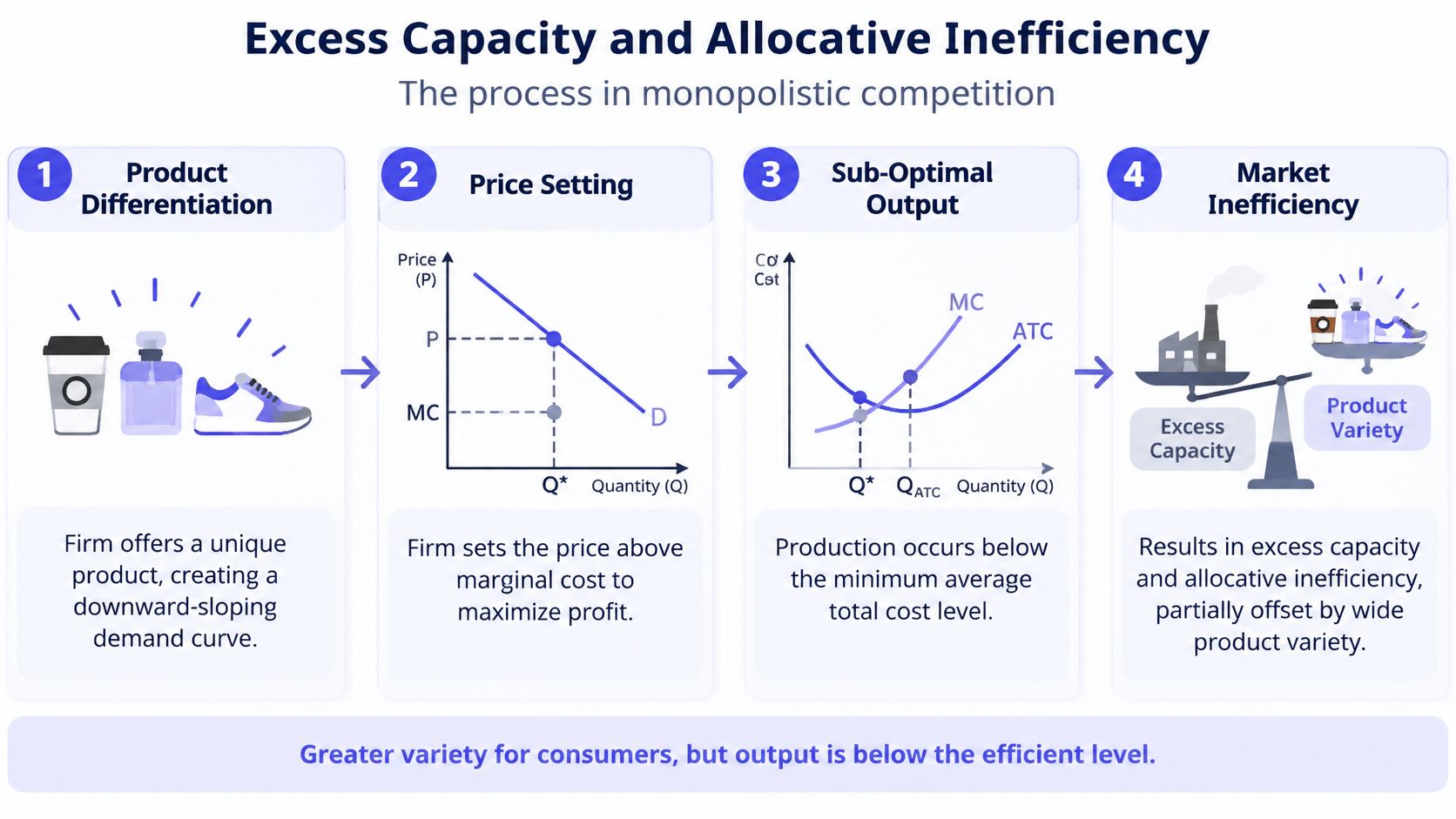
Digital delivery softens the cost problem because scalable files don't need empty seats or shelf space. It doesn't remove the choice problem. Use demand data to avoid producing options nobody buys, and make sure your differentiation adds real value. Variety that helps students find a better match justifies a higher price. Duplication doesn't.
8 Characteristics of Monopolistic Competition at a Glance
From Theory to Exam Answers Putting the Eight Features Together
Don't memorise these eight features as a disconnected list. They form one causal chain, and examiners reward answers that show the links. Start with structure, move to behaviour, and finish with performance. That order turns recall into analysis.
Many sellers plus product differentiation give each firm a downward-sloping demand curve and limited price power. Because no firm dominates, decisions stay largely independent, and because products differ, firms compete through advertising, quality, service, and branding as well as price. Short-run economic profit is possible at that stage, and a well-differentiated café or study guide can earn it.
The chain from profit to long-run equilibrium
- Profit attracts entry: Low barriers let new cafés and new note sellers join profitable niches.
- Entry shifts demand left: Each incumbent keeps fewer customers at every price.
- Profit erodes to zero: Entry stops when price equals average total cost and only normal profit remains.
- Inefficiency remains: Output stays below minimum average total cost and price stays above marginal cost, while consumers keep the variety they value.
Here's an exam-ready summary you can memorise. Monopolistic competition has many small firms selling differentiated products with free entry and exit. Each firm faces downward-sloping demand, has limited price control, competes on non-price factors, and acts independently. In the long run it earns zero economic profit, produces with excess capacity, and charges price above marginal cost.
If a question gives you many firms, ask one follow-up. Identical products mean perfect competition. Differentiated products mean monopolistic competition.
Apply that filter and most market structure questions narrow quickly. Then check entry conditions to predict long-run profit, and check price against marginal cost and average total cost to judge efficiency. Practice drawing the long-run diagram until you can show marginal revenue equals marginal cost, demand tangent to average total cost, and the excess capacity gap without hesitation.
When you revise this topic, match your materials to your exact syllabus rather than reading generic summaries. On CramShare you can find course-specific microeconomics notes matched to your course code and academic year, with substantial free library access and multi-page previews of premium documents so you can judge quality before buying. If you've written strong notes yourself, you can publish them there while keeping ownership of your materials, with no exclusivity requirement, no lock-in, and freedom to publish the same material elsewhere at any price.
Turn this topic into marks by revising with notes built for your exact module, not a generic economics summary. Visit CramShare to search microeconomics resources by university, course code, textbook, and academic year, preview premium documents across multiple pages before you pay, and publish your own original notes when you're ready to help the next cohort.