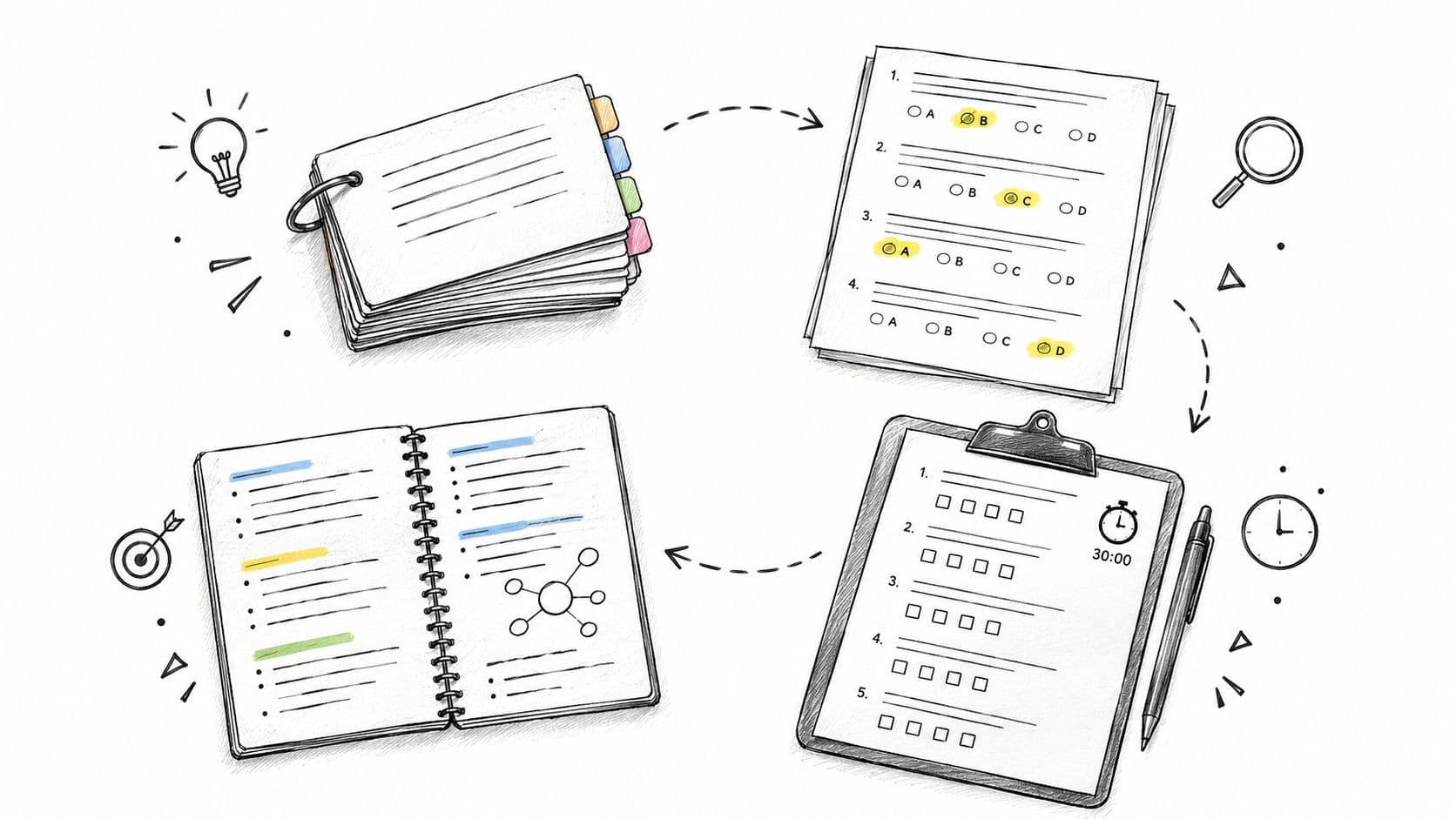
Chapter 6 Summary: How to Write a Smart Study Guide
Learn to write an effective chapter 6 summary that boosts recall and exam performance. Includes retrieval strategies, structure tips, and ethical use guidance.


You're in the library, your exam is approaching, and the phrase “Chapter 6 summary” is staring back at you from a search page. You find several versions, skim one, and feel familiar with the material. Then you close the document and discover that you can't explain the main argument, remember the evidence, or predict what your instructor might ask.
A useful summary should do more than make Chapter 6 shorter. It should help you understand the chapter, retrieve its ideas without help, and check that your study material matches your course. The routine below turns a passive outline into a practical self-testing engine you can use tonight.
Why Most Chapter 6 Summaries Fail Students
The common mistake is copying the chapter into smaller paragraphs. A student highlights definitions, shortens examples, and keeps the headings. The result may look neat, but it still asks you to reread rather than remember.
Rereading creates a feeling of recognition. You see a term and think, “I know that.” An exam asks a different question: “Can you define it without looking, explain how it works, compare it with another idea, and use evidence to support your answer?” A compressed copy often leaves those abilities untested.

Summary for orientation versus summary for performance
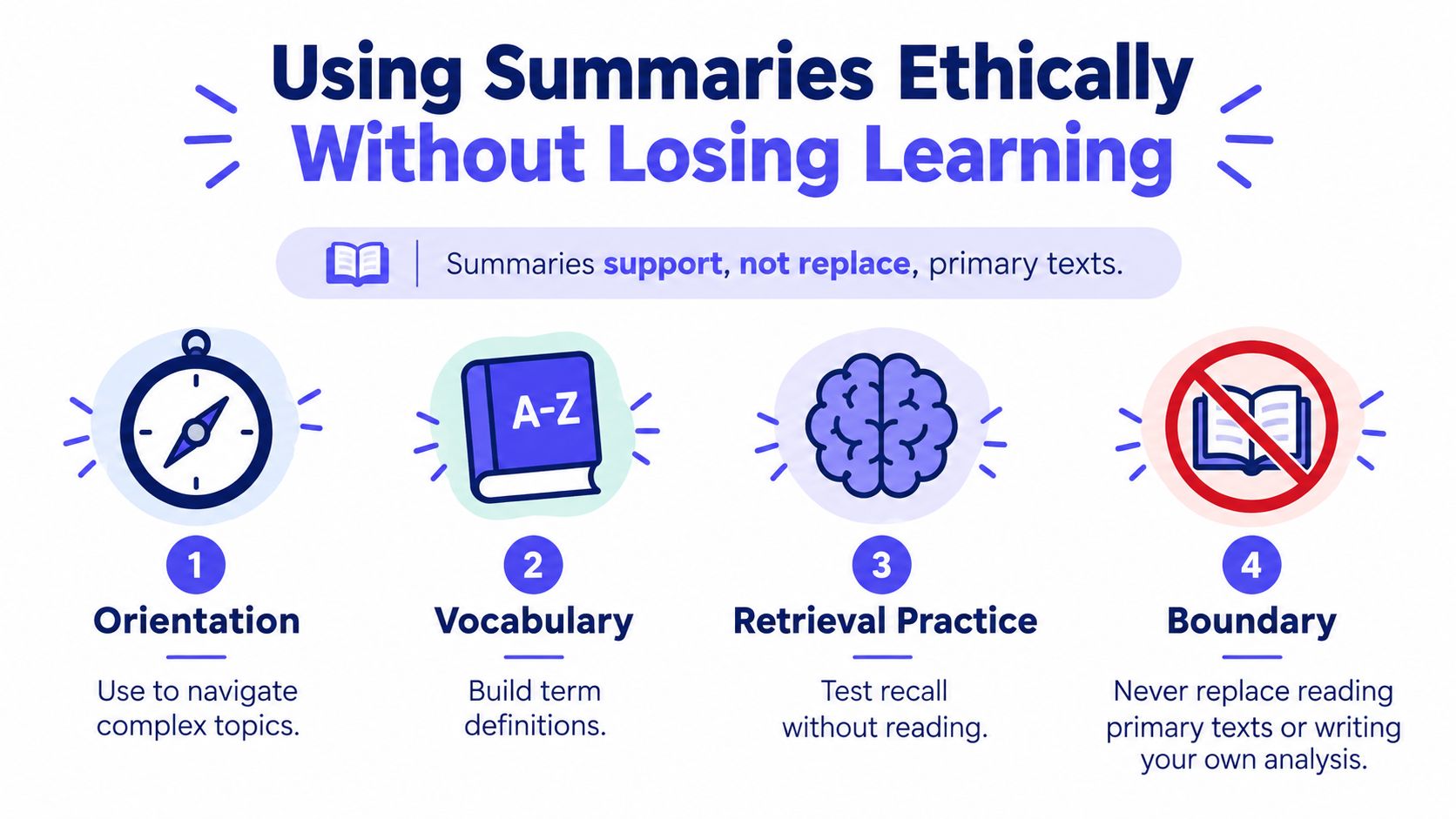
An orientation summary answers, “What is this chapter about?” It can help you identify the topic, vocabulary, characters, theories, or process stages. That's useful at the beginning of revision, especially when you've missed a class or opened the textbook after a long gap.
A performance summary answers harder questions:
- What is the central claim?
- Which concepts cause or explain the outcome?
- What evidence supports the claim?
- What assumptions, exceptions, or limitations matter?
- What could appear in an essay, short-answer question, or problem?
The second type is a study tool, not a miniature chapter. It gives you something to do with the information.
Practical rule: If you can only use a summary with the page open, it's a reading aid. If you can use it to test yourself with the page closed, it's revision material.
Retrieval practice is the missing ingredient. A systematic review of classroom experiments involving 5,374 learners found that 57% of reported effect sizes showed medium or large benefits from retrieval practice, with benefits observed across educational levels, subjects, test formats, delays, and feedback conditions. See the systematic review of retrieval practice research (opens in a new tab) for the evidence and conditions.
For more guidance on turning notes into active revision, compare this method with effective student study notes. The key shift is simple: stop asking whether your Chapter 6 summary looks complete, and start asking whether it makes you retrieve what matters.
What Makes a Strong Chapter 6 Summary
A strong Chapter 6 summary preserves explanatory structure, not just key phrases. Start with the chapter's central proposition, then show how the important concepts connect. If the chapter argues that one factor influences another, write the chain clearly rather than listing both factors in isolation.
A practical structure might look like this:
- Central thesis: What is the chapter trying to establish?
- Core concepts: Which terms or variables must the reader understand?
- Causal or logical links: How does one idea lead to, challenge, or qualify another?
- Evidence: Which examples, studies, passages, calculations, or events support the argument?
- Limitations: Where does the explanation stop applying?
- Application: How would you use the idea in a new situation?
This arrangement works across subjects. In a technical course, retain equations, units, boundary conditions, process stages, and decision rules. In literature or history, preserve claims, evidence, chronology, contrasting interpretations, and source limitations.
Build a coverage map
Take every major heading or learning objective from Chapter 6 and give it three companions:
- An explanation: What does this idea mean in plain language?
- An example or counterexample: What would it look like in practice, and what would not count?
- A recall question: What could you answer with the summary closed?
For instance, a definition of “opportunity cost” is incomplete if it lacks an explanation of why choosing one option means giving up another, an example involving study time, and a question asking you to identify the forgone alternative in a new scenario.
Research on summary generation found that training students to create summaries as an addition to studying improved free recall, objective-test performance, and especially essay-test performance. The research on summary generation and learning supports a useful habit: after compressing a passage, explain it again in your own wording.
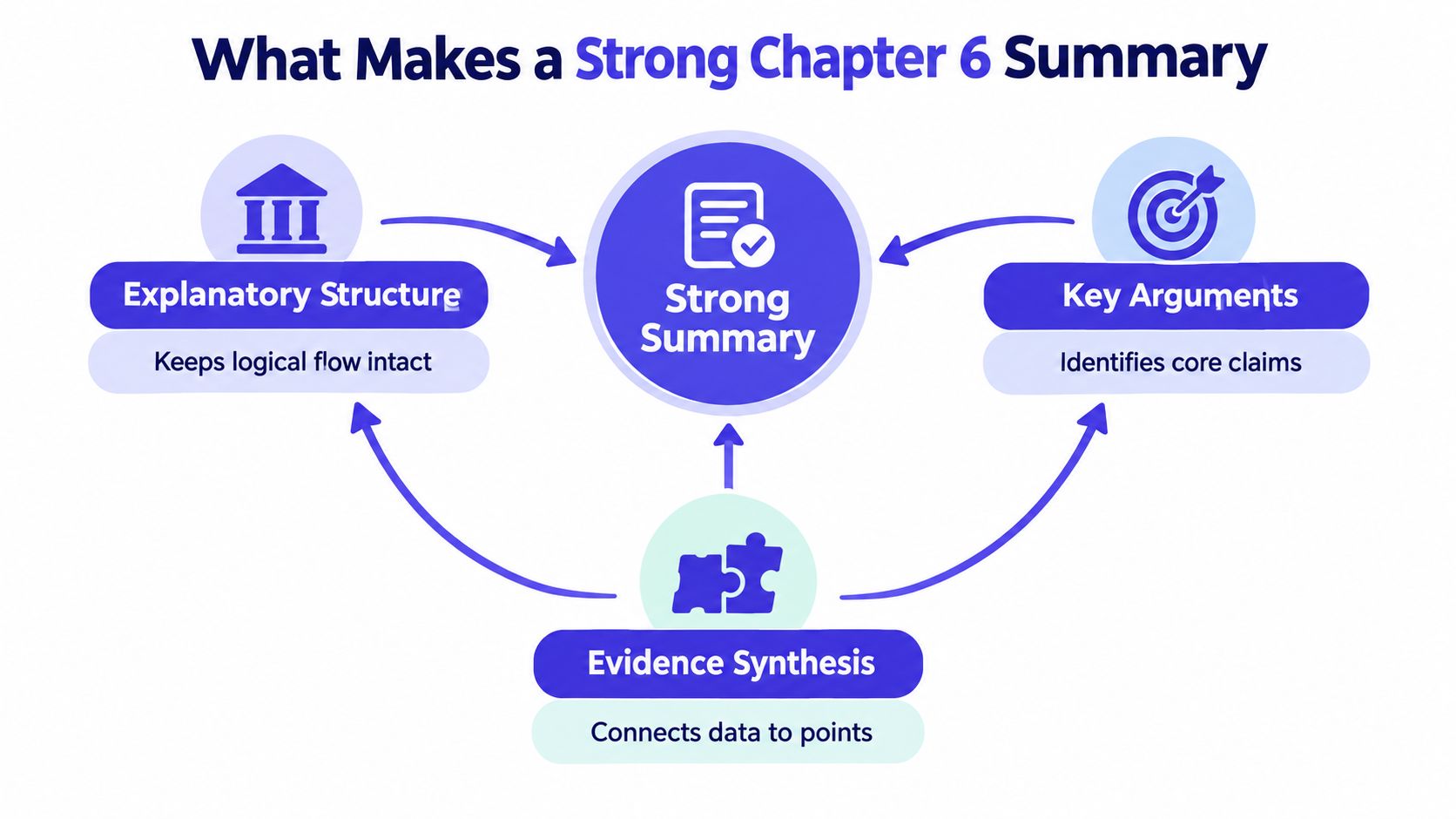
A polished document can still fail if it omits a mechanism, qualification, or examinable example. Coverage mapping exposes those gaps before exam day. If a heading has only a copied definition, it isn't finished.
Watch the video on YouTube (opens in a new tab)
How to Turn a Summary Into Retrieval Practice
Begin with a closed-book pass. Read one part of your Chapter 6 summary, cover it, and write what you remember. Don't worry if the first attempt feels incomplete. The omissions show you what needs another retrieval attempt.
Then convert each major concept into a question. Use different question types so you're not rehearsing one shallow pattern:
- Mechanism: What mechanism explains why this outcome occurs?
- Comparison: How does Concept A differ from Concept B?
- Evidence: What evidence supports the chapter's central claim?
- Application: How would this principle work in a new example?
- Qualification: What assumption or exception limits the explanation?
- Sequence: What happens first, next, and last in the process?
Place a concise answer key beneath each prompt, but hide it while answering. Your first response should come from memory, not from visual cues. Afterward, check the key and mark omissions, inaccurate links, and vague wording.
Include what exam answers need
A useful Chapter 6 summary should contain more than terminology. Add:
- Definitions: State each important term in plain language.
- Relationships: Explain how concepts influence or depend on one another.
- Assumptions: Identify what must be true for the explanation to work.
- Examples: Use one concrete case to make an abstract idea visible.
- Exceptions: Record situations where the usual rule changes.
- Likely prompts: Turn learning objectives and instructor emphasis into questions.
Suppose your chapter presents a process with three stages. Don't write only the stage names. Ask, “What triggers Stage 1?”, “What changes during Stage 2?”, and “What evidence would show that Stage 3 has occurred?” Your answers should be short enough to review but precise enough to reveal a missing step.
Retrieval can feel harder than rereading, and that discomfort can mislead students into thinking it's less effective. Treat the effort as part of the method, not as a sign that you're studying badly. After checking your answer, correct the error in your own words and try the prompt again later.
A simple schedule is better than one long rereading session. Test yourself after creating the questions, revisit the difficult prompts over the following days or weeks, and keep changing the order. These exam study techniques can help you combine retrieval with other revision habits without turning your summary into a script to memorize word for word.
Course-Specific Versus Generic Chapter Summaries
“Chapter 6” doesn't identify a text by itself. Search results can combine To Kill a Mockingbird, Frankenstein, Paperboy, Rebecca, and A Room of One's Own, even though their subjects, chapter structures, and assessment needs have nothing in common. A generic result may be accurate for another book and still waste your revision time.
Verify the match before studying the content. Check:
Edition checks matter because chapter divisions and page numbers can change. In a novel, the opening event or key characters can confirm that you've found the right chapter. In a science or business textbook, compare terminology, figures, formulas, and learning objectives with your assigned edition.
Course-specific resources are more useful when they carry enough metadata to establish relevance. A summary connected to a university, module, textbook, and academic year gives you more information than a page titled only “Chapter 6 Summary.” That context also helps you decide whether the examples and questions match your instructor's expectations.
A longer summary isn't automatically a better summary. The first priority is reducing the chance that you're studying the wrong Chapter 6.
Use generic summaries for orientation when necessary, but confirm important claims against the primary text, lecture materials, and course instructions. Before investing time in retrieval questions, make sure the source is yours.
Using Summaries Ethically Without Losing Learning
It is 10 p.m., the library is closing, and a Chapter 6 summary looks like a shortcut. Used well, it can still help. The summary should function like a quiz card, not a substitute chapter. It can point you to terms, structure, and likely trouble spots, then push you back into recall.
That distinction matters in assessed work. A shared summary may help you remember what appeared in the chapter. Your assignment still depends on your own explanation, the assigned source, and the citations your course requires. If you borrow wording, examples, or interpretation from someone else's summary, you cross from studying into misuse.
Academic-integrity guidance regularly warns about plagiarism and inappropriate sharing as common questionable practices. That is why summaries work best as study scaffolds for independent learning, not as evidence or ready-made prose. Review the academic-integrity guidance on responsible study practices (opens in a new tab) and this explanation of why academic integrity matters before you use shared material in coursework.
A safe workflow
- Scan for structure: Use the summary to spot the chapter's key ideas, terms, and questions.
- Trace each claim back: Find the page, passage, slide, figure, or problem set item behind anything you may use.
- Hide the summary: Rebuild the idea from memory in your own words.
- Support with course evidence: Cite the primary text or assigned material in the required style.
- Draft independently: Keep the summary as a prompt for retrieval, not a sentence bank.
Do: turn headings into self-test questions, compare the summary against the assigned source, and add your own examples.
Don't: paste borrowed sentences into your work, treat a shared summary as proof, cite the summary itself when your instructor expects the original source, or upload material you do not have permission to distribute.
Closing the summary before paraphrasing protects your independence and strengthens learning. It works like covering the answer key before solving the problem. If you can explain the point without looking, you are studying. If you can only rearrange the summary's wording, stop and return to the chapter.
Quick Checklist for Building Your Chapter 6 Summary
Use this routine whenever you prepare a new chapter:
- Confirm the match: Check the title, author, edition, chapter marker, course, and assigned page range.
- Map the scope: List every major heading or learning objective.
- State the thesis: Write the chapter's central claim in your own words.
- Explain the links: Show the causal chain, comparison, sequence, or reasoning.
- Add evidence: Include the examples, passages, data, calculations, or events that support each major point.
- Record limits: Note assumptions, exceptions, competing interpretations, and source limitations.
- Create prompts: Write closed-book questions about mechanisms, differences, evidence, applications, and likely exam tasks.
- Add answer keys: Place concise answers beneath the questions, hidden during testing.
- Check coverage: Make sure every major heading has an explanation, example, and recall question.
- Schedule retrieval: Revisit difficult prompts across several study sessions instead of reading the summary once.
Your final document should help you answer, not merely recognize. If a page looks complete but leaves you unable to explain the chapter without looking, revise the questions before revising the formatting.
CramShare lets students find and share course-specific study materials, including summaries and revision guides matched by institution, course, module, textbook, and academic year. Use CramShare to compare relevant resources, then turn the material you trust into your own closed-book questions and original explanations.