7 Best Study Websites for Students in 2026
Compare the best study websites for students in 2026, including notes, textbooks, courses, flashcards, practice questions, and past-paper resources.

The right study website depends on the task, not the platform's popularity. A student searching for lecture notes that match a specific module needs something different from someone repairing a calculus gap, learning from a textbook, following a complete course, or memorising terminology before an exam. The best study websites for students should therefore be judged by syllabus relevance, quality control, depth, access model, usability, and academic-integrity implications.
That distinction matters because online study resources have evolved from static collections of links into platforms combining textbooks, videos, worked examples, datasets, quizzes, and practice activities, as the University of California, Berkeley statistics resource guide (opens in a new tab) illustrates. Students also use digital resources actively rather than passively browsing them. An international survey found that 84.4% downloaded material from file-sharing or homework-help websites, while 49.3% used those sites in multiple ways, including downloading, uploading, and paid access (Taylor & Francis study (opens in a new tab)). This roundup evaluates seven tools by the study job they perform best, with CramShare standing out when exact course or module matching is the priority.
1. CramShare
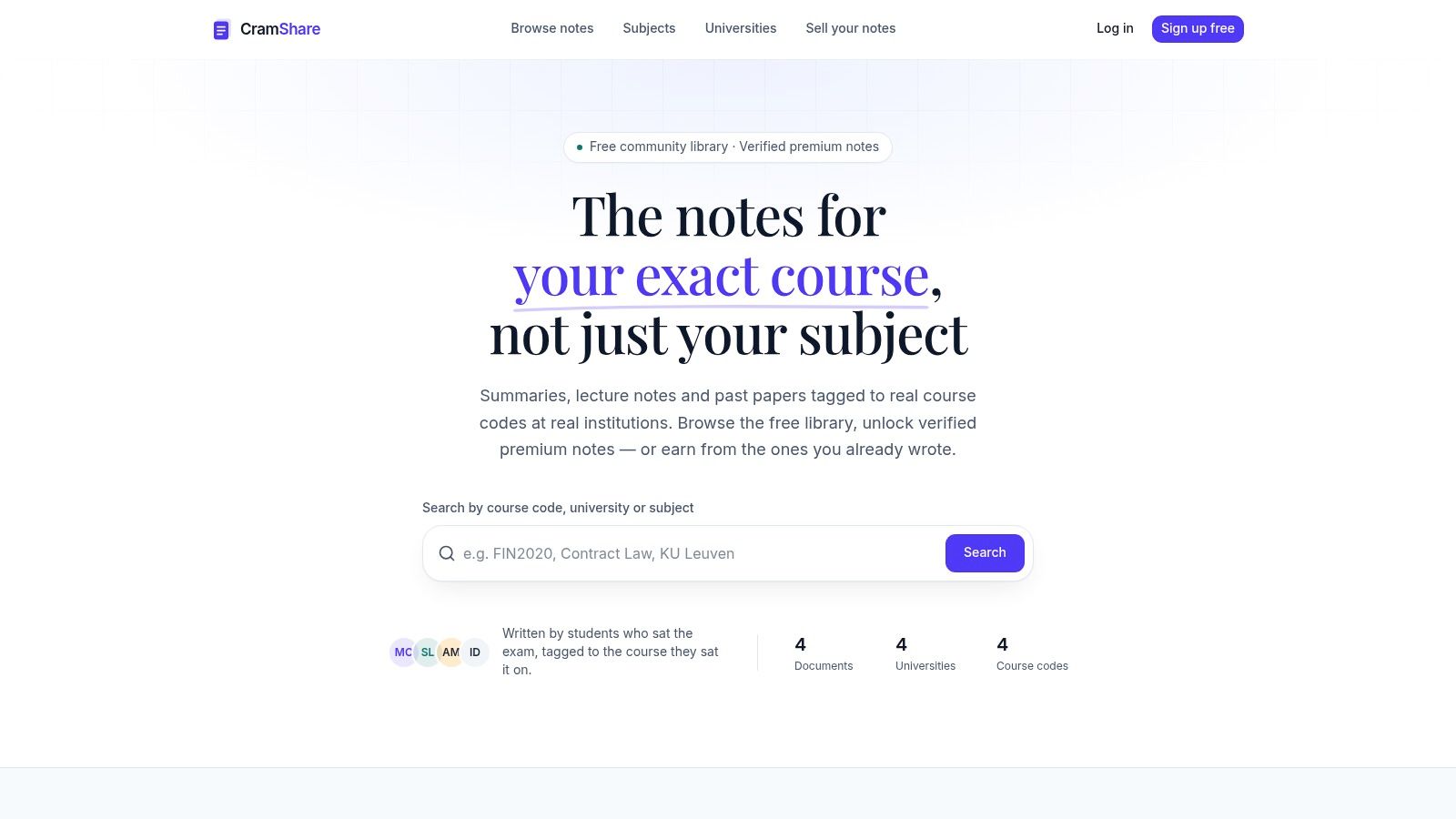
CramShare is strongest at a job broader platforms often handle poorly: finding study materials for the exact course you're taking. Students can search by course code, university, module, textbook, subject, and academic year, then find lecture notes, summaries, revision guides, past papers, and practice resources tied to that context. That course-level organisation makes it useful when a search for “biology notes” returns plenty of material but little that matches your lecturer's sequence or assessment.
A large part of the community library is free to browse and open immediately, without daily access caps or watermarks. Premium documents are checked for completeness and legibility, and multi-page previews let you inspect the material before opening it. Eligible purchases include a refund policy when a document does not match its advertised course information or preview. Students should still compare any shared resource with their syllabus, because user-created notes can differ in accuracy, emphasis, and depth.
Best use case and limitations
CramShare is most useful when the problem is retrieval rather than explanation. If an exam is approaching and you need a course summary, past paper, or textbook-linked revision document, precise indexing can reduce the time spent sorting through generic results. The platform also lets student authors publish original materials, retain ownership, choose whether documents are free or paid, and receive 70% of eligible sales, with monthly payouts and no minimum threshold. Students who want to publish their own legitimate notes can learn more through selling study notes online.
Practical rule: Use a course-specific document to orient your revision, then verify its terminology, learning outcomes, and answers against official course materials.
The marketplace model means coverage varies by institution and module. A heavily represented course may offer several useful resources, while a newer or less common module may have limited material until students contribute. CramShare presents itself as a complement to classes and independent work, not a replacement for attendance, original assignments, or institutional academic-integrity rules. Visit CramShare's course-focused study library to search by the identifiers that matter to your course.
2. Khan Academy
Khan Academy performs a different job from CramShare. It's a knowledge-gap repair tool, especially when a current university topic depends on skills you haven't fully mastered. A student struggling with introductory statistics may need probability fundamentals first. Someone stuck in chemistry may need to revisit algebra, graphs, or unit conversion before the assigned chapter becomes manageable.
The nonprofit platform provides free instructional videos, practice exercises, progress tracking, and mastery-oriented learning across mathematics, science, computing, humanities, and test preparation. Its practice engine is more valuable than a video library alone because it gives students a way to test whether a concept has become usable. Khan Academy also offers official SAT preparation content, teacher and coach dashboards, mobile access, and offline options through supported experiences. Explore the Khan Academy learning platform (opens in a new tab) for the subjects and prerequisite skills it covers.
Alignment and access
Khan Academy's core individual experience is free and doesn't rely on a paid subscription for basic lessons and practice. That makes it a strong choice when a student needs to rebuild foundations without adding another textbook or course fee. Optional AI tools, including Khanmigo, have availability that can depend on schools, districts, or family access arrangements.
Its main limitation is alignment. The platform generally teaches by subject and skill rather than by your university's course code, lecturer, textbook edition, or weekly assignment sequence. You'll need to map its lessons to your syllabus and stop once you've repaired the relevant gap. It also isn't designed to replace advanced, upper-division course materials in every subject.
For a more efficient workflow, identify the precise concept causing difficulty, use Khan Academy for the prerequisite lesson and practice, then return to your institution's lecture or textbook. Students looking for broader free online study guides can use that same principle: choose the resource based on the gap, not on the size of its subject catalogue.
3. MIT OpenCourseWare
MIT OpenCourseWare is best treated as a deep reference library for university-level study. It gives independent learners access to materials from MIT courses, including syllabi, lecture notes, readings, assignments, problem sets, exams, and, for many courses, video lectures. Those materials can help a student move beyond a simplified explanation and see how a demanding institution structures a subject from foundations through more advanced applications.
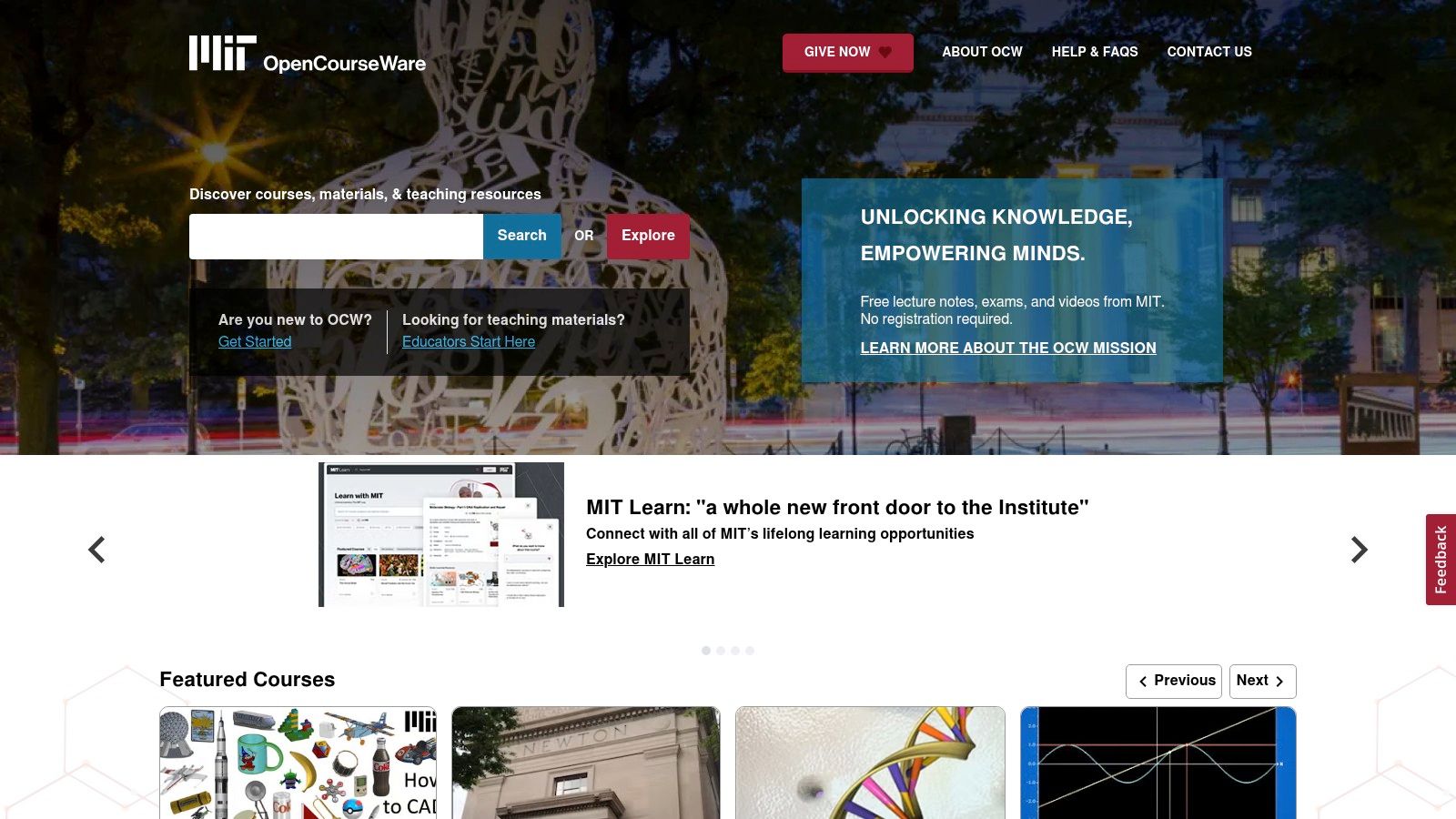
The MIT OpenCourseWare collection (opens in a new tab) is free to use and doesn't require an account for ordinary access. Downloadable materials make it practical for offline reference, while open licensing supports lawful reuse for learning. A student in computer science, engineering, economics, mathematics, or another technical field can use an OCW course to compare approaches, find additional problem sets, or explore a topic beyond the assigned reading.
What it does not provide
OCW is not a course enrolment system. Students don't receive academic credit, a certificate, regular instructor feedback, or automatic grading by using the materials. Interactivity also varies substantially between course sites. Some include rich video and assessment resources, while others function more like a carefully organised syllabus and document archive.
That access model creates a useful but demanding study experience. OCW gives you high-quality material, yet you must choose the course, sequence the work, check solutions, and decide how it relates to your own curriculum. It also isn't indexed by your institution's course codes, so it won't necessarily match your lecturer's terminology or assessment priorities.
Use MIT OpenCourseWare when you need depth, comparison, or a serious independent reference, not when you need a quick answer for tomorrow's seminar. Pair it with your official course outline and treat its problem sets as extension practice rather than assumed replacements for assigned work.
4. OpenStax
OpenStax is the strongest choice when the study job is building a reliable textbook foundation without paying for a conventional textbook. Its nonprofit publishing model provides free, openly licensed college textbooks in subjects including biology, chemistry, physics, economics, statistics, and calculus. The materials are built for sustained reading, so they're better suited to learning a sequence of concepts than to locating a short summary before an exam.
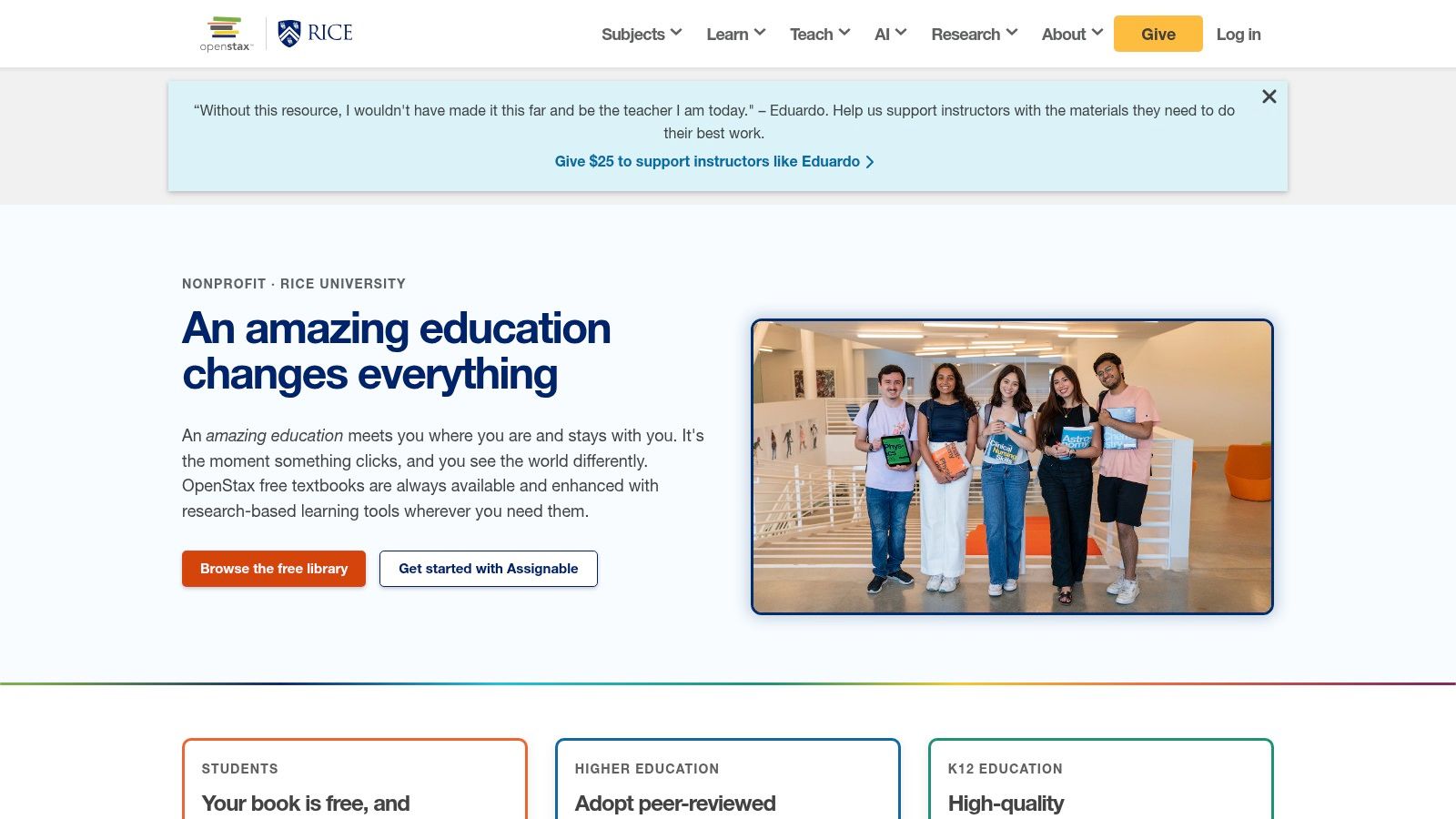
Students can read OpenStax books online or use PDF versions, while low-cost print options are available for those who prefer paper. The OpenStax textbook library (opens in a new tab) also provides openly licensed materials that can be linked in learning-management systems and reused in legitimate educational contexts. Peer review, accessibility features, and instructor resources support classroom use, although the exact supporting materials differ by title.
Foundation before acceleration
OpenStax works particularly well for introductory and early-undergraduate courses. A student who has lecture slides but lacks a coherent explanation can read the relevant chapter, work through examples, and then return to class exercises with a more stable conceptual framework. It's also useful for checking whether a set of notes has omitted definitions or foundational steps.
The trade-off is breadth at advanced levels. OpenStax has fewer upper-division titles than it does introductory texts, and problem sets or ancillary resources vary between books. It may also follow a different sequence from your lecturer's textbook. That doesn't make it unsuitable, but it means you should match chapter headings and learning outcomes rather than assume page-for-page equivalence.
A free textbook is most valuable when it gives your revision a dependable sequence, not when it simply adds another tab to your browser.
Use OpenStax as the central reading layer, then add course-specific notes for local emphasis and an active-practice tool for recall. That combination separates understanding the subject from remembering what your class is likely to assess.
5. edX
edX is designed for students who need a structured learning path, rather than a collection of disconnected explanations. Its university-backed courses generally use a syllabus, ordered modules, readings or lectures, activities, and assessments. That structure can help independent learners maintain momentum when a broad subject search leaves them unsure what to study next.
The edX course catalogue (opens in a new tab) covers academic subjects and professional skills from institutions around the world. Many courses offer a free audit route that provides access to lectures, readings, and some practice materials. Paid verified tracks can add graded assessments, certificates, or credentials, with availability and pricing determined by the individual course. Professional Certificates and microcredentials provide a more career-oriented path than a single revision session.
Course structure versus course matching
edX's main strength is its teaching sequence. A student can select a course in programming, data analysis, economics, or another field and follow a coherent progression instead of assembling lessons manually. This makes it useful for self-study, preparation before a new subject, and learning outside a student's current degree.
Its limitation is that a structured course is not necessarily your course. edX does not normally map lessons to your campus course code, lecturer, assessment calendar, or required textbook. A course may also use different terminology or assume a different level of prior knowledge. The free audit model can restrict graded work or credential features, so students should check the access terms before designing an entire study plan around one course.
Choose edX when you need direction and continuity. If you need a specific past paper, lecture summary, or module-aligned note, a course marketplace or institutional portal is likely more direct. If you need to learn the subject from the beginning in a deliberate sequence, edX has the better fit.
6. Quizlet
Quizlet handles one study job particularly well: recall and memorisation. It suits terminology, formulas, definitions, vocabulary, processes, and other information that must become quickly retrievable. Students can create or import flashcards, then practise through Learn, Test, and Match modes on the web or mobile apps.
The Quizlet study platform (opens in a new tab) also offers a large public library of user-created sets. AI-assisted features such as Magic Notes and the Q-Chat tutor can convert notes or readings into study material and generate interactive prompts. Access is divided between free and paid features, so some advanced functions and AI tools require a subscription.
Use it after understanding
Quizlet works best after you understand the underlying idea. A card can prompt a definition or formula, yet it cannot by itself show whether you can apply that formula to an unfamiliar problem. Public sets also differ in accuracy, completeness, and fit with a lecturer's expectations. Compare imported material with your notes, textbook, and official terminology before using it for exam preparation.
Interactive practice has support from student-perspective evidence. One Florida textbook survey found that 65.9% of students preferred interactive practice questions as a top study aid (ERIC paper (opens in a new tab)). Quizlet's testing and retrieval modes address that preference, while explanation and application still need to come from course materials or other learning resources.
Recall is a test of access, not proof that you understand the whole topic.
Build small sets around one lecture, chapter, or learning outcome. Review missed cards with spaced-repetition tools, then return to Khan Academy, OpenStax, MIT OpenCourseWare, or your course materials for explanations and worked applications. Quizlet is a revision layer, not a replacement for a textbook, lecture, or structured course.
7. Studocu
Studocu is another strong option for course-level discovery, particularly when you want to see how other students have organised notes for a university, course, or instructor. Its repository includes student-shared notes, summaries, assignments, and practice resources, with materials arranged around institutions and courses. That structure can make it easier to locate documents that resemble your syllabus than a general subject search would.
The Studocu resource library (opens in a new tab) combines free and premium documents in an interactive viewer. Studocu AI can summarise uploaded notes and generate practice questions, while an upload flow may provide temporary Premium access. Those features make it useful for compressing a long document into a starting revision set, especially when you already have legitimate course notes but need a quicker way to identify themes and test yourself.
Fit, quality, and responsible use
The platform's value depends heavily on the quality and relevance of individual uploads. A document may be associated with the correct university but still reflect a different lecturer, academic year, assignment brief, or level of detail. Preview the material where possible, compare it with your syllabus, and verify important claims before using it as a study authority. Premium access also means students should understand what is available before committing to it.
Independent higher-education usage evidence supports the importance of course-linked resources. One study reported that 94.2% of respondents used a college or university library website, while 90.3% used a learning-management system; 79.6% used the LMS weekly or more (Leung study (opens in a new tab)). That pattern suggests students return to resources that connect directly to recurring coursework, rather than relying only on broad educational brands.
Studocu is best when you need to locate a course-shaped starting point. It shouldn't replace attending class, completing your own assignments, or checking whether shared documents may be distributed under copyright or institutional rules.
Top 7 Study Websites Comparison
Build a Study Stack, Not a Single-Website Habit
No single platform covers every study job well. CramShare and Studocu are the practical choices for finding course-level notes, summaries, past papers, and other materials connected to a university or module. Use Khan Academy when a prerequisite gap is blocking progress. Choose MIT OpenCourseWare for deeper university-level reference, OpenStax for a coherent core textbook, edX for a structured course sequence, and Quizlet for active recall after you understand the material.
This division reflects a wider weakness in generic “best study websites” lists. Students often have access to lecture slides, reading lists, and electronic books, but availability doesn't guarantee usefulness for a particular course. A UK survey reported that lecture slides were available to 92% of students, online reading lists to 84%, and eBooks or e-journals to 81%, while the continuing problem was whether those resources matched actual course needs (Higher Education Policy Institute report (opens in a new tab)). The right tool is therefore the one that closes the specific gap between what you have and what you need.
Use a short selection process before spending time or money:
- Start with the study job: Decide whether you need discovery, explanation, textbook reading, structured instruction, application, or recall.
- Match the syllabus: Compare the resource's course, module, topic, textbook, academic year, and learning outcomes with your own requirements.
- Check quality and date: Look for authorship, completeness, clear formatting, updated terminology, and consistency with official materials.
- Preview before relying on it: Sample chapters, document pages, lessons, or practice sets where the platform allows it.
- Test understanding actively: Close the notes and solve a problem, explain the concept, answer practice questions, or retrieve key terms from memory.
- Protect academic integrity: Use shared resources for learning and revision, not as substitutes for independent assignments, and follow your institution's copyright and assessment rules.
The most efficient combination is usually layered. Begin with a course-matched resource to identify what matters locally, use a textbook or lesson platform to repair explanations, and finish with practice that forces you to retrieve or apply the knowledge. That approach is more reliable than repeatedly switching between popular websites hoping one will solve every problem.
CramShare helps students find, preview, and share course-specific notes, summaries, past papers, and revision materials by university, course code, module, textbook, and academic year. Visit CramShare to search for resources that fit your actual course and evaluate the material before you use or purchase it.