Sell Study Notes Online and Earn from Your Revision
Learn how to sell study notes online the right way — from preparing and pricing to listing, marketing, copyright checks and quality tips that help you earn.


You've just finished a module, your folders are tidy, and the notes look better than anything you used in week one. The obvious question is whether all that work can earn something back, or whether it's just another pile of PDFs sitting on your laptop. I've listed notes before, and the difference between a file that gets ignored and a file that gets bought usually isn't luck. It's whether the notes are clearly original, matched to the exact course, and easy to trust from the preview.
That's why selling study notes online works best when you stop thinking like someone dumping files and start thinking like someone packaging a useful academic resource. Buyers aren't browsing for “biology” in the abstract. They're looking for the exact course code, the exact module, and the exact kind of revision help they need before an exam. The market data backs that up, since demand is concentrated in digital, higher-education use cases rather than broad generic content, with the global study-notes marketplace estimated at $2.8 billion in 2025 and projected to reach $5.2 billion by 2034 in one industry report, while digital study-notes platforms accounted for $1.19 billion in 2025 and 42.5% of the total market market report (opens in a new tab).
The best sellers I've seen usually share the same habit. They make the note pack look like it was built for one course, one cohort, and one assessment style. That's a different game from uploading loose lecture scribbles and hoping a subject tag does the rest.
Introduction to Selling Your Study Notes Online
The first time I listed notes, I thought the subject mattered most. It didn't. What sold was the pack that looked like it had been made for a specific lecturer's rhythm, a specific assessment format, and a specific set of mid-semester topics. A broad “economics notes” label brought in little interest, while a course-coded revision guide got clicks because buyers could immediately tell it matched what they were taking.
That distinction matters because the market is already crowded with generic material. Public coverage still talks about “study guides” and “student notes” in broad strokes, but the core buyer question is narrower, something like, “Are these notes for my exact module, year, and assessment style?” The need for precision also shows up in the wider market estimate, which put the global study-notes marketplaces market at USD 4.2 billion in 2024 and projected it to reach about USD 12.3 billion by 2033 Cornell University's academic integrity resource. That kind of scale means there's demand, but it also means students have plenty of weak listings to ignore.
What actually tends to sell
The files that move fastest are usually the ones that feel finished. That means typed notes, cleaner structure, a summary page, and enough course detail that someone can verify relevance before buying. The strongest listings usually solve a very specific problem, like “I missed lectures,” “I need exam revision,” or “I want a shorter version of the module content.”
Practical rule: if your notes wouldn't help you revise next semester, they probably won't convince a stranger to buy them today.
A lot of students also underestimate how much trust comes from the first preview pages. If the preview looks messy, vague, or incomplete, buyers assume the rest is the same. If the preview is clean and course-specific, they're much more willing to pay for the full pack.
The mindset that pays off
Treat each upload like a small product, not a one-off file drop. The goal isn't to upload everything you own, it's to publish the version of your notes that another student could open and use immediately. That mindset also keeps you away from the sloppy stuff that gets rejected, flagged, or refunded later.
Consistency matters here too. One strong set of notes can be useful to future cohorts if the course hasn't changed much, which is why course-level matching is such a useful habit. Generic subject browsing is noisy. Exact course relevance is what gets the click.
How to Prepare Notes That Students Will Pay For
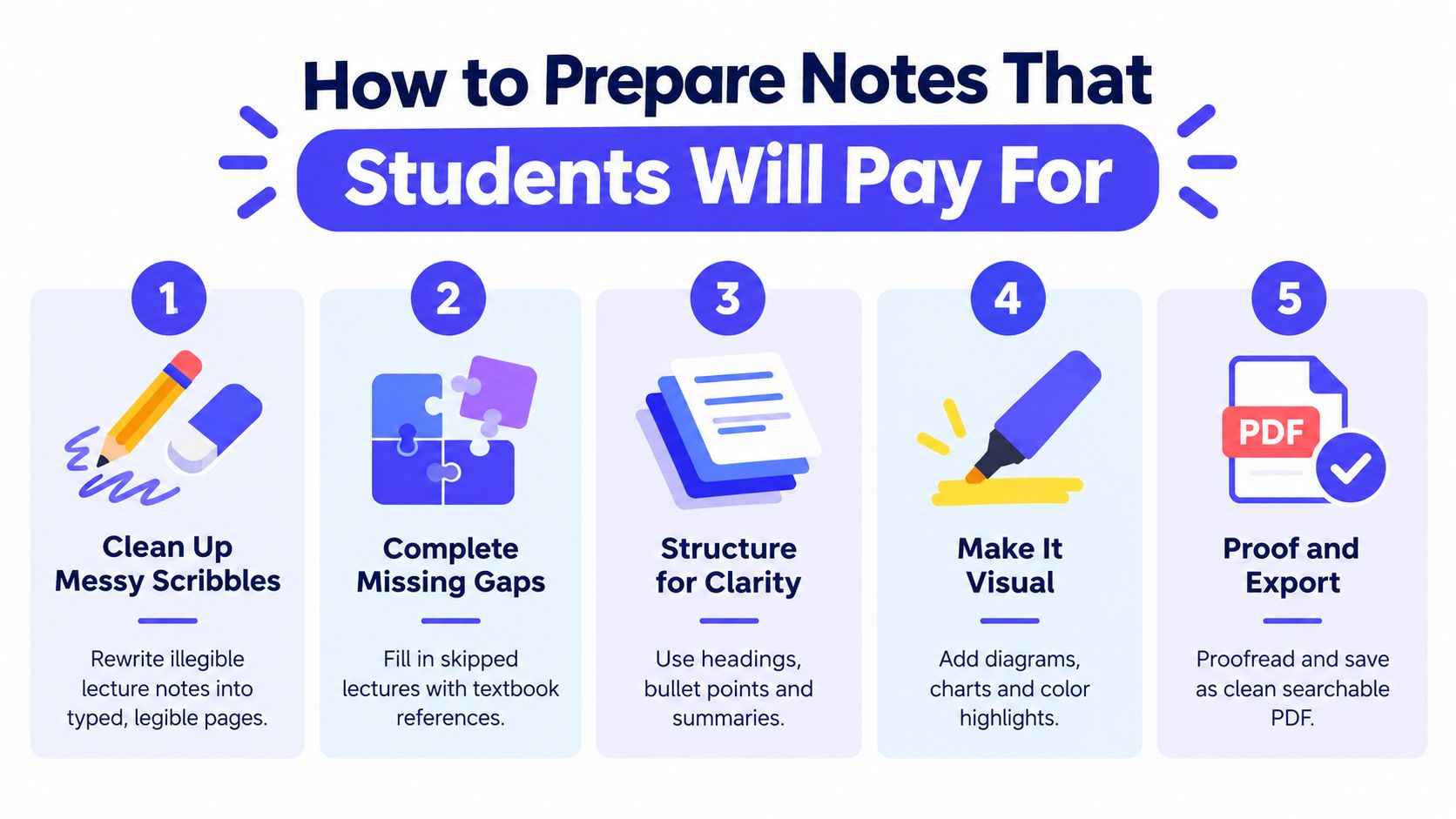
Preparation starts with the ugly version of your notes. Lecture scribbles, half-finished bullets, random arrows, and the page you only understood at 2 a.m. all need a clean second pass before anyone else sees them. If you upload raw notes, buyers can tell instantly, and most won't gamble on unfinished work.
Clean the content first
Rewrite illegible sections into typed text and remove the shorthand that made sense only in class. If a page relies on your memory to explain it, it isn't ready to sell yet. The point is to make the notes stand alone, so a stranger can read them without sitting beside you.
Fill gaps before you format anything. Skipped lectures, missing examples, and blank sections create the impression that the pack is incomplete, even if the rest is strong. I've had better reactions to a slightly shorter pack that was complete than to a longer one with obvious holes.
Make the structure obvious
Good structure does half the selling. Use headings, subheadings, bullets, and short summary sections so the buyer can scan quickly and find the topic they need. If you used a messy wall of text, break it up with topic headers and page breaks that follow the course flow.
A simple before-and-after example helps here. “Week 4 notes” is weak. “Week 4, Thermodynamics, lecture summary, key equations, exam-style examples” is much better because it tells the buyer what they're getting before they open the file.
The file format matters too. A clean, searchable PDF is easier to preview, easier to read on a phone, and easier to trust than a clumsy export with broken formatting. If diagrams are part of the notes, keep them clear and legible rather than crowded into tiny margins. Buyers usually won't pay for something that looks like it was rescued from a printer tray.
I'd also do a fast self-audit before uploading:
- Check legibility: Every page should be readable on a phone screen.
- Check completeness: No missing lecture blocks, blank sections, or unexplained jumps.
- Check scan quality: If you scanned handwriting, make sure contrast and alignment are clean.
- Check consistency: Fonts, headers, spacing, and page numbers should match.
- Check usefulness: The file should help someone revise, not just remind you what happened in class.
The linked guide on using PDF notes effectively is worth keeping nearby if you're deciding whether to keep notes as a document pack or split them into smaller study resources.
Keep the preview honest
Buyers judge the whole listing from the preview. If the first two pages are polished, structured, and clearly course-specific, they'll usually open the rest with more confidence. That's why the preview should show your real standard, not just the nicest title page.
Clean notes don't just look better. They reduce refunds, improve trust, and save you from the awkward conversation of explaining why the file looks unfinished.
Watch the video on YouTube (opens in a new tab)
What You Can Legally Sell and What to Avoid
A lot of sellers get this wrong because they assume “I found it in my folder” means “I can sell it.” It does not. If you created the material yourself, your position is much cleaner than if you copied, scanned, pasted, or repackaged someone else's work.
Before you list anything, review the platform's rules on copyright and permitted materials. That one check saves a lot of bad uploads.
What's usually safe to sell
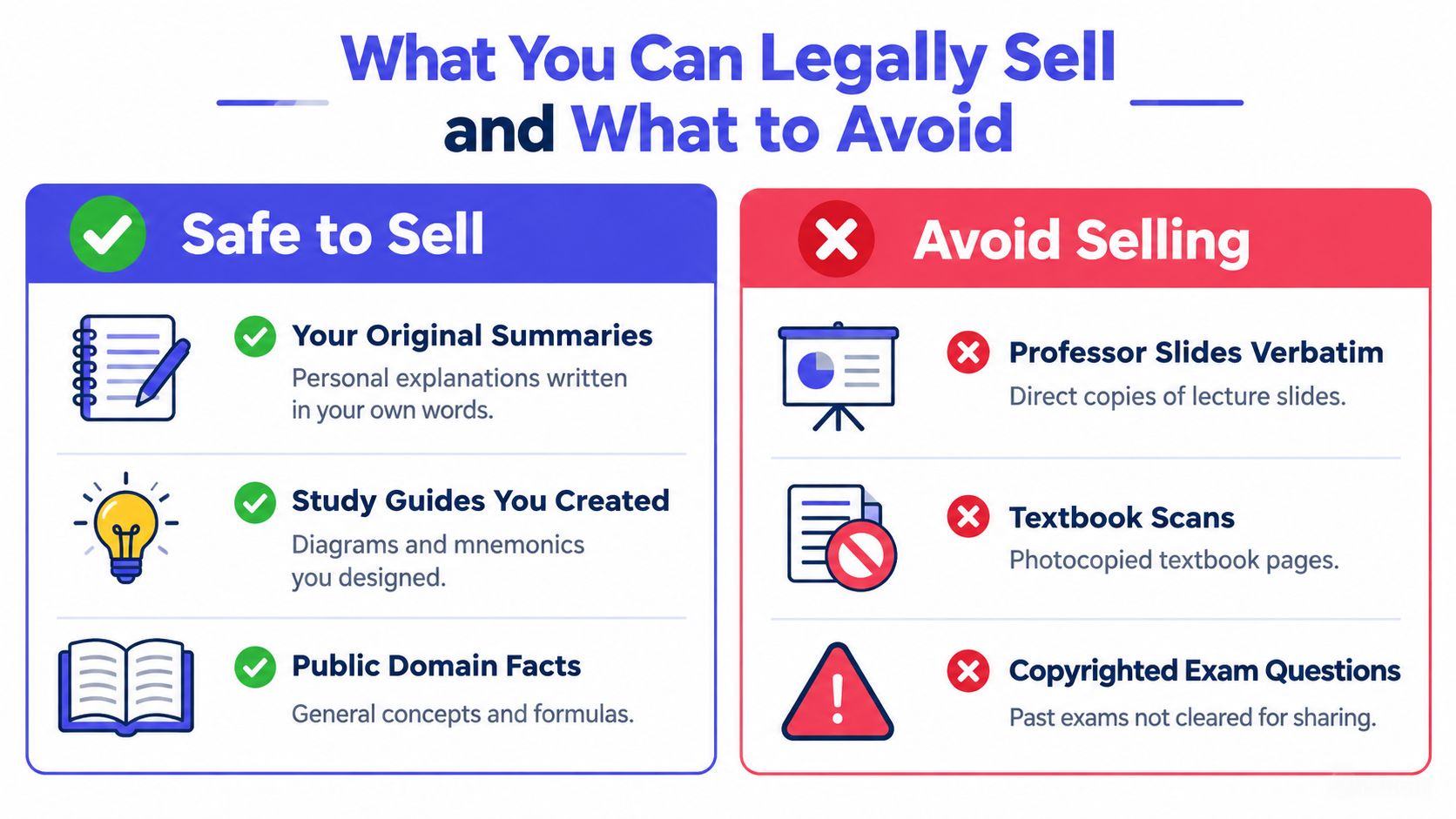
Original summaries, rewritten explanations, your own diagrams, and study aids you made from scratch are the safest place to start. If you turned a lecture into your own notes, then cleaned it up and re-expressed it in your own words, that is much closer to a legitimate student resource than a copy of the slides. Public-domain facts and general concepts are also fine, as long as you are not borrowing protected wording or copying a publisher's layout.
Course-specific originality is what helps a listing convert. A buyer can get generic AI summaries or broad revision material anywhere. A file that matches the exact course, uses the right terminology, and reads like real student notes has a better chance of being trusted and bought.
What I leave out every time
I do not upload professor slides verbatim, textbook scans, photocopied pages, or anything that looks like a direct reconstruction of an instructor's work. Past exam questions can also be risky when they are not cleared for sharing, and answer keys are the kind of thing that can create far more trouble than they are worth. If a page feels like it belongs to the university, the publisher, or the teacher, it probably does not belong in a listing.
That caution matters because institutions often separate personal notes from prohibited redistribution of course materials, answer keys, or instructor content. Cornell's academic integrity guidance on students buying and selling course materials makes that boundary clear.
Permission and platform review
If you are unsure about a section, leave it out. That is the easiest safe rule. A clean, original file sells better than a risky bundle that gets flagged, taken down, or refunded after review.
Platform checks also tend to favor material that looks clearly authored and course-relevant. That means clean file names, consistent formatting, and no signs that the pack was stitched together from other people's work. Originality is not just a legal shield. It is also a sales advantage, because a buyer can tell when the notes were made for study rather than copied for resale.
The pressure is sharper now because students are using more AI-based study help. HEPI's 2025 survey found 88% of students used generative AI for assessments, up from 53% the previous year HEPI survey (opens in a new tab). Generic AI summaries are free and everywhere, so a file that only restates lecture slides has no edge. Verified, course-specific notes still do.
Pricing Listing and Publishing for Course Specific Discovery
A good listing starts with the title. The buyer should know the university, course code, module name, and academic year before they even open the preview. If they have to guess whether the file matches their class, they'll usually click away.
Write for search, not just for style
Use the exact identifiers students search for, especially course codes and module names. “Biology revision notes” is too broad. “University name, course code, module title, semester, revision notes” is the kind of title that helps the right student find the right file.
The description should do the same job. Mention what's inside, what format it takes, and what kind of student it helps. If the notes are better for exam prep than lecture catch-up, say that plainly. If the file includes diagrams, summaries, or worked examples, name those too.
A practical rule is simple. Put the identifying information at the front of the listing, not buried at the bottom. The first line should answer the trust question, “Is this for my exact course?”
Price by depth, not by sentiment
Don't price notes based on how long they took you to make. Price them based on how complete, polished, and useful they are. A slim revision summary and a full semester pack aren't the same product, even if both came from your own study.
A quick way to think about it is:
- Lower price: short summaries, one-topic sheets, or single-week revision packs.
- Mid-range price: full module notes with clear headings, summaries, and diagrams.
- Higher price: heavily polished packs with strong structure, multiple previews, and clear course matching.
If you're unsure where to start, test the listing conservatively, then adjust after you see buyer response. Overpricing a weak preview usually kills the listing faster than underpricing a strong one helps it.
Build trust before payment
Preview quality is one of the biggest conversion levers. Give enough pages to show structure, legibility, and relevance, but keep some of the best material inside the paid file. Buyers want proof, not a mystery. They'll pay more willingly when the preview demonstrates the file is real and useful.
If you're using a marketplace that reviews uploads and covers refunds when the document doesn't match its advertised course details, that changes how you should publish. It rewards precision, because the listing, preview, and file all have to agree. A course-specific marketplace with seller tools, monthly payouts, and a 70% revenue share gives you a cleaner incentive to make the title and document metadata match exactly what's inside revenue calculator.
A lot of poor listings fail because the seller treated publishing like a formality. It isn't. Publishing is where your notes become a product, and the exact wording, file quality, and course tags decide whether the right student can find them.
Simple Marketing That Helps the Right Students Find Your Notes
You don't need a big audience to move notes. You need the right students to see the right listing, and you need them to trust what they're clicking. Spammy reposts in random groups usually annoy people faster than they help you.
Keep promotion close to the course
The cleanest visibility comes from places where the course already exists. Class Discords, Facebook groups, module chats, and relevant study threads are all better than broad “buy my notes” blasts. If you share something useful first, like a concise revision tip or a preview page, people are much more likely to click without feeling sold to.
Course codes matter here too. Students search in specific ways, and exact module names do a lot more than general subject labels. If two students are both studying the same subject at different universities, broad tagging won't help them tell whether your notes fit.
Use previews as your main marketing asset
The first page of a file often does more selling than any caption. A clean preview gives hesitant buyers a quick way to judge layout, depth, and match. If the preview looks polished and the course name is obvious, you've done the hardest part already.
Reviews help too, but only when they're genuine. I'd rather have a few honest ratings from relevant buyers than a pile of vague praise that looks fake. Reviews should confirm that the notes matched the advertised course and were usable.
A simple weekly routine
A lightweight routine beats noisy self-promotion. Once a week, check whether the listing still matches the current academic year, verify the preview is still clean, and answer any questions from interested buyers. If the course has changed, update the title and description instead of hoping nobody notices.
The best marketing for notes is usually quiet. Make the file obvious, make the preview useful, and show up where the course already exists.
That approach also protects you from platform or university trouble. You're not trying to build attention through volume. You're trying to help the right student recognize the right file quickly, which is exactly what a course-specific listing should do.
Final Checklist and Next Steps to Keep Earning
A repeatable process matters more than one good upload. Before every listing, check that the notes are original, legible, complete, and clearly tied to the exact course. If one of those four pieces is weak, fix it before you publish.
The easiest way to stay consistent is to treat each semester as a new revision cycle. Update the notes after you finish the module, keep the strongest pages, and remove anything that no longer matches the syllabus or assessment style. That way, each cohort gets something current instead of a stale file with the wrong labels.
Run this before every upload
- Confirm originality: Only include material you created or have the right to distribute.
- Confirm match: Make sure the title, course code, and preview all point to the same class.
- Confirm readability: Check the file on a phone, not just on your laptop.
- Confirm usefulness: The pack should help someone revise, not just collect content.
- Confirm honesty: Don't oversell what's inside the document.
Track which listings get attention and which ones sit untouched. The notes that sell are usually the ones with the strongest course match, the cleanest preview, and the clearest exam relevance. The weak ones usually fail because they're too broad, too messy, or too risky.
The long-term play is a small portfolio of original, course-specific packs that can stay useful across cohorts. That's more durable than chasing random uploads, and it fits the way students shop for resources now. Precision, legitimacy, and consistency are what make notes worth paying for.
If you're ready to turn good revision work into something useful for other students, publish your first original pack and improve it from there. CramShare gives student authors a place to share course-matched notes, previews, and revision resources without treating every upload like a generic file dump. Visit CramShare and list the notes you already trust, then refine the next set with even better course matching and cleaner previews.