10 Free Online Study Guides for Every Course
Compare 10 free online study guides for literature, STEM, exams, and university courses, with tips for matching resources and checking accuracy.
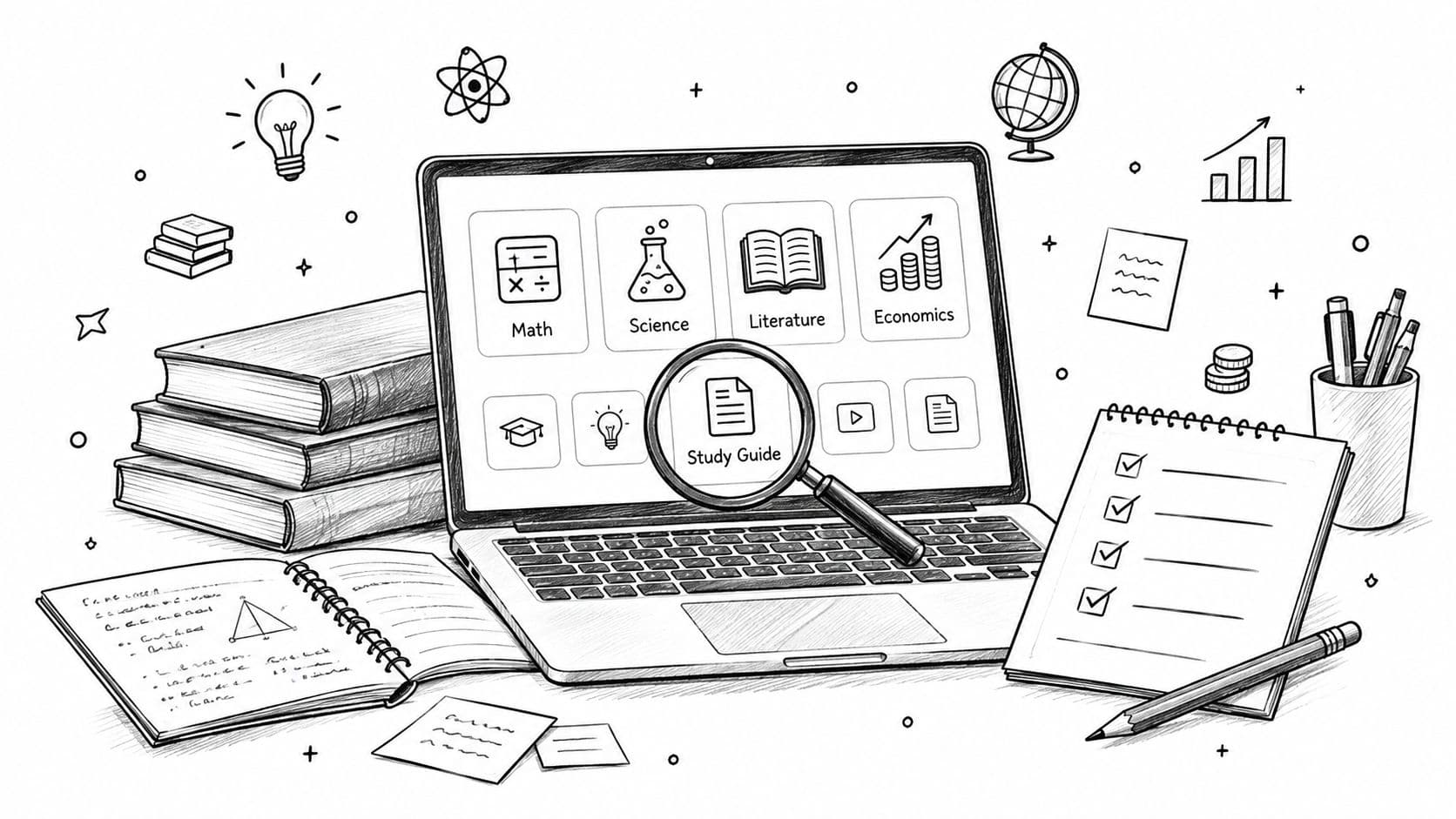
The most popular study guide isn't automatically the most useful one. A polished summary can still be wrong for your module, too basic for your academic level, or disconnected from the textbook and assessment you need to pass. The better question is not “Which free study guide has the biggest library?” It's “Which resource matches my course, learning outcomes, subject, format, and level most closely?”
That distinction separates the ten resources below. Some are designed for exact course matching, while others support structured self-study, open-textbook learning, literature analysis, foundational revision, or memory drills. Their trust signals also differ. A university archive, an openly licensed textbook, and a student-created flashcard set shouldn't be judged by the same standard.
Free online study guides became a mainstream part of academic support through projects such as David M. Lane's openly accessible Online Statistics course and StatTrek's broad tutorial library. University libraries now curate these resources alongside open textbooks, lecture materials, and practice sets, reflecting a shift toward study support organized around course outcomes rather than broad subject labels (SMU's statistics learning guide (opens in a new tab)). Start with the list, then use the verification workflow at the end before relying on any resource for assessed work.
1. CramShare
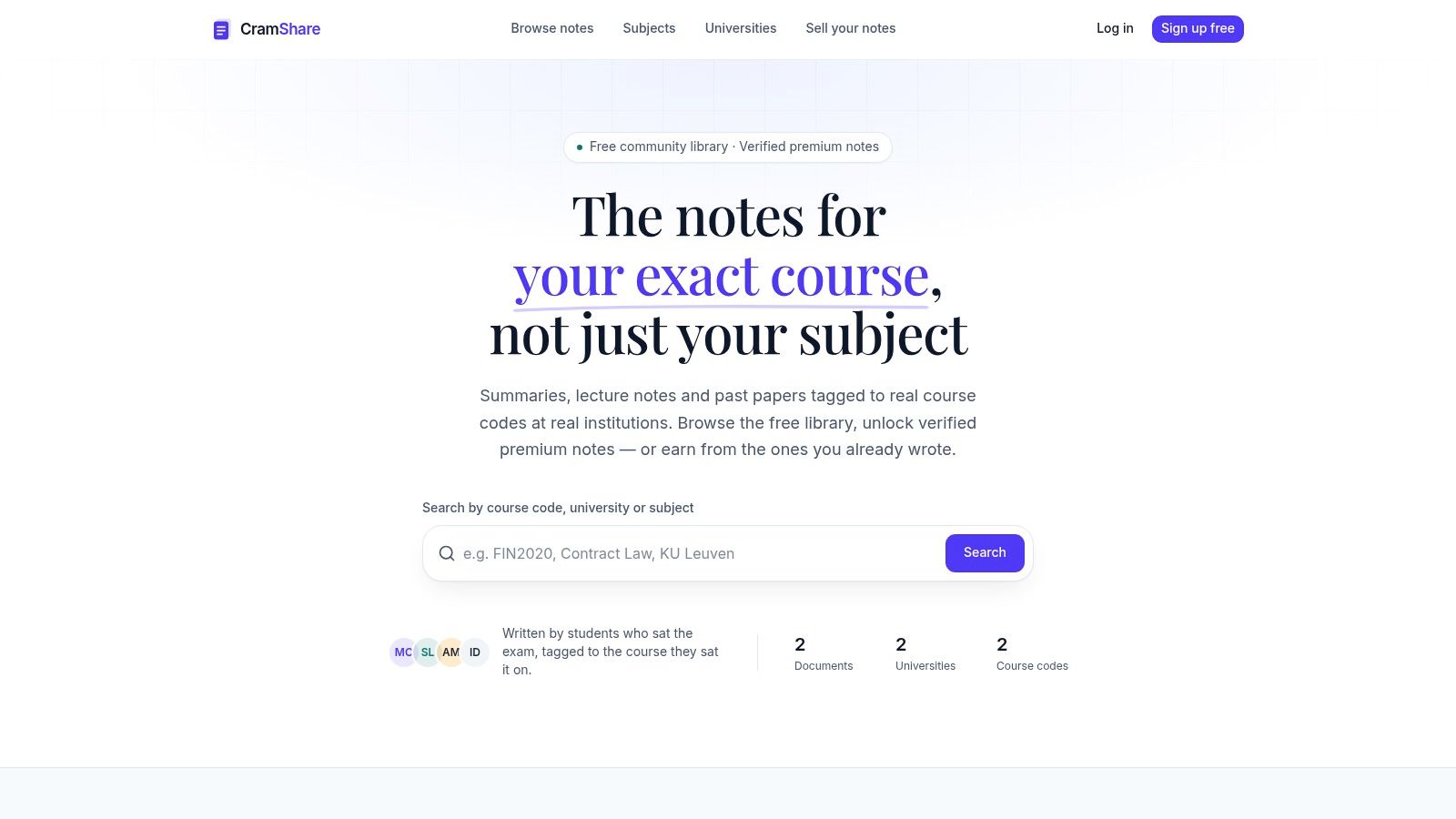
CramShare is the strongest choice when course-level relevance matters more than general subject coverage. Instead of asking you to browse a large “biology” or “economics” category, it organizes materials around the details students use to identify a real class, including university, course code, module, textbook, and academic year. That makes it particularly useful when your lecturer follows a local syllabus, a specific edition, or an assessment pattern that broad resources don't reflect.
The platform combines a free community library with a marketplace for reviewed premium documents. Free materials can be accessed without page limits, watermarks, or daily caps, while premium documents offer multi-page previews before purchase. Eligible purchases are covered by a refund policy when a document doesn't match its advertised course information or preview. Those features don't prove that every document is academically correct, but they give you more information before you decide whether a resource fits.
Best for exact course matching
CramShare's main advantage is discovery precision. A student searching for a particular module can compare lecture notes, summaries, revision guides, past papers, and exam resources that are connected to the same course context rather than relying on a generic topic match.
Premium uploads are reviewed for completeness, legibility, document quality, and course relevance. Ranking is based on how often documents are reopened rather than paid placement, and buyer ratings can provide an additional signal. Copyright takedown requests are acknowledged within one working day, but students still need to use materials lawfully and follow their institution's academic-integrity rules.
Student authors retain ownership, publish non-exclusively, set prices, and receive 70% of eligible paid sales, with monthly payouts and no minimum threshold. That seller model can encourage students to share useful original notes, although the platform launched recently, so catalogue breadth and ratings may vary by institution and module.
Practical rule: Use CramShare when the course code and module are your starting points, not merely the subject name. Preview any document, compare it with your syllabus, and treat it as support for independent study rather than a substitute for attending class or completing coursework.
Pros
- Precise discovery: Search by institution, course code, module, textbook, and academic year.
- Accessible free library: Community materials have no page caps, watermarks, or daily access limits.
- Preview-based purchasing: Multi-page previews and an eligibility-based refund policy reduce the risk of buying an unsuitable document.
- Author-friendly publishing: Student creators keep ownership and receive 70% of eligible paid sales.
Limitations: It's a newer platform, so coverage and social proof may be uneven. Student-created materials can also vary in depth and accuracy, which means syllabus comparison remains essential.
Visit CramShare to search for course-specific study materials.
2. Khan Academy
Khan Academy is most useful for structured concept review and mastery practice, not as a substitute for course-specific notes. Its free library covers mathematics, science, computing, economics and finance, humanities, and test preparation. Lessons, articles, practice problems, quizzes, and progress tracking convert a broad revision goal into identifiable skills.
Its strongest academic role is repairing prerequisites. A student struggling with statistics can review the algebra or probability concepts that support it, complete targeted exercises, and then return to the harder topic. The sequence is more systematic than a short summary, though it may not follow a university lecturer's terminology or order.
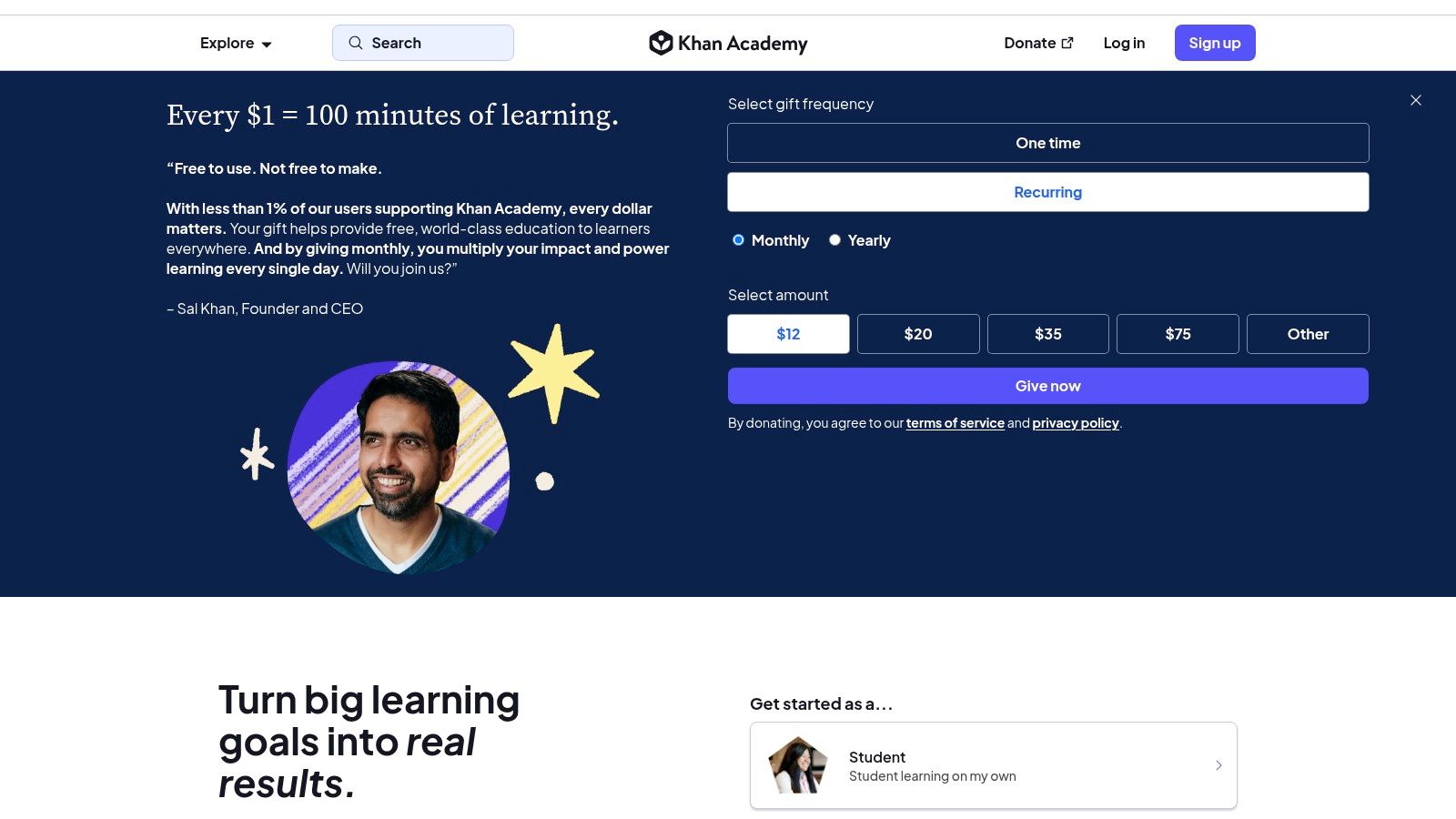
Use the platform actively. Search by course or topic, study the explanation, and attempt practice questions before moving on. Quizzes expose misunderstandings that passive reading can leave hidden. Teacher and classroom tools can support assigned work, and mobile access suits short, repeated sessions. Optional AI-enabled features such as Khanmigo may vary by context, so base a study plan on the free lessons and exercises.
Khan Academy remains topical rather than university-course-specific. A lesson can explain the relevant principle while using different notation, definitions, or sequencing from your module. Compare the topic list with your syllabus, lecture slides, and assessed learning outcomes. Then test a few explanations against the method your course expects, especially in mathematics and science.
Pros
- No-cost core learning: The main lesson and practice library is available without payment.
- Guided progression: Prerequisite skills connect to more advanced topics.
- Active recall and practice: Questions and quizzes reveal gaps more clearly than passive review.
- Flexible access: Web and mobile formats support brief study sessions.
Limitations: Coverage may not match your institution, course code, textbook, or lecturer. Advanced material and AI-enabled features can also vary in availability.
Use Khan Academy (opens in a new tab) to clarify and practise concepts, then verify each relevant definition, notation choice, and topic against your course materials. A Khan Academy (opens in a new tab) resource earns a place in your study stack when it strengthens the exact skill your syllabus assesses.
3. MIT OpenCourseWare
MIT OpenCourseWare works best as an institutional course archive for rigorous self-study. Its pages may include syllabi, lecture notes, assignments, examinations, and selected videos from MIT subjects across engineering, computer science, mathematics, science, humanities, and management. That archive gives learners access to university-level sequencing and assessment practice, making it distinct from topical lesson libraries and short revision summaries.
Its strongest academic role is structured, demanding practice. A student preparing for a mathematics or engineering exam could use an OCW syllabus to establish a sequence, study the matching lecture notes, and attempt archived problem sets under timed conditions. The method builds more independent problem-solving practice than a brief guide, but it leaves accuracy checks to the learner. OCW usually provides no built-in grading or instructor feedback for a missed step.
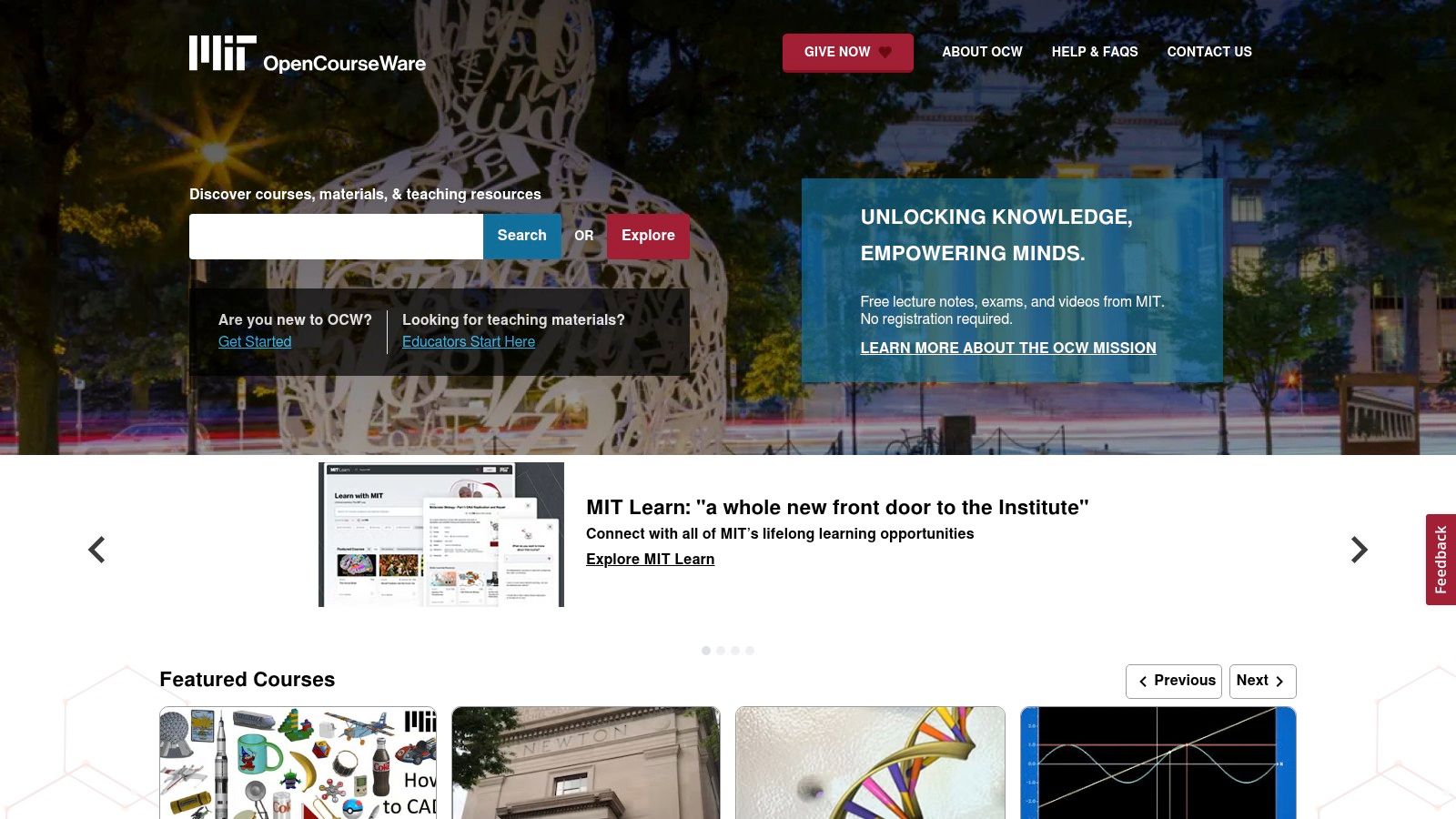
Use the archive selectively
OCW suits students who need deeper explanations, university-style questions, or a complete framework for independent study. It is less efficient for a single narrow clarification or a resource written for an exact campus module.
Verify the match before following an archived course from start to finish. Compare its syllabus with your own course outline, then check topic order, assumed prerequisites, notation, terminology, and assessment emphasis. Matching titles do not guarantee matching coverage. Select the units that correspond to your syllabus, and confirm difficult solutions against lecture materials, a textbook, or another reliable reference.
For a wider framework for comparing resources by purpose and reliability, see this guide to study guides online.
OCW's practical strengths are clear:
- Authentic course structure: Syllabi and assessments create a realistic university-level framework.
- Serious practice: Problem sets and exams test application rather than recognition alone.
- Wide discipline range: The archive extends beyond introductory subjects.
- Offline access: Notes and assignments can be saved for later study.
The limitations affect how you should use it. There is no credit or personal tutoring, and alignment with your institution is not guaranteed. Older course materials may also use terminology, notation, or sequences that differ from current teaching.
Explore MIT OpenCourseWare (opens in a new tab) when depth and challenging academic practice matter more than convenience. Verify the match first, then combine selected materials with feedback and course-specific guidance.
4. OpenStax
OpenStax is most useful when you need a structured textbook foundation, not a quick revision sheet. Its openly licensed college textbooks cover mathematics, science, business, social sciences, and writing, with connected explanations, examples, summaries, review questions, and end-of-chapter practice. That makes it particularly suitable for guided self-study and for courses built around a standard introductory or intermediate sequence.
A textbook can show how ideas relate, develop, and apply across a chapter. A short guide may provide a definition, but OpenStax gives students more context for checking whether they can explain the concept and use it. Its strongest academic role is therefore textbook support or primary learning material when the assigned course follows, or closely resembles, an available title.
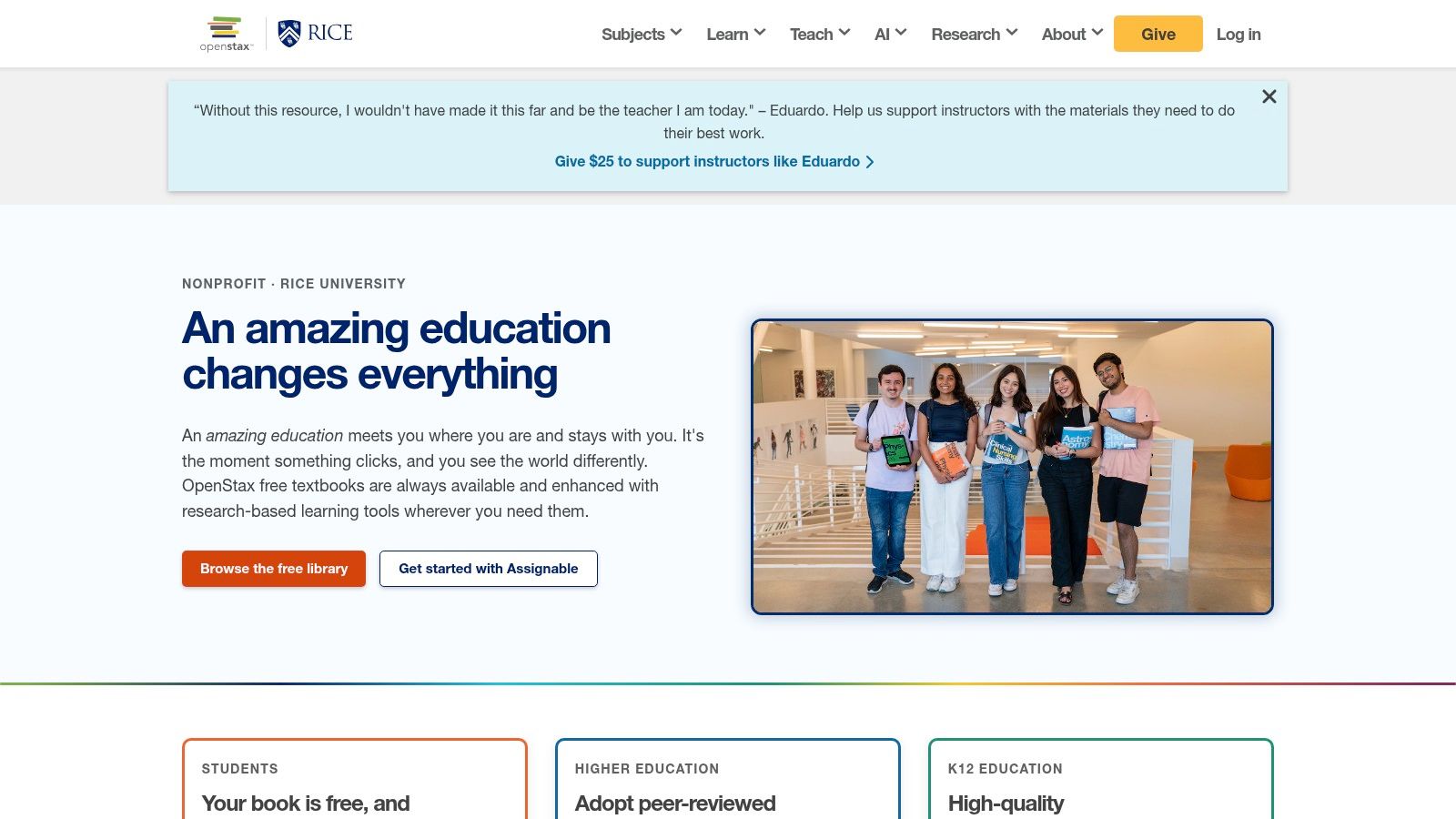
Use the syllabus as the test
Start with the exact book title, then compare its chapter sequence and topic coverage with your syllabus. A close match supports reading the relevant sections in order. Use the review questions to test recall and application, while notes and highlights mark definitions, unclear examples, and material that needs confirmation from lectures.
OpenStax's peer-reviewed editorial process offers a useful quality signal, yet it cannot ensure complete coverage of a particular course. Local policy, advanced theory, laboratory conventions, and instructor-selected readings may fall outside the book. Check those gaps against institutional materials before treating the textbook as sufficient preparation.
Pros
- Textbook depth: Explanations, worked examples, summaries, and review questions reinforce one another.
- Open access: Web editions are free to read and openly licensed.
- Course structure: Available titles may follow common college-course sequences.
- Active reading tools: Notes, highlights, and student resources support review.
Limitation: Specialized or advanced modules may require another textbook or institutional source, even when the general subject matches.
Browse OpenStax (opens in a new tab) when you need a free textbook with enough structure to support learning, practice, and syllabus-based checking.
5. SparkNotes
SparkNotes is most useful as a rapid literature-analysis tool, not a general study platform. Its strongest academic role is post-reading orientation: it can refresh a plot, character relationships, themes, chapter structure, or key passages before a seminar or examination. The site also offers material on philosophy, history, quizzes, infographics, and selected No Fear Shakespeare modern translations.
That range does not make every guide a match for every course. Compare the title and assigned sections with your syllabus, then check whether the guide addresses the questions your instructor emphasizes. A plot summary may cover events while omitting language, form, narrative choices, historical context, or the passages required for an essay.
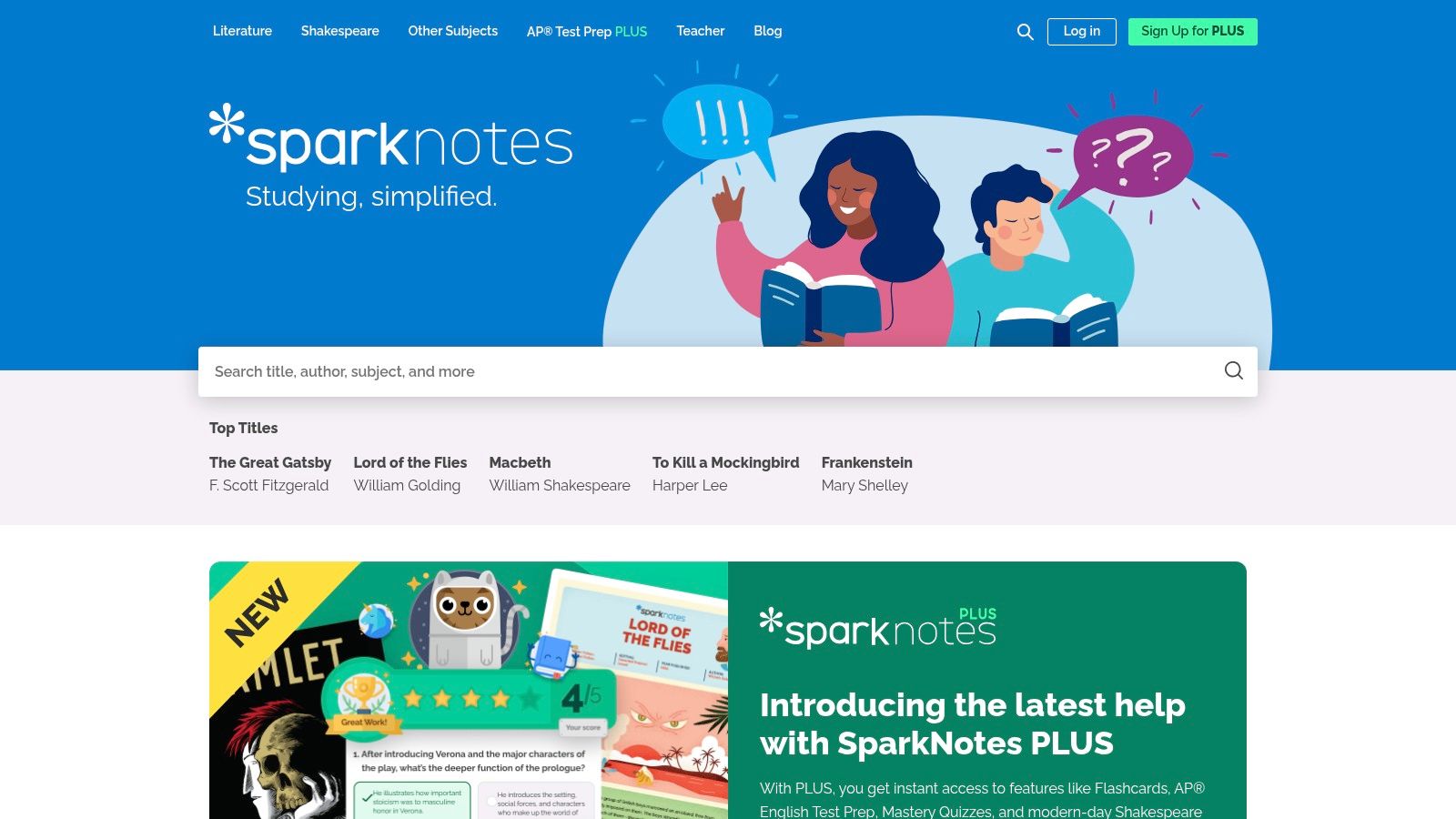
Read first, verify second
Use SparkNotes after reading and annotating the assigned work. Compare its themes and character descriptions with your notes. When an interpretation differs, return to the original passage and examine the wording before accepting either view.
For essay preparation, treat the guide as a source of questions, not evidence. Select passages assigned by your instructor, develop your own claim, and test whether the text supports it. This process turns recall into analysis and exposes gaps that a short summary can hide.
- Fast orientation: Plot and chapter breakdowns restore the basic shape of a work.
- Humanities focus: Character, theme, and quotation-related analysis can support seminar preparation.
- Active review: Quizzes and visual materials provide alternatives to rereading notes.
- Broad literary utility: Many commonly taught works have guides.
SparkNotes is weak for STEM learning, and its summaries cannot replace close reading. Some extra features, including ad-free access, require SparkNotes Plus, so confirm which material is free before planning a revision session.
Use SparkNotes (opens in a new tab) for literary recall and idea generation. Its screenshot and homepage presentation can be reviewed through SparkNotes (opens in a new tab).
6. CliffsNotes
CliffsNotes is most useful as a last-minute literature refresher, not as a substitute for reading. Its concise summaries, character notes, theme discussions, study articles, and exam guidance help restore a work's basic context before class discussion. The scannable format suits limited study time, especially when you need to locate a plot point or formulate questions quickly.
Its strongest academic role is recall and orientation. Concision also limits depth. A short guide can identify major interpretive threads, yet it may omit passages needed for an advanced essay or fail to address less familiar texts. Compare the title and topics with your reading list before relying on its coverage.
Use the guide to test understanding
Begin with your notes and the assigned reading. Then use CliffsNotes to locate gaps or unfamiliar terms. Close the guide and write a brief explanation of a theme using your own textual evidence. Reopen the original passage to check whether its wording supports your interpretation. If the guide's claim and the passage diverge, the passage takes priority.
A practical verification sequence is simple: match the guide's title and edition to the assigned work, compare its themes with lecture notes, and confirm every quotation in the primary text. This process separates a useful prompt from an unsupported summary.
Topical study articles, selected video explainers, and downloadable materials extend the site beyond individual books, although literature remains its main focus. Prompts for paid books or companion resources may appear, so confirm which material is freely available before scheduling a study session.
A concise guide should reduce search time, not reduce the amount of thinking you do.
Use CliffsNotes when you need:
- Quick recall: Short summaries support final review.
- Interpretive prompts: Theme and character notes can generate revision questions.
- Text selection checks: Coverage can help identify whether a familiar title is represented.
- Supplementary practice: Articles and selected explainers offer extra context.
Coverage and depth are strongest for core literature titles. CliffsNotes does not replace assigned reading, lecture notes, or properly cited textual evidence. Visit CliffsNotes (opens in a new tab) for a compact reminder, then verify its claims against the original work.
7. BBC Bitesize
BBC Bitesize is a foundational revision tool, not a universal course guide. Its strongest role is helping students in UK secondary education repair gaps in mathematics, science, English, and other school subjects. Pages are organized by subject and level, and may combine concise explanations with examples, recap quizzes, podcasts, flashcards, videos, and study guides.
That format makes Bitesize useful before harder work begins. A student who cannot follow a university explanation of a basic concept may first use a Bitesize topic to establish the vocabulary and underlying idea. The platform's GCSE and A-level framing can also create mismatches with North American courses and university modules, so completing a topic page does not demonstrate coverage of an undergraduate syllabus.
Verify the match before relying on it
Select the relevant subject and qualification level, then compare the page's terminology, examples, and learning outcomes with your syllabus, lecture slides, and textbook. If the concept matches but the notation differs, record the equivalent terms before attempting assessed problems. Check the official qualification outcomes as well, since an interactive page may support recall without covering the full required scope.
Quizzes provide retrieval practice, while My Bitesize and mobile features can support repeated review. Their practical value depends on whether the questions test the same knowledge your course assesses.
Use Bitesize when you need:
- Foundation repair: Short explanations clarify prerequisite ideas.
- Retrieval practice: Recap quizzes test whether you can recall a concept.
- Course-level orientation: Subject and qualification categories help identify an appropriate starting point.
- Multimedia review: Podcasts, videos, flashcards, and study guides offer different ways to revisit material.
Its main limitation is scope. UK curriculum terminology and sequencing may differ from your course, and advanced university coverage is limited. Visit BBC Bitesize (opens in a new tab) for a clear starting explanation, then verify its coverage against your syllabus and use course-specific materials for deeper study.
8. LibreTexts
LibreTexts is best used as a deep open-textbook ecosystem, not as a single standardized study guide. Its collection covers chemistry, biology, mathematics, engineering, social sciences, humanities, and other disciplines. Individual books may include learning objectives, worked examples, practice problems, end-of-chapter exercises, and interactive features such as Jupyter notebooks or molecular viewers.
Its strongest academic role is support for advanced or specialized study. A suitable text can provide more explanation and application than a short summary, especially when an introductory textbook library does not cover the topic. The trade-off is variation: authors and books differ in organization, depth, notation, and editorial consistency. Assess the specific resource rather than assuming the platform applies one quality standard throughout.
Match the book to the course
Begin with your course learning outcomes, then compare them with the book's chapter titles and section headings. Read a sample of definitions, examples, and exercises to check whether they use the same terminology and conventions as your lectures. If the notation differs, keep your lecturer's notation as the reference and record equivalent terms before solving assessed problems.
A useful check is to compare one LibreTexts chapter with your textbook and syllabus. If it explains the concept clearly but omits required applications, use it for understanding and keep course materials for exam preparation. For practical guidance on checking shared notes alongside open resources, see free study notes.
LibreTexts also offers an OER Remixer for adapting open content. ADAPT and some institution-level features can add interactive practice, though availability may depend on the implementation. Basic reading does not require those tools.
Use LibreTexts when you need:
- Broad coverage: Resources span STEM and non-STEM subjects.
- Advanced options: Some books address specialized topics beyond introductory courses.
- Interactive learning: Notebooks, viewers, and practice activities can support application.
- Adaptable content: Open resources can be remixed for a particular course.
Quality and depth remain book-specific, and some interactive features may not be available at no cost. Explore LibreTexts (opens in a new tab) when you need an open textbook and are prepared to verify its alignment, examples, and exercises against your course.
9. Saylor Academy
Saylor Academy's strongest role is structured course self-study, not quick reference. Its free, self-paced courses organize learning outcomes, readings, study guides, practice quizzes, and final assessments into a defined sequence. That format suits learners who need a route through general education, business, or technology topics rather than a collection of unrelated pages.
The course sequence can also help you judge fit before studying. Start with the learning outcomes, then compare them with your syllabus. Check whether the assigned readings cover the same concepts, terminology, and level of application. A course may provide clear explanations yet still omit topics your instructor expects you to know.
Saylor's materials often combine open educational resources instead of relying on one original textbook. This gives courses varied readings, but quality, depth, and consistency can differ. Treat the quizzes as diagnostics: passing recognition-based questions does not show that you can explain an idea independently or apply it to an unfamiliar problem. Use institutional materials to confirm definitions, methods, and assessment expectations.
Some courses carry ACE or NCCRS credit recommendations. Those recommendations do not guarantee acceptance by your institution. Ask the registrar or an academic adviser about transfer rules before choosing a course for credit.
Best fit
- Guided self-study: Outcomes, readings, practice, and finals provide a coherent route.
- Flexible scheduling: Self-paced access lets you set the study timetable.
- Progress checks: Quizzes and final exams expose gaps before further review.
- Possible credit pathway: External recommendations may support a credit request, subject to institutional approval.
Limitations: Aggregated content may vary in depth and accuracy. Proctoring requirements, fees, and institutional policies can affect any credit route.
Try Saylor Academy (opens in a new tab) when you need a complete independent course and are prepared to verify its alignment with your syllabus.
10. Quizlet
Quizlet's academic role is narrower than its popularity suggests. It is a memory-drill platform, useful for retrieving terms, vocabulary, formulas, definitions, and other discrete information. It does not establish that the material is accurate or that a set matches your course.
Its main advantage is speed. Students can turn lecture notes into flashcards, then use short sessions to locate items they repeatedly forget. Flashcards, Learn mode, tests, and quizzes make retrieval practice convenient across web and mobile devices. For memory-heavy courses, that convenience can support regular review more effectively than rereading notes.
Accuracy requires separate checking. Community-created sets may omit qualifications, use outdated definitions, contain incorrect answers, or follow another instructor's syllabus. A set can therefore be useful for practice while remaining unsuitable as the authority for exam preparation.
Use Quizlet as a checked practice layer
Create sets from lecture slides, approved textbooks, and corrected class notes whenever possible. For a community set, compare every high-impact card with an authoritative course source before memorizing it. Formula cards should include the conditions and variables that determine when a formula applies, rather than listing symbols alone.
A practical workflow is to verify course coverage first, check definitions against approved materials, and then test yourself without looking at the answer. This separates three questions that students often combine: whether Quizlet covers the syllabus, whether each card is correct, and whether you can recall or apply the information independently. Guidance on spaced repetition tools can help you choose a review schedule after the cards pass that check.
Some modes are limited on the free tier, and advanced features require a paid plan. Those restrictions matter less than content quality. A polished drill still reinforces an error if its source was never reviewed.
Verification habit: If a flashcard could affect an exam answer, trace it to your syllabus, lecture material, or approved textbook before trusting it.
Best fit: Retrieval practice, rapid review of terminology, and short study sessions. Limitations: Community quality varies, some modes require payment, and Quizlet cannot confirm exact course alignment or answer accuracy.
Use Quizlet (opens in a new tab) for practice, not as the final authority.
Comparison of Top 10 Free Online Study Guides
Build a Reliable Study-Guide Stack
The best result usually comes from combining resources with different jobs. A course-specific document can tell you what students in your module emphasized. An open textbook can clarify the underlying concept. A practice set can test application, while flashcards can strengthen recall. Treating all four as interchangeable creates gaps because each format answers a different academic need.
Begin with the syllabus and learning outcomes. Copy the exact module names, topic headings, textbook chapters, assessment terms, and required formulas into a working list. Then match every guide against that list. A resource that covers the right subject but misses two assessed modules isn't a complete study plan, and a document from another academic year may use a different sequence or assessment emphasis.
Use this order when evaluating a resource:
- Match the course context: Check institution, course code, module, academic year, textbook edition, and academic level where those details are available.
- Match the learning outcome: Ask whether the material helps you define, explain, compare, calculate, analyse, or evaluate what the syllabus requires.
- Confirm authoritative content: Check definitions, formulas, terminology, quotations, and answer keys against your approved textbook, lecture materials, institutional library, or lecturer-provided source.
- Test transfer: After reading a guide, solve a new problem, explain the idea without notes, or write a paragraph using your own evidence.
- Check currency and ownership: Look for dates, author context, citations, and signs that the creator had permission to share the material.
- Review academic-integrity rules: Don't submit copied notes, answers, or another student's work as your own. Sharing and using materials must comply with your institution's policies.
The distinction between static guides and adaptive tools matters more now. Recent coverage describes AI companies targeting students, while current learning-tool trends emphasize personalization, multimodal formats, and real-time analytics. That doesn't make traditional guides obsolete. It means students should decide whether they need a stable explanation, an interactive drill, or help adapting material to a particular weakness, and they should verify AI-generated explanations just as carefully as user-created notes (NPR's coverage of AI tools and college students (opens in a new tab)).
A practical stack might begin with CramShare for precise university, course-code, module, textbook, and academic-year matching. Add OpenStax or LibreTexts when you need textbook-level explanation, Khan Academy or BBC Bitesize when you need to repair foundations, MIT OpenCourseWare or Saylor Academy when you want structured depth, and Quizlet for retrieval. Use SparkNotes or CliffsNotes only as literature supplements, then return to the primary text and your own annotations.
The final test is simple. Close the guide and attempt the task your course will assess. If you can recall a definition but can't apply it, explain a process but can't solve a problem, or summarize a novel but can't support an interpretation with textual evidence, the resource has helped only partially. Keep it in the stack, but add the missing form of practice.
CramShare combines a free community library with course-specific search across universities, course codes, modules, textbooks, and academic years, making it useful when broad subject searches produce irrelevant notes. Visit CramShare to preview and compare study materials that can support your syllabus-led revision.