Chapter 7 Summary: A Student's Guide to Bankruptcy
A clear chapter 7 summary covering liquidation, exemptions, and the means test. Learn how Chapter 7 bankruptcy works for consumers in 2026.

Chapter 7 summary in U.S. bankruptcy law means liquidation bankruptcy, where nonexempt assets can be sold to pay creditors before qualifying remaining debts are discharged. The modern federal chapter system took shape in 1978, became generally effective in 1979, and later changed again in 2005 with tighter consumer eligibility screening.
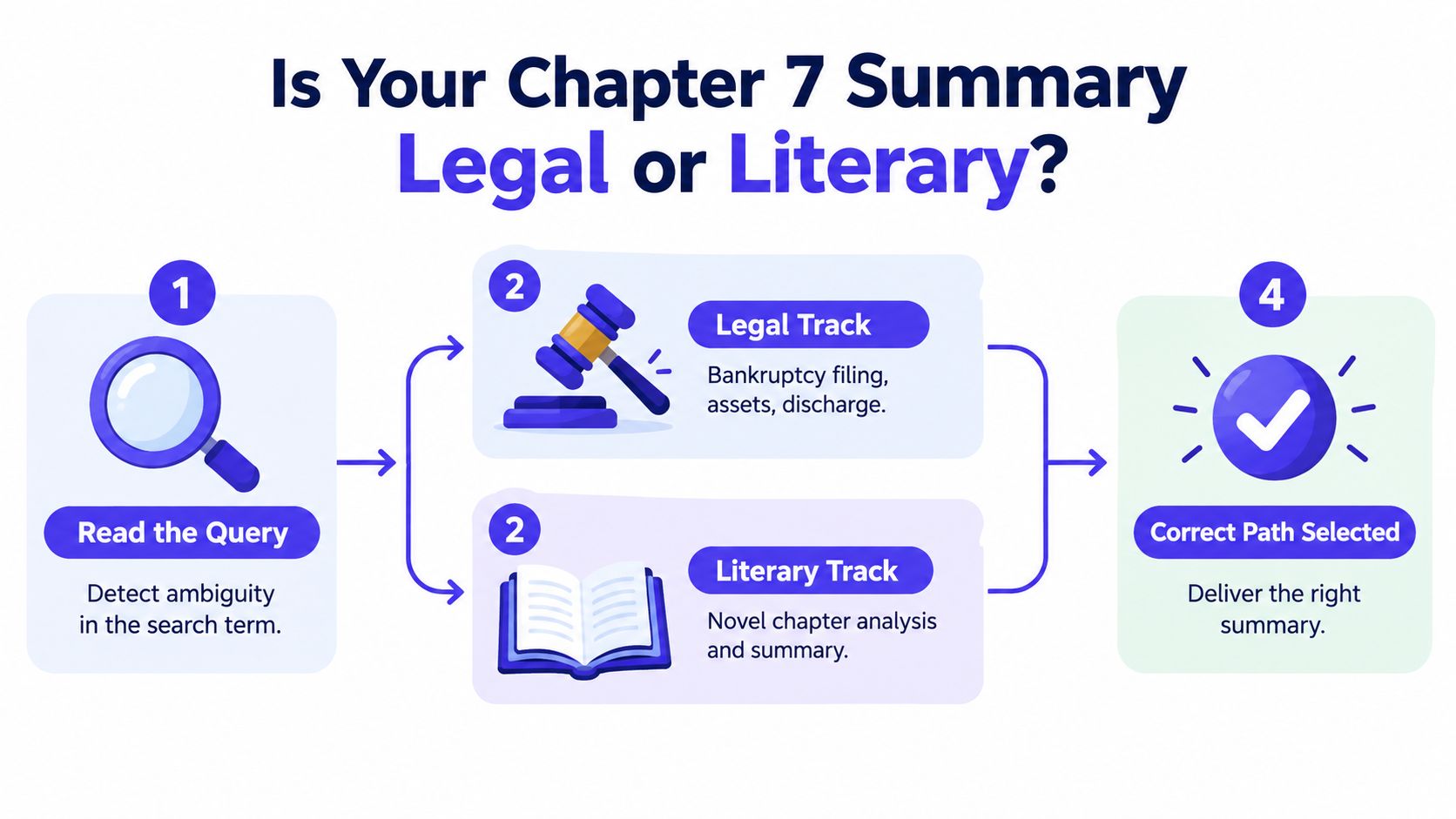
You may have searched this phrase while trying to study a novel chapter, or while trying to understand debt relief after a financial crisis. That confusion is common, because “Chapter 7 summary” can point to two very different things, and the correct answer depends on which one you mean.
Is Your Chapter 7 Summary Legal or Literary
The fastest way to avoid confusion is to identify the subject before you summarize anything. If the assignment is about a book, the “chapter 7 summary” is literary, and you need the title, author, edition, and course context to make sense of it. If the subject is U.S. law, Chapter 7 means bankruptcy law, not fiction.
Read the Query First
Start with the words around the phrase. If you see terms like bankruptcy, creditors, debt, discharge, or assets, you're on the legal track. If you see a novel title, an author's name, or a class reading list, you're dealing with a literary chapter.
That split matters because a generic summary can be misleading when the audience is different. A law student needs the legal process, while a literature student needs plot, themes, and interpretation. The wrong pathway gives the wrong answer, even if the phrase looks the same.
Practical rule: Don't summarize first and sort out meaning later. Decide whether the phrase is legal or literary before you write a single sentence.
For students worried about using outside help the right way, the academic-integrity basics are worth checking in advance, especially if you're matching notes to a course requirement. A useful starting point is this guide on academic integrity, because a summary should support learning, not replace it.
What This Guide Covers
This article focuses on the legal meaning of Chapter 7 summary. That means the federal bankruptcy chapter, the liquidation process, and the study points students usually need for exams or class discussion.
It does not treat Chapter 7 as a fictional chapter number. Instead, it explains how the law works, why it exists, and how to tell it apart from Chapter 13. That distinction is the foundation for everything that follows.
Historical Foundations of the Bankruptcy Code
A Chapter 7 summary can sound simple until students hit the word “history.” At that point, the question is whether they need a literary timeline or the legal background of the bankruptcy chapter. For the legal path, Chapter 7 sits inside the modern federal system shaped by the Bankruptcy Reform Act of 1978, with the main provisions generally taking effect on October 1, 1979 (Bankruptcy Reform Act of 1978 (opens in a new tab)).
Why the Timeline Matters
The code did not arrive in one single piece. The 1978 reform created the chapter-based framework students still study, and later consumer-bankruptcy changes in 2005 added tighter screening, including the means test for many consumer debtors. That sequence explains why Chapter 7 is both a faster route to relief and a regulated process.
Congress built a system that gives eligible filers a path toward financial relief while still protecting creditor rights. Chapter 7 is not only about debt relief. It also depends on liquidation, exemptions, and court oversight, which work together like guardrails on a road.
What to Remember for Class
Keep these three anchors in mind:
- 1978 enactment: the chapter system was established.
- 1979 effectiveness: the current framework became generally active.
- 2005 reforms: consumer screening tightened.
Those dates show how the law changed over time. If a professor asks why Chapter 7 looks the way it does now, the best answer is legislative history, not just procedure.
Chapter 7 also serves a clear policy role. It became the main federal tool for a relatively quick financial reset while still preserving a liquidation process that supports creditor recovery. That balance is the key idea to remember.
Chapter 7 Versus Chapter 13 Comparisons
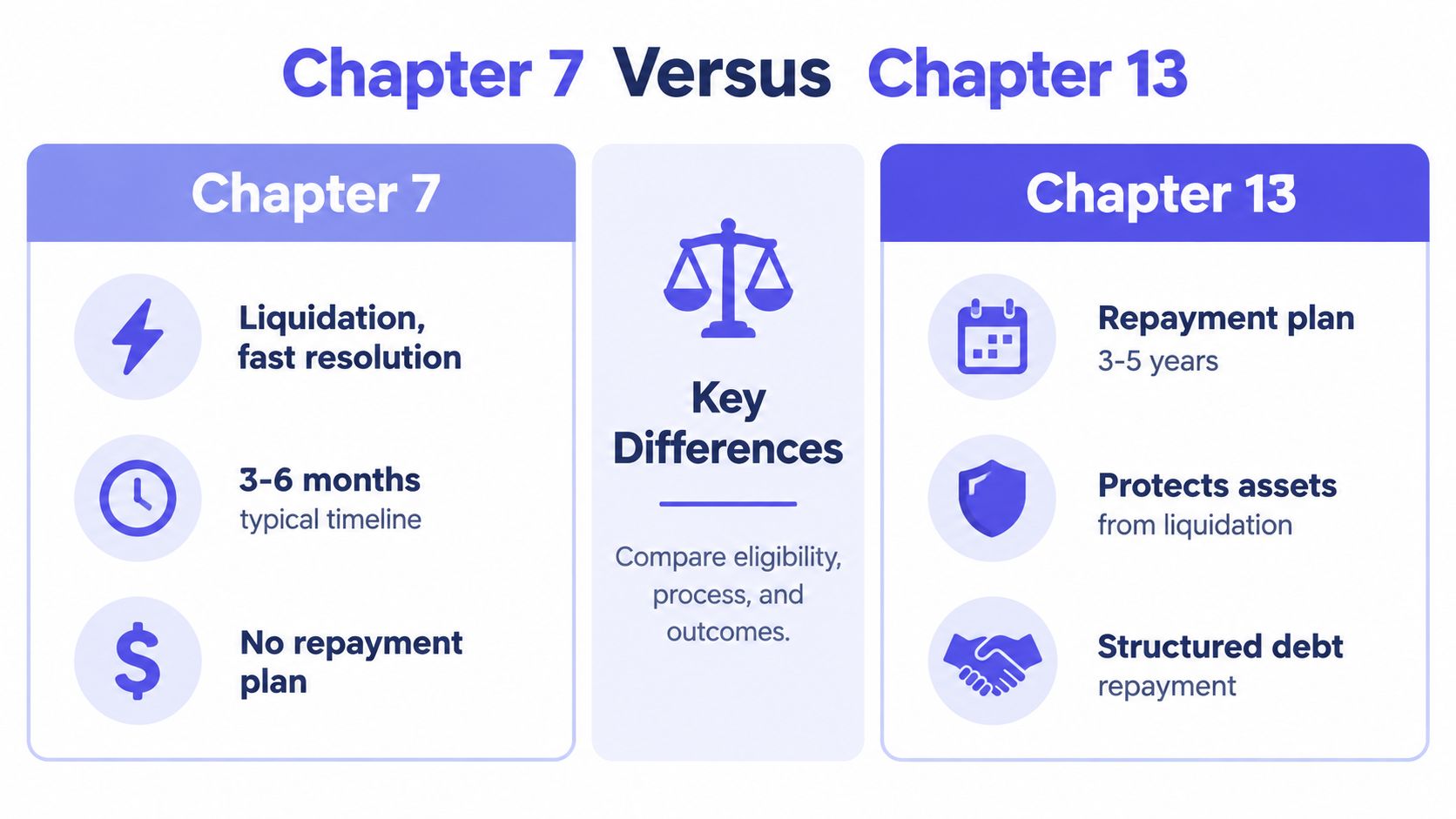
A student can confuse bankruptcy chapters by treating them like labels on the same folder. The law separates them by method. Chapter 7 focuses on liquidation, while Chapter 13 centers on repayment through a court-approved plan (U.S. Courts - Bankruptcy Basics: Chapter 7 vs Chapter 13 (opens in a new tab)).
Liquidation Versus Repayment
Under Chapter 7, nonexempt assets may be sold and the proceeds distributed to creditors. Under Chapter 13, the debtor keeps property and repays debts through a plan approved by the court. That difference is the first one many exam questions target.
The comparison is straightforward. Chapter 7 works like clearing out what the exemption rules do not protect. Chapter 13 works like a payment schedule built around future income. One is centered on liquidation, the other on making regular payments over time.
Watch the video on YouTube (opens in a new tab)
Who Usually Fits Each Path
Chapter 7 is often associated with individuals and households, because consumer filings have historically dominated it. Chapter 13 fits people who can keep up with a repayment schedule and want a different way to handle debt.
The practical test is easy to state. If the facts point to selling nonexempt property and then seeking a discharge after liquidation, the case fits Chapter 7. If the facts point to ongoing payments under court supervision, the case fits Chapter 13.
Study shortcut: Chapter 7 asks, “What gets liquidated?” Chapter 13 asks, “What gets repaid over time?”
That difference also changes how you describe the result. Chapter 7 can end with a discharge of many remaining eligible debts, but it is not automatic forgiveness. Chapter 13 starts with repayment, then ends with completion of the plan.
The Liquidation Process Step by Step
A Chapter 7 case starts when the debtor files a voluntary petition. That filing triggers the automatic stay, which stops many creditor collection actions while the case moves through the court system.
Filing, Trustee, and Creditor Review
After filing, a trustee is appointed to look at the estate and the available property. The trustee's job is to sort out what can be used for creditors and what is protected by exemptions. That's why the phrase nonexempt assets matters so much.
A simple classroom example helps. If a filer owns property that the exemption rules don't shield, that property may be sold. If the property is exempt, it stays with the filer. The legal question is never just “Does the person own something?” It's “Is it protected?”
Then comes the meeting of creditors. Here, the trustee and creditors can ask questions about the filer's finances, assets, and paperwork. The process is procedural, not personal, and its purpose is to test whether the disclosures match reality.
Liquidation and Discharge
If there are nonexempt assets, they may be liquidated and the money distributed to creditors. After that, a qualifying individual may receive a discharge of many remaining eligible debts. That discharge is the ending point many students remember, but the path there is what controls the outcome.
A discharge is the result of the process, not a shortcut around it.
That's also why Chapter 7 should not be described as automatic forgiveness. Exemptions, eligibility rules, reaffirmation agreements, nondischargeable debts, fraud objections, and court procedures can all change the final result. The case may look simple in a one-line definition, but the legal mechanics decide what really happens.
For study purposes, the safest memory chain is: file, stay, trustee, creditor meeting, asset review, liquidation if needed, discharge if eligible. That sequence keeps the legal logic intact without overcomplicating it.
Analyzing Chapter 7 Filing Statistics
A common search mistake is to treat “chapter 7 summary” as a general summary, while students often need the legal Chapter 7 chapter itself. The filing data helps clear up that confusion. In the 12-year period from October 1, 2005, through September 30, 2017, federal courts received about 12.8 million consumer bankruptcy petitions. About 8.7 million, or 68%, were filed under Chapter 7, and roughly 4.1 million, or 32%, were filed under Chapter 13 (U.S. Courts consumer bankruptcy filings (opens in a new tab)).
What the Numbers Show
Those figures show that Chapter 7 is not a narrow or unusual topic. It has been the main consumer route in federal bankruptcy practice for a long stretch of time. The same report notes that 97% of Chapter 7 filings were nonbusiness cases, which means the process is used mostly by individuals and households, not companies.
Recent data point in the same direction. For the year ending September 30, 2025, Chapter 7 filings totaled 344,825, making up 62% of all bankruptcy cases filed, and that was a 15% increase from 298,644 in the comparable 2024 period (U.S. Courts bankruptcy filings (opens in a new tab)). Filing activity has also risen and fallen across recent years, which shows how closely it tracks household pressure and wider economic strain.
Why Students Should Care
These numbers matter because they show what kind of legal problem comes up again and again. When a topic appears often in real cases, professors usually expect you to know its definition, process, and consequences with confidence.
They also keep Chapter 7 from feeling like abstract doctrine. It is one of the main bankruptcy tools people use when debts become hard to manage and a discharge is part of the legal solution.
If you are collecting study notes for this topic, a course-specific library like CramShare can help you find materials such as UB2020 journal ledger quick revision notes matched to a module, course code, or textbook.
Essential Exam Revision Points and Key Terms
The fastest way to study Chapter 7 is to memorize the legal vocabulary first. If you know the terms, the facts stop feeling random. If you don't, the process blurs together.
Key Terms to Know
- Automatic stay: the court protection that pauses many collection actions after filing.
- Means test: the eligibility screening strengthened by the 2005 reforms.
- Exemptions: the rules that protect certain property from liquidation.
- Nondischargeable debts: debts that survive the case even after discharge.
- Reaffirmation agreements: agreements that can keep certain debts in place instead of wiping them out.
Each of those terms answers a different exam question. The automatic stay is about immediate legal effect. Exemptions are about property. Nondischargeable debts are about what survives. Reaffirmation agreements are about exceptions to the clean break.
What Professors Often Test
The most common trap is to treat Chapter 7 as total debt erasure. It isn't. The process can end in discharge, but only after eligibility, exemptions, and court review do their work.
Another common trap is confusing Chapter 7 with Chapter 13. One is centered on liquidation, the other on repayment through a court-approved plan. If you remember nothing else, remember that difference.
Exam rule: If the question mentions selling property to satisfy creditors, think Chapter 7. If it mentions a repayment plan, think Chapter 13.
The timing of the case is also worth remembering. Federal court data show a median of 127 days from filing to closing for consumer cases closed during the year ending December 31, 2025, while the mean was 499 days (U.S. Courts bankruptcy business report (opens in a new tab)). That spread tells you that Chapter 7 outcomes can vary a lot in practice, so a neat one-line definition never captures the whole story.
Final Checklist
Before an exam, make sure you can do these things:
- define Chapter 7 in one sentence,
- explain the role of the trustee,
- distinguish exempt from nonexempt property,
- contrast Chapter 7 with Chapter 13,
- name the core terms without hesitation.
If you can do that, you can handle most short-answer and essay prompts on the topic. For broader revision planning and course materials, a study platform like exam preparation materials can help you organize notes into a cleaner study set.
If you want a cleaner way to study this topic, visit CramShare to look for course-matched summaries, revision notes, and exam resources. It's useful when you need a Chapter 7 summary tied to a specific class, textbook, or syllabus, not just a generic explanation.