Note Taking from Textbook: A Practical Student Guide
Learn practical note taking from textbook strategies that actually work. Skim, highlight, summarize, and integrate notes with lectures for better exam prep.
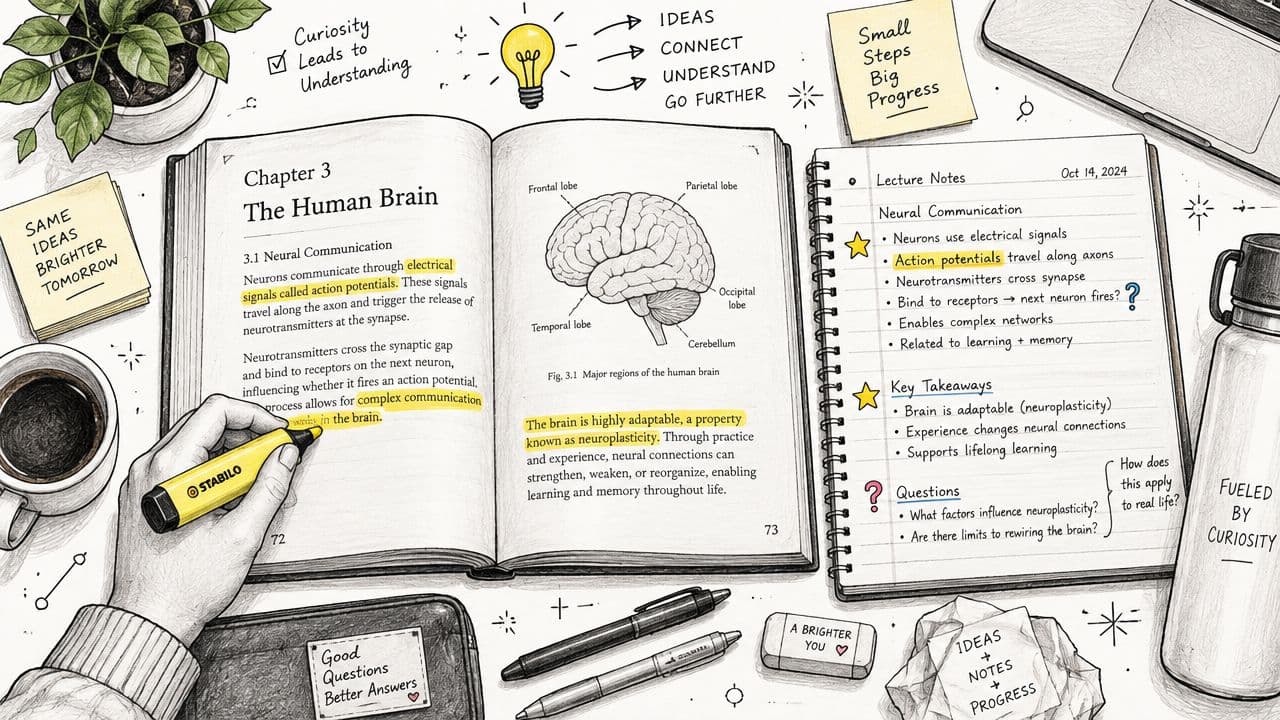
You open the chapter late, the deadline's already real, and the page in front of you looks familiar in the worst way. You've highlighted half a spread, copied a few lines that sounded important, and still can't say what the chapter argued. That's the moment textbook note taking has to become more than decoration.
Good notes from a textbook aren't a record of everything you saw. They're a compact way to understand, remember, and find the chapter again later. The students who do this well don't read harder than everyone else, they read in passes, choose what matters, and turn dense prose into something they can review without reopening the whole chapter.
Why Textbook Notes Need a Different Approach
Open a textbook chapter and the problem shows up fast. One page may hold definitions, arguments, examples, figures, captions, summaries, and review questions, and each piece deserves a different level of attention. If you treat all of it as equal, your notes swell with copied phrases, and the core ideas get buried in the extra text.
note taking from textbook works better when you use a sequence instead of one slow pass. Research on note-taking and review shows that retention improves most when notes are reviewed, not just written once, and that the benefit depends on method and context (Claremont thesis (opens in a new tab)). In older note-taking research, taking and reviewing notes produced the strongest retention, while reading or listening without review did worst.
The habit traps that waste the most time
Two habits drain time. The first is giving every page the same attention, which pulls you into examples and side notes before you know what the chapter is doing. The second is using highlighting as a substitute for judgment, which leaves a bright page and a weak memory.
A better routine follows the chapter's own structure. Survey first. Then read actively. Then write notes in a format that fits the subject. After that, fold in lecture material if you have it. End with review by trying to recall the point before you look back. Textbook reading is usually self-paced, so you can slow down where the argument gets dense and skim the parts that only support the main idea.
That pacing matters. A chapter is more like a map than a transcript. If you move through it at one speed, you miss the signals that tell you where to stop and where to move on. A dense definition may deserve a careful note, while a long illustration may only need a short label. That is how you avoid the over-highlighting trap, and it is also how you keep your notes useful when exam week arrives.
Practical rule: if a sentence will not help you answer a question later, it probably does not deserve space in your notes.
Good textbook notes should let you read with purpose, capture structure instead of copying whole passages, and turn a chapter into a short set of pages you can use again.
Survey the Chapter Before You Read
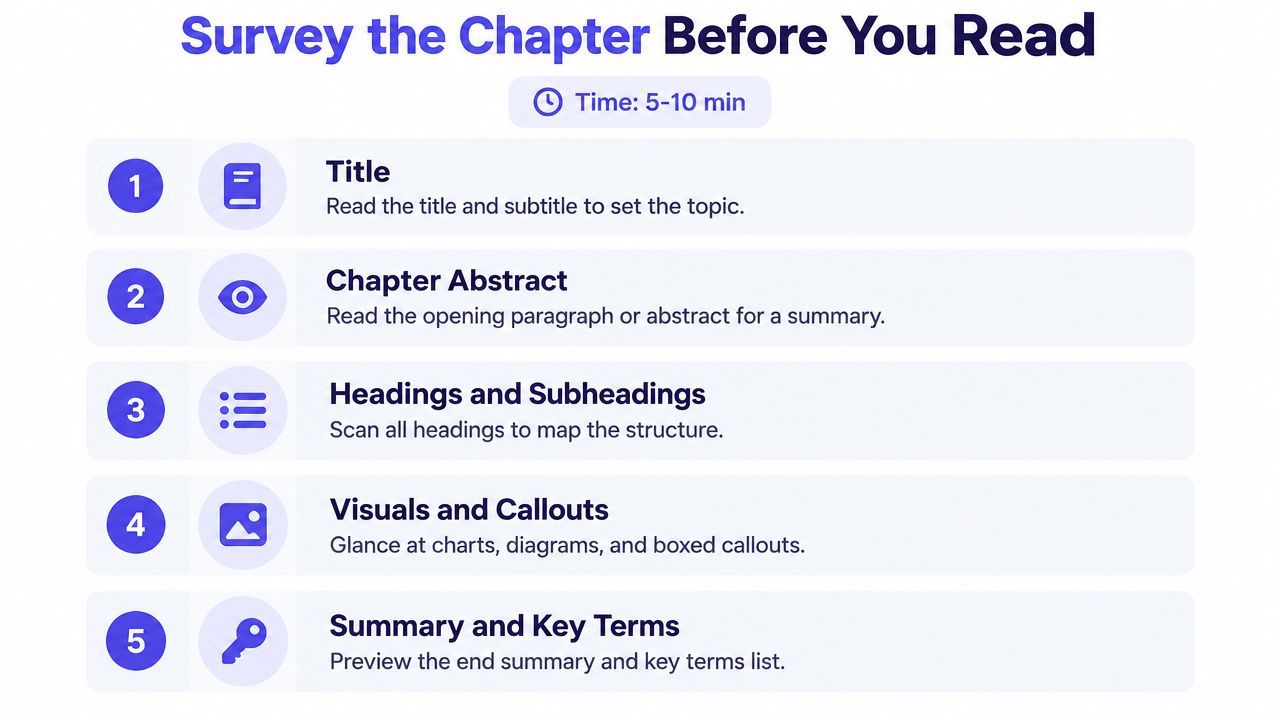
The survey pass should feel short and slightly mechanical. Five to ten minutes is enough to build a map of the chapter, and that small investment stops you from reading every section with the same level of effort. The point is not to learn the chapter yet, it's to decide where the chapter is headed.
Start with the title and subtitle, then read the opening paragraph or abstract if there is one. Move through the headings, subheadings, bold terms, figures, tables, chapter summary, and end-of-chapter questions. That order follows the structure many study guides recommend for making notes from reading, where you first map the text and only then go back for detail (Newcastle University Academic Skills Kit (opens in a new tab)).
What to skip on the first pass
Skip full paragraph prose, worked examples, and sidebars on this pass. Those parts matter, but they matter later, after you know where the chapter is going. If you read every paragraph during the survey, you lose the main advantage, which is speed.
A quick chapter map can be just three to six lines. Write the central question, the main stages of the argument, and the key terms you expect to see again. If the chapter has a summary or review questions, use them as clues about what the author thinks is important.
Good survey notes look thin on purpose. They should help you decide where to slow down, not try to replace the reading itself.
This is also the moment to separate slow-reading sections from skim-only sections. A dense definition page or core theory section usually deserves more attention than a long example that just repeats the same principle in a story. If you treat the survey as optional homework before the work begins, you end up doing the hardest reading with no map at all.
Read Actively and Mark With Intention
Active reading turns the textbook into a conversation. Instead of waiting for the chapter to finish explaining itself, you keep asking what the author is trying to prove, define, compare, or apply. That shift matters because passive transcription keeps your eyes busy while your mind drifts.
A useful rule is to cap highlighting at roughly ten percent of the page and to highlight phrases, not whole sentences, unless a sentence carries one clean idea. Use the highlight as a finder, not as the finished product. If every line glows, nothing stands out when you come back.
Use margin marks that mean something
Margin notes should do the work that highlighting can't. A question mark can flag confusion, an exclamation mark can flag a key insight, a star can flag exam-likely content, and a short cue word can compress the paragraph into one label. You're not decorating the page, you're building retrieval cues.
A strong move here is to turn headings into questions before you read the section. If the heading says “Types of Synaptic Transmission,” rewrite it as “What types of synaptic transmission does the author compare?” Then read the section looking for the answer and write the answer in the margin in plain language.
That's the difference between notes that merely look organized and notes that can start a self-quiz. If you want a clean example of how students organize that kind of study system, the study resources at CramShare's study resources hub show how review-oriented materials are often structured around cues, summaries, and questions.
Keep the mark with the thought
Don't leave a highlight without a paired action. If you mark a phrase, add a one-line margin note or cue word beside it. If you circle a term, write what makes it different from nearby terms. If you star a paragraph, write the question you'd expect an exam to ask about it.
The best annotation is brief enough that you can read it in seconds, but specific enough that it forces recall.
This also helps you avoid the over-highlighting trap, where the page becomes a color field and you can no longer tell what mattered. The next step is to decide how those cues should be stored so they're still useful a week later, not just while the chapter is open.
Choose a Note Format That Fits the Subject
The right layout depends on what the chapter is asking you to learn. Some subjects are built around arguments, some around relationships, some around categories, and some around procedures. If you force every chapter into the same structure, you make retrieval harder than it needs to be.
Cornell works well when the chapter reads like a guided argument. You can put the main notes in the wide column, keep cues and questions in the narrow column, and use the summary box for a plain-English recap. That layout is especially useful when you know you'll review the chapter more than once.
Match the structure to the exam question
A matrix is better when the test will ask you to compare things. For a psychology or biology chapter, you might use rows for concepts and columns for definitions, examples, and contrasts. That format is strong because it forces you to see how ideas differ instead of scattering the differences across the page.
Outline notes work when the chapter is already built in levels, such as a process, taxonomy, or sequence of steps. Summary-only notes can save time on review chapters or on sections you already understand, but they're weak if you haven't built enough cues elsewhere.
If you want a simple decision rule, use this. If the chapter is concept-heavy and relationships matter, use a matrix. If it's argument-driven, use Cornell. If it's procedural, use an outline. If it's mostly reinforcement, use a summary. And once you choose a format for that chapter, stay with it, because switching halfway through fragments your retrieval cues.
The safest habit is to try a short five-line sample in each format before you commit. Pick the one that matches how your thinking flows, not the one that looks neat on social media.
Connect Textbook Notes With Lecture Notes
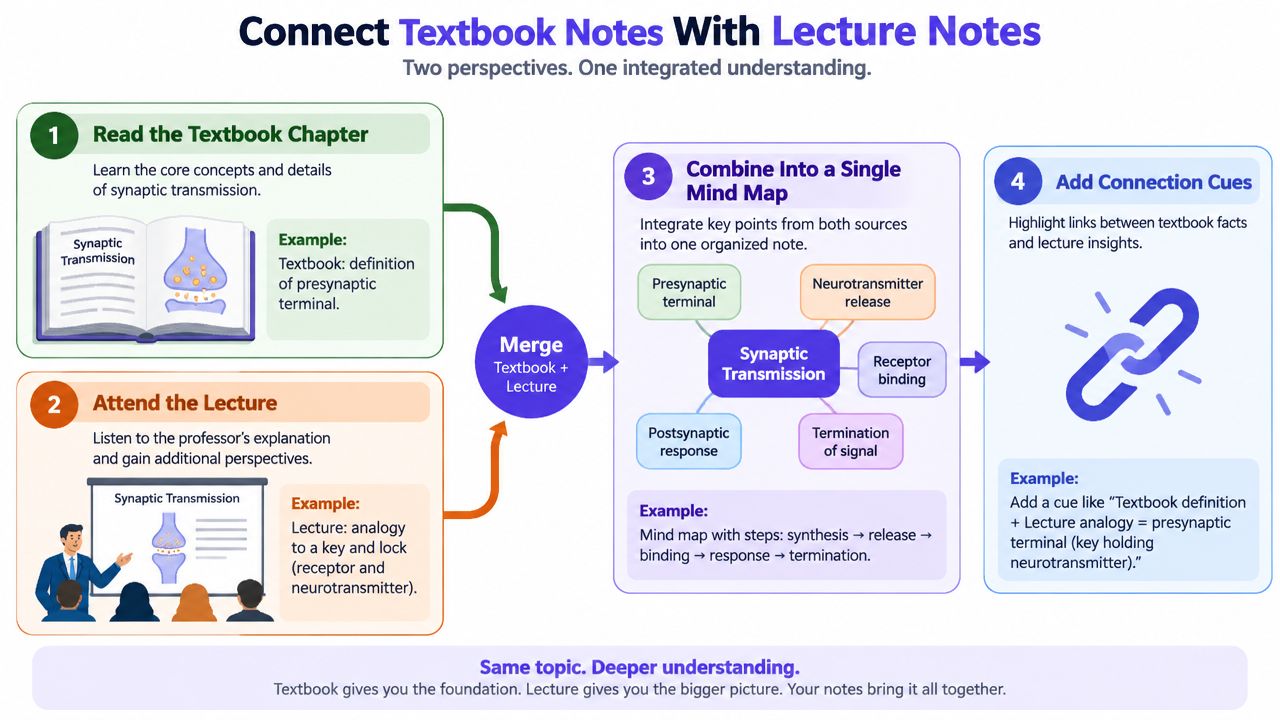
Textbook notes and lecture notes work best in one system. If they stay apart, you end up reviewing two half-finished versions of the same topic, and the overlap turns into repetition instead of support. The textbook gives you the structure. The lecture fills in what the professor emphasized, corrected, or connected.
A simple example is a chapter on synaptic transmission before a neuroscience lecture. Write cue questions from the subheadings first, leave space in the margin for class notes, then add only the points the professor expands on. That way, you do not rewrite the chapter twice.
What not to do in lecture
Do not copy the textbook by hand during lecture. Do not copy slides word for word either. Both habits waste time and keep you from noticing where the professor adds value, especially when an example changes or a term needs correction.
Use a small cross-reference system so the two sources stay easy to tell apart. A green dot can mark a lecture addition, a red asterisk can mark a contradiction with the textbook, and a blue arrow can mark an exam-relevant example. The page should show the merge point clearly.
A few students save a surprising amount of time this way. They stop treating notes as separate archives and start treating them as one living page. If you use a digital workspace, tools like CramShare can fit that workflow as one place to store course-specific study materials alongside your own notes, but the habit still has to begin with how you read.
Rule of thumb: textbook notes supply the skeleton, lecture notes supply the muscle.
When the chapter and the lecture meet in one note, revision gets easier and the page becomes easier to trust. Clean pages matter less than clear meaning, because a neat notebook that hides the professor's emphasis is still a weak study tool.
Review Your Notes Using Retrieval, Not Rereading
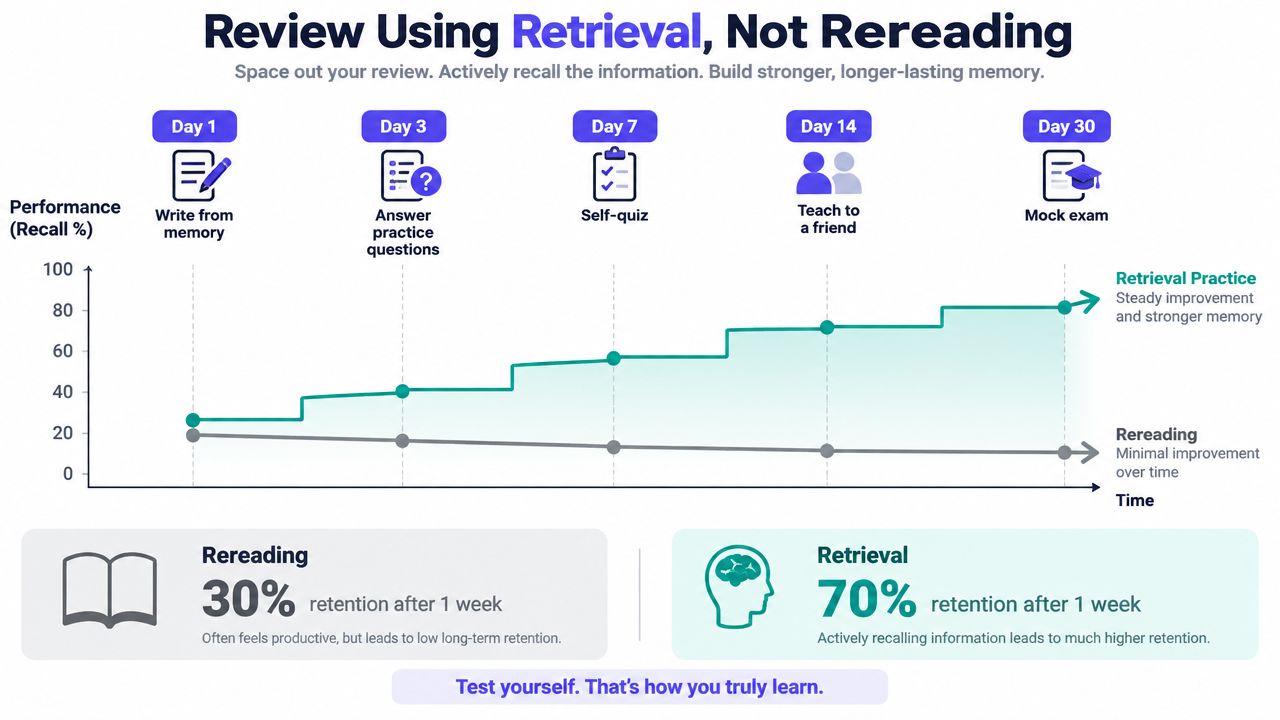
You finish a chapter and the pages look familiar, so it feels like progress. Then you close the book and try to explain the main idea, and the blank space shows what rereading hid. Notes work better when they are used to bring information back from memory, not when they are just scanned again.
Use the notes you already made for a retrieval pass. Cover the summary column and say the key ideas aloud. Answer the cue questions without looking. Close the notebook and redraw the matrix from memory, then check only the parts that slipped.
A simple review rhythm
A workable rhythm is one retrieval pass a day after the first read, another after a few days, another about a week later, then one last pass before the exam. Keep each pass short. The point is to make memory do the work, not to turn review into another full reading session.
If the first pass feels slow, that usually means the notes are doing their job. The effort shows you where recall is weak, which is the part that needs attention. A clear format from earlier, whether Cornell, SQ3R, or a matrix setup, should make that check possible.
The easiest trap is turning review back into reading. Students highlight the page again, reread it, and mistake familiarity for knowledge. That feels safe, but it leaves the weak spots untouched.
For a printable template to structure retrieval practice, see this study notes PDF guide.
If you cannot explain the page without looking, it is not ready for exam week yet.
Your notes were meant to be tested. Retrieval exposes what is solid and what still needs work.
Common Pitfalls and How to Fix Them
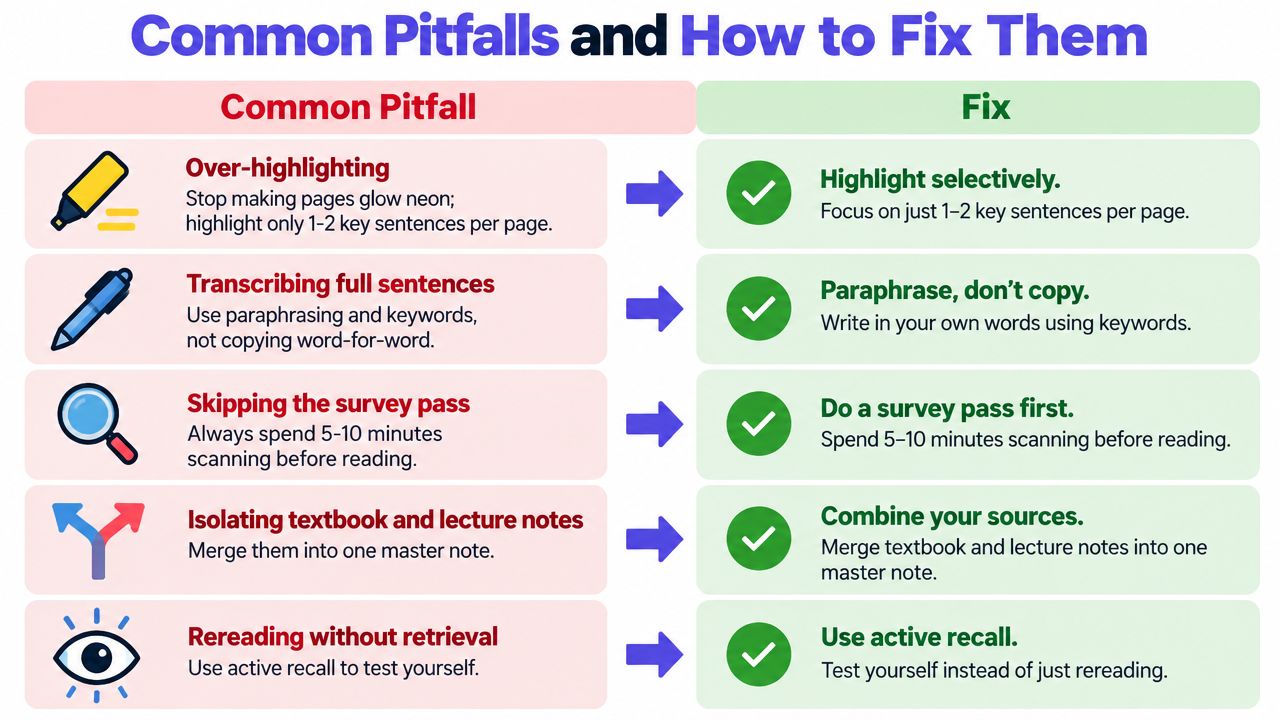
The fastest way to clean up textbook note-taking is to spot the habits that make the pages look busy while reducing recall. Most of them are easy to fix once you can name them. A short self-audit before each study block catches a lot of wasted effort.
- Over-highlighting. The page turns neon, but nothing stands out later. Fix: highlight only the phrase or clause that carries the idea, then add one margin cue beside it.
- Transcribing full sentences. You feel productive because you're writing a lot, but you're mostly copying the book. Fix: paraphrase the main idea in your own words and keep only key terms or page references.
- Skipping the survey pass. You dive into paragraph one without a map. Fix: spend a few minutes scanning headings, figures, summary, and end questions before the close read.
- Separating textbook and lecture notes. You end up reviewing two half-notes instead of one strong note. Fix: leave space for lecture additions and mark them in the same system.
- Rereading without retrieval. You keep looking at the page until it feels familiar. Fix: cover the notes, answer the cues, and rebuild the main ideas from memory first.
If you want a good reminder about why copied or loosely shared material needs care, the guidance on academic integrity and student sharing is worth reading before you post or reuse study content. That matters because useful notes should be original enough to help you learn, and clear enough to share responsibly when you do.
A final self-check takes less than a minute. Ask whether you surveyed first, whether your highlights are sparse, whether every mark has a purpose, whether lecture additions are visible, and whether your review is testing recall instead of reading. If one of those answers is no, fix that habit before the next chapter, not after the exam.
If you want course-specific notes, lecture resources, and revision materials organized in a way that's easier to find and use, visit CramShare and look for study materials that match your module, textbook, and academic year. It's a practical place to compare notes, share originals, and keep your own study system focused on the exact course you're taking.