7 Ways to Earn Money as a Student in 2026
Explore 7 practical ways to earn money as a student, from tutoring and micro-internships to selling original study materials ethically.


Across OECD countries, 19% of 18–24-year-olds combine work and study, while 54% of that age group are in education overall. The strongest way to earn money as a student depends on what you can reliably offer, whether that's campus or project work for experience, tutoring for expertise-based hourly income, or original study materials with potential for repeat sales.
The popular advice gets this wrong by treating the highest-paying option as automatically the best one. A demanding freelance project may pay well but collapse during exam season, while a modest tutoring arrangement can fit your timetable and build a dependable income stream. Your choice should match your available hours, strongest skills, preferred work format, and whether you need predictable pay or income that can repeat after the initial effort.
The seven routes below sell different assets: your time, your subject expertise, original study materials, project work, or participation in research. Compare the likely payout with the time per task, flexibility, competition, platform rules, and how easily the work fits around classes and exams. Before everything else, submit only work you own or have permission to distribute, avoid prohibited academic assistance, and keep completing your own coursework independently.
1. CramShare
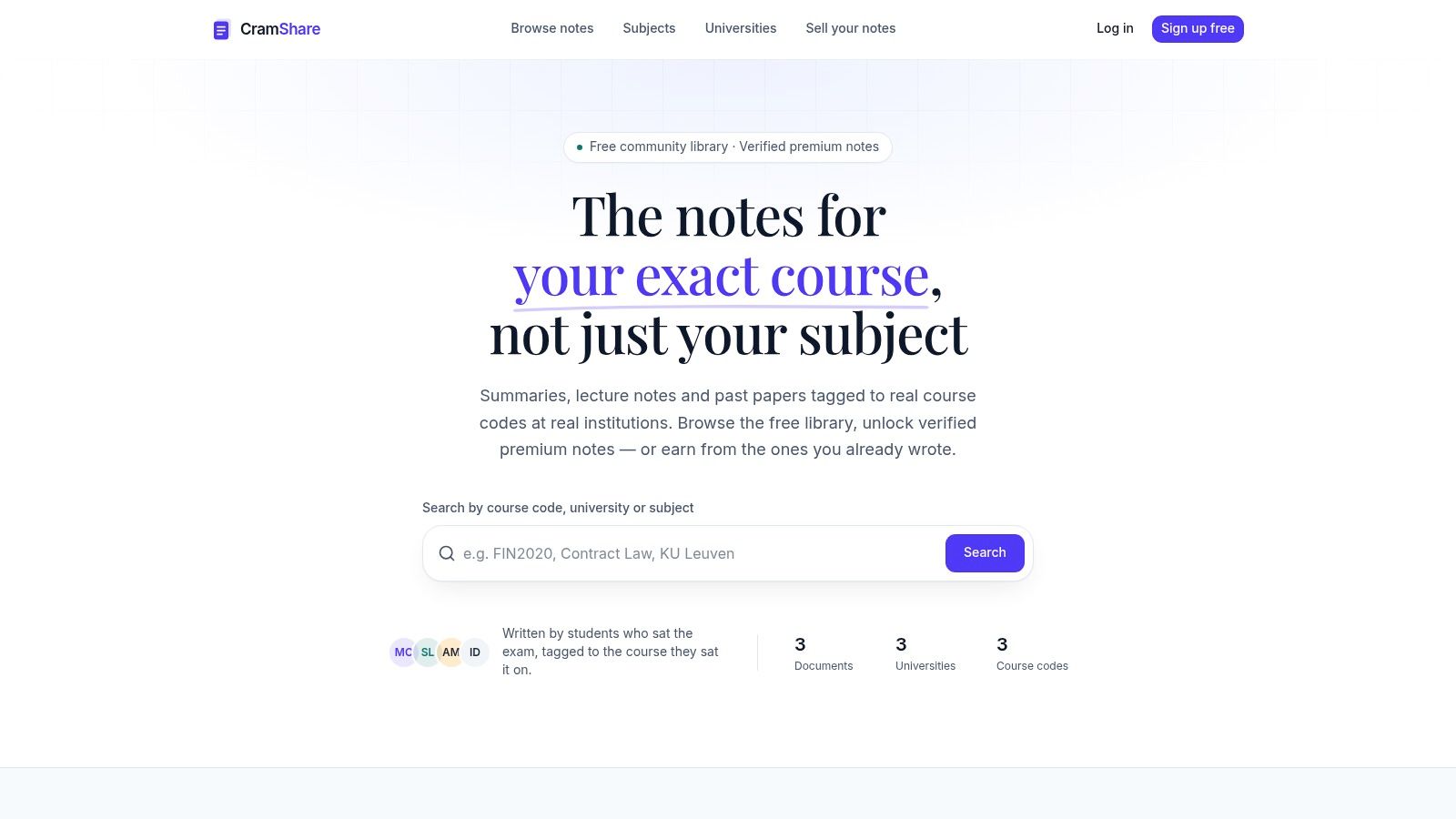
CramShare suits students who already produce useful, original notes and want those materials to keep generating value after the writing is finished. The contribution is an original study asset, such as lecture notes, summaries, revision guides, past papers, or exam practice materials. This route demands concentrated work upfront, then offers more flexibility than selling another hour of labour.
The platform matches documents to specific courses and modules. Students can search by institution, course code, subject or module, textbook, and academic year, helping them find relevant material instead of sorting through broad “biology” or “economics” categories. Clear course details also make it easier for buyers to judge whether a document fits their revision needs.
CramShare combines a free community library with a marketplace for reviewed premium documents. Free resources have no page caps, watermarks, or daily access limits. Buyers can preview multiple pages of premium documents before purchasing, and eligible purchases may receive a refund if the document does not match its preview or advertised course information. Premium uploads are reviewed for legibility, completeness, quality, and course relevance.
Why it works around a course schedule
Authors control pricing and can publish their work non-exclusively. They retain ownership, can unpublish documents, and receive 70% of revenue from eligible paid document sales, with monthly payouts and no minimum payout threshold, according to the CramShare student author information. This setup can fit around classes and exams because one document may sell repeatedly without requiring a scheduled session for each buyer. Income remains uncertain, however, because demand depends on the specific course and the quality of competing resources.
The main limitation is course coverage. A niche module may have fewer buyers and fewer useful documents than a heavily enrolled subject. Sellers must upload only work they created or have permission to distribute. Restricted lecture slides, copyrighted textbook pages, another student's work, and assessment content without permission should stay off the platform.
Practical rule: Sell the notes you made to understand your course, not material copied from the course itself.
CramShare works best for students who take structured notes naturally, can organize them clearly, and are willing to create a resource future cohorts may use. It can support lectures, assignments, and independent study, but it cannot replace them.
2. Stuvia
Stuvia suits students who already produce detailed, well-organized notes and want a straightforward document marketplace. You upload original notes, summaries, exam preparation materials, or study guides, choose a price, and earn when another student buys the file. The asset is your finished academic resource, not your live availability.
The appeal is simple workflow. A strong document can remain listed while you attend classes, work another job, or prepare for exams. That creates the possibility of repeat sales without booking a new session for every buyer. The model works best when your materials solve a specific revision problem, such as turning scattered lecture notes into a clear topic summary or organizing concepts into an exam-ready guide.
Stuvia provides tools for uploading different file types, setting prices, and managing seller activity through its seller Help Center and marketplace (opens in a new tab). It also serves students searching across subjects and courses, so authors aren't limited to finding buyers personally.
The limits of document income
A listing doesn't guarantee sales. Results depend on the quality of the document, demand for the subject, how clearly you describe it, and whether students can find it among competing resources. A polished file with a vague title is harder to evaluate than a document that identifies the course, topics, academic level, and type of revision support it provides.
Copyright requires particular care. Write your own explanations, use your own diagrams where appropriate, and remove material you aren't authorized to distribute. Don't upload scans of textbooks, restricted school documents, or another person's notes just because you can access them.
For a practical comparison of document marketplaces and publishing considerations, see the guide to the best study notes. Stuvia is a reasonable option for students who want a broad marketplace and can create original resources consistently. It's less suitable if you need guaranteed weekly income or if your notes are incomplete and only useful to you personally.
3. Studypool
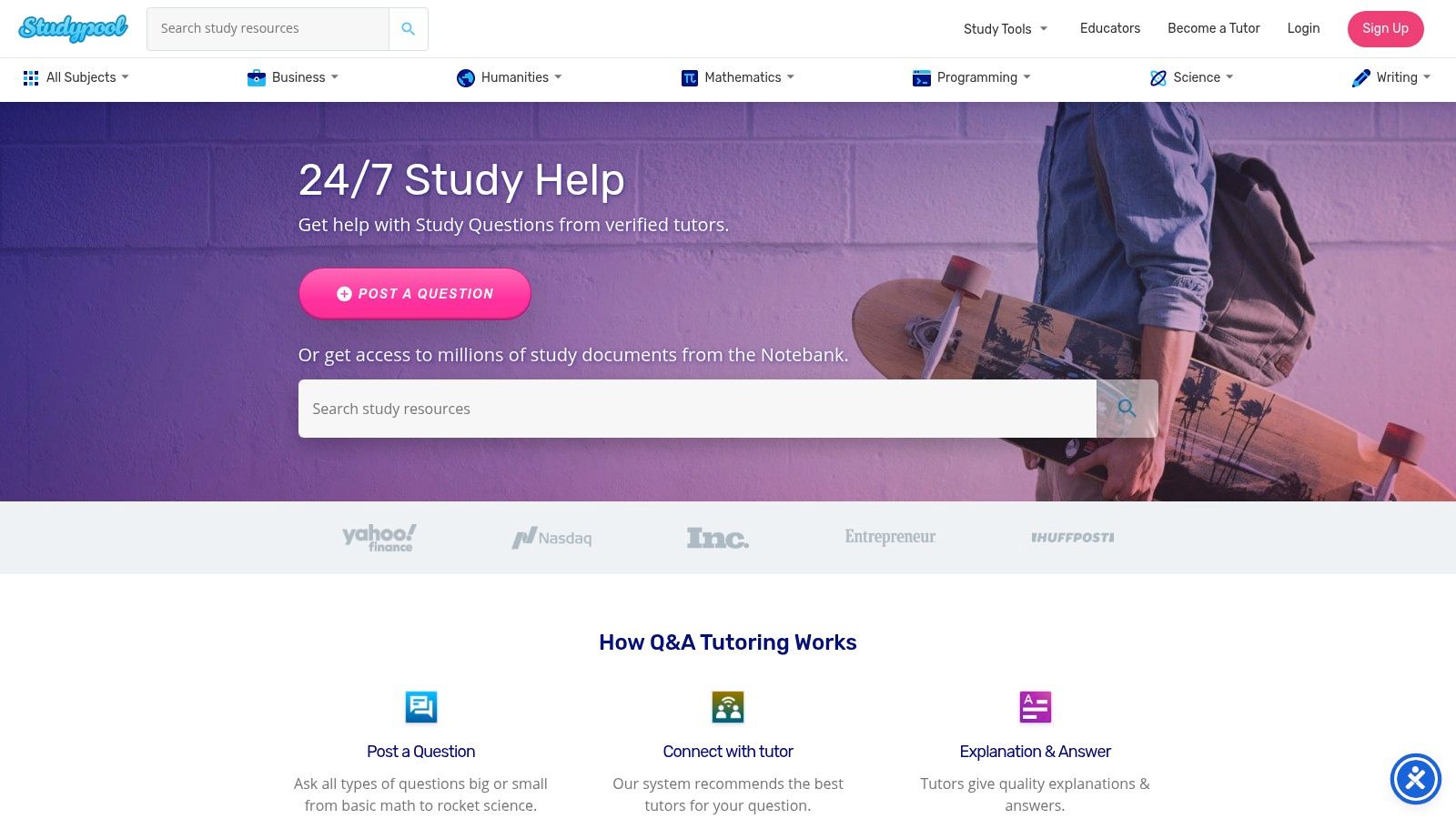
Studypool uses a different asset model from a normal document marketplace. You contribute an authored study guide, lecture note set, or exam review document, and the platform can pay you when students view the upload. Your earning potential therefore depends not only on whether someone wants to buy a file, but also on whether the document continues attracting attention.
That can suit students with resources covering high-demand topics. A concise guide that explains a difficult concept, organizes a revision topic, or helps students prepare for a particular type of exam question may receive more interest than a general notebook dump. Before uploading, edit for clarity, add useful headings, and make sure the title tells a student exactly what they're getting.
A recurring model with strict ownership rules
The per-view structure offers a form of recurring income because one document can be viewed by multiple students. It also introduces uncertainty. A document may attract views without producing meaningful income, and demand can vary sharply by topic, timing, and quality. Treat any platform ceiling or promotional example as a maximum possibility, not as a normal expectation. The Studypool document-selling page (opens in a new tab) explains the platform's upload process and contributor rules.
Studypool's honor code and copyright requirements matter here. Only upload material you authored or have explicit permission to distribute. Course materials supplied by a university, professor, publisher, or school may remain protected even when you downloaded or annotated them yourself.
A document marketplace rewards usefulness and discoverability, but neither platform visibility nor a high view count removes your responsibility for ownership.
Use this guide to selling study notes online before publishing anywhere. Studypool makes sense for students who have a strong archive of original resources and are comfortable with variable demand. It won't suit someone who needs a predictable amount after every hour worked.
4. Course Hero
Course Hero is designed for students who can explain academic questions clearly and independently. Rather than selling a prewritten resource, you answer questions asynchronously and receive payment for accepted solutions. The asset you contribute is subject expertise and reasoning time.
This format offers more control than a scheduled lesson. You can choose questions in subjects you know well, work when your timetable allows, and decline problems outside your competence. A strong answer should explain the method, identify the relevant concepts, and help the learner understand how to reach the result. Copying a solution or providing an unexplained answer creates poor educational value and may breach platform rules.
Course Hero's tutor programme (opens in a new tab) provides information about tutor applications, subject areas, question selection, and payment. The platform covers a wide range of academic subjects, but the flow of questions and acceptance standards can vary. Your results will depend on the subjects you select, the difficulty of questions available, and the quality and accuracy of your responses.
Protect your academic boundaries
Asynchronous tutoring can become risky when students ask for direct answers to active assessments, real-time exam help, or work they're expected to submit as their own. Don't complete prohibited tasks for another student. Explain concepts, demonstrate a comparable method, or direct the learner toward a legitimate study approach instead.
The best candidates are confident in a defined group of subjects and can write explanations efficiently. The route is less attractive if each answer takes too long to research or if you need income that arrives on a fixed schedule. It also requires careful quality control, because an accepted answer depends on meeting the platform's standards rather than just submitting something quickly.
Course Hero is therefore a good middle ground between selling documents and teaching live. You reuse your knowledge across many questions, but you don't build the same long-term client relationship as a private tutor.
5. Wyzant
Wyzant fits students who want to turn expertise into live, hourly tutoring. Tutors create profiles, choose subjects, set their hourly rates, and meet students online or in person. Compared with asynchronous question answering, this route requires more calendar commitment, but it can create a steadier relationship with a small group of learners.
Your profile does much of the early selling. State the subjects you teach, the level you support, the types of problems you can explain, and whether you work online, in person, or both. A student searching for calculus help needs a different profile from a family looking for writing support or a professional preparing for an exam. Specific positioning helps potential clients decide whether you're suitable.
Wyzant's tutoring marketplace (opens in a new tab) gives tutors control over their listed rates and provides profile tools for reaching students, particularly in the United States. Tutors keep 75% of their listed rate, with the platform retaining the rest as a fee. That deduction matters when you compare your take-home income with private referrals or campus tutoring work.
Best for building a roster
Wyzant works better for students who can reserve recurring weekly slots than for those whose availability changes every few days. A regular learner may provide more predictable work, but you still need to prepare, communicate clearly, manage cancellations, and protect time for your own assignments.
Competition can be strong in popular subjects. Your advantage may come from a narrow specialty, strong explanations, useful practice materials, or experience with a particular course level. You can also use these exam study techniques to improve the structure of sessions without doing assessed work for your learners.
The trade-off is straightforward. Wyzant offers more control and relationship-building than a question platform, but it gives you less flexibility once lessons are booked. Choose it if you want to practise teaching and develop a repeat client base, not if you need work that can disappear completely during exam week.
6. Parker Dewey
Parker Dewey sells a different kind of student asset: scoped project work. Its micro-internships connect students with employers for paid assignments that can be completed remotely or on site, often with a fixed fee and a defined deliverable. You're contributing project execution, not just spare time.
This route is valuable when the work itself matters as much as the immediate payment. A marketing analysis, research brief, design task, data project, or operations assignment can give you a concrete portfolio example and a better story for future applications. Students from different majors can find relevant projects because employers need more than one type of academic background.
The Parker Dewey Career Launchers platform (opens in a new tab) describes paid, clearly scoped micro-internships and employer-facing opportunities. Many listed projects fall in the $200 to $600 range, although the specific fee, workload, deadline, and selection process vary by assignment. Read the scope carefully before applying. A fixed fee only makes sense after you estimate research, meetings, revisions, and delivery time.
Experience over predictable cash flow
Micro-internships can fit between classes because they're shorter than a conventional semester-long placement. They're still real client work, so “flexible” doesn't mean casual. Missing a deadline or accepting a project you can't complete may damage your reputation and reduce the value of the experience.
Availability changes by season, and applications can be competitive. Parker Dewey shouldn't be your only income plan if you need weekly certainty. It's better as a primary route for students prioritizing résumé evidence or as a selective option during a period when they have room for a defined project.
Before accepting, ask what the final deliverable is, who owns the work, how feedback will be handled, and whether the project conflicts with university rules or another commitment. A well-chosen assignment can pay you and demonstrate capability. A vague assignment can consume study time without producing a useful result.
7. Prolific
Prolific suits students who want short research tasks between classes and don't want to sell notes, teach, or apply for client projects. You participate in academic and industry research, including surveys, user experience tasks, and longitudinal studies. The asset here is your time and informed participation.
The platform displays the estimated duration and reward for each study. Prolific's participant guidance sets a minimum pay rate of $8 per hour and recommends $12 per hour, as stated on its participant information page (opens in a new tab). Participants can cash out after reaching $6, with payments handled through the platform's supported payout methods. These figures describe platform guidance, not a guarantee of how much work you'll be offered.
Flexible, but not dependable
Prolific is useful for filling short gaps. You can check available studies, review the eligibility requirements, and decide whether the task fits before starting. That's more transparent than survey sites that hide the reward until the end, although eligibility and availability vary by study, time, and participant profile.
The limitations are practical. You may not qualify for every study, some tasks require verification, and there may not be a suitable project when you're free. Don't build rent or tuition plans around research participation. Treat it as supplementary income that can fit around protected study blocks.
Research ethics apply to participants as well as researchers. Read consent information, answer truthfully, protect confidential details, and leave a study if the requirements don't feel appropriate. Prolific is a good choice for low-commitment gaps, but it offers less résumé value and repeat-income potential than tutoring, original study materials, or project work.
7-Platform Comparison: Earn Money as a Student
Build a Student Income Plan You Can Sustain
The best way to earn money as a student isn't to join every platform. Choose one primary route and one backup based on the asset you can contribute consistently. A student with strong subject knowledge might use tutoring for scheduled income and publish original study materials for work that can be reused. Another student might choose a Parker Dewey micro-internship for experience, then use Prolific for short gaps between classes.
Start by setting a weekly hour ceiling before you accept work. Reserve your lectures, revision sessions, assignments, sleep, and exam preparation first. Then decide how much remaining time you can offer. If your availability changes every week, asynchronous questions, document sales, and research tasks may fit better than recurring live lessons. If you want a stronger portfolio, a scoped project may justify a larger uninterrupted block.
Track time spent, net earnings, rejected work, travel, platform fees, and preparation. A route that looks attractive at the advertised payout can become poor value when you include unpaid messages, revisions, waiting, and commuting. Review the results after a few weeks and keep the option that fits your semester, not the one with the most impressive headline.
Keep this ethical standard throughout:
- Use original or authorized materials: Publish only work you created or have permission to distribute.
- Protect restricted content: Don't share copyrighted textbooks, private lecture files, assessment papers, or institutional resources without authorization.
- Keep coursework independent: Never complete assessed work, live exams, or prohibited assignments for another student.
- Check platform rules: Verify eligibility, payout methods, fees, withdrawal requirements, and tax responsibilities before relying on an income stream.
- Follow university policy: Your institution's academic-integrity and copyright rules still apply when a platform accepts an upload.
CramShare is a particularly relevant course-focused route for students who already create lawful, useful study resources. Authors retain ownership, publish non-exclusively, set their own prices, and can make their notes available to students searching by precise course and module details. That makes it a practical complement to tutoring or project work, provided your materials are yours and support learning rather than replacing it.
CramShare lets students publish original lecture notes, summaries, revision guides, and other course-specific resources, with free library access and reviewed premium documents for buyers. If you already create useful study materials and want a flexible route that can continue working around your timetable, visit CramShare and explore how it can fit into your student income plan.