Academic Integrity Examples: 8 Breaches to Avoid in 2026
Academic integrity examples from plagiarism to contract cheating and AI misuse, with real cases and practical prevention tips for every student.
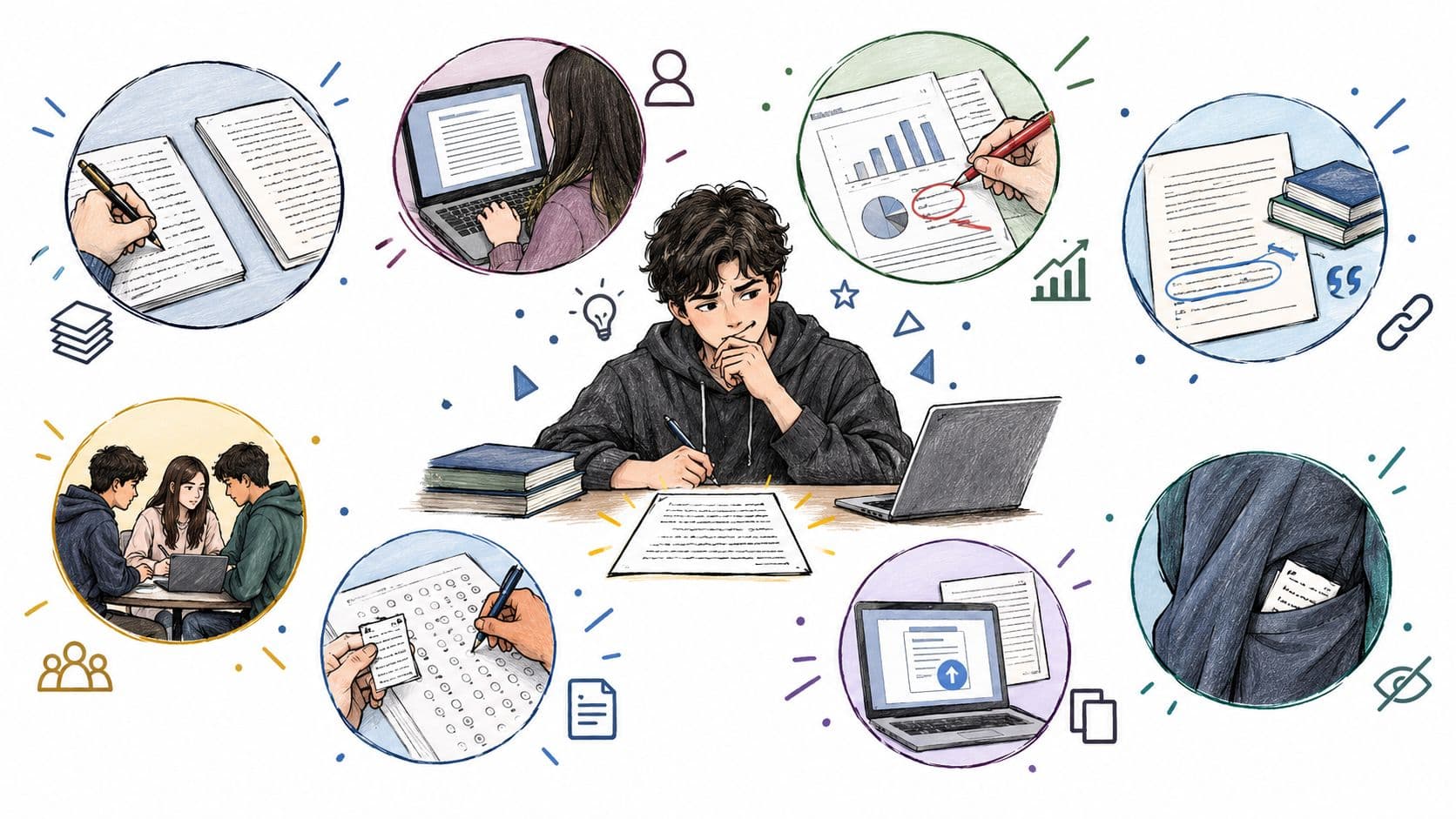
It's 11 p.m. Your deadline is tomorrow. A classmate drops a finished solution file into the group chat and someone types that you can just adapt it, change the wording, and submit. You're tired, the work is nearly done for you, and adapting feels different from copying.
That small decision is where most cases start. Students rarely plan a dramatic fraud. They copy a few sentences, open a leaked question, paste an AI paragraph, or share a file they shouldn't share. Then the submission no longer shows their own work.
These eight academic integrity examples show you what that moment looks like in a real course. Some are clear violations in almost every institution. Others are grey areas where your assessment brief, module handbook, or instructor's instructions decide the outcome. For each one, run the check before you act. If you can't explain the work as yours, cite where it came from, or point to a rule that allows it, stop and ask.
1. ICAI Fundamental Values of Academic Integrity
You're about to post your lecture notes for classmates. You wrote them, so sharing feels harmless. Before you upload, you check whether the slides inside them are yours to share. That pause is the values framework in action, not just rule following.
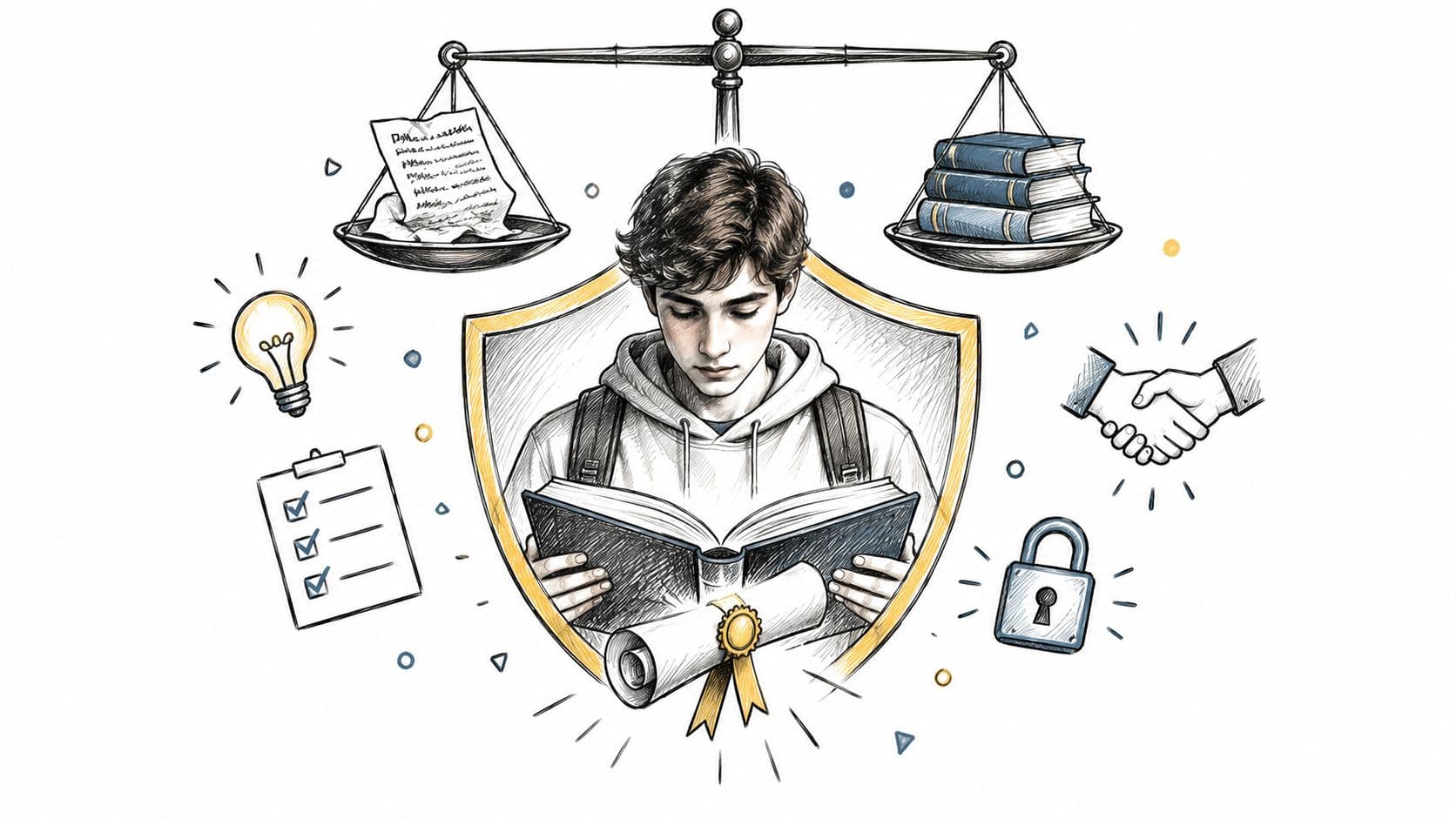
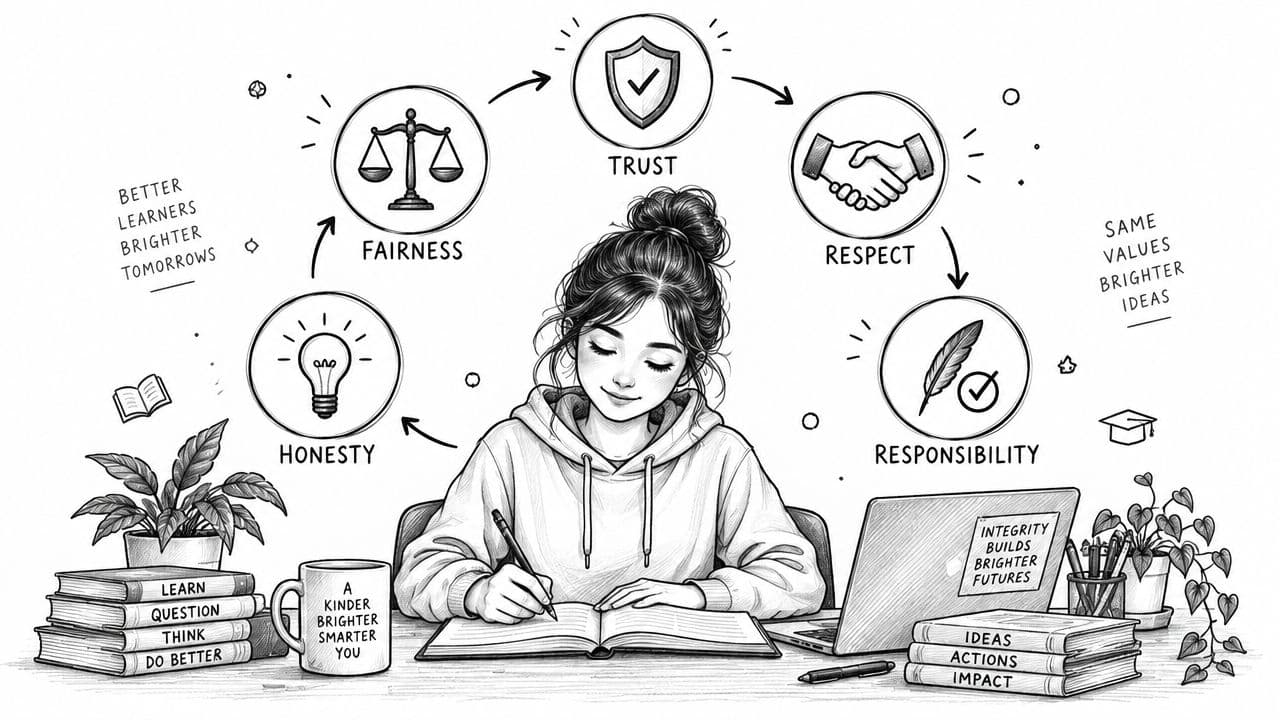
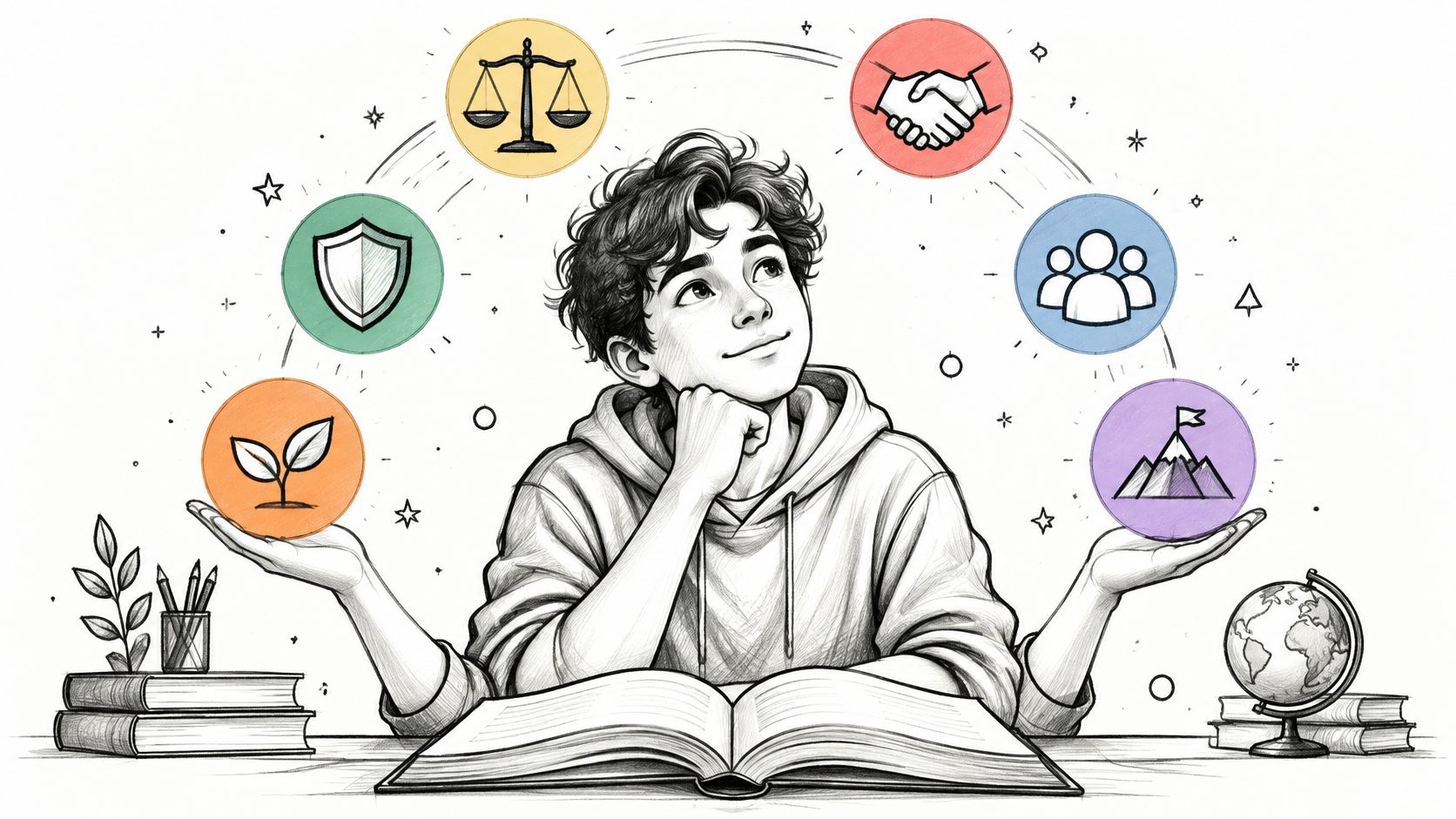
The International Center for Academic Integrity defines six fundamental values, honesty, trust, fairness, respect, responsibility, and courage, first published in 1999 and revised in 2014. Universities use them when they write policies and judge conduct. You can use them faster than a handbook when a decision lands in a group chat at midnight.
What the values look like in a course
Courage and responsibility mean you report suspected exam misconduct through the proper channel instead of staying silent to protect a friend. Respect and fairness mean you ask before posting a lecturer's slides externally, because other students and the creator have a stake in that material. Honesty means your name on a submission signals your own reasoning, not borrowed work with light edits.
The need for that check is not theoretical. The Center reports that more than 60% of university students have freely admitted to cheating in some form in McCabe's original research and later follow-up studies, according to the ICAI facts and statistics page (opens in a new tab). Rates vary by behavior, question wording, and anonymity, so don't treat any single figure as a global rate. Treat the pattern as a warning that ordinary actions can count as misconduct.
Pre-action check: Would my instructor and classmates see this as fair if I described exactly what I did?
Read the values alongside your local rules. Start with a plain definition of academic integrity and how institutions apply it, then check your module handbook for the specifics. The values tell you why the line exists. Your course rules tell you where it sits for this assessment.
2. Honor Code Systems (Princeton and University of Virginia)
You open a take-home exam and see a question you discussed with a classmate. Your university relies on an honor pledge, not an invigilator in the room. Before using those notes, check the pledge and the exam instructions. The key question is whether that help is authorized.
An honor code sets expectations for honest academic work and may place responsibility for reporting violations on students. Princeton's code dates to 1893, and the University of Virginia's honor system dates to 1842. Their systems differ, but both make your own choices central to academic conduct.
Two systems, one personal duty
At Princeton, students pledge on take-home exams and papers that they have neither given nor received unauthorized aid. At the University of Virginia, a student-led committee hears allegations of misconduct. These systems put more responsibility on students to follow the rules and act when they witness a breach.
For a shared solution file, leaked question, or classmate's notes, don't guess what the pledge permits. Check the assessment instructions first, then ask your instructor if the rules leave room for interpretation. The history of academic integrity systems (opens in a new tab) includes different institutional approaches, so a practice allowed at one university may breach another's rules.
Use this check before you submit:
- Read the pledge closely: Does “open-book” allow textbooks only, or also shared notes, websites, and help from classmates?
- Name the aid: Write down any person, file, or tool you used. Confirm that the instructions permit it.
- Protect exam questions: If another student has a later sitting, don't share live questions unless your instructor explicitly allows it.
A shared answer file is a clear violation when the course forbids collaboration. Using a study group's practice notes may be allowed, but the assessment rules decide. If the wording is unclear, pause and ask before using the material.
If your university has no honor code, apply the same check yourself. Agree with your study group on what you can share for practice, and keep assessed work separate. A clear rule agreed before exam pressure makes it easier to spot a breach and avoid one.
3. Contract Cheating and Essay Mills
An essay-mill advert appears during deadline week. It offers custom work and promises a grade. Before you respond, check your course rules: if someone else writes assessed work that you submit as your own, that is contract cheating, a clear breach of academic integrity.
Contract cheating means arranging for another person to complete assessed work for you. Essay mills sell this service. Original work written for you may not trigger similarity software, but your institution can still question who produced it.
Why the risk stays with you
Research on contract cheating reports that some students purchase work from essay mills, while others do so sometimes. The study does not make buying an essay safe or acceptable. Your university may examine drafts, file metadata, and changes in writing style, or ask you to explain your argument. Keep your outlines and research notes so you can show how your work developed.
England's Skills and Post-16 Education Act 2022 introduced provisions aimed at cheating services. Essay-mill advertising can target students under pressure, so treat promises of guaranteed grades as a warning, not reassurance.
An offer to write your assignment puts your degree at risk. It is not study help.
If you are behind, email your tutor now and ask about an extension, mitigation, or academic skills support. Use help that leaves the assessed writing with you, such as lecture notes, worked examples, and approved past papers.
One check can prevent a breach: before paying for, accepting, or submitting any text, ask, “Did I write this work myself, and do my course rules allow this help?” If the answer is no or unclear, don't submit it. Ask your tutor what support is permitted.
research on contract cheating prevalence (opens in a new tab)
4. Unauthorized Sharing of Copyrighted Course Materials
A friend asks for the publisher's solution manual. You have the PDF, the whole class wants it, and uploading it takes ten seconds. Your intent is generous. The problem is ownership. You don't own that file, so you don't get to distribute it.
Textbook solutions, publisher test banks, licensed course packs, and lecturer-created slides are typically owned by publishers or creators, not by students who received access for a course. Sharing or selling them without permission can infringe copyright. It can also breach your university's rules on course materials, even when no money changes hands.
Two cases that show the boundary
In 2021, Pearson sued Chegg over alleged unauthorized copying of textbook solutions. In Cambridge University Press v. Patton (11th Circuit, 2014), the court examined how Georgia State University's electronic course reserves used copyrighted book excerpts under fair use. Neither case is about a student helping a friend with homework. Both show that “for education” doesn't automatically make copying lawful.
Apply a simple ownership check before you upload anything:
- Share what you created: Post your own summaries, diagrams, and revision notes instead of scanned chapters or publisher answers.
- Read the notice: Check the copyright page, licence, or platform terms before you redistribute a document.
- Ask the creator: Message your lecturer before posting slides or handouts outside the course site.
- Cite paraphrases: When your notes restate a textbook idea, name the source even if you didn't copy the wording.
If you're looking for material to revise from, start by understanding how study material downloads should be sourced and used legitimately. Downloading a peer's original summary for revision is a different act from downloading a test bank you're meant never to see. The source and permission decide which side of the line you're on.
5. Appropriate Use of Past Papers and Exam Banks Versus Leaked Exam Papers
Two files arrive in the same week. One is last year's paper from your module page. The other is a photo of questions from this morning's sitting, sent by someone who sat the exam earlier than you. Both look like exam practice. One is revision. The other is misconduct.
Past papers that instructors publish for practice are legitimate study tools. You can use them to learn question formats, practise timing, and spot recurring topics. Leaked papers are different. Using current, unreleased questions obtained through a peer, unauthorized access, or an earlier sitting while the paper is still in use gives you an unfair advantage and breaks exam rules in most institutions.
The availability test
Ask one question. Was this material released for practice to everyone in the cohort? If your instructor posted five years of papers on the module page, use them hard. If a classmate photographed a live paper or recalled questions for a later group, don't open the file, don't forward it, and don't ask for hints from it.
Exam conditions themselves change behavior. A cross-national study of 894 students, 484 from 11 U.S. universities and 410 from five Romanian universities, found online instruction during the COVID-19 period was associated with increased exam cheating, while plagiarism and assignment cheating didn't consistently increase, according to the cross-national COVID-19 cheating study (opens in a new tab). That makes your handling of exam material more important, not less, when supervision is weaker.
Use approved papers this way:
- Confirm approval: Check the module page or ask your instructor which papers and mark schemes you may use.
- Rehearse under time: Sit the paper closed-book if that's your real format, then mark it against official guidance.
- Learn the method: Rewrite the reasoning behind each answer instead of memorizing a model solution.
For sourcing legitimate practice material, review how university past papers should be used for revision before you download anything from a group chat. If you receive a leaked question, delete it and tell the sender you can't use it. Opening it “just to look” already changes what you know going into the exam.
6. Ethical Collaboration Versus Collusion
Your group discusses a problem set, compares methods, and then each student writes a separate solution. That is collaboration if your course allows discussion. Sharing one completed file and changing a few lines before submitting crosses into collusion. Before contributing to a shared answer, check the assessment instructions for what group work is permitted.
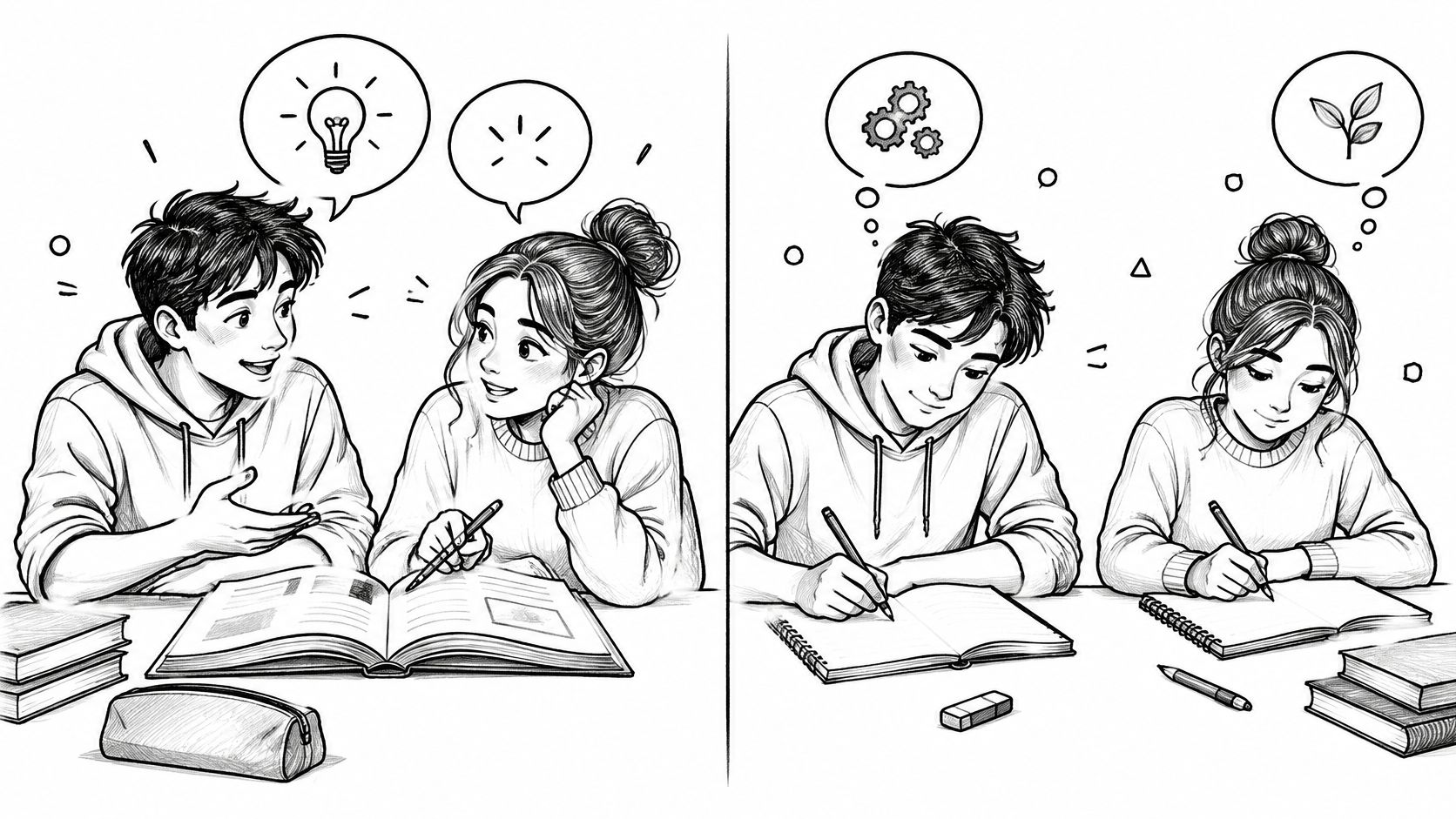
Collusion means working together beyond the assessment rules and presenting shared work as individual work. Ethical collaboration lets you learn with classmates while keeping your submitted reasoning, calculations, code, or writing your own. Course rules decide where discussion must stop.
A workable separation method
Talk through concepts, formulas, and possible approaches. Then close the shared notes and solve the problem independently. Write your answer in your own structure. Before submitting, compare the work: if the reasoning and wording closely match a classmate's, ask whether the group shared the answer rather than just the method.
Group projects need clear records. Agree on roles early, keep a contribution log, and save version history. If a teammate copies work into a shared section, document what you contributed and ask your instructor or student support office for confidential advice before the deadline, if possible. Keep to facts you can show.
Students may feel unable to report suspected misconduct. The reporting on the 2025 student integrity survey (opens in a new tab) provides context on student views, but does not establish the specific reporting percentages sometimes attributed to it. You do not need to make a public accusation. Ask for confidential guidance and check your institution's reporting and appeal procedures.
Group rule: Share methods in the room. Produce answers alone.
If the rules are unclear, email your instructor before meeting. Ask: “Can we discuss approaches if we write our solutions separately?” Keep the reply, then follow that guidance.
7. Undisclosed Generative AI Use and AI Detection Concerns
You ask an AI tool to explain a statistical test. It gives a clear explanation and a neat paragraph you could drop straight into your methods section. The explanation helps you learn. The paragraph, submitted as your writing without permission or disclosure, misrepresents authorship. Same tool, different act.
Most institutions don't treat every AI use alike. Some courses permit brainstorming, outlining, or grammar checks with disclosure. Others prohibit AI for specific assessments. Your job isn't to guess the sector norm. It's to read your course policy and match your use, disclosure, and records to that policy.
Watch the video on YouTube (opens in a new tab)
Where students get caught
In a 2025 survey of 1,047 students, 53% wanted more education on ethical AI use, while only 21% supported AI-detection software, according to the HEPI Student Generative AI Survey 2025 (opens in a new tab). Students are asking for clearer guidance because the grey area is real. Brainstorming, proofreading, translation, and citation checking don't carry identical risks, and your module may allow some while banning others.
A separate 2024 survey across six Australian universities found approximately 14% of students reported verbatim copying from generative AI without acknowledgment, according to the Australian generative AI copying study (opens in a new tab). Copying output word for word is the clearest breach in this category.
Detection adds another risk. In a widely reported 2023 Texas A&M University case, an instructor failed a class after asking ChatGPT whether it had written student essays, and grades were later reinstated after the answers proved unreliable. Don't rely on a detector to clear you, and don't panic if one flags you.
Protect yourself with records:
- Save prompts and outputs: Keep them with drafts when AI use is permitted.
- Verify everything: Check facts and references against primary sources, because AI can fabricate citations.
- Disclose as instructed: Use your course's exact statement format, not a vague note that you “used AI.”
8. Plagiarism and Proper Citation: The Karl-Theodor zu Guttenberg Case
You copy a textbook definition into your notes during revision. Weeks later, you paste it into an essay from memory of your own notes, without quotation marks or a citation. You didn't set out to steal text. You've still presented another writer's words as yours. That's plagiarism.
Plagiarism covers words, ideas, and data presented without proper attribution. It can be deliberate, but careless note-taking creates the same problem in the submitted text. Markers judge what's on the page and whether you can show where it came from, not what you intended at 2 a.m.
When unattributed text ends a career
Karl-Theodor zu Guttenberg was Germany's defence minister when investigators examined his dissertation. In 2011, the University of Bayreuth revoked his doctorate after finding substantial unattributed passages, and he resigned from his ministerial post shortly afterward. Your coursework won't attract national investigators, but the principle is identical. Unattributed borrowing can surface long after submission.
Institutions still investigate routine cases every year. The University of East Anglia recorded 239 formally investigated undergraduate and postgraduate plagiarism cases during 2023–24, according to the university's Freedom of Information disclosure on academic misconduct. You don't need a famous name to face a panel.
Build citation into note-taking, not into a final cleanup:
- Log at capture: Record author, title, page, and quotation marks the moment you copy any text.
- Paraphrase properly: Close the source, explain the idea in your own words, then cite it anyway.
- Use a manager: Store sources in Zotero or Mendeley so references don't scatter across screenshots.
- Check before submission: Run your draft through your institution's similarity checker if one is available to students.
If you can't point to the source of a sentence, don't submit the sentence yet.
How the Eight Academic Integrity Breaches Compare
Turning These Examples Into Everyday Study Habits
You don't need to memorize every policy document your university publishes. You need a short routine you run before you collaborate, download, generate, or submit. Build it once, then use it under pressure when judgment gets weaker.
Start every assessment by reading three things, the brief, the module handbook section on collaboration and AI, and any pledge or declaration you'll sign. Highlight the exact verbs. “Discuss” doesn't mean “write together.” “Open-book” doesn't automatically mean open-internet, open-classmate, or open-AI. If a term could change how you work, email the instructor before you start and keep the reply with your drafts.
Your four-part routine
- Check permission first: Confirm what's allowed for collaboration, AI, shared notes, and past papers for this specific assessment, not for the course in general.
- Log sources at capture: Add quotation marks, page numbers, URLs, and author names when you copy anything into notes, not during final editing.
- Keep an authorship trail: Save outlines, drafts, calculations, prompts, version history, and contribution logs so you can explain how the work became yours.
- Ask before sharing: Confirm consent, copyright, and course rules before you upload slides, solutions, exam material, or another student's work.
Use legitimate resources aggressively. Work through approved past papers under timed conditions. Compare your answers with lecture material and official mark schemes. Read a peer's original summary to test whether your own notes miss a topic, then close it and write your revision guide from memory. Ask AI for practice questions where permitted, answer without help, and check your reasoning afterward. That work builds the exact skills your exam or coursework is meant to measure.
Handle grey areas by narrowing the question. Don't ask yourself whether AI, collaboration, or note sharing is cheating in general. Ask which specific action you're about to take, whether it preserves your authorship, and what disclosure your course requires. Using shared lecture notes for revision can be legitimate when they're lawfully obtained and not submitted as coursework. Submitting the same material, or a lightly edited version, as your assessed work crosses the line.
Ask for help early when you're behind. An extension request, a tutor meeting, or an academic skills session may feel uncomfortable for an hour. A misconduct investigation can follow you across modules and into references, placements, or professional registration. If instructions from an instructor conflict with university policy, seek clarification in writing. If you're accused unfairly, preserve drafts and records, respond factually, and use the appeal procedure instead of arguing from memory.
Platforms such as CramShare fit this routine when you use them for course-specific lecture notes, summaries, revision guides, and practice material that support your own learning. Preview the material, check it matches your exact course and year, and never submit someone else's work as your submission. The resource is legitimate when it helps you understand. Your assessed answer still has to come from you.
Find lecture notes, summaries, revision guides, and past papers matched to your exact university, course code, module, and academic year on CramShare, then use them to build your own answers and keep your authorship trail clean. Search your course today, preview the material before you rely on it, and share only original notes you have the right to publish.